 As Columbia Gorge Organic approaches the start of its third decade on the market, the brand, one of a handful to pioneer the super-premium juice category, is nevertheless endeavoring to keep up with a rapidly evolving market for high-end bottled juice.
Launched in 1994, Columbia Gorge Organic is owned by the Stewart family, which has resided and farmed in Oregon’s Hood River Valley for nearly 40 years. The family owns and maintains 180 acres of organic farmland, which is used to source much of the produce used in its juices. With distribution in 15 states, the brand has achieved gross revenue of $10-13 million for each of the last 3-4 years, according to company president Jimmy Stewart.
Despite robust sales and distribution, and while it operates within a burgeoning market for super-premium juice and organic beverages, Columbia Gorge is constantly facing a range of threats to its position on the shelf. In a wide-ranging interview with BevNET, Stewart discussed some of most pressing concerns facing Columbia Gorge, and the company’s approach and strategy to confronting each.
Perhaps the most challenging issue affecting Columbia Gorge, Stewart said, is in having to justify why the company hasn’t made a transition from pasteurization to high pressure processing (HPP).
Its critics point out that the category is in the midst of a swift evolution in which HPP, which uses pressure instead of heat to inhibit bacteria growth in raw products, has been embraced by brands like Evolution Fresh, Blueprint and Suja, all of which have found admirers in natural retailers and consumers and opened the door to a wave of new and upstart juice brands.
 To be clear, Columbia Gorge is not against the use of HPP, Stewart said. The company has experimented with the processing method, and last year began using HPP for some of its juice blends, having found that HPP provides a higher retention of flavor for its Green Apple Greens, Lemon Ginger Greens and Kale Apple Lemon juices than pasteurization.
However, Stewart said that the company has conducted other experiments in which it compared the flavor and nutritional value of a juice in a raw state to that of the juice after it has undergone HPP. The company conducted the same experiment using flash pasteurization. In nearly every case, the pasteurized juice was superior the HPP in both flavor and nutrient retention, he said.
As a result, Stewart and his family, who are the primary owners of Columbia Gorge, are convinced and steadfast in their belief that pasteurized juices often have a leg up in terms of flavor and nutrition as compared to their HPP counterparts, and are increasingly disturbed by consumer education and marketing that suggests otherwise. He noted that the wave of information and advertising that promotes HPP has had a “direct impact” on sales of Columbia Gorge juices.
“We want to set the record straight,” he said.
Stewart believes that some nutritional marketing claims by HPP juice brands could elicit a host of class-action lawsuits (in the past six months, Blueprint and Suja have each found themselves on the receiving end of one), however, he said that he’ll stay out of a potential legal battle. Instead, Columbia Gorge will attempt to educate its consumers — and the trade — about what Stewart views as wrong and misleading statements about the benefits of HPP versus pasteurization.
It’s not just the marketing of HPP juices that concerns Stewart. While Columbia Gorge uses much of its own fruit — the company grows apples pears, cherries and peaches — it also sources produce from organic farms in Oregon, Washington and California. Though the company has cultivated longstanding ties with its farmer-partners, Stewart remains apprehensive about supply, with his worries rooted in the growth of companies like Suja and Blueprint, which he said are “trying to buy all the ingredients up.”
“We have our relationships with our farmers… we’ve fought for them for years,” Stewart said. “Over all these years, I knew that there was a storm coming of other juice brands trying to get into this [category], and that the number one thing for our survival is to maintain that relationship with our farmers and make sure that we have the ingredients when we need them.”
Stable and consistent lines of supply are critical for a super-premium juice brand; perhaps just as important is reliable distribution, something that Columbia Gorge has had certainly had its issues with in recent years.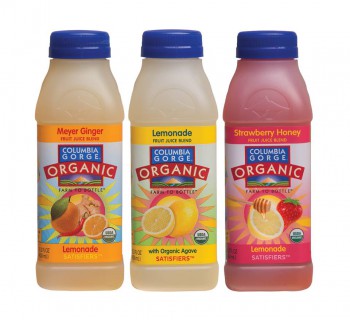
The company entered the juice business in 1994 beginning with an apple juice that it produced and distributed for a small chain of natural food stores in Portland, Ore. Three years later, Columbia Gorge introduced a range of new juices and smoothies and signed on with a local wholesaler, which it worked with until 2004. That year, the two companies parted ways — Stewart cited “issues” with the distribution partner — and Columbia Gorge launched its own wholesaling operation called Cogo Northwest, which began to distribute its products in the Portland market.
While Columbia Gorge has since worked with a number of other wholesalers and expanded distribution across the U.S., Stewart bemoaned the process, which he said has been tumultuous.
“Every distributor that we’ve ever dealt with pretty much has been the same thing — they just lie and cheat as much as they can to everything they can from you,” he said.
He did, however, offer praise for one company: Natural Choice Distribution, a DSD operator that services Northern California. Stewart said that Natural Choice was “probably our best distributor,” but that a packaging change in 2009 — Columbia Gorge introduced a new bottle — prompted a split between the two companies. As a result, Columbia Gorge signed a new agreement with natural and specialty DSD distributor Green Shoots Distribution.
The deal would precipitate a whirlwind of change at Columbia Gorge. According to a Green Shoots press release from November, 2010, its partnership with the juice company’s “led to an 80% increase in sales [of Columbia Gorge products] and introduced the brand to four new markets nationally.”
Stewart acknowledged that the relationship with Green Shoots “was good for the first year, despite some of our financial issues with them,” but fumed at what he described as the distributor’s continued inability to fulfill orders and meet financial obligations, as well as its infringement of a non-competition agreement when Green Shoots began to distribute Blueprint juices.
Columbia Gorge recently filed a civil suit against Green Shoots, Stewart said, however, he declined to offer specific details about the case. At press time, Green Shoots was unable to comment. (Shortly after publication, Green Shoots issued a statement. See below.)
By 2012, the company realized that its future with Green Shoots was untenable and decided to steadily increase its reliance on self-distribution, Stewart said. He noted that decision was also influenced by Starbucks’ 2011 acquisition of Evolution Fresh, and the coffee giant’s national aspirations for the juice brand. Cogo Northwest added new distribution in Salt Lake City, New Mexico, Chicago, Minnesota and North Carolina. It has since taken over distribution from Green Shoots in Southern and Northern California and the Rocky Mountain region.
Cogo has grown to a 40-truck operation and now handles 99 percent of the distribution for Columbia Gorge products, according to Stewart. The company distributes in the Western, Central and Southeastern U.S. While Columbia Gorge juices had been distributed in the Northeast, the brand is no longer represented in the region, Stewart said.
Leveraging its reach and infrastructure, Cogo also carries a number of other natural and specialty brands including Stumptown Cold Brew coffee, Brew Dr. Kombucha, Motto, House Kombucha, DrKefir and Hotlips soda, most of which are based on the West Coast.
“Certainly, first and foremost, our brand is our priority, but we want to make it so that our distribution company is more self-sustained,” Stewart said, noting that economies of scale made it attractive to add other beverage brands to Cogo trucks.
While self-distribution presents a number of complexities and challenges in its own right, it appears that Columbia Gorge has finally achieved some stability and success by controlling the flow of transportation. Now, if it can only influence the flow (and content) of information about HPP…
Editor’s Note: Shortly after the publication of this article, Green Shoots e-mailed BevNET the following statement in regards to Columbia Gorge’s lawsuit against the company:
“Greenshoots prides itself on providing superior customer service and acting as a true partner with each brand that it distributes. Unfortunately, Greenshoots is presently involved in litigation with the makers of Columbia Gorge Organic, a former brand partner. Greenshoots strenuously denies all of the allegations Columbia Gorge has made in the context of the lawsuit. Additionally, Greenshoots intends to vigorously prosecute the counterclaims it has made against Columbia Gorge. Because the case is currently pending, however, Greenshoots cannot comment any further at this time.”