

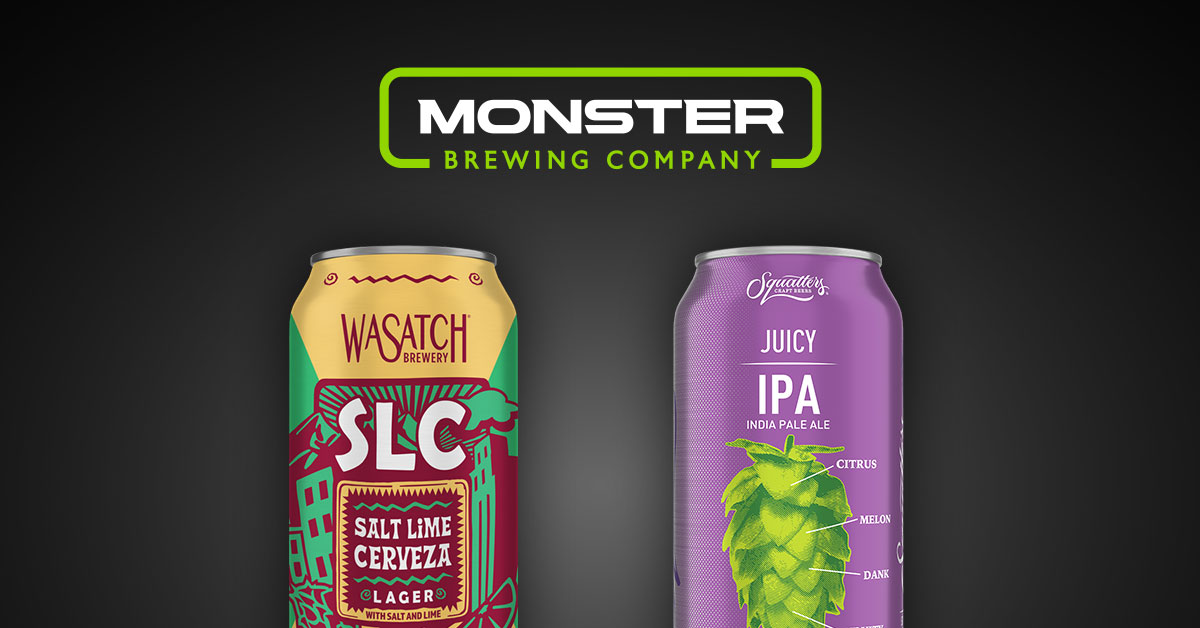
Monster Brewing will cease operations in Utah late next month, the company announced Thursday.
Production of its Utah-based brands Wasatch Brewing and Squatters Brewing will shift to other facilities within Monsters’ bicoastal network, according to a statement from Monster Brewing president Ray LaRue.
The company has opted not to renew the lease on its Salt Lake City brewery, taproom and retail location, which will close on May 27.
“Monster Brewing Company continues to balance efforts in the regional craft and national brand segments,” LaRue stated. “While we are enthusiastic about the momentum from recent innovation and selective growth of our regional brands, it is important that we remain diligent to ensure the future strength of the company.”
The brewery closure will eliminate the jobs of 25 employees, who “will be offered a separation package and have been encouraged to apply for available positions within the company.”
News of the closure follows comments by Monster chairman and co-CEO Rodney C. Sacks in February that the company would “be implementing further adjustments in the coming months with the intent to optimize our personnel and facilities to support the current demands of our portfolio and innovation pipeline.”
Monster Beverage Company reported a $130.7 million impairment charge on its alcohol brands in its Q4 2024 earnings report, bringing its total write down on its bev-alc business over the last year to more than $138.7 million. Monster recorded a $39.9 million write-down on its alcohol brands in Q4 2023.
The Squatters and Wasatch portfolios will remain in distribution. Their footprint includes Arkansas, Arizona, Colorado, Idaho, Iowa, Louisiana, Minnesota, Missouri, Montana, Nebraska, Nevada, New Mexico, North Dakota, Oklahoma, South Dakota, Wisconsin and Wyoming, according to the brands’ website.
“We believe in the legacy of Squatters and Wasatch and are committed to maintaining their high-quality standards and each brand’s unique identity,” LaRue said. “Our Utah-based commercial team will continue to support their success and growth locally. By consolidating production, we will be able to combine shipments of our larger portfolio and expand availability into other parts of the country.”
The closure of the Utah facility follows similar moves elsewhere in Monster’s network. The company shuttered Oskar Blues’ Austin, Texas, facility in November 2023, and Deep Ellum’s Dallas brewery and taproom in May 2024. Cigar City’s Tampa production facility transitioned to a cross-category R&D hub in March 2024.
Significant remaining production hubs include Oskar Blues’ facilities in Longmont, Colorado and Brevard, North Carolina, according to Monsters’ website.
Wasatch was the first craft brewery in Utah when it opened in 1986, and Squatters followed three years later in 1989. The breweries merged to form the Utah Brewers Cooperative in 2002, according to their website. They joined the then-CANarchy Craft Brewery Collective in 2017.
Monster Beverage acquired the platform – which also contains Oskar Blues, Cigar City, Deep Ellum, Wild Basin hard seltzer and Perrin – in January 2022. In February 2022, Squatters founders Peter Cole and Jeff Polychronis’ PRC Restaurant Company and other backers bought back Squatters and Wasatch’s brewpubs and restaurants. They continue to operate each brand’s brewpubs in Salt Lake City.
Cole and Polychronis aren’t the first founders to reclaim some facet of their brands from CANarchy. Three Weavers founder Lynne Weaver purchased her brand and brewery back in 2021, three years after joining the collective.
In 2023, Monster was the ninth largest craft brewery in the country by volume, according to data from the Brewers Association (BA). Its output declined 11%, to 325,000 barrels of beer, and it held a 1.39% share of craft volume, according to the BA.
Monster added The Beast flavored malt beverage to the portfolio in 2023 and Nasty Beast hard tea in 2024, which are tracked separately in scan data from the company’s craft beer offerings.
Year-to-date (YTD) through March 23, dollar sales of Monster’s craft brands have declined in dollars (-5.2%) and volume (-7.8%) at off-premise retailers tracked by market research firm Circana.
The Beast and Nasty Beast, tracked as Monster Brewing, recorded steeper declines: -15.7% in dollars and -14.4% in volume YTD.
Monster Brewing ranks as the 22nd largest beer category vendor in multi-outlet grocery, mass retail and convenience stores ($21.1 million YTD), while the former CANarchy brands are the 25th largest ($18.3 million YTD).
This article original appeared on BevNET’s sister publication, Brewbound.