
Search across the BevNET CPG Media network including BevNET, Nosh, Brewbound, Taste Radio, Nombase and CPG Jobs.

New Beverage Showdown Finals - Round 1
Transcript
Note: Transcripts are automatically generated and may contain inaccuracies and spelling errors.
Speaker 1 [00:14] We've reached our final round of the showdown, which is sponsored by Venturing and emerging Businesses, an operating unit of the Coca-Cola Company. It gives early stage and promising brands the opportunity to present their business plans and products to a panel of expert judges and the Bevnet Live audience. The winner of the two-day competition will receive an industry awareness package worth $10,000. Join a shortlist of brands that have triumphed in the showdown, including Health Aid, Rise Brewing Co. Can, and Hoplark. Out of the 12 semifinalists who presented yesterday, 6 have made it to the final round. Let's talk about the rules for the final round. Each of the 6 brands will have 5 minutes to present and receive 5 minutes of immediate feedback from the judging panel. The final round is split up into a morning session and an afternoon session with 3 brands participating in each. After all the brands have presented, the judges will convene and we'll announce the winner here on stage at 3:50 p.m. Eastern time. Just a note, there will be no audience voting in the final round and the judges have already sampled the products. Let's introduce our esteemed judges, beginning with our very own Mike Schneider, who is a serial tech CMO turned Bevnet Nosh and Brewbound chief marketing officer and a co-host of the Tas Radio podcast. He started his career as a system architect and database analytics guy. Today he uses his experience to help organize and make sense of the world through brand building, messaging, and optimize user experiences. Next we have Bonnie Shah, who is the CMO of LA Libations. Bonnie began her career developing award-winning sponsorship activations for Fortune 500 brands and later founded a coconut water business in the Philippines. In 2018. She built an incubation program for LA libations, serving as a launchpad for emerging brands to enter retail, and two years later launched an in-house CPG marketing agency which she passionately leads today. Thanks for being with us, Bonnie. Next we have Matt Hughes who is the VP of Emerging businesses of new revenue streams at the Coca-Cola Company. That leads to merging brand commercial strategies across channels and routes to market, partners with NRS as in new revenue streams, investment portfolio brands to accelerate growth and leads integration of investment brands upon acquisition. Finally, we have Danielle Muller, who is the chief strategy officer of the Grow Agency. Danielle brings over 15 years of experience in dynamic brand creation, marketing strategy, and e-commerce growth. She joined the Grow Agency as their chief strategy officer in 2018, and her focus is on developing insights and impactful strategic direction that connects brands with consumers. Fantastic panel we have today. Thanks so much for joining us. All right, it's time to hear from our first finalist for this round. That is Alex Malin, who is the co-creator of Roots. Come on up, Alex. I apologize, we have 2 presenters here. And we have 2 microphones. Here's one. There you go. Please keep an eye on your timer.
Speaker 2 [03:31] Hey everyone, we're the creators behind Roots. Roots is a mood boosting, stress reducing, sugar free iced tea infused with adaptogens designed for creatives. We started Roots back in college when our friends just seemed to be down. We felt the weight of too much work, anxiety, stress, procrastination, breakups, brain fog, and were just uninspired. Mental health has become a salient issue among our generation, and it is the responsibility of companies to create brands and products that support and inspire their customers. Despite the recent innovations in the beverage world, mental health as a functional category and iced tea as a product category have yet to be disrupted. So, we wondered, can we create a beverage with real functional effects while still tasting delicious? And that's when we discovered ashwagandha. Ashwagandha is a root, hence the name Roots, that comes from India and naturally reduces the cortisol in our body. These are the hormones that regulate the stress levels that we feel physically and mentally. Ashwagandha helps to reduce stress, anxiety, promotes endurance, hair growth, wellness and improved sleep. So we went to Whole Foods to try some ashwagandha and all the products were in the form of unbranded tinctures and supplement pills. That's when we knew there was a white space in the market with massive tailwinds. Calming beverages are estimated to reach a market size of $11 billion and iced tea is estimated to be an $8 billion market opportunity. We know that the functional beverage market is already huge and growing rapidly, set to reach $250 billion in 2030.
Speaker 1 [05:14] Enter Roots, the first iced tea inspired by feeling good and designed to be mood boosting and absolutely delicious. Unlike legacy tea brands, Roots is entirely sugar free. It ranges between 0 and 10 calories, and it's brewed with organic and handpicked ingredients. And even when stacked compared to other functional. Other functional beverage brands and mood enhancing beverage brands were lower in sugars, calories, higher in function, and competitively priced. We used a full dose of KSM 66 ashwagandha using a 350 mg serving to really enhance the full feeling and effect we're trying to get from ashwagandha. It was really important for us to focus on the original flavors, that core flavors we grew up drinking, which is why we focused on really giving our roots upgrade to our sweet mint green tea and our peach dragon fruit green tea, and we're really excited to be rolling out our lemon green tea later this summer as requested by our community. When we launched Roots, we wanted to see if we can organically gain traction without the guise of marketing, a sales team, or even a DSD push. And you know, without really realizing it, we sold through our entire production run much sooner than expected, and we gained distribution in key retailers such as Airwan, Foxtrot, Juice Press, Equinox, and Urban Outfitters, and now have a footing in New York, Chicago, DC, SoCal, and we're soon to roll out in Texas as well. Through our core retailers that we experimented with, we achieved around a velo, an average velocity of a case per skew per store per week, and in one cafe in SoHo alone, we're moving 60 bottles a week. Based on this data, we believe we found product-market fit, and we plan on expanding both our retail and marketing efforts. We're building a community centered around Gen Z and millennials, and we plan to insert ourselves based on where our target customer builds their habits. We know where they like to eat and play, and we have a lot of core channels, core retailers coming out soon. Unfortunately, we just can't name any names yet, but we're very excited to release some news in the near future. Generally speaking, the mission of Roots is to really promote mental health beyond our, beyond our bottle, and we're building a portfolio of creatives, artists, designers, musicians, and like I said, all creatives alike to help really build a community centered around creativity to help inspire the world around us. And in case you think our packaging might be too focused on Gen Z and millennials, just look at Alison's dad. As he sur surprised as you see the creativity being pulled out of him, or maybe he's just slightly confused by our, by our labels. But based on the guise of yesterday's response and feedback, we're already improving our labels to be more focused and directed on what exactly we're, we're putting in our liquid. Thank you guys for listening and we're roots, and we're here to help you find your roots. Hold on. You guys can stick on stage actually for a sec because the judges may have some questions for you. There you go. Ah, Mike, we've heard a lot about the importance of mental health, as it relates to this brand. Um, at the end of the day, taste is really important for any brand. How did this product taste? I think it's a good, it's, it's definitely a tea product, um, and it, it's good tasting tea. But I don't know if it's, if everybody wants like a, a bitter tea when they drink a tea. I think they think it, it, I think there's an expectation, some expectation of sweet, which would make it a bit more mainstream. Um, as far as the branding goes, I think there's a nice organic look and feel here, and, but the problem with Roots and you being on brand Roots-wise, is I think more people buy flowers, so. Uh, putting some of this, the creativity behind your brand, front of pack is going to be key here. Bonnie, um, a lot of interest, uh, around Ashwagandha, um, and it seems like Ashwagandha is a key attribute of this brand for sure. Um, does it speak to that Gen Z millennial, community like Roots is targeting? Yeah, I think it does. Um, I think people are researching and looking for, uh, ways to not use medicine and use plants as, as their medicine. So I think you guys have targeted that really well. One thing that I would advise is some people don't know what ashwagandha is, you guys write what your beverage does on the side of your packaging. I think maybe if you were to put some of that more forward, you might have a better pull strategy off-shelf. Thank you, Matt. Scalability is of course important. Uh, we saw Snapple. We saw Honest Tea, uh, in some of the slides as well. I mean, do you think that Roots has the potential to be as big as those brands one day?
Speaker 3 [09:58] Yeah, I think that's a, it's a great question. Um, based on where you are today, it, it feels like this is very much a specialty food retail, natural food retail, which is a great place to play. The question for me would be in current, the current way you go to market, the current look and feel, taste. Is it destined to stay there, or could this, you know, scale up to traditional mainstream mass club, etc. over time? I, I, I don't know the answer yet, but in what I couldn't, it was too small for me to see that the retail price point you're targeting is what right now
Speaker 1 [10:31] it's 399.99 and we plan on lowering that in the near future, OK. And Danielle, there seems to be a feeling about this brand. Um, does the brand to you speak what we heard, ah, on stage today?
Speaker 4 [10:45] Um, wow, I think I'm going to echo some of the other comments in that you have created an emotional sense in the, in the visual identity, but the actual value proposition and the benefit doesn't come across. So I too would move some of that information to the front, and you had already said you were working on that, but I also, I just want to say that on the taste front. I actually found it to be a very uh subtle flavor and very sweet, so I would have liked to have experienced a little more of the tea flavor.
Speaker 1 [11:19] All right, great feedback. I, I have one more thing to add. Oh, I'm sorry, I have a question to ask here. Um, how do you plan to sell an iced tea when the only call out is the lick, uh, for that it's iced tea is the color of the liquid? So you did put iced tea on the front of the label for the new design. Great, good answer. All right. Thank you so much. Well done. All right, up next we have Ariana Salinas, who is the co-founder and CEO of Somi Energy. Arianna. Once again you have your clicker here. And please keep an eye on your time.
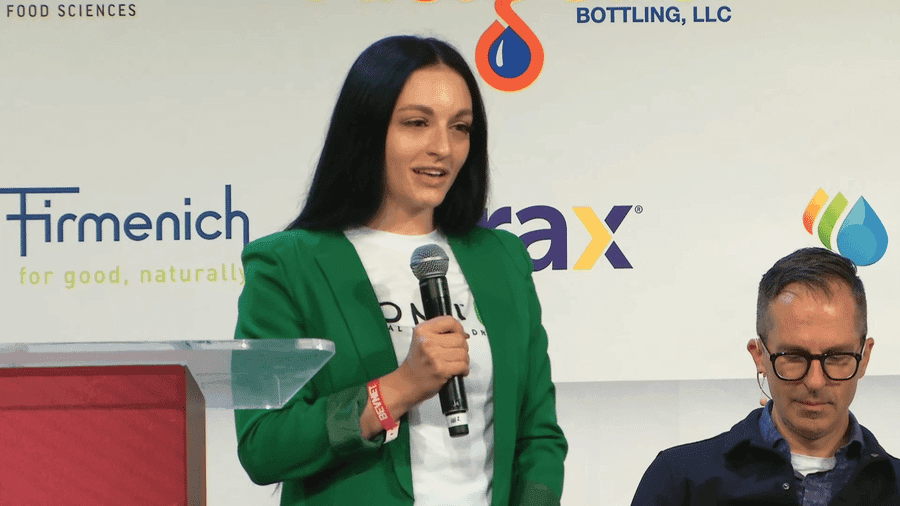
Speaker 5 [12:03] Good morning. My name is Ariana Salinas, and I'm the co-founder and CEO of Somi, the world's healthiest energy drink. For decades, the $57 billion energy drink category has been a stubborn duopoly, forcing consumers to choose between their mental and physical health or energy. And though in the moment these drinks may give you the energy you need, they oftentimes leave you feeling guilty, bloated, and jittery. While working in investment banking at Goldman Sachs, as well as in the restaurant industry, I was like millions of other people, consuming an energy drink every day. I thought I lived a healthy lifestyle. I exercised regularly, ate nutrient-dense foods, and I avoided sugar at all costs. But my afternoon energy drink was my necessary evil. But in 2020 I decided I would no longer trade my health for energy. All other markets were innovating to meet the growing demand of the health conscious consumer, but it's like energy drinks were stuck in time. It's like we'd all made a silent agreement to trade our health for energy, but the truth is nothing's more important than our health. And that we wish something as simple as an apple a day keeps the doctor away could be true. We at SOMI believe it's less about what you put into your body and more about what you refuse to allow in. That's why we created Somi, an all-natural, zero sugar matcha-based energy drink. Somi is a Japanese term. It means beauty, hope, and idea. We turn to Japanese inspiration for our minimalistic packaging, our calligraphy inspired icon, and our name, all to pay homage to our hero ingredient, matcha. Each can is packed with 170 mg of natural caffeine, is gluten-free, vegan, non-GMO, keto-friendly, and packaged in BPA-free cans. Somi's available in three delicious flavors our super matcha, our Yuzu lemonade matcha, and fancy mango matcha, all with zero sugar and only 5 to 15 calories per can. Our mission is to break the stigma of energy drinks as a necessary evil. By creating a truly good for you energy drink, free of compromise. To do this, we turn to the queen of caffeine, Masa. For centuries, matcha has been used not only as a clean energy source but also for its natural antioxidants which have been shown to lower cholesterol levels and decrease inflammation. As well, there's an amino acid in matcha called altheni, which is known for reducing stress and anxiety while increasing clarity and focus. But what really is matcha? Matcha is a Japanese term that means ground tea. The traditional matcha ceremony involves ground tea leaves mixed with hot water and frothed with a bamboo whisk. The preparation of eating the entire leaf and consuming it as opposed to simply steeping the leaves allows matcha to have more benefits, more natural antioxidants, and more caffeine than traditional teas. Aside from matcha, Somi also contains another fruit, superfood, monk fruit. It's one of our natural sweeteners that allows somi to be slightly sweet without any bitter aftertaste and without including our nemesis, sugar. Many industry experts have assured us that anything containing less than 5 g of sugar is acceptable by our markets, but we refuse to compromise. By eliminating the mess and hassle of the traditional matcha ceremony, we believe Somi has the potential to be the number one energy drink in the natural category. Our market is Excuse me, 18 to 40 years old, health conscious, and looking for products that not only look good but make them feel good too. With 71% of matcha consumers being female today, we're targeting a primarily female audience, though our sleek packaging and 170 mg of natural caffeine caters to all genders. Since our launch in January, Somi can be found in over 70 Austin, Texas retailers, direct to consumer on our website and on Amazon. We've partnered with a local distributor and are currently onboarding with UNFI and GPuff to bring Somi to the greater Texas community. Our growth strategy outlines expansion first within Texas and then nationwide with retail partnerships in the Natural Grocery Channel, as well as the C-Store Channel with established brands like Whole Foods, Sprouts, and 7-Eleven, as well as innovative brands like Foxtrot and Neighborhood Goods. As we face the 800 pound gorilla that is the energy drink category, we at SOMI invite you to become one with Mother Nature's nourishing power. Enjoy the energy she has in store for you and meet your matcha. Thank you.
Speaker 1 [17:02] Hold on, grab your microphone. Uh, Matt, you know, it feels like there have been a lot of brands chasing that better for you energy opportunity. Feels like no one's really cracked the code on that yet. Can Somi break that cycle? Yeah,
Speaker 3 [17:15] we'll see. Uh, maybe. I think, um, early days, obviously I, I love the category play. I mean. If you want to pick a category, pick a big one, so, well done. Uh, it's, it's, it's giant, um, but with some really established players and, and so coming after it from a health and wellness angle is interesting. Um, I think you will have some local success, regional success. The big question will be, you know, can you make that leap to national and scale it? With, uh, without a, a DSD presence will be a question. So that, that's gonna be in your algorithm at some point, I would think, because your, your competitors are all out there really in a, in a DSD environment. So, um, but, uh, we'll see it, it's, it's a good start and, uh, having a health, a, a healthier concept than the key competitors is a good place to play.
Speaker 1 [18:11] Uh, Danielle, we heard from Ariana about, uh, this is the world's healthiest energy drink. Um, did you see that? Did that speak to you in terms of the package design?
Speaker 4 [18:21] I do think that the package design is effective. I really like the concept. Um, I do think it comes across as being a health and wellness product, and it's a very clean design. I think there's going to be a shopability issue with your citrus skews. I think you need to differentiate those color bands a little bit. Um, and I also would increase the size of your statement of identity a little so it's easier to recognize.
Speaker 5 [18:47] Thank you. If I may chime in, we actually are undergoing our package change because we, that was the first thing we realized when they're all in the tray, you can't tell the difference in the flavors. So we're bringing the color band up and also launching an additional flavor.
Speaker 1 [18:59] Mike, you're a big matcha drinker, aren't you? I love matcha. Yeah, yeah. What do you think of Somi? Well, first, I want to acknowledge that you have the charisma of a superhero, and you're, you're saying female, and the audience will agree, the audience will agree, but you, uh, you're saying this is female and natural, but you just talked about the 800 pound gorilla, and it's not an 800 pound gorilla. It's like boxing and MMA. You're going against like Mike Tyson, Conor McGregor, and Ronda Rousey all at once. And, you know, in Rockstar Bang, Red Bull, Monster, Godzilla, even too, um, so, and you've seen, you saw Machab bar try to take them on hustle. This is, this is kind of your similar fighters here. And why do you, a similar but like smaller resource wise fighter, think you can stand out in this market and go toe to toe with these folks?
Speaker 5 [19:44] You forgot the rock.
Speaker 1 [19:46] Oh yeah.
Speaker 5 [19:48] That's who I like to stand next to. There, there are these big players in the space, but I like to think of myself as kind of a relatable player. And also speaking to a market that I feel like is being ignored in the energy category. I feel like Celsius is doing a good job of catering to the female audience, um, but there's still that audience of people who aren't extreme athletes. They aren't daredevils. They're not trying to do life risking activities. They're trying to live their everyday life. They're trying to go to work. They maybe want to raise a family. Maybe they enjoy yoga and Pilates and being outside. So we're looking to do like that everyday lifestyle energy as opposed to your extremist.
Speaker 1 [20:21] Bonnie, you hear a lot of pitches. Uh, I'm sure you hear 10 or so daily at this point, at this point. Um, did you hear what you wanted to hear out of Somi's, uh, pitch today? And if not, did you have any questions for? I did. One thing that I really liked is that you're focusing on the Texas market and you're focusing digitally. I like that you're focusing on one market, um, that's going to let you really go deep into the market and really build a reputation for yourself and And efficiently spend your marketing dollars on one market and testing the concept, figuring out what works for you, and then expanding that. I think you're, I, I love matcha, um, and I'm 71% female. I think it's really, I think you're really focused, and I think that's going to really help you build your brand. One thing that I was thinking about is your brand is really modern. It's, it's really modern, it's really clean. But sometimes if you, if you think about energy, it's really energetic and it can be really fun and loud, right? I think Bang with their crazy flavors really helped them differentiate in the market, and I wonder if you could do something similar with matcha and, you know, maybe bring in some heritage flavors or uh make it really unique that people were like, oh, I want to try that. Um, your flavors are, are great, but I think you could maybe be a little more creative to To bring something fun. Thank you. All right, we're out of time, but very well done. Thank you. All right. Our final presenter for the morning session of the New Beveridge Showdown Finals is Vassa Martinez, who was the founder and CEO of PEI. Why not, Vassa? You're clicker.
Speaker 6 [22:09] I'm definitely using the laser pointer on this. Um, today we're gonna start with a video. So we, let's, let's roll that. We got it. Nope. All right, we'll get to it later. The next to see if the next big soda brand will actually be called a soda, right? That's the big question. Is soda a bad word now or is soda now a sparkling or seltzer? Uh, so that's, I'm very, very curious to see how that progresses over the next 5 to 10 years. Who's going to step up and save soda? Well, So I chatted about that yesterday and I basically said thanks to the brand, the brands that are already starting this functional soda category. Um, today I'm gonna start with a briefer version of the founding story, to be honest, I can't go through that again. Um, but the idea behind Perfy all started from years of traumatic events in my life and what my goal is to turn pain into purpose with Perphfy. So when I was drinking sodas and taking notropics and adaptogens to try to deal with the pain, I thought, well, hell, why, why not make my own? So that's really the, the start of Purphy. The big right now. But when you look at the data, you'll see that Gen Z is the least likely to say that they're very well with their mental health. And on top of that, 74% of Gen Z said that, that they had unwanted weight gain during the pandemic. So my hypothesis is that metabolic health and mental health go hand in hand. Right now, 1 in 10 people in America are type 2 diabetic, and by 2025, 1 in 5 will be if we keep up on the same pace. On top of that, 98 million Americans, one third of America, are pre-diabetic, and of those, 80% don't even know. So when I talk about perfume and I talk about making a healthier soda, everyone says, oh man, beverage is tough, and, and everyone knows soda is bad for you. But my question always is, but do you really? Do you look at the data? Right now, over 150 pounds of sugar is consumed by an average American. That's a shit ton. So, excuse my language there. Uh, my hypothesis is, how do you make something with this amount of sugar, this is one sugar cube or 3.5 4 g. Taste is good. As something with this amount of sugar, and that's 14 sugar cubes or about 40 + grams, and the way that I sought out to do that was A lot of the presenters up here this week have said, hire people smarter than you. Well, yes, I hired R&D that's actually good. I don't have the story that I was in my kitchen with one of those sparkling things and fruit. I don't. I, I went straight for the best and I said, hey, we need to use allulose. Allulose and sea salt will help make a full sugar soda mouthfeel, and I think that's what people want. Because the consumer journey, people go from Coke to Diet Coke to LaCroix. And there's a huge gap in the middle of Diet Coke to LaCroix, and that's indulgence. So again, I said, how do we bridge that gap with something that's decadent and delicious where people don't have to feel like crap afterwards? And that's what we did. So what is Perfy? Perfy is a low sugar soda enhanced with nootropics and adaptogens for a happy brain. The reason sugar ties into the metabolic health, the diabetes. The reason it's for a happy brain is hopefully people that were going through the same things that I go through can resonate with the product and hopefully it makes them feel good. Today we're going to go a little bit deeper on what Perfy actually is. We're now keto certified, not keto friendly, which is great for us. Um, so diabetics can trust us. They say that Perfy has the same impact on their blood sugar as water. And for me, one of the, the huge goals pre-launching and then launching three months ago was let's send it to diabetics and let's have them test their blood sugar. There's no way you can lie or market your way around that. If it's bad for their blood sugar, you're done. And then we expod at the LA Fit Expo where people that are just 2% body fat walking around jacked, the Conor McGregor's are the rocks of the world, and at first it reminded me of my time at Quest. At Quest we couldn't hand out a Quest bar. People were like, Oh no, I don't eat that. And people are like, oh, I don't drink soda. But lo and behold, later on during that show, people like, everyone told me to come try this, it's so good. And it reminded me a lot of that, my, my early days at Quest. Perfy is also brain boosting. We use 50 mg of Lheanine and either 30 mg of ashwagandha or turmeric based on the flavor. You might ask why, well, why such a low dose? Well, I don't want perfy to be a supplement, and I also want share of stomach, and I, obviously, if you're a beverage brand and people drink 2 or 3 or 4 cans a day, that's not bad. So that's why I went with that amount. One of our major points of difference is that we're not from concentrate. I'd be hard pressed to find any CSD that doesn't have concentrate, I think I said that right, double negatives. Um, well, it's tough to find, not for concentrate is a goal, that's why we went for so much freshness. There's nothing artificial. It's caffeine-free. Well, why is it caffeine-free? Damn, I'm not gonna, it's my last slide. Um. Because people would drink at night, boom, familiar but different. OK,
Speaker 1 [27:10] Ben. Great job. You can grab one of your microphones. Yup. Oh, that's for you. I got one right here. No, I'm good. Thank you. Um, Bonnie, uh, a low, a low sugar soda for a happy brain. Uh, is the market looking for a product like this? I think so. I think they absolutely are. Um, Poppy, Ollipop have done a great job and Educating the consumer that there are better for you sodas out there, um, I would like to slow clap your branding, uh, and your positioning and the taste of your product. Uh, I think it's absolutely delicious. I love that you've gone with 14% juice. I love that you added real flavors in there, so people are actually also getting the health benefits of the fruit. I don't think your competitors have done that aside from Spindrift, right? But I don't know if they're really trying to be a soda, um. I think you've really hit the mark with this one. Thank you very much. Matt Vassa talked about how people go from Coke to Diet Coke to LaCroix and there's nothing really in between Coke and LaCroix. Does Perfy fit into that space?
Speaker 3 [28:18] It, yeah, from a bridge perspective, it's interesting, right? I hadn't thought about it until you, till you brought it up, uh. Again, great category to play in, really big, uh, really established, so, uh, well done in terms of that in terms of Moving those consumers on that journey and as we age, it's the same thing, right? It's, it's also an age, an age curve as well as a health and wellness curve. So I, maybe so, yeah, it's, it's a good thought, uh, but, uh, and, and the unlock on value of course is huge, so I like it.
Speaker 1 [28:50] Thank you very much. Danielle, uh, again, a brand, a brand that's sort of centered around better, uh, better for your mental health or a better for your soda addressing mental health, uh, does that speak to you on the can? I mean, do you see what Boss is trying to, uh, express on the can of, on the front of the can of Perfy?
Speaker 4 [29:06] Uh, well, first of all, I just want to say that you're a really relatable presenter, which is wonderful. Um thank you. I think that I appreciate that he kept the adaptogens in the new Tropics lower in the communication hierarchy actually so that it would have broader appeal, though I think that the consumer doesn't necessarily know what adaptogens in new tropics are, so you need to bring the actual function, the benefit to the front. Instead of the uh feature and, um, you know, I, uh, I think your approach overall is really thoughtful. I think the flavor was nice, it was a little sweet for me, but I understand the target, and I would just um. Oh, you know, I actually think I'm gonna go against Bonnie. I actually think that your visual identity is not differentiated enough. I think that you really need to stand out between the poppy and the culture pop and find your own identity.
Speaker 6 [30:01] Fair enough. I appreciate that. And regarding the um. The hierarchy on our new label that launches in August, it says for a happy brain up top, and we quantify the amount of the functional ingredients on the side. The flavors on the bottom, much easier to read. So we asked a lot of friends in the industry, uh, tell us what you would do, and they did, and we did it.
Speaker 1 [30:18] There you go, Mike. You get the last word, and we haven't necessarily heard too, too much about taste. How do these products taste? And by the way, I love fruit punch. There's not enough fruit punch flavors out there, folks. So how did the fruit punch taste? Like fruit punch. There you go. Like fruit punch should taste like. It tastes like Hawaiian Punch. If you have a, I mean, you want it to punch you in the face because that's what fruit punch is supposed to do and it does, and that's awesome. Let me ask you a question. Do you know how hard it is to make science interesting? You know what you just did in front of us here? Do you know what you like, it didn't sound like marketing and it didn't sound like science, like Like Vassa, you know this already, but I really like you as a person and I think someone just needs to interview you about all the things that you love about this and just Then, you need to like Perfy, it's like bottling your essence and when you drink it, you're like, oh I get it now, but it's not coming through on pack like Perfy, the word Perfy and uh like I almost cried when you talked about your mom yesterday and, and uh so I'm a little choked up right now, but if you got to figure out how to get that on the pack because new trophics and diptogens are not what you're selling and you're, and even the, even the calm, you know, that's not it either. There's something there. If you capture that, you're going to win.
Speaker 6 [31:33] Thank you. Will do.
Speaker 1 [31:34] Outstanding. Very well done, Vassa. Thank you. Outstanding job by the 1st 3, 1st 3 finalists that we saw today. We're going to see the other 3 finalists or the final three finalists at 2:00 p.m. Eastern Time. You don't want to miss it. We're going to announce the winner of the competition at 3:50 p.m. Eastern Time.


