

 Another major spirits group has blamed geopolitical instability for cutting its sales outlook.
In the same week competitor Diageo warned tariffs would hamper its recovery, Pernod Ricard moved up its earnings results to report a 6% sales drop in the first half of FY25, and warned of a low single-digit sales decline for the year when it had previously expected growth.
The owner of Martell cognac was already struggling with a trade war between the European Union and China that has hurt brandy suppliers across the board since last fall. Martell accounts for 85% of Pernod Ricard’s business in China and the brand has already seen a soft Chinese New Year, a peak holiday season for sales, partially prompting the change in guidance.
Next year will be a “transitional year,” said chief executive and chairman Alexandre Ricard on Thursday, with trends expected to improve in organic sales despite trade tensions.
If tariffs on Mexican and Canadian goods are imposed, and if President Donald Trump makes good on his threat to impose U.S. tariffs on European imports, the group estimates it would be hit with a $207 million (€200M) loss, including the already established retaliatory tariffs from China. Since October, Beijing has imposed temporary anti-dumping measures for imports of European brandy.
But spirits suppliers are already reeling from slower sales, and Pernod Ricard is no exception. In the U.S., sales dipped 7% organically. The group expects to see sequential improvement in H2, but will still be in decline for the full year.
“The elephant in the room is the U.S.,” said Ricard, despite some “early green shoots that are starting to materialize.”
Volume improvement in the U.S. is partially due to the group “carefully and actively working on profitable promotional activity and as well, when it’s required, adjusting price,” said finance chief Helene de Tissot.
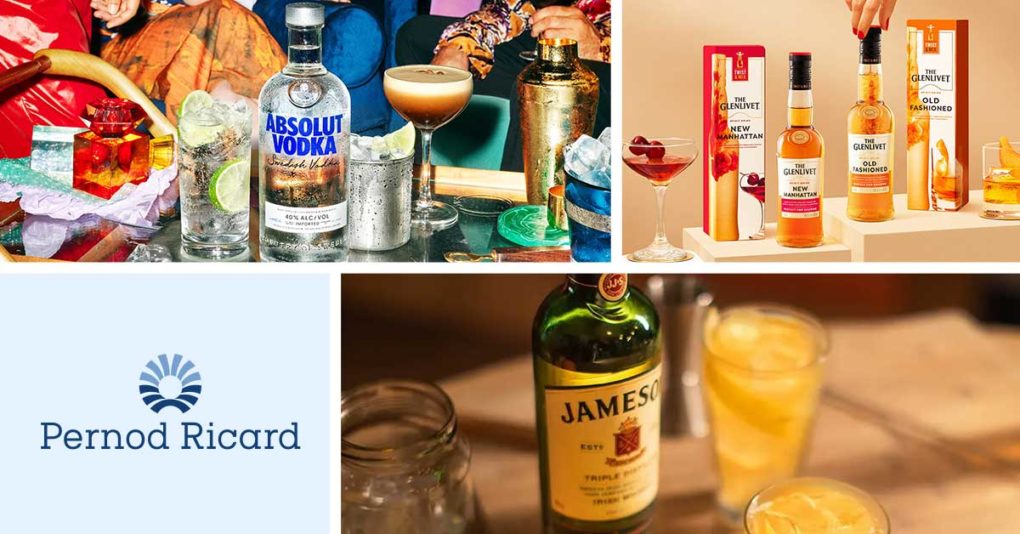
Ricard highlighted improving U.S. sales numbers in the latest four weeks for major brands Jameson, Absolut, Kahlua and Malibu. Those numbers included ready-to-drink (RTD) extensions, which the company recently put more weight behind. Globally, RTDs were the bright spot of the entire portfolio, rising 15%, led by Absolut RTDs.
The group is optimistic that headwinds in beverage alcohol consumption are mostly cyclical and “mainly driven by economics” versus a total generational shift away from drinking.
“They [Gen Z] will drink less frequently and more occasionally, and if they have the purchasing power when they do, they will trade up to stronger, upper-value spirit brands, which is the segment in which we operate,” said Ricard. “The dynamic emergence of spirits-based RTDs tends to accelerate this phenomenon.”
Overall, sales for H1 FY25 totaled $6,413 million and net profit hit $1.24 billion, down 24%. From fiscal years 2027 to 2029, the group is projecting stronger organic net sales growth, with a range of +3% to +6% with organic operating margin expansion.