

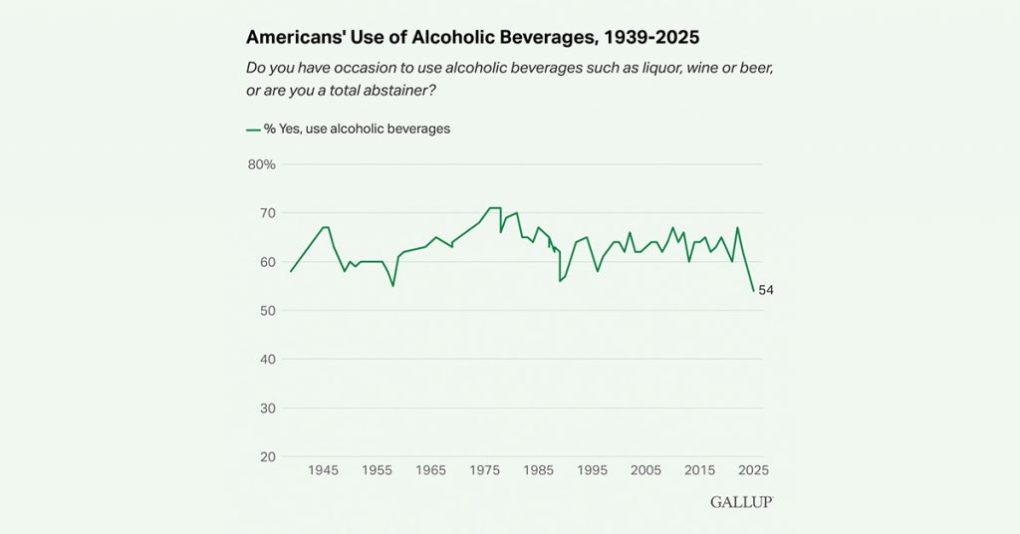
 The percentage of Americans who say they drink alcoholic beverages has fallen to its lowest point – 54% – in the history of Gallup’s annual survey tracking drinking patterns of adults.
The firm said the decline comes amid “a growing belief among Americans that moderate alcohol consumption is bad for one’s health, now the majority view for the first time.”
“Americans’ drinking habits are shifting amid the medical world’s reappraisal of alcohol’s health effects,” Gallup wrote. “After decades of relative steadiness in the proportion of U.S. adults who drink, Gallup has documented three consecutive years of decline in the U.S. drinking rate as research supporting the ‘no amount of alcohol is safe’ message mounts.
“Compounding the challenge for companies that sell alcohol, drinkers now appear to be dialing back how much they drink, as well,” the firm continued.
The findings were part of Gallup’s Consumption Habits poll, a telephone survey of 1,002 adults aged 18 and up taken July 7 to 21. The survey’s results have a margin of error of +/-4%.
From 1997 to 2023, at least 60% of U.S. citizens reported consuming alcoholic beverages, Gallup wrote. However, the percentage declined from 63% in 2023, to 58% in 2024, before reaching 54% in 2025. Those figures were down from highs of between 68% and 71% from 1974 to 1981. The previous low was 55% in 1958.
Of those who consume alcohol, “a record-low 24%” said they had a drink within the last 24 hours, Gallup reported. Meanwhile, 40% said the last time they had a drink was more than a week ago, which was “the highest percentage since 2000,” the firm added.
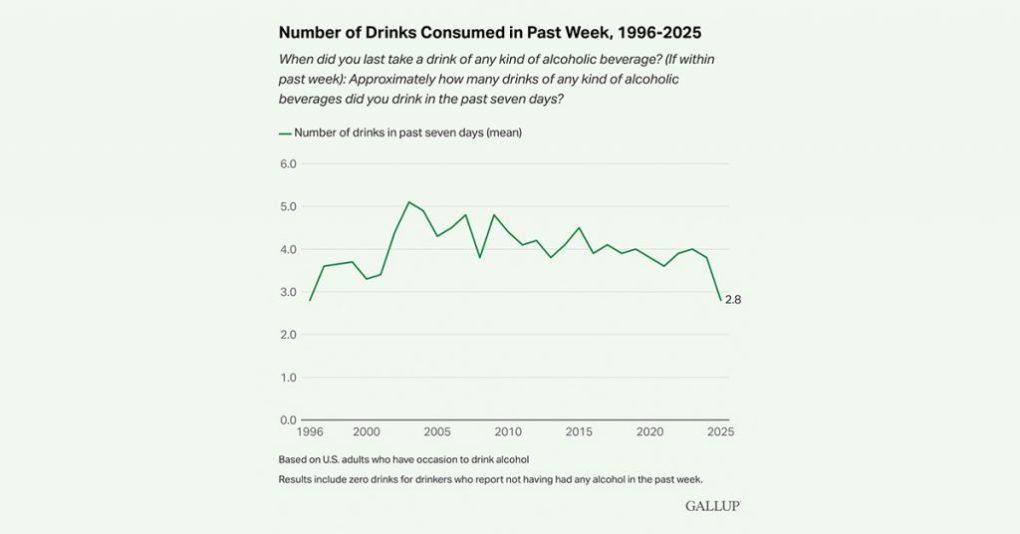
Across all alcoholic beverage consumers, including those who did not have a drink within the last week, the average number of drinks consumed within the last seven days was 2.8, which Gallup noted matched the previous low in 1996.
A year ago, the average number of drinks consumed within the last week was 3.8 and the figure had hovered around 4.0 drinks over the previous seven-year period. Those numbers also mark a decline from 5.1 drinks consumed per week in 2003.
Industry stakeholders have noted that the year-over-year variation should be taken with a grain of salt. Brewers Association president and CEO Bart Watson noted on LinkedIn the “small” size of Gallup’s survey pool (around 1,000 people), which also includes underage consumers as “underage drinking has plunged.”
Nevertheless, here’s a look at Gallup’s findings.
Demographic data: Women Drinkers Declining Compared to Men
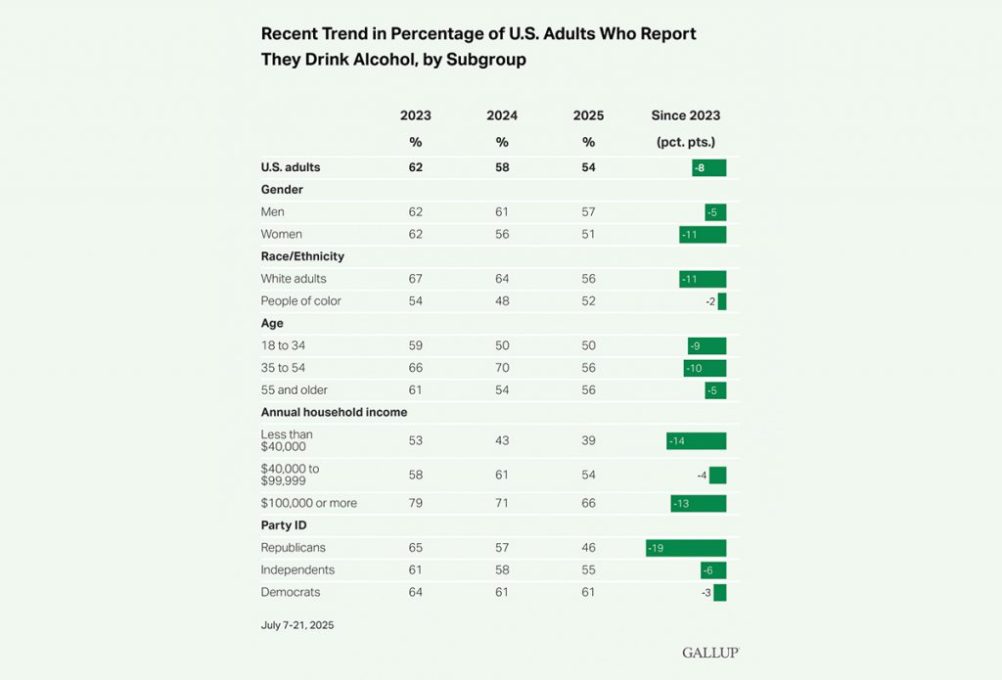
The declines were steepest among women, as 51% said they drink, dropping 11% since 2023 (62% who said they drink) and 5% compared to 2024 (56%). Gallup found that women were more likely than men to believe that moderate drinking is unhealthy (60% versus 47%).
The decline in men drinkers has been slower, dropping 5%, to 57% in 2025, after a 1% decline between 2023 (62%) and 2024 (61%).
By race/ethnicity, the number of white adults who said they drink has declined from 67% in 2023, to 64% in 2024 and now 56% in 2025, an 11% decline over the last two years.
The percentage of people of color who said they drink was already lower than white adults. In 2023, 54% of people of color said they drank, which declined to 48% in 2024, but bounced back slightly to 52% in 2025.
Young Adults ‘Quicker’ to Cutback on Alcohol
The number of drinkers among the youngest adults (18 to 34 year olds) has held steady at 50% over the last two years, after declining from 59% in 2023.
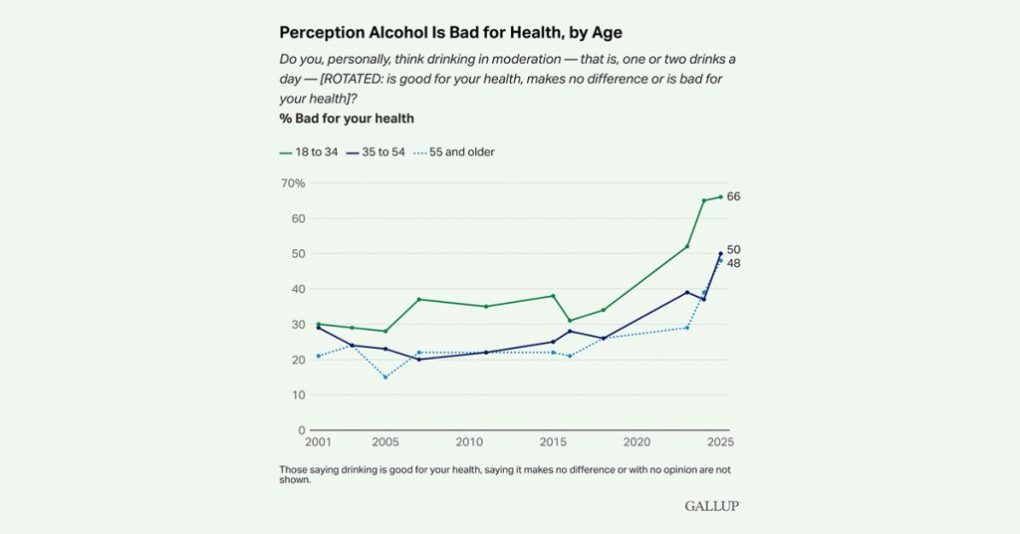
Gallup pointed to younger adults being “quicker than older Americans to embrace the idea that drinking is detrimental,” with 66% of the youngest demographic saying they believe consuming alcohol is bad for your health.
Consumers ages 35 to 54 have fluctuated over the last three years, going from 66% saying they drink in 2023 and bumping up to 70% in 2024 before dropping 14% to 56% in 2025.
The oldest consumers (55+) have also fluctuated, going from 61% in 2023, to 54% in 2024 and then increasing 2% to 56% this year. Still, Gallup wrote that “the belief that drinking is detrimental is now gaining traction with older Americans.”
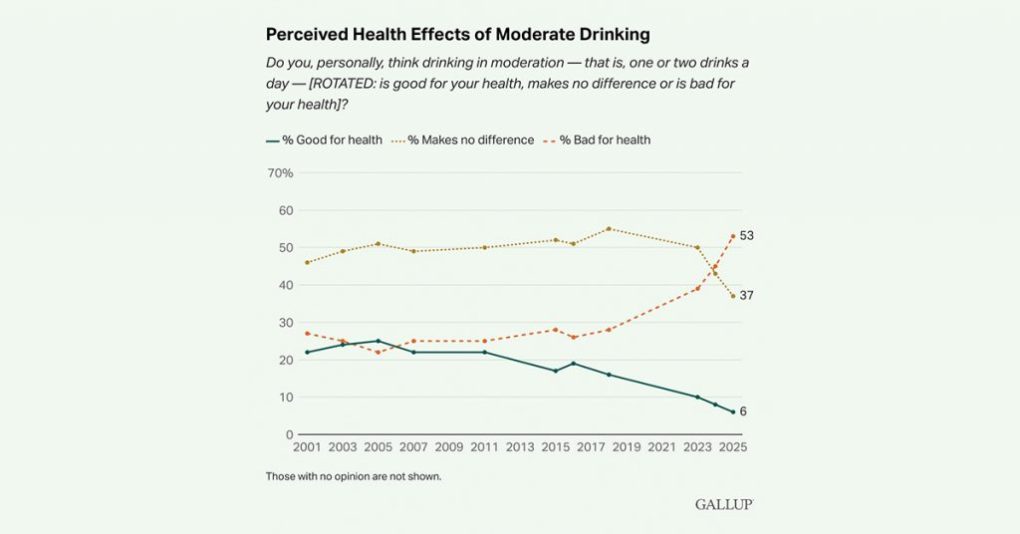
Majority of Americans Believe Moderate Drinking ‘Bad For One’s Health’
A majority of Americans (53%) told Gallup that they believe moderate drinking – one to two drinks daily – “is bad for one’s health.” That’s compared to 6% who said moderate drinking is good for health and 37% who said it makes no difference.
“Today’s belief that moderate alcohol consumption is unhealthy follows increases from 28% in 2018 and 39% in 2023 to 45% a year ago,” Gallup wrote. “By contrast, from 2001 through 2011, the percentage with this view hovered near 25%, roughly equal to those who considered drinking beneficial.”
Even though a majority of drinkers believe moderate drinking is bad for their health, those consumers “are just as likely as all others to report they drink alcohol (55% and 54%, respectively),” Gallup reported. Still, only half of those who reported health concerns about drinking reported that they had a drink within that last week, versus 69% who did not report health concerns.
Those with concerns who did report having a drink within the last week reported having fewer drinks on average than those who weren’t concerned (4.5 drinks versus 6.4).
“The continuation of these trends may hinge on whether recent pronouncements about drinking’s risks are the final word on the subject, similar to how the U.S. Surgeon General’s warnings about tobacco in the 1960s marked the start of a long-term decline in smoking,” Gallup wrote. “The trajectory of U.S. drinking could also depend on how much doctors, health authorities and policymakers reinforce the message that no amount of alcohol is risk-free.”
The Department of Health and Human Services (HHS) and the U.S. Departments of Agriculture (USDA) are scheduled to release updated dietary guidelines this year, and the bev-alc industry has been waiting with bated breath to see if the new guidelines will lower existing recommendations (two drinks per day for men, and one drink per day for women).
The latest dietary guidelines process has been heavily criticized by bev-alc industry members across the three tiers, who have suggested studies informing the HHS and USDA’s decisions are biased against alcohol. The updated guidelines, which would be enacted through 2030, were expected to be released last month, according to the BA, but appear to be delayed.
High and Low Incomes Households Post Steepest Declines
Drinking in households across all income levels has declined, with the steepest drops at the low and high ends of the income spectrum:
- Less than $40,000: 53% said they drink in 2023; 43% in 2024; 39% in 2025;
- $100,000+: 79% in 2023; 71% in 2024; 66% in 2025.
The middle-income level ($40,000 to $99,999) posted the lowest declines after increasing YoY from 2023 (58% drinkers) to 2024 (61%) and then declining to 54% in 2025.
Across party affiliation, Gallup found a steep decline (19%) among Republicans who say they drink, falling from 65% in 2023 to 46% in 2025.
Democrats’ consumption has remained steady at 61% over the last two years, but declined 3% compared to 2023 (64%).
Drinking among independents declined from 61% in 2023 to 55% in 2025.
Democrats (58%) and independents (55%) were more likely than Republicans (44%) to believe that moderate drinking is unhealthy.
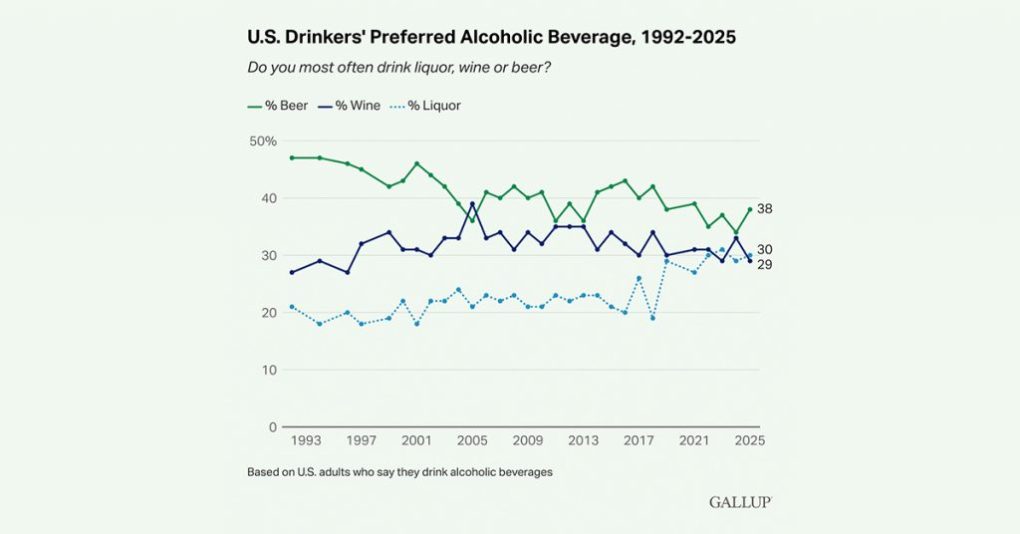
Beer Still Drink of Choice
So what are consumers drinking? Beer remained the most cited alcoholic beverage (38% in 2025) followed by liquor (30%) and wine (29%). The percentage of people who cited beer increased from 34% in 2024, when wine was neck-and-neck at 33%.
Gallup reported sharp preferences along gender lines, with beer more popular with men (52%) than women (23%). Women told Gallup that they preferred wine (44%), with only 14% of men choosing wine. Spirits was more even, with 29% of men and 32% of women choosing liquor.
Beer has remained in the 30% range since 2019, down from its highest point of 47% in 1996 and last peak of 46% in 2001.
Gallup’s research found that declines in alcohol use were not due to consumers shifting their consumption to “other mood-altering substances,” such as recreational marijauna even as cannabis use is higher now than it was a decade ago.