Search across the BevNET CPG Media network including BevNET, Nosh, Brewbound, Taste Radio, Nombase and CPG Jobs.

Breakout Session II: Trends & Challenges in Functional Beverage Sponsored by Kerry
Transcript
Note: Transcripts are automatically generated and may contain inaccuracies and spelling errors.
Rajesh Botinani [00:12] Hi, uh, my name is Rajesh Botinani. Um, I lead the taste division of, uh, North America for Kerry, um, where, uh, we look into all kinds of, uh, natural flavors, uh, clean label, uh, aspects, modulation in the areas of, uh, sugar reduction, uh, masking of sweeteners, uh, mouthfeel, um, and also into salt reduction, uh, where needed. So those are the categories within the taste, uh, that I lead, uh, and, uh, we have a fantastic group here, David, who is my co-partner today, and I also have a full set of Kerry team sitting in front, encouraging us. So with that, I'll pass it on to David.
Dave Di Virgilio [00:50] Afternoon, everyone. Uh, my name is Dave Di Virgilio. Uh, I work in the Proactive health division at KAERI. Uh, basically, uh, if, if Rajesh is the taste side of this equation, I am the functional side. So, proactive health, uh, is focused on science-backed, clinically backed brands, uh, and ingredients. Um, so we'll talk you through quite a few of those today. Uh, I've been with KAERI for almost 5 years now, um, but been in the, the food, beverage, and supplement industry for, um, about 12 now. So, um, looking forward to presenting to you today.
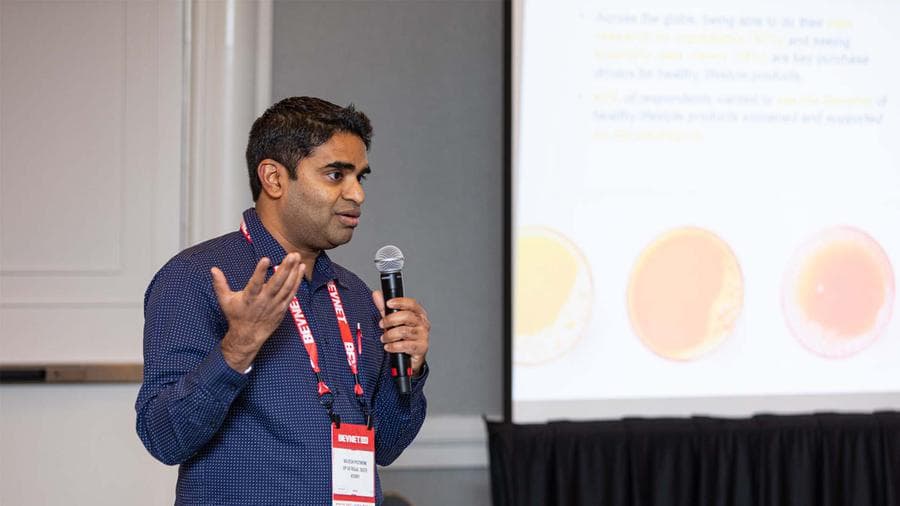
Rajesh Botinani [01:22] So, with that, uh, so today, we will quickly, I'm quickly going to run through the agenda. I think we're going to, uh, I mean, this is a fantastic opportunity and we are trying so many different functional ingredients today as, as well as the contests that are happening. So, we are going to very quickly hit how the trends within the functionality are moving and what that looks like. Um, David will run you through some of the market snapshots and which are the categories that are growing and, uh, how. How to tackle some of those and where to spend our energy in those spaces. So, and then we will focus, uh, very much zoom in into concepts, um, and this is where we'll spend a, a decent amount of time on physical health, uh, concepts, personalized nutrition concepts, and cognitive health concepts. And the idea is not just run the, the concept from a health perspective, but also what are the challenges that we tend to face as a formulator. If you put yourself in a formulator's shoes, what are some of the challenges as a food scientist or as a beverage specialist? That you have to take into consideration, as well as what are the some of the known science behind so that we can back it with science, especially on the immunity, uh, and on the digestive health concepts standpoint. Next one. So very quickly, right, um, I, I think instead of reading the slide, if you look at the picture on the, on the right, it tells you there used to be a time where hydration means Gatorade. Right? COVID, before COVID, after COVID, now hydration and immunity go together, and we all know how important the immunity has become. In the process, one of the key things also you'll realize is the areas of mood and body health without compromising taste. Like consumers and everything, every product that we are tasting in the last 7 hours or 6 hours this morning, everything is linked to how is it good for me. What is it going to do for me while I don't want to forego the experience of this? And how do, and as some of the, uh, as entrepreneurs here, how do you get the consumer back so that after tasting the first time, they will say, I like it, I'm going to buy it again. That's what the, what we are looking for in this space, and that's what the functionality, the marriage of functionality, taste, and, uh, is becoming very critical. And that's what it says. 80% of the consumers are now planning to drink healthier. Right, like this morning I I, I got up, I was trying to have coffee and I was trying to eat something. My wife calls me and say, Make sure to eat healthy. I'm like, yes, I am, right? So, so just to give you a gauge of how life has turned into. OK, uh, with that, uh, next slide. So, so the critical thing is, I, I, I mean, you have heard in the morning, and we are just repeating, there's more people looking at the label. Gone are the days where you get, get with the colors and the prints. There's at least 42% of the ingredients that, that get researched on. And then the scientific claims are being looked at by the consumers before they purchase. This is, this is a big deal. Why is it a big deal? Because those, those 43% of the recipients that you're looking here. They also want to make sure it's sustainable. The packaging needs to be sustainable too. In the process as R&D head or as part of the R&D, it becomes very critical that the consumer sees the value. And believes, and we had to build that trust. That means the signs need to be very solid. The claims need to be very clear. And at the same time, the product needs to taste great. At the end of the day, it can, you can make the best fermented dish, but if you can't drink it, a 16 ounce or 8 ounce, you're not going to have it. So the research behind is becoming very, very critical, and that's something, the credibility of research is something we at Kerry also emphasize a lot, and that's where the partnership of a functionality and taste come in handy. Next slide, please.
Dave Di Virgilio [05:28] So I'm just gonna take you through. Um, some higher-level trends, uh, to, to base that from a functional standpoint. Um. I would say that, um, the top 5 may come as no surprise to this group. Uh, many of you have SKUs that are out there, many of you have brands, uh, that are potentially even based on one of these need states. I would say the The takeaway that I'd like you to have from this slide is really the need states themselves, and what I mean by that is The The conversation that starts when you, uh, begin to form a product, or you, right, you, you're at the, the high end of the funnel for your product development cycle, um. What's different and what I've noticed, uh, has changed over time is that you, the brands, and your customers are speaking in these states now. You're not speaking in raw materials necessarily. Yes, we get, you know, we get requests for raw materials all the time. We want green tea extract, we want MCTs, we want, you know, whatever raw material. Um, but I've noticed over the past, let's say 5, 5-ish years that the conversation has kind of pivoted. To these need states. And so that whole ideation process will now start with a brand and we will say, OK, well, where, where are you SKU extending or what, what do you want your brand to be about and, you know, it kind of starts with, well, we, we would like something in the energy space or we would like something in the immunity space, or we already have an immune product and we want to skew extension into digestive. Um, so, I, I feel like a lot of the conversation is pivoting around these particular health need states. Here's the category snapshot. You can see pretty robust growth, uh, across the board, really, uh, except for weight management powder. Um, my thesis on this would be that Uh, weight management as a stand-alone is pretty much just morphing into some of these other categories, right? So, instead of something just being, you know, the, the anchor tenant is weight management, I would say that maybe some of that weight management is moving into plant-based or maybe some of that weight management is moving into performance nutrition. Um, but as you can see, pretty, pretty robust growth, uh, across the board. So I'd be remiss if I didn't mention COVID, given we're all wearing masks in this room. Um, COVID distinctly had an effect on the beverage consumers' behavior. Um, I think it's no shock to see that immunity went through the roof, um. That makes perfect sense. What doesn't necessarily make sense, um, until you think about it a little bit further, is the, the stress and the, the mental health. Um, I find that really interesting because we were seeing stress and mood and cognitive and that kind of umbrella trending before, uh, COVID, but I think COVID really brought it into focus because we were all You know, we were all doing 9 more jobs than we had to do beforehand, before we were, uh, you know, uh, entrepreneurs and brand owners and or employees, and then we became teachers and coaches and counselors, etc. So, I think the, the focus that got brought in on, uh, cognitive stress and sleep, uh, in the mental health space, um, is really interesting, and I, I don't really think it's going anywhere anytime soon. Um, I will touch on sustainability. I, I wanted to touch on the comment that was made this morning, uh, in that initial panel, when, um, and I, I apologize, but I forget who said it, but in that initial panel, um, There was a comment that was made that brands really need to focus on their, you know, one or two, maybe top 3 things that, um, they're going to identify themselves with. Um, I would argue that sustainability is becoming one of those top 3 things and you really have no choice in, in the matter. Um, so you, you can choose your other top 2, but sustainability is kind of a, a given at this point. Um, we all think packaging and, and yes, fine, you can see the, the massive jump in. Uh, sustainable packaging, but I would also encourage brands to think beyond the bottle, um, and go into their supply chain from an ingredient standpoint. Think about the traceability, think about the, uh, the sourcing, um, the emissions that goes into, uh, producing the ingredients. Um, are there waste streams that are then being used as well, so you have a more robust, uh, supply chain or story that you can tell. Um, so I would You know, as a general sentiment, just, just take it one step further beyond, uh, beyond the bottle with your suppliers.
Rajesh Botinani [10:27] So, so one other comment is, a lot of the entrepreneurial companies, when you're starting off, You don't have a choice, right? You're looking for the best way to work. This is where I think partnering with already partners in this space of suppliers or, or your co-partners who already have taken a stand on sustainability and are taking the commitment would actually make it easy for you because once your brand does get big, you don't need to then go find ingredients or go find ethically sourced partners. So that's something, another thing, find your partners or companies that are already doing this from day one so that when you do get big, you already have done your homework and you have the right partner in crime. And that's why we, we take it very strongly that sustainability, we don't start from the beginning, there's no way in the middle you can be sustainable, yeah.
Dave Di Virgilio [11:19] Yeah, it's a great comment. Do the legwork upfront, um, and, and find the right partners upfront. Um, so, we, we've talked a lot. I mean, on the initial slide, you saw the trends that were happening on the need states. We're gonna pivot now and go into, uh, some concepts that will highlight, uh, cognitive, digestive, and immunity. Um, the cognitive one's a little bit of an energy play as well, you'll see, um. So, Rajesh and I are gonna kind of bounce back and forth here, take you through what, um, you know, challenges you might have with certain need states and formulating certain need state beverages, um, and, uh, Oh, Rajesh, you want to take us through like a high level.
Rajesh Botinani [12:01] So here, what we are trying to do is we are putting ourselves in the shoe of a, of like, you have, you have agreed that you're going to launch in a certain category, let's say cognitive or digestive or stress. Regardless of what it is, at the end of the day, the product developer has to build the concept while it's, it's literally a seesaw. You have taste on one side, functionality on one side, and the, and the triangle that is holding is the formulation. So how do you balance that? So that's where it basically comes down to these 4 elements that we want to pick through in each of our concepts as we go through. What I mean is, let's say, let's, let's say taste. In the taste space, obviously, we know in general already existing even before COVID, less sugar, right? Low calorie products, and the natural sweeteners have already been on, on, have been growing up. With that now, the added functionality of the ingredients becomes critical. So we will zoom in for each of the scenarios, what the taste aspect is the same way we'll also focus a bit on the challenge that you get depending on the format you pick. If it's a powder format versus a liquid format, the type of process and how that would impact your formulation and the type of challenges you tend to face. The third one, obviously, you, you already have an idea of what, how you're positioning your need state. So, your need state will already define the functionality and that's something, uh, David will take you a bit more zoomed in for each concept. At the last, after we go through the three of the concepts, at that point, we will actually talk a bit more about what does it mean to be in the supplier partnership relationships and how do you select the right partner? And, and, and that's how we want to end here.
Dave Di Virgilio [13:46] So, concept number one, berry hibiscus kombucha. Um, this is a powdered form, so everybody's walked into their local grocer and grabbed their nearest glass bottle of kombucha, um, and, uh, in the refrigerated section, this is essentially the, the convenient form of that in whether it's a sachet or whether it's a bulk powder to dump and mix. Um, we essentially challenges on the functional side that you would see here. Um, would be using the fermented tea product. Um, so we, we ferment the black tea, um, and then in, in that drying process, you basically lose the lactic acid bacteria. Um, so you, in order to make that digestive health claim, especially a clinically backed digestive health claim, you add back a probiotic. We added back BC-30, uh, which is one of our spore-based probiotics. You can put it in a dry powder beverage because, um, you've controlled water activity, um, and therefore, and, and at low enough water activity at ambient temperature. Um, you get good survivability. So I would say the biggest challenge on this one from a claim standpoint would be to get a probiotic that works in your, uh, powder package. Um, beyond that, um, there's some taste.
Rajesh Botinani [14:59] So here the challenge from a taste point. So we are using a tea vinegar, which is, uh, sort of an acidic acid. We have juice, natural juice, uh, concentrates that we use in this. So you can clearly imagine the acidityity too, and plus we do not want to use sugar. Right, so you, you're making this with, with one of the natural sweeteners. So in this scenario, the sweet to acid balance becomes very critical. So this is where we, the technologies like the sweet modulation that helps you get back the sweet intensity without not adding calories, as well as ability to bring back the syrupy body and some of the. So basically that balance of, of that acidity modulation becomes very critical. That's one of the challenges that you tend to see from a taste perspective. The other one you, you tend to see is, uh, it's a dry solution. What does, what, what, what does that mean? Like kombuchas in general are in the refrigerated section, and whenever you open and you have it, they tend to be fresh, and there is a type of flavor pairing that happens with the acid. So now you're trying to change that into a powder format that you can carry in your pocket and put in water and drink it as you walk through a kombucha. So how do you make sure that flavor that you are going to convert into a powder format is still fresh and delivers the same, same nuanced. Um, like, like in this case, it's hibiscus, right? That perception of, of, uh, of the berry, berry, berry and hibiscus. So how do you do that? That's, that's one. Second one is that flavor pairing, and I think, uh, uh, we spend quite a bit of time in that space. How do you pair the right halo, health halo ingredient with the functionality? So those are some of the taste challenges that, that you look at and you solve. And then from a, because it's a powdered product, and you want to have, make sure its shelf life is more than a year, most kombuchas in a refrigerated section are gone in less than that time. So how do you make sure, so the clumping, as well as the blending, uh, sort of, and the solubility of it as you are putting it in your, your shake, shaking it, those are some of the aspects that you have to take into account from a formulation perspective. By the way, this drink, this is not a made up concept. It's upstairs. Please stop by our Kerry booth, and this concept is available so that you can taste with tea vinegar. It's made, and that's the uniqueness of this one. We actually made it with a tea, um, um, we extracted out of tea leaves and then fermented it, so, and it is in crystal form as well, so it is in a powder format already available. So just, just to give, which is highly soluble, yeah.
Dave Di Virgilio [17:36] Uh, next concept. Uh, so this is our take on a coffee, not coffee. So it is a caffeinated beverage, uh, coming naturally from the guarana, um, but we wanted to give it a, you know, an energy, but with a, a, a focus slant. So, we basically have the natural caffeine coming from the guarana, you have the synergy with the L-theanine, um, And Ltheanines really works really well with the, uh, works really well with caffeine, because it kind of normalizes that caffeine curve and gives you a less jittery up and down and a more, you know, gentle or normalized, uh, caffeinated pop. Um, we also added in uh Ashwagandha for a non-caffeinated energy claim, um, and then we have, you know, the, the vitamin blend in there as well, um. I would say challenges that you will encounter, uh, right off the bat here. Uh, I'm gonna point out dose. This is a pretty stacked, uh, ingredient deck. So, if this is, let's say this is, uh, I mean this could be either, uh, dry or RTD, but let's say it's dry, um, and you want to put it in the sachet. My initial concern with this would be. I've got, you know, 1 to 2 g of functionality in there. What do I do with my, my masking and my, you know, my taste. Um, if it's, um, Or sorry, the second thing I was gonna say is, since there's such a laundry list of ingredients in here, you're looking at, uh, making sure that those ingredients are globally. Uh, sourced or globally approved from a regulatory standpoint, so that, yeah, I mean, given the scope of your brand or of your company, um, you really want to make sure that a lot of these ingredients are ticking all of those boxes, um, which you would usually do when you have a shorter ingredient deck, but making sure that the claims that you're gonna get off of all those three that I mentioned, um, really do carry whether it's in, in Europe or whether it's in the US or Canada, um, or beyond.
Rajesh Botinani [19:52] So from a taste perspective, here, here is, here's a, you, you're seeing the list. If you taste guarana by itself, uh, let's say 45 mg or 70 mg, some sensitive people will catch the caffeine, uh, bitterness, but some will say, ah, it's not a big deal. But when you put it together with ashwagandha, with guarana, and then you start adding this, the bitterness of the product before you know it, like by themselves may not feel like it, but they stack up very big, and we need to realize we have 25 bitter receptors in our mouth, so the synergistic bitter bitterness is much higher. And that's something you may have, you may have it in one sip, no problem. Like you take small sips in demos and stuff, that's OK. But if you are asking a person to taste that 18 ounce bottle and still buy it next time, we better make sure that the bitterness is not accumulating in your mouth. So that's where we spend quite a bit of time in covering, covering the bitter masking in, in this case. The other thing here is we did not use a coffee extract. We actually made a coffee flavor. That actually is is in synergistic because it's another way of approaching a natural coffee flavor that actually drives consumers' preference. Um, and that's something also we, we focused on. And the third one is obviously again, the sweetness. How do you get the sweetness, especially when you have all these functional ingredients that along with bitter, you don't want some of the natural sweeteners lingering to be a distraction. So those are some of the taste elements that we take into account when we are when we created the product and we optimize the taste. Then from the formulation perspective, again, the key thing is an alternate coffee solution. I think again here we are using guarana instead of caffeine coming from coffee. That was, so in that sense, the handling of this material is very different from that of a coffee. The other thing is now you're adding like ashwagandhas and ginsengs. They, they have other polyphenols and stuff. So if the pH of the product is not done right, you will start to see the sedimentation at the bottom. And, and that's sometimes consumers, depending on the category, some may see it as, as a drawback. So that's also the second thing, um, you have to take into account. By the way, again, same thing, the product, uh, is in a demo format upstairs. Please visit Grick.
Dave Di Virgilio [22:18] And that sediment, that sedimentation would happen, uh, you know, if, if you mixed it in a ready to mix, right? You, you want somebody to consume over 30 minutes, let's say, and you want it to be homogeneous. Um, but again, on, on the RTD side, you know, a lot of these powders are, are heavy. Um, so you really have to take that into consideration when adding these functional powders and make sure that you've accounted for that. Um, and last but not least, um, this is, this is the genesis of this product, uh, it is a concept, again, it's upstairs, uh, but the genesis of this product was, um, a children's, uh, immunity beverage, um, and so what I'm gonna point out here is that When creating a product for your specific brands, uh, demo, um, and you want to add, and you want to add functionality to it, um, look a little bit further and try to find an ingredient that has the clinical studies in your specific, uh, categories demo. Um, we, we ended up using our Well-mune ingredient. Wellmune has clinical studies in the children's population. Um, and so that hurdle that that specific customer, um, had when we were kind of mulling this, this, uh, concept over, that was cleared very easily for them. Um, the, the other piece I would say here, um, and it kind of dovetails into the, the children's piece is, you know, just, just know your dosing, um. A lot of times, you know, a certain study is done at one dose and another study is done at another dose, and there's different populations, and just, so just, just be very mindful of what the efficacious dose of your functional ingredients are, um, so that you don't accidentally put in the children's dose. If you're making an adult, uh, product, or you don't necessarily put in a dose for a a a clinical that was done in You know, in a, in a study that wasn't done in a healthy population, cause you probably don't want to use that study, um, just, just be very mindful of the dosing on a lot of these functional ingredients in the clinical studies that have been done.
Rajesh Botinani [24:27] So this product, uh, I see, see it has a, it's a three-pronged leg. We have hydration, which is known for a long time. There's quite a bit of salt that we tend to use. Then there is protein. The protein, again, the selection of the protein becomes important. Are you going to use an intact protein or if you're going to use a clear protein or some kind of hydrolyzide format, that's that the selection of that matters. And then the third one is on the immunity side. I'm making sure based on the dosage that it is soluble in the final product. Um, the biggest challenge we see here is the protein offnote. Um, if you are going for an intact protein, the, again, you can, you, I mean, I'm assuming there are some other product developers in the room, you can get a plant-based protein from 3 suppliers and they won't taste the same. They all have their own baggage in a different way. Some may be high in cardboard, some have earthy, some have fermented not. Some have metallic note because the process defines what happens to the protein. So you need to take that into account and, and it's not like I say. If a flavor house says I can give you a protein masker, one shot and it solves your problem. I doubt it. OK. Um, it's mostly, I always say it's an analogy of a tennis game. You are going back and forth a few times between the customer, and then you figure out what works for your, for your solution. So that's where we spend a lot of time. And then, of course, the pH of the solution, depending on whether you're going for a retort or a cold press. So that also matters. So, so that's what, and so we have designed protein masking solutions that actually work through retort. As well as it may not be relevant, but can work through extrusion conditions. So that tells you that, that some of the technologies can withstand very high temperature and as well as shear. Um, the other one is the sweetener interaction. I think it's again becomes critical that the pairing of the flavor to the sweetener becomes very important as well in this, uh, in this category. Um, the last one is the mouthfeel. Like sometimes what happens is, especially with the intact proteins, you may be using it like, um, like I'm just, the thing that comes into mind is the products like hoya in the market. Like there's like some of those products tend to have protein, they have caffeine, they have, but then the mouthfeel becomes very important because you want to get the fatty note without not adding the fattiness or the creaminess that leaves you behind a nice mouth coat so that you can take the next sip. So in this case it is a very clear beverage. So the concept that you will be tasting is a is is a clear protein. In this case, some of the off notes such as brothy, because you obviously are using a hydrolyzide type of protein, need to be tackled. So just some of the areas that we work on within this space. So into the supplier partnerships. This becomes very critical because a lot of the companies, as they are growing in their journey, they need to, like I, I mentioned the sustainability and the role of a supplier partnership. So, one of the things I clearly, uh, look for is regulatory expertise because you are, you are, you are maybe playing within the supplemental facts versus a nutritional fact space. And again you can clearly see how you label the ingredient deck is very different depending on where you're positioning your, your material. In the case of supplemental deck, you're screaming that we have these functional ingredients, whereas in the nutritional facts you don't have much flexibility. There's a very clear guidelines on what to follow and what to say. So, so that, that, that, and also sometimes like saying I use a certain functional ingredient, there are concentration and clinical studies, and there are limits to it. So there the regulatory expertise becomes very critical. The other one is the consumer insights linked with sensory so that it's not testing only, 05 of us tasted, this product is great. Let's, let's launch it versus really getting some of the consumer relevant data. So that you know where your hiccups would be or how the repeat purchase for this product will look like. And then manufacturing expertise, ability to do scale-ups, even in a pilot scale, and ability to do variations quickly within this space. And so selection of that supplier partner becomes very critical. And of course, depending on your brand needs and ability to have that conversation on those demand moments that David has mentioned before. So here are some of those. David, anything I missed?
Dave Di Virgilio [28:53] I, I would just say if you're a, a brand owner in this room, if you're not asking these questions of your suppliers, um, use this as a cheat sheet, um, and, and go ahead and take a photo of it or copy paste it, um, when it comes out because you, you really should be leaning on your suppliers for. Uh, a lot of this detail, um, and, and you should be asking detailed questions about supply, regulatory, sustainability, um, differentiation, etc. Um, and then, uh, you know, really, it, it, it dovetails off that previous slide, but to kind of bring it all together, um, you know, your customers, uh, are Align your customer needs are aligned to your needs, right? So, whether it's personalized nutrition, you need on trend flavors and functionality, um, and you don't, your customers don't want to sacrifice their taste, but on the flip side, you need operational excellence, regulatory, you know, expertise and or global regulatory prowess, um, alongside with, uh, you know, scale and price, um, and so really.
Rajesh Botinani [30:00] So basically, again, just, just to summarize where, how Kerry plays within the space, we do have very strong application expertise. Actually, just, just to comment, in our, at Kerry, we don't call it as R&D we call it as RDNA. The A, the applications is mentioned a lot heavily because of the expertise and the, and the thoroughness that we have and, and, and I do have some of our. Application colleagues here. Um, so that's something we are very proud of and something we could definitely help anybody interested in that space. The other one is the science packed. We have any, any of our functional ingredients, they have claims, they have papers, publications, and factually checked. And, uh, so, and even as we acquire new companies, that's something of very much of interest that unless there is not good science, you're not going to buy a company like that. Third one is the concept to conceptualization. From the concept, having a product and getting excited to doing the pilot trials to helping all the way to commercialization is something we do very well and love to partner anybody who's interested in, uh, from concept to commercialization. Last one, but not least, taste. At the end of the day, your product that somebody's buying is because of the taste and the experience. And the camaraderie that comes with it, so you don't compromise taste. While giving the functionality. So, that's what we do at GED. Thank you. Not sure how much time we have, Carol. 10 minutes. Please feel free to ask any questions.
Dave Di Virgilio [31:52] We don't have any plants in the audience, so if you have a question, you're
Speaker 3 [31:55] gonna have to ask a
Speaker 4 [31:56] question.
Speaker 5 [31:58] And I was wondering about the kombucha concept. Where does the sparkling element come if it's a powder?
Rajesh Botinani [32:05] Uh, uh,
Speaker 5 [32:05] can you repeat again? For the kombucha concept, where does the sparkling element come from if it's a powder, if it's still water.
Dave Di Virgilio [32:16] The, the effervescence that that you would find in a regular, you, you can do that in powder form as well. Um, I don't know what the raw material is that it's sodium bicarbon, calcium carbon, yeah.
Speaker 5 [32:29] So you can carbonate the water from the
Rajesh Botinani [32:31] powder. Yeah, the carbon dioxide releases. Yeah, it's
Speaker 6 [32:33] a temporary, it's gonna be a temporary solution, right, from the calcium carbonate, but you'll get that effervescence. But if you let it sit for a long period of time, then obviously the effervescence will go away on the metformin.
Speaker 4 [32:42] Got you.
Rajesh Botinani [32:43] It's, it's assumed that you're not drinking for like you added it, shook it, and went on with your life. Yeah,
Dave Di Virgilio [32:51] yeah, yeah, you're not, you're not gonna, you're not gonna blend it, sit it in the fridge for 3 hours, and then come back and have an effervescent beverage. I saw a hand over him. Yeah, I believe so. Um, Bevnet. Yes.
Speaker 3 [33:10] I'm curious about how you see botanicals figuring into this, um, just as there are legalization pushes kind of from the regulatory standpoint and also any challenges with botanical ingredients in terms of formulation.
Dave Di Virgilio [33:23] I'll take the first part, you take the second part. Um, the, the answer to the first part is yes. Uh, I mean, botanicals are, are having a moment, right? Um, but I think the, the real challenge in botanicals, if we're talking about true functionality, is adding a botanical that is efficacious and gives you something that you can tell your customers does something in your product, right? That's always a challenge. I can, I mean, I can put Any extract I want into a beverage and say that that extract is in that beverage, and yes, there might be a halo effect in that, but I think there's a real pull through from consumers who want a, a front of pack claim, whether it's digestive health, uh, supports immune health, etc. etc. um, and that will be the challenge that, uh, extracts will, we'll see that challenge happen to extracts as they continue to grow in the marketplace.
Rajesh Botinani [34:21] So, so, I, I think what you asked is a very interesting question because the, the botanicals are not only giving the functionality, but they're also driving the taste. So this is where we actually spend like what we call is our platform Simply Nature. So the idea is taking those extraction and the concepts and stuff while you don't not only are losing the functionality of the captive ingredient that David just mentioned, how do you make sure the rest of, of the components are extracted and added back in a format that at the end, the final application, whether you're talking it more as a um a low pH versus a powdered format or a high pH. So we take that into account when we are doing those extraction techniques and leveraging also more physical techniques, uh, physical and physiochemical instead of just chemical techniques. So, so that's something also we spend a lot of energy without not losing the authenticity because the challenge is once heat hits, again, the, the authenticity of that of the flavor integrity of that botanical is lost. So that's something also we spend quite a bit of time.
Speaker 3 [35:28] And you're not suffering from any like denaturing once it's in extract form. extracts to powders or
Rajesh Botinani [35:36] no, you do need to start somewhere before you convert into powder. So you do need to create it in some kind of extract, and then you can convert into a powder format. So, but the methods that you use has to be heat, heat, uh, you have to be conscious of the heat as well as the yield, because at the end what you extract is dependent on the, if there's a chemical engineer here, they'll be the first one to say yield, yield, buddy. Right? Without that, you cannot make it commercialized.
Speaker 3 [36:05] One more thing, sorry, I'm bore everyone here, but, uh, so interesting, I mean, digestive health, you know, all that makes sense. Uh, stress reduction is a disease claim, as I understand, for FDA regulation. The word stress, the word anxiety is being viewed as a disease similar to hangovers. Uh, by the FDA, so how everyone wants to get at that, right? Everyone wants to get a stress reduction. No one can say it explicitly when they can, um, I guess from a formulation standpoint, are there other ancillary, you know, ancillary ingredients that you're putting in there? And how, what's the language that you're seeing?
Rajesh Botinani [36:38] I, I'll take the taste component and then pass on the functional component again here. Uh, from a taste perspective, I think the advantage is, again, I mean, I mean, if, if you, there, there's, there's a lot of information, you can call it anecdotal or you can call it. Grandma has said it or however you call it, but there is that you can, you can go back and look like if you're taking the Ayurvedic, Ashwagandha comes from Ayurveda. I mean, I'm from India, and as a kid I didn't realize that this will be this popular now. I, I should have bought some farms then, right? Right. So, so my point is some of these Ayuryurvedic or TCM, which is the Chinese medicine, these, these existed a while, and there are doctors, and there are degrees actually, doctors in Ayururveda in India. So this is not like cooked up science, but you need more backing or more clinical studies to prove that at a certain dosage, you have the right efficacy. That's what we are working now. And so, so that's half the answer to your question. The second half I pass on to him.
Dave Di Virgilio [37:41] So, I'm not a regulator, and I don't play one on TV, so this is a, this is an end of one opinion, um. You, when getting at that stress comment that you made there and, and what is a claim versus what is a disease claim, um, you can do studies that will have claims, uh, associated with them that, um, doesn't necessarily have that reduction word in it, and I think that's maybe where you're getting hung up, um. You can say supports healthy stress levels, and, and, and this, this is why it's really, really important when you're looking at Uh, functional ingredients to make sure that that supplier, it really has, you know, kind of dotted all their I's, crossed all their T's, and they have a reg a regulatory department to back, and, and I'm not even gonna say a regulatory department to back. I'm gonna say a regulatory department to back it, and a third party to vet it as well. Um, that, that would be my recommendation, cause the language is difficult, and, and your point is very well taken, but that is kind of my advice there. It's, it's kind of in the intricacies of the, the language on the stress piece.
Speaker 4 [38:58] OK, uh, so you guys touched upon consumer trends, um, in the beginning in terms of the overall health and wellness, but as a result of COVID we've also seen consumer purchasing behavior has evolved. They started to buy in bulk multi-packs. Um, there's a level of certain level of at home consumption even exists today. Do you see those trends, um, stick in the long term, or do you see those as more of a short term?
Dave Di Virgilio [39:28] Oh, good question. Um, I wish we had our insights person here. Um, I would say from what I've seen that right now, and again, the situation's kind of fluid right now, but right now we're seeing those trends that you just mentioned sustained strength, um, whether they change in, uh, or whether they drastically change in 12 months or, you know, 1218, 24 months from now. Man, if I had a crystal ball, I'd let you know, but, um, that I, I think what we're seeing right now is that those trends are, are sustaining strength.
Rajesh Botinani [40:03] Also, we are not out of the pandemic, so people still view health as one of the primary drivers. So I, again, I think since we haven't gone out, it's, you know, as humans, we have a short-term memory, stronger. So, so once we pass, life looks good, maybe. So, I would say it is there to stay for some time. Any other questions or thoughts, comments?
Dave Di Virgilio [40:32] We'll be upstairs. Um, we're just be walking around the booth. The booth is upstairs. All the demos are up there for you to tape. We'll be happy to answer
Rajesh Botinani [40:40] any more questions. And we have Abby, uh. You guys stand up, Sean. Please stand up, Daniel, and all the teams here, so. Feel, feel free. We are, we are available and uh again, uh, we are here to help and also get helped. Thank you.