Search across the BevNET CPG Media network including BevNET, Nosh, Brewbound, Taste Radio, Nombase and CPG Jobs.

New Beverage Showdown 22: Finals - Round I
Transcript
Note: Transcripts are automatically generated and may contain inaccuracies and spelling errors.
Ray Latif [00:12] Good morning. Once again, I'm Ray Latif, the editor and producer of Bevnet's Taste Radio podcast, the number one podcast for the food and beverage industry. I'm also the host of Bevnet's new beverage showdown, Bevnet's signature beverage brand competition. We've reached the final round of the showdown and which is sponsored by Venturing and Emerging Brands, an operating unit of the Coca-Cola Company, and gives early-stage and promising brands the opportunity to present their business plans and products to a panel of expert judges and the Bevnet Live audience. The winner of the two-day competition will receive an industry awareness package worth $10,000 and join a shortlist of brands that have triumphed in the showdown, including Health Aid Kombucha, Malk, Can, and Hop Lark. Out of the 12 semi-finalists who presented yesterday, 6 have made it to the final round. Let's talk about the rules for the final round. Each of the 6 brands will have 5 minutes to present and receive 5 minutes of immediate feedback from the judging panel. The final round is split up into a morning session and an afternoon session with 3 brands participating in each. After all the brands have presented, the judges will convene and we'll announce the winner here on stage at 3:20 p.m. Pacific time. Just to note, there's no audience voting in this round. Let's introduce our esteemed judges. Starting all the way to my left is John Craven, who's the founder and CEO of Bevnet and a widely recognized authority on the beverage industry. He's frequently cited in mainstream media as well. His vision shapes the editorial, publishing, and positioning of all Bevnet properties, and he told me that if I mention a certain sport where you kick a ball with your foot, he would drop kick me off the stage, so I'm not gonna do that. All right. Up next is Maxine Kosler Kovin, who is the co-managing director of LDR Ventures and Consulting, a female-led and Los Angeles-based firm that consults to and invests primarily in female entrepreneurs at the Seed and Series A stages. They focus on marketplaces, consumer products, and services that make people's lives better. LDR also helps to develop platforms, products, and business models with clear paths to profitability. Maxine is also a limited partner at Bell Capital, which invests exclusively in early stage and emerging female founded and led companies. Next up is Eric Kcker, who's the team lead of the North American marketing operations team at Coca-Cola. Prior to his current role, Eric most recently led competitive and marketplace intelligence for North America, and he also has run Human Insight for the company's venturing and emerging brands division. Before joining Coca-Cola, Eric spent 8 years at Delta Airlines managing their consumer insights and research team. Next and finally, someone you all know, Ken Sadowski, a senior advisor with Verlinvest and known by insiders in the beverage business as the beverage whisperer. Ken has an incredible track record of investing in and advising many of the fastest growing and most successful new beverages over the last 20 years, including Glasso vitamin Water, Vitacoco, Hint, and Bay. Very excited to be with this incredible panel. Thank you. All right. Let's get to the competition and introduce our first finalist for this part of the New Beverage Showdown final round. That's Laura Shenkar, who's the founder and CEO of this PKN. Laura, come on up.
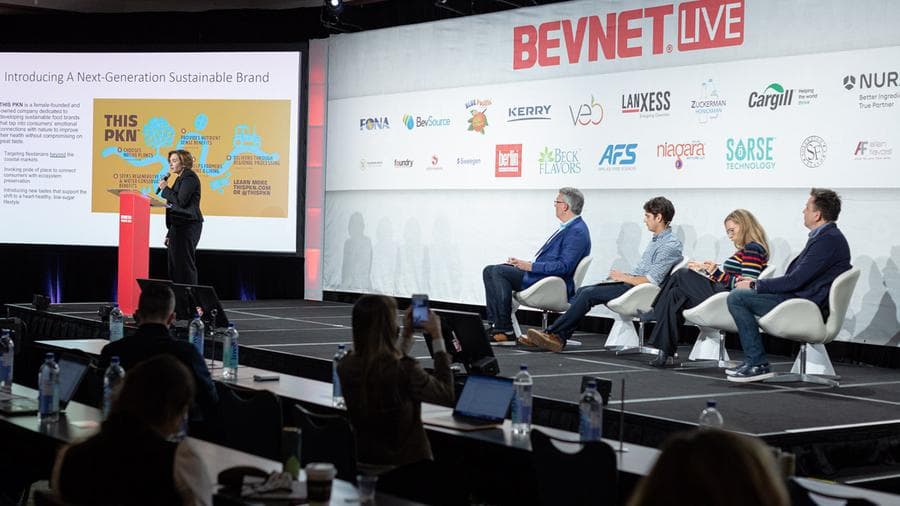
Speaker 2 [03:30] Thank you very much, Ray. So I, I wanted to thank everyone, uh, the team, uh, behind me is very excited to be getting feedback. We got some great comments yesterday and we're looking forward to hearing comments today. I wanna get a call out quickly. How many people here are from Texas? Nobody. All right, so I'm gonna make some references and we can check them afterward. Anyway, I wanted to start off. Answering a question from yesterday. When humans first walked the alluvial plain of the Mississippi more than 8000 years ago, there were already lots of plants and bees and bugs, uh, and animals, and there were pecans, and those pecans have an understanding of the great heat waves and the great droughts that will be important as we go forward into the future. Uh, those native plants are an anchor that will enable, enable us to continue to produce food. So we've named our product, uh, uh, with a 21st century turn on the word pecan, which is the Native American term for, uh, nuts for, uh, pecans. This pecanan. The story starts with me as uh a consultant and entrepreneur working in water and natural resources looking at water preservation. The places included Texas and we were struck by the potential for pecans. The the trouble is that in terms of pecans, farmers need a reason to want to get into regenerative farming to think ahead years and decades. Over the last 18 months, we've put together a team of dedicated female founders who come from incumbents in CPG as well as startups, uh, and I bring a lot of experience from both the venture capital side as well as, uh, management of startups. Our partnerships with PR firms like NAC PR, uh, the design firm 11 Creative are essential. We've been bootstrapping this and so we look toward those partners as an essential part of the team. This is our concept. You choose the right plant, you support the farmers, you find food that is nutritious and provides dense nutrition for the future, and then you look toward how you can be on top of the latest manufacturing, all to reduce the greenhouse gas emissions and environmental footprint of a product that is what you're going to be eating 40 years from now. We're targeting people who aren't tree huggers, so when you talk about sustainable brands, the thing that always used to drive me nuts was when people would say, oh dear, that's so nice that you're taking care of water. Well, what we want to do is have a a business that really makes money, that really is a mainstream product we need to hit people who aren't tree huggers. So what we're talking about are using all the elements to tug at. The heartstrings of people who aren't worried about the environment but who love specific places we've chosen Texas as a first step and we're doing something in a very maverick way we're looking at how we can launch in a place that isn't Los Angeles please forgive me, everyone, and isn't New York, but really, uh, taps into the local pride of a $25 million.25 million person market. What we see is an enormous white space. Most Americans know what a pecan is, and they love it. There's no pecan milk on the shelf with all of those other milks. Oatley, Califia, and some other great brands like nut pods have burst through and created a new generation of, uh, plant-based milks of CPG brands, but they're tied to a lot of the old identity of what a CPG is with very large global manufacturing, global sourcing, and you. Can't continue for that for the long term and we're beginning to see that on the other hand you have these handmade brands that are local favorites but they don't, they don't have the ability to last, uh, more than a few days and they're constantly running into economic issues as well as supply issues. In the middle we have a shelf stable product that is clean label and refers to a long term food that makes sense for the next 40 years. These are the specs of the product. And I guess we'll get into those in more depth, but this is a high antioxidant nut. Uh, we're planning on selling it at 599. I'm about to run out of time. I'm gonna flip through. This is the long term that we're seeing as we progress into retail.
Ray Latif [08:45] Nicely done. If you can just grab your microphone. You can slide up here with me. Thank you. So, uh, yeah, you can stand right there where the X is. Great. Um, so Laura described, uh, pecan or pecan milk as an enormous opportunity. Ken, I'm sure you've seen a lot of alt milks, uh, pitched to you. Uh, what do you think of the opportunity for pecan milk? Well, the short answer is I don't know, but it is unique. So I do like, you know, the sort of identification of the white space. Um, it's a good start. Eric, uh, Laura outlined the target consumer and a regional opportunity for the brand. Can you talk about, uh, your thoughts on both? Yeah,
Speaker 3 [09:26] no, I echo what Ken said. I think that it is a unique white space opportunity, so I applaud you, Laura, for identification there, and I do, I really, I wrote that down. I really admire your, um, your focus on the target consumer that's beyond the coastal markets. I I think that's a consumer we often forget when we're launching new products. I loved your attention there and you know I think in terms of my wonder, I think your package is really, really strong. It's very clear in terms of communicating what's in the product. I wonder if there's a way to amplify your message around sustainability and create more of a consumer problem you're solving there with your offering.
Speaker 2 [09:59] You want to address that? Sure, yeah, so I, we, I launched online with a very, um, strong, uh, social media program. Uh, we've been benefited, um, from some wonderful press coverage at the beginning. I think we have a tremendous firm of mavericks working in PR and I guess that that's the real question we need to, when we talk about customer discovery, we want the customers to discover us online, but we also need to discover them. So I guess the idea is how do you get to someone who isn't a tree hugger and talk to them about sustainability? I spend my whole life talking to these people and what we see with social media in particular is this is an enormous opportunity to listen. So what we, what we see going forward for the next year in particular is how do we learn as much as possible.
Ray Latif [10:47] Thank you. Are consumers looking for a brand like this, Maxi? I mean, do you see, uh, do you see a long runway for pecan milk?
Speaker 4 [10:54] Um, I think again, congratulations on finding something new because that in itself is, um, a good challenge to have conquered, and I do again, um, think Texas and starting somewhere else is the best way to go for it because if you can build strength there and you have your numbers and you have a lot of power to it. Um, I look at it like there's no other pecan milk out there, but why pecan? I, I, you know, there's a lot of dairy alternatives, a lot and really good ones, so I almost feel like it's like when kombucha came on the market, you have an education process or a Pom Wonderful, um, how are you educating the consumer? Why would I pick pecan over any other nut-based milk?
Speaker 2 [11:37] God bless you for answering that question that way. That was wonderful. Thank you. So I, I guess it is that this is one of those rare moments where it sells itself. I guess if you don't have a nut allergy, you probably know what pecan pie is. And we have any other questions, I think, I think it sells itself. There is, uh, uh, getting to the customer with a new product is always a challenge. So as we choose our first retail retailers, as we choose our first presence, I was listening to the story of nut pods and thinking about how we need to be very, very attentive. To those first presentations and I think you see with the with the uh with the collaterals that we've paid a lot of attention to creating an optimistic and audacious uh very American feel this is not neutral we're Americans we can't help ourselves we're not this isn't Switzerland.
Ray Latif [12:30] John, um, we haven't talked about the brand name. Uh, I'd love to hear your thoughts on the brand name this PKN and the liquid itself.
Speaker 5 [12:36] Sure, I mean, I think the brand name, you know, it's, it's one of those like, you have to think about what it is the first time, and I kept calling it this PKN, you know, I don't know if that's good or bad, but You know, a lot of brands, you know, some of the, the big ones, I mean, I remember thinking Google was stupid when I first heard it, you know, so, I mean, everything's kind of got a chance, right? Um, you know, I, I do sort of, I, I guess as far as how it rolls off the, you, you know, your tongue and whatnot, I mean, I think it's, to me it feels a little clunky having the word this in it. I have less, I have more issue, more issue with the word this as opposed to the PKN part, um. Just because it doesn't sound like something that can be like a, a Kleenex or something like that, you know, one of those brands that's ubiquitous, kind of the way oatley is, honestly, at this point with oat milk. Um, I think, you know, the liquid, you know, there's no mistaking that it's a pecan milk. Um, I didn't particularly like the stevia and the chocolate flavor. I also kind of thought that would be a sweet flavor, so I'm kind of not totally sure what you're supposed to do with it. The original like makes total sense, like quality is great.
Ray Latif [13:44] All right, we're almost out of time, but Ken, you have one more comment. And one of the first things that I asked myself was, is this a line extension for an existing alt milk player, and full disclosure, I'm an investor in Califia, or is it going to be white space? Gotcha. All right, great feedback. Great presentation. Well done, Laura. Thank you so much. All right. Up next, we have Bianca Giovanni, who is the owner of Simplicity Beverage Company. Come on up, Bianca. Hello again. Hello. There's your clicker.
Speaker 6 [14:21] Use
Ray Latif [14:21] the green
Speaker 6 [14:21] button
Ray Latif [14:22] and please mind your time.
Speaker 6 [14:23] Awesome. Good morning again. um, thank you to Bevnet for this finalist opportunity. Thank you to everyone here present in person as well as those tuning in online again, my name is Doctor Bianca Chiiovanni, and I'm the owner of Simplicity Beverage Company in Atlanta, Georgia, where we produce flavor forward distinctive tea and lemonade flavors. I've come to understand that simplicity, the target audience is an individual actually ages 18 to 20. Um, they're open to trying new concepts in terms of restaurants, beverages, things of that nature. They are calorie carbon footprint, and chemical conscious and would typically use platforms such as Instagram to stay on top of local beverage and food trends, but that's not how Simplicity started at all. Simplicity. Beverage companies started on a quest to do better, so in educating my patients what I noticed was no one took into consideration what they drank in terms of creating a healthy lifestyle, only what they ate myself included, so that led me on a quest to self formulate in my own kitchen my unique tea and lemonade flavors. Those flavors are basil breeze, which is our premium basil lemonade, where a 16 ounce bottle comes in at 100 calories. Guava goodness, I did change the name, it's not Guava goddess, shout out to GT's kombucha, um, where a 16 ounce bottle actually comes in, it's kinda cut off there at 180 calories. We also have fulfillment, which is premium mint infused green tea, which comes in at 120 calories and Island time, which is our tropical flavored hibiscus tea, which is 130 calories per 16 ounce bottle. And so when I was doing my focus groups and beverage tastings around Metro Atlanta, and I can't lie it was very easy and low hanging fruit to sample my patients as my focus group, um, I kept getting the same question over and over again how is this good for me? What does this do for me? How does this benefit me? And so that repeated question allowed me and and led me to create the droplets of knowledge and the droplets of knowledge are printed on the front of each simplicity bottle and what that is are little healthy factoids about the potential benefits of what's in the bottle never intended to be medical advice or medical direction. I like to consider it a micro dose of education so that again consumers can be more cognizant and aware of what they are putting in their bodies. Throughout the weekend learning here at Bevnet I've learned a new term, the term functional beverage. I'm very familiar with functional medicine, but I didn't even know what a functional beverage was. Companies are adding things like adaptogens, botanicals, amazing products to their beverages, and I understand that simplicity is not a functional beverage. I like to consider it a beverage with multiple functions, and what I mean is for those of us who maintain a healthy lifestyle, sim. Simplicity products can be enjoyed as a treat or an indulgence, but what about the individual that's on the cusp of getting on medication who understands that they need to start making some better choices immediately or the trajectory of their health could be at risk. So simplicity could also be seen as a tool to help people start to make more cognizant and again more healthier beverage choice options. I took a very, very, very unique approach to entering the market. A lot of people, their goal is to get into big box retailers, stores, things of that nature. I took a D2C approach and actually launched Simplicity on online food delivery platforms because we all know that food delivery services exploded within the past year and a half. So currently you can. Find simplicity on Uber Eats, Postmates, DoorDash, Grubhub, as well as two ghost kitchen concepts in Atlanta which are 4th Street Eatery and Oak Street Eats. And at those two ghost kitchen concepts, I'm actually the only beverage option that's offered. So based on the algorithms, you kinda, if you're looking for something to drink, you kinda have no choice but to choose the simplicity product. We're actually each 16 ounce bottle currently the SRP or the suggested retail price is $3.99 and we currently offer a Simplicity sample pack which is a 44 pack, one bottle of each flavor so people can understand which flavors resonate with them and what they choose to purchase in the future. Um, my vision for Simplicity, of course, is to increase the distribution footprint, you know, regionally and of course nationally. Do I understand that we're not a functional beverage? Am I here to solve all the health issues? I am not, but as a doctor, do I firmly believe that this could be a strong contender for someone looking to make clean, healthy options? I absolutely believe it does. Thank you.
Ray Latif [19:24] Well done. Let's slide up to the X here. Thank you. Uh, Eric, let's start with you. Bianca talked about simplicity as having an opportunity, having an opportunity to be a tool and a treat. Do you see it that way?
Speaker 3 [19:36] Yeah, so I applaud, um, simplicity for a lot of, um, aspects of the presentation. So thank you for sharing that with us. I think, um, you know, it's really interesting you didn't know about functional beverages until this week. I think that's a really nice lightning that you've stumbled upon and to, to find the term this week, I think is pretty impressive. I think your product smells beautiful. It has a nice aroma when you open it, and so it really kind of sets that taste expectation from the onset. I think, and I love hearing about your route to market. I think that was such a novel approach because the functional beverage industry is quite large and crowded, and I think You found a nice way to reach your consumer there. I, I question if you start to scale with the current package, I think it's gonna be hard to communicate that treat in the current package. So I think you probably found something on the D2C route, but I wonder how that scales to brick and mortar retail.
Speaker 6 [20:26] Um, because we're new to market, that's another reason why I actually came to Bevnet. I know for a fact I don't know everything about distribution, so I'm really leaving myself very open and flexible to learning, um, so that I don't go in very rigid and that, you know, if I find an option that's gonna be suitable for us, I'm 100% for it.
Ray Latif [20:45] Maxi, uh, what do you think of Bianca's presentation? Are there any questions, concerns that you have with what she brought up and, and the information that you shared?
Speaker 4 [20:52] Um, so the two things, just congratulations for launching this and seeing your patients and being motivated to help. I appreciate that, um, and the online, um, food delivery, uh, exclusivity, genius, completely genius, and any kind of data you can garner from that will be unbelievable who actually ordered it. Um, my question though is, is I know calorically you're trying to stay at a certain level and you see like the other brands here, the sugar's really high and so what is your position on that?
Speaker 6 [21:25] Uh, my position currently is just getting feedback from consumers, um, right now like per, uh, just for example, I checked this morning, um, we have nothing but 5 star ratings per Uber Eats, um, but again with my co-packer who's based in Atlanta. Atlanta my HPP facility is in Atlanta, so it leaves me very flexible to make immediate changes. Um, um, my co-packer is actually open to doing very small runs so because we've just started producing, he's open to making any changes as the market deems appropriate.
Speaker 4 [21:54] That's a huge win to have a co-packer like that.
Ray Latif [21:57] Yeah. Yeah, let's talk about the label front of pack. Uh, Bianca, Bianca talked about droplets of knowledge. John, what do you think of that approach?
Speaker 5 [22:03] Um, well, I think, you know, as far as the package goes, just looking at it as, you know, a person who's seen a ton of beverages, it looks a lot like a cold pressed juice to me. Um, and I think that's kind of the wrong positioning for this type of product. Um, you know, I think similar to what, you know, Maxine said, like, you know, the sugar is going to be an issue, and I think, you know, you can solve that either with like, you know, a smaller package, uh, or you can do the, you know, age-old, uh. Add water, you know, margin goes up. It's a good deal. But, um, you know, I think that that will be something like as you expand that you'll, you'll need to deal with. I mean, the flavors that you've created are, are tremendous, um, you know, I think it's definitely a super tasty product. It's just gonna be how to really scale that, um, and I think that seems like the most, you know, obvious solution or, or thing you need to work on at this point.
Ray Latif [22:55] Yeah, let's stay on scale. Uh, Ken, what do you think about simplicity as a, as a scalable proposition? I think there's a couple of things to talk about straight away. One of them is how the label would be faded out by putting it on retail shelves. It just doesn't pop. Secondary messaging, I think, is your romance copy should not be wasted on that valuable front panel. You need to take really succinct messages and make them bolder. Your romance copy that you've got all those droplets of knowledge, gotta be on a side panel, has to be on a side panel in my opinion. Um, the other thing is, I, I appreciate the fact that you. Understand the term functional beverage the way your product is today. It's a refreshment beverage with some functionality. I mean, it's just, you have to lean in on one or the other, in my opinion, and the way you are right now, the product's delicious. I mean, it does not taste like hogwash. I like island time. It is really delicious. If I had vodka, I wouldn't be sober right now on stage.
Speaker 6 [24:00] Let's talk about that
Ray Latif [24:01] later. Yeah, much later, much later. Well done. Oh yeah, I'm on,
Speaker 6 [24:06] I'm still on Eastern time. I'm sorry. Excuse me.
Ray Latif [24:08] All right, Yako, very well done. Thank you so much. Thank you. Right. I knew we'd get a vodka call out at some point in this more this. All right. All right, our last finalist for this part, uh, part one of the Newburg Showdown final round is Autumn Kendrick, who is the chief marketing and ideation officer for newbies. Hey, Adam. Hi. Perfect.
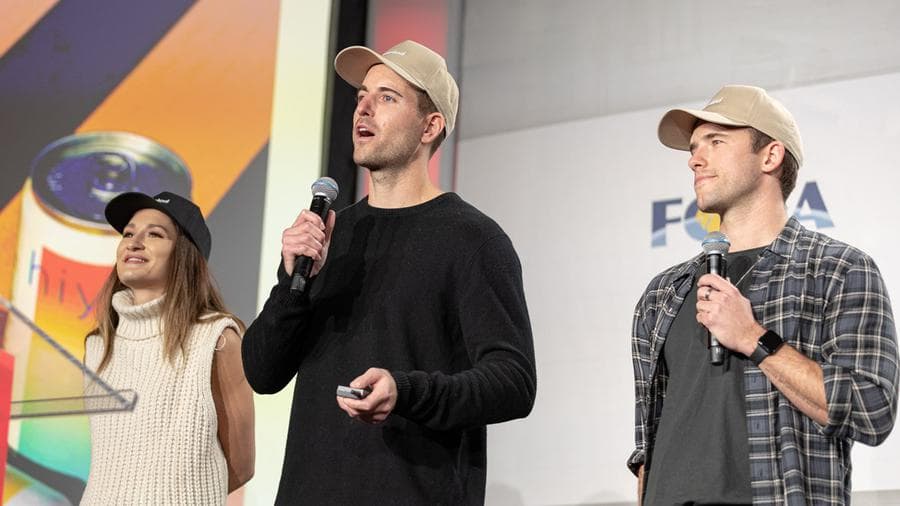
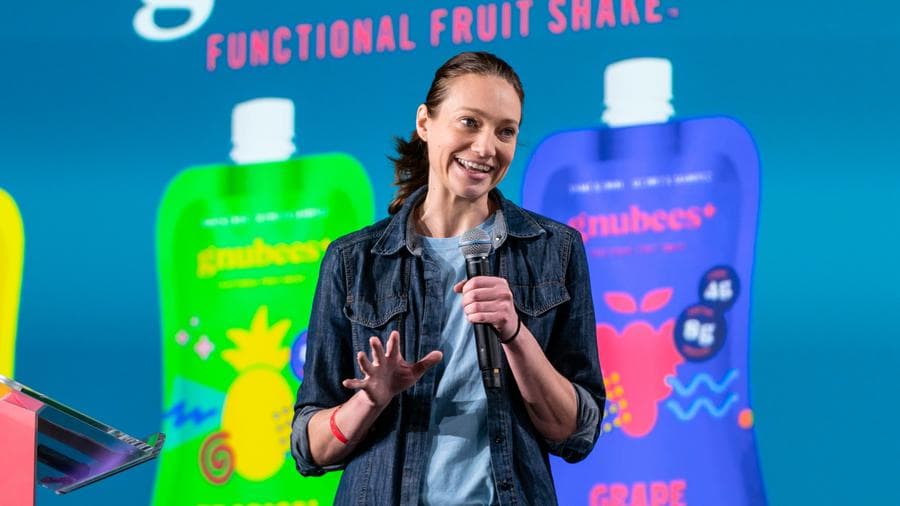
Speaker 4 [24:39] Hi, I'm Autumn Kendrick from Newbies, and I'm so excited to be back here and sharing more with you about the Newbies Plus story. Let's do a quick review. Newbies Plus is a functional fruit shake designed for busy families. It's dietitian and picky eater approved, has 8 g of grass-fed protein, 4 g of soluble fiber. That means no sugar peaks and crashes, plus 30% of daily vitamin C and D. It's made with coconut cream and organic juices for a delicious shake experience. We're bringing functionality to the kids' market and then all in an eco-friendly pouch. Let's talk pouches for a second. OK, so taking care of the planet is really important to us. We did our research and found that flexible pouches were the best alternative packaging. They waste less water than glass by 1,200%, use less energy than aluminum by 75%, and 5 times less material than other rigid containers. OK, so how did we get here? Let's talk story. So we're actually part of a bigger group called Catalyst. That's a fully integrated beverage development company specializing in formulation and small-scale pilot production. I'm the owner's daughter, and Newbies Plus is my first creation. When a family friend was struggling to get their daughter to enjoy any sort of meaningful nutrition, our founder Ron Kendrick helped them out, got to work, and created the first version of what has become newbies. And we got our first newbies kid. Looking to store shelves, we discovered there was an opportunity to be a category disruptor. And it was time to get to work. Let's take a moment. Yesterday, the judges commented on the Newbies Plus side. I'm excited to address this, this, this strategic choice. You see, Newbies Plus has a sister. Newbies. It's targeted at the younger age group of 3 to 9 and just 6.5 ounces. What we had was a growing community of fans that were aging up and still wanting their newbies. But not that kitty packaging, so we saw an opportunity to expand our portfolio and fill this demand, creating newbies Plus, and we were excited to find out that there was an even bigger market potential here. And since launching late this summer, we've had vastly greater sales than we expected, and we've even won the BC Food and Beverage Product of the Year, not new product, Product of the Year. OK, so, Let's talk activation because let's be honest, kids' products is a hard market and there's a lot of big players, so we've utilized a couple of interesting channels one digital activation. Driving awareness and trial through social media and in our e-commerce store direct to consumers has allowed us to provide trial and even build loyalty with our subscription program. We've also utilized activity cafes. There's a lot of them, by the way, climbing gyms, laser domes, bowling centers, play cafes, and we've directly hit a captured audience with awareness and gained some of our biggest fans, soccer dads, and hockey coaches. So This seating approach has allowed us to hit retail, traditional, and the growing delivery grocery market. So price point. At 299, which is 379 Canadian, our price point, we found it to be a sustainable sweet spot. We acknowledge that functional high quality ingredients cost more, but this price allows us to still be competitive in the market, providing 40% to retailers and margins for our team with Unify Canada. We're currently in about 130 locations and quickly approaching 300 doors. What's next? Well, we're coming to the US and super excited about it, but recognize that it needs its own strategy. We're looking to go to natural retailers, reaching opinion leaders that are looking for delicious nutrition in an eco-friendly pouch and e-commerce. So we know kids' beverages are a difficult market to penetrate, but we believe we have the right proposition, differentiation, economics, and activation plan to win. Even a small share of this category will deliver great success. We're thinking big and ready to win.
Ray Latif [29:44] All right, great stuff. Uh, Max, let's start with you. Uh, Autumn talked about, uh, a significant white space for a product like Newbies. Um, did she convince you?
Speaker 4 [29:55] I have an 8 year old at home. Um, who, honestly, I don't, he, it wouldn't be cool for him to do a pouch. So I'm wondering how are you tackling that in terms of it is, I know you've got the plus, but it's still, they're still sitting there like using a pouch. So we have some fun ways that we do that, um, we're being at soccer games and everything like that we have. Kids that we highlight the durability of it, so they kick it around and then a parent, a lot of the parents are just loving it because it packs down to nothing. So there's no concern of them throwing them in the hockey bag or anything like that. And as more and more pouches are coming to market, you're seeing Klondike do a drink with it, you're seeing teas in it, you're seeing the sports people having more and more pouches. It's been a struggle, no doubt, but it's becoming an. Accepted format and we're not getting that same pushback, especially this year with Newbies Plus. OK, so if body armor comes out with a pouch or gold, we're, we're gold, we're set, but it is growing. It's been a struggle, especially with newbies and the younger kids, um, but newbies Plus, we've really seen a bigger approach.
Ray Latif [31:02] OK, awesome. John, Autumn mentioned soccer. I didn't, so you can't keep dropping me off the stage. Um, kids soccer, kids soccer, right. Uh, let's talk about the taste. Obviously, you know, this product is for kids, but, uh, what do you think of the flavor and the taste of newbies?
Speaker 5 [31:15] Yeah, I mean, the, the flavor is great. Um, you know, I think I really like the coconut aspect to it, um, you know, I guess kind of looking at, you know, the name of it and what was on the pouch. I, I sort of felt like I was going to find something that tasted overly functional, like, that's kind of what I took the plus to be, um. You know what I mean, it's really hard to, to not harp on the pouch though. I mean, I think that's, you know, even just you had to explain like the why. I mean, it just, it's gonna be complicated and, you know, it's certainly limiting the use occasions, so. You know, I think that's, that's just gonna be the challenge, you know, if you could put this in like a bottle today and a pouch, you know, down the line like that might, you know,
Speaker 4 [31:59] we actually did research, um, with our loyal fans and consumers and reached out to them and we're like, would you like us to be in other packaging, and we list them and we talked about what they liked about the pouch and we had 98% of those consumers come back and say we like that you're. In a pouch you wouldn't want to.
Speaker 5 [32:15] Yeah, I mean, the people who are buying it for sure like
Speaker 4 [32:17] no, but that was also to others because there was a convenience factor. So there was a blind question. So yeah,
Speaker 5 [32:22] and again, I'm not saying this. No, absolutely,
Speaker 4 [32:25] and it's, it's a growing avenue of packaging. So we get that a lot and are always happy. Are,
Speaker 5 [32:31] are you launching the newbies line in the US as well or just newbies
Speaker 4 [32:35] Plus? Uh, we'd like to launch both newbies. Plus has the bigger market opportunity we've found and a taste profile that's just really exciting people. We purposely don't want it to taste functional, you know, you're having picky eaters as kids. When it tastes functional, they're not coming back to you and asking for more. Yeah,
Speaker 5 [32:52] I guess just one last comment. I, I feel like there might be maybe a better way to differentiate the two so that it's more clear that like this line is for an older consumer like. I looked at it and it very much like we immediately were talking about like the go go squeeze uh applesauce, you know,
Speaker 4 [33:08] so absolutely and we're looking at that with newbies for sure cool.
Ray Latif [33:14] As Autumn talked about, kids' products, really tough. Uh, Ken, uh, do you see a runway for newbies, uh, within this tough kids' beverage category? It's hard for me to draw on my inner nine year old right now, I'm saying, um, but I, I did like the viscosity. I thought it was interesting, you know, maybe that cuts through the clutter of what the competitive set is. I think there's um certainly some callouts like if the coconut has MCT oils, I mean, I don't know if that's a satiety thing. Is that too much to introduce to a 9 to 14 year old? Not sure, but the, the liquid tastes good and the viscosity is interesting.
Speaker 4 [33:57] Thank you. And on the coconut that also came from feedback of our consumers growing up and having lactose issues, so we wanted to give an alternative that didn't have lactose in it.
Ray Latif [34:07] I'm just intolerant, not lactose. Um, Eric, let's, uh, wrap up with you. Um, in terms of the go to market strategy for the US, can you comment on that?
Speaker 3 [34:17] Yeah, you know, I think, um, it's, I, I think, I think a lot of what we've been talking about is the pouch, you know, and I think it was interesting to hear your defense of the pouch in terms of sustainability stats. I guess one question I had is the pouch actually recyclable itself?
Speaker 4 [34:31] So it's a recyclable 7, which is recyclable in Canada. We're working to get a recycle. And we're also working at other avenues to really stay true to that eco footprint and always open to whatever technology is coming. So for us, it's had that beautiful convenience factor and being able to stand our pillar of eco-friendly. Awesome.
Ray Latif [34:50] Thank you. All right, we're out of time, but well done. Thank you so much. OK. I really enjoyed all those presentations. Well done once again for all three finalists.