Search across the BevNET CPG Media network including BevNET, Nosh, Brewbound, Taste Radio, Nombase and CPG Jobs.

How To ‘Rethink’ Food Insecurity, And More From Our NYC Meetup
Show notes:
Cole Riley, VP of Engagement and Partnerships at Rethink Food, described how the chef-led nonprofit repurposes excess food from restaurants and CPG brands to combat food insecurity, having delivered over 30 million meals across NYC and Miami. Austin Rief, co-founder of Morning Brew and Oceans Talent, explained how Oceans helps U.S. companies hire vetted overseas talent – mainly from Sri Lanka – for up to 65% cost savings while maintaining high-quality work and cultural fit. Rachel Krupa, founder of The Goods Mart and Krupa Consulting, highlighted her mission to spotlight better-for-you brands through curated retail and hotel minibars, emphasizing taste, founder values, and ingredient integrity. David Segal, the founder of David’s Tea and now president of Highbeam, shared how his frustration with traditional banking led him to join and help grow novel financial platform Highbeam – a financial platform that automates finance tasks, optimizes cash flow, and provides tailored banking and credit solutions to scaling consumer brands.
Transcript
Note: Transcripts are automatically generated and may contain inaccuracies and spelling errors.
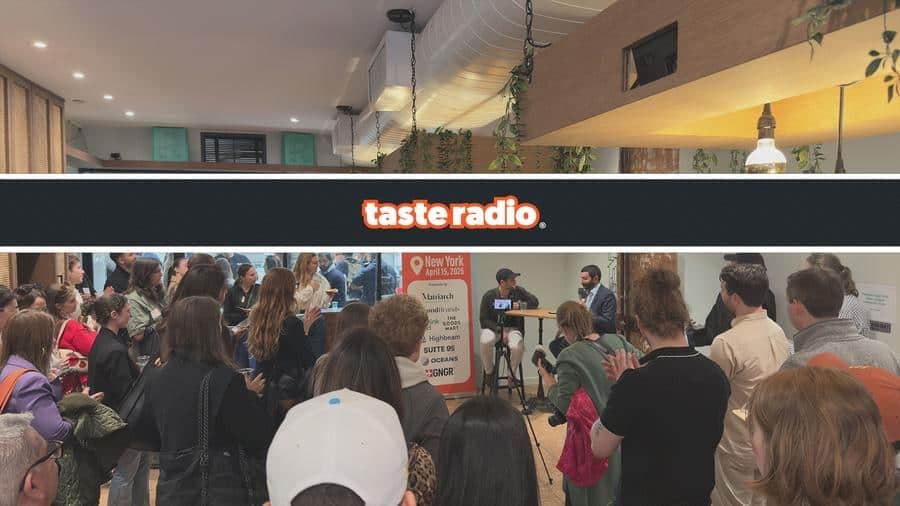
Speaker 1 [00:04] Mr. Cole Riley is the VP of engagement and partnerships for Rethink Food. He is a gentleman and scholar of the highest accord. Cole, great to see you. Cole, thanks for having me. Thank you so much for being with us. And once again, thank you all so much for being here at Taste Radio's meet up here in New York City. Thank you so. Much to our sponsors, our partners, which include Matriarch Wealth Management, Beyond Brands, Rethink Food, The Good Smart, High Beam, Suite 9C, and Ginger Labs. You are all amazing people. If you see those people from those companies here at the event, say hi because they can definitely help your business or make you feel better like the folks at Ginger Labs can do. All right, Cole, thank you again for having us here. You know, when Rachel Krupa mentioned that we should hold this event at Rethink Community Kitchen, I was like, what is Rethink Food? I didn't know much about the company. What do you guys do?
Speaker 2 [00:59] Yeah, so we're, I would say one of the more dynamic food nonprofits in the city. You know, we're a chef-led nonprofit working with the best restaurants and the best food businesses in the city, feeding communities better. And what we're doing and what we've been doing for the past 7 years is really, really incredible. We have been feeding hundreds of thousands of people across the 5 boroughs, and we also have an operation down in Miami, and we've been engaging companies and restaurants across the spectrum from brand new restaurants just launching, new CPGs just getting off the ground, to some of the largest hospitality groups, some of the largest. Strategics getting product through the door, getting food into this kitchen, getting meals on trucks and out to communities at scale. And so over the past 5 years we have taken a whole another leap to a whole another level. And again, I really like to think of us as one of the more dynamic, one of the more scaling nonprofits in the space right now.
Speaker 1 [01:53] Yeah, and one of the things I think is most interesting about Rethink Food is that You guys work with food waste, and I think there's a misconception about what food waste is, what it represents. Can you talk about your definition for food waste?
Speaker 2 [02:06] Food waste could mean a multitude of things, and it depends on the business that we're working with. If it's a restaurant, it could be scraps. It could be excess Brussels sprouts. It could be a variety of different things, and that's what we have our 5 trucks on the road doing every day, doing these routes, going across the city, picking up excess and finding creative ways to Repurpose those incredible ingredients into meals for CPGs, it could be a mislabeling. It could be a production run that isn't 100% retail ready but it's perfect in every other way. Or it could be a skew that you're sunsetting, but it's still a delicious product that can find some type of impact whether it's a packaged product or something that we can turn into a meal. So excess really, there's a variety of different. Definitions and what I think for CPGs and your audience to really understand is that having an incredible social impact partner in place like Rethink Food that can be creative with your access, that's paramount. It's paramount when you're building out your brand, you should have a nonprofit like us in your SOP because we can take that product and find a creative use for it that makes an impact
Speaker 1 [03:09] and make delicious food with it. The food in your kitchen, I think everyone's tried. Has everyone tried some of the food in the kitchen? It is phenomenal. Thank you for, thank you for saying yes. Sometimes I ask these questions and no one responds. No, but I think that's the key is food waste can go a long way. It can be a great thing as long as there are participants, as long as people want to be involved. How do they get involved with Rethink
Speaker 2 [03:31] exactly? So it really just starts with reaching out to us and us understanding your needs. It could be a one-off donation at a restaurant or with a CPG. It could be an ongoing deal. But see, we, when I say that we're a chef-run nonprofit, I really truly mean that at every leadership level from the board, from our founders, from 11 Madison Park to our incredible culinary team led by Ken Baker. The chefs in this kitchen, our whole team is dedicated to finding creative ways to take packaged products, proteins, carbs, whatever it may be at restaurants and CPGs and finding a great way to use it. It starts with reaching out to Rethink Food, sending us an email and saying, Hey, how can we get involved? I assume there's
Speaker 1 [04:10] a tax benefit perhaps to this. Yeah, exactly.
Speaker 2 [04:12] So there really is, and that that tax benefit can carry forward for brands just starting up that aren't profitable and won't be profitable. for years, most likely you get that tax write-off. It's not only doing good, but it's a great business case to repurpose and find a home for these excess ingredients. We know, especially in the space with the beverage space, we know you're running through different production runs. We know there's going to be mess ups. So finding that partner like Rethink Food is paramount and yeah, there's a great tax incentive to it as well.
Speaker 1 [04:41] And I will say this just you know on a personal note, it is amazing when you do get to see the impact that you may be having. In the community feeding people who may not have access to food. I mean, food insecurity is a huge problem in this country and it's an underreported problem in this country.
Speaker 2 [04:56] Absolutely. And look, like since our founding we've made or funded over 30 million meals that have gone out to community centers that have gone out to migrant sites that have gone out to pantries and churches and shelters across the five boroughs and down in Miami and again this model powered by this kitchen. And the network of restaurants that we work with and all the partners across the food industry, that's what's really powering this incredible impact. But yeah, it's a, it's an evergreen issue and what we're trying to do is attack it uniquely, not just moving pallets around and Calling things meals we're actually for a lot of our work creating meals from scratch in this space and with our restaurant network so it's it's a really unique nonprofit that we've built here and we're really looking for more CPGs in this industry to rally around it.
Speaker 1 [05:47] Absolutely Cole, thank you so much again for all you do. This is an incredible company that I think everyone in this room, everyone listening at home. should get involved with. So reach out to Cole. Yeah, work with us. Yes, work with him. Send him LinkedIn DMs, flood his inbox. Yes, and definitely. Cole, thank you so much and thanks so much for having us here today. I really appreciate it. Yeah, thank you. You can leave your microphone there and we're going to bring up our next guest, Austin Reef, who is the co-founder of Morning Brew and Ocean's Talent. Austin, great to see you. You know, I think there's a few folks here who are probably familiar with you because you are the co-founder of Morning Brew. But you're also the co-founder of an amazing company called Ocean's Talent, and I already had a conversation with someone who uses your company. Um, let's start with Morning Brew, uh, and your history in the business media community.
Speaker 3 [06:35] Yeah, uh, I started Morning Brew at the University of Michigan. Uh, Go Blue. Uh, yeah, I don't know who that was, but Go Blue. Uh, I started it almost 10.5 years ago now. Uh, so we started it as or I was a sophomore in college, and it grew a bunch, and I did it full time after college and we sold the business in 2020. I stayed there for about 4 years and probably 2.5 months ago now I stepped down and went full time on Oceans.
Speaker 1 [07:01] Nice. Well done. You also poached one of our employees from Bevnet, just, just so you know. Sorry about that. Yeah, that's OK. It's OK. Maybe we can use Oceanstown. To fill in that role,
Speaker 3 [07:11] we could, yeah, yeah,
Speaker 1 [07:11] that's a good idea. What is Oceans Talent? Yeah,
Speaker 3 [07:14] so we are an overseas staffing firm, so we help US based businesses. A lot of CPG companies, a lot of DSC companies hire the best overseas talent. So we have a headquarter in Sri Lanka. Where we help you find the top 1% of EAs, marketers, finance folks, op folks, uh, come work full time in your business. Uh, we work with a lot of CPG and D2C companies like I said, Sanzo and uh 4 Sigmatic and a bunch of companies that I, you know, I can't say, uh, but just many, many, many, many companies in the space and the idea is you get the, the same caliber talent as people here in the US but you save 60 to 70%.
Speaker 1 [07:52] Saving money is great. Culture is really important. How do they fit into the culture of their business? How do you vet for
Speaker 3 [07:58] culture? Yes, that's actually one of the number one things we vet. So we put people through a very detailed culture screening, make sure they are notch in it for things like The money, but we really want people who vibe with the company they're going to. So we have a matching process. It's a very extensive process where we make sure you get to interview the person, they interview you back to make sure they're a great fit just like any other person you'd hire here in the US
Speaker 1 [08:24] So what specific roles do you hire for? Is it, say, finance, marketing, administrative assistants? I mean, what really Fits with the kind of service that you offer.
Speaker 3 [08:34] Yes, so our business is about 50% EAs. Another 50% are finance, so FPNA, accounting, bookkeeping, everything in the finance suite, marketing, so paid marketing, event marketing, uh, ops, and then we do 10% about everything else. So engineer, someone before was asking about a designer. We'll do designers, so we'll do a little bit of everything.
Speaker 1 [08:55] Outstanding. I think the other big question here is, you know, the reliability of overseas talent, maybe it's just me talking, seems to be not so great. How do, how do you make sure that the people that you're hiring, the service that you're offering is as reliable as having someone in the office?
Speaker 3 [09:12] Yeah, so that's actually how I got involved. Ocean. So I was running Morning Brew and I had a few experiences with some other overseas firms, you know, people in the Philippines. I had really bad experiences, really struggled to integrate people from some of these other countries into our US, you know, Western culture, and I found this guy Ian Myers, who's the CEO of Oceans, and he was starting this business, and he really pushed me and said, no, Sri Lanka's very different. Sri Lanka has this amazing culture. Uh, where it's very westernized, people even go overseas to America, to, to, to London, to the UK to study. I, I gave it a try and I was just amazed at how, how great the talent is. So I, you know, I was customer number 2 or 3, I think, and it really showed me how amazing it could be to integrate people from other countries, you know, people from Sri Lanka into the US culture. And so we had people at Morning Brew, and now we have 250 to 300 customers of people who have them. You know, in their in their business,
Speaker 1 [10:13] now I think the one question everyone here is wondering is how much is this going to save me because this is a very challenging, uncertain time for companies and people are wondering how can I cut costs, how can I maintain my business at a level that is still offering top notch quality but yet reduced costs and expenses.
Speaker 3 [10:34] Yeah, and so we're seeing a lot of that. We're seeing a lot of people reach out. Us who are impacted by the tariffs, impacted by the economy, and want to grow their business but want to lower their optbacks. And so we save people on average about 65%
Speaker 1 [10:48] 5%. Yeah, wow, that's a big number. It is. Who wouldn't want to save 65%? It's a great on their staff costs. Yeah, well done. Austin, thank you so much for being here. I really appreciate it. Thanks so much for your partnership for this event. Yeah, for sure, and reach out to Oceans out to Austin and Oceantown. What's the best way to do so?
Speaker 3 [11:05] I'll be over there so you can just come by me.
Speaker 1 [11:07] I'll be over there outside of the event for people listening at home. What's the best way to
Speaker 3 [11:10] connect? Yeah, you could just, you know, on LinkedIn, Austin Rief, just shoot me a DM.
Speaker 1 [11:14] outstanding. Thank you so much again, Austin. Really appreciate it. Thank you. Yeah, a round of applause for Austin. Fantastic. You can leave that there. Is this yours? Thank you so much. All right, Rachel Krupa, where is Rachel Krupa? Because she looks like she's hiding. She shouldn't be because she's incredible. Have a seat, Rachel Krupa. Woo.
Speaker 4 [11:32] Wow, how are you? You should be in sports.
Speaker 1 [11:36] Sports for folks who don't know, Rachel was an integral part of putting this event together. She connected us with Rethink. She has connected us with people who are supplying the bar, who are supplying some of the samples here. She is just incredible. Day and night I can reach Rachel. She hates me for doing that, but you know, I try to reach her. Do you sleep, by the way? You are so busy.
Speaker 4 [11:58] Yes, I, I don't
Speaker 1 [12:00] need
Speaker 4 [12:01] a lot of sleep,
Speaker 1 [12:01] OK, I figured because I look at your Instagram profile and all I see is work and play, a good kind of play, and it's just like work, work, work, play, play,
Speaker 4 [12:09] play. Well, in my mind, work is play and play is work.
Speaker 1 [12:14] Why is that?
Speaker 4 [12:15] Because if you love what you do every day, it's not work. And they merge so well together in the sense of food, you know, meeting founders, talking to humans on the other side of my life is the PR and so that's just meeting again, like meeting founders, learning about new things. I feel like I'm a student. Life and I love to learn things and meet people and just be inquisitive of why, how, how can I help and so it's fun.
Speaker 1 [12:43] You'd be a good podcast podcaster. Do you have a podcast?
Speaker 4 [12:46] No. Do you want me on yours?
Speaker 1 [12:47] Yes, we're kind of already on the podcast as we speak. So yeah, I didn't mention you are the founder of the Goods Mart and Krupa Consulting. Let's talk about the Goods Mart because this is a really amazing retailer. What was the origin story? What do you guys do?
Speaker 4 [13:02] We are a Better For You socially conscious convenience store where we fill our shelves with emerging brands, and that was basically the goal is how do we get these really great brands that you are trying here, everyone here, into the hands of more. People and so that was by creating a convenience store where you could find them and we vetted it for you based on taste based on founders. We're actually celebrating our 7th year on Thursday, which is wild of being in the industry for 7 years. Where is the Giz Mart? We started actually in LA, but that is our IP. The sign is still there, so please take a picture and send it to me. I like that. It cost more to. Take it down and leave it up and we're in SoHo right now so we're on Lafayette between Broome and Grand um but the biggest thing of what we're doing now is we created a new vertical that was more called curation by the Goods Mart and so we're placing again these incredible young brands into hotel minibars and corporate pantries and again it recerdifies that goal of how do we get these incredible brands in the hands of more people.
Speaker 1 [14:07] How do you source these brands? Where is a lot of people coming to you, or are you finding these brands and saying, Hey, you should be part of our platform?
Speaker 4 [14:15] All of the above. OK. And so I believe in order to be a really great at curation, you have to look and do your homework equally as much as people are coming to you. So that is talking to people, talking to founders, having been in. The PR industry from like CPG side for 15 years, 20 years kind of in the industry that you know a lot of people too, but it's talking to commissary kitchens, it's traveling, it's seeking, it's asking people and then people come to us and coming to events like this, coming to events like this where you can meet
Speaker 1 [14:45] Rachel Krupa, you know,
Speaker 4 [14:46] Benet and Osh are great. Bevnet
Speaker 1 [14:49] Nosh are great. Yes, they're just a plug for Bevnet Live coming up here in New York City June 11th and 12th. It is the event for the beverage industry. If you haven't already signed up, now is the time to do so. So when you talk about vetting brands, what is the vetting process? I mean, is there specific things you cannot have in your brand? Yeah,
Speaker 4 [15:06] for us everything is non-GMO, no artificial flavors, no preservatives from a baseline. And then everything then is based on taste, based on founder, based on like ingredients. So like if the ingredients, say we were just talking over here, if you have ashwagandha, do you have enough ashwagandha to actually make it like efficient and you're actually making it useful if you're functional? How much
Speaker 1 [15:29] ashwagandha does it take to make something functional? Oh,
Speaker 4 [15:32] see, I knew you were going to ask that. Where is I know, but in the product right here, Joy.
Speaker 1 [15:38] Oh,
Speaker 4 [15:39] Zenjoy Zenjoy delicious product. How many?
Speaker 1 [15:44] How many we're doing crowd work.
Speaker 4 [15:46] 150 150 mg. Look at this. This is crowdsourcing. Yeah,
Speaker 1 [15:51] I mean that that sounds like a pretty high number,
Speaker 4 [15:53] right? Yeah, but sometimes you don't have like enough from a standpoint of just being efficacious and like I just love asking that question of like what do you have? Can you feel it because if you're spending more money on a premium of having a functional ingredient like you want it to do something for you. Yeah,
Speaker 1 [16:08] absolutely. Now I love when brands get their start in small retailers like yours because they can develop a lot of learnings. They can try to figure out what's working on a really small scale and apply those learnings to a bigger retailer. How do people do that? What are they learning from the goods
Speaker 4 [16:24] mart? A little bit of everything of packaging. We are working with another organization right now in the sense of like. Insights group where we actually talk to 150 people of like what do you think about packaging callouts on packaging like does it attract you? do you know what actually it is like one of the biggest things I always love is like I love Hector from Tia Lupita and remember it was cactus tortilla chip. But people didn't know what cactus tasted like and so now it's changed to just tortilla chip and cactus is secondary or I think 3rd on like the packaging. So it's actually having callouts that attract you and then bring you in once you are a big fan and a lover of it, you know. Yeah,
Speaker 1 [17:10] I mean cactus doesn't. That necessarily sound like the most appetizing thing and I think, yeah, but I mean you know founders might want to say we just want to be transparent about what we're doing, but transparency and marketing sometimes don't go hand in hand. Yeah,
Speaker 4 [17:22] and I think it's just packaging is really once you see it on the shelf, you know how it stands out. One of the biggest things I always like to tell founders is like go bold when you're coming into our store your first iteration. You're going to have to change it 2 or 3 times. So why make it look like a mainstream standard product on a shelf? You're going to get there 100%. You're going to have to have an apple, you know, watermelon, a hibiscus plant on the cover, you know, you're going to need that. But like at first, like stand out, what is going to make someone grab it's going to be packaging first. So Ruby hibiscus, I think, did it really well at first, and then you can see in future iterations like he had to change it a little bit,
Speaker 1 [18:03] yeah. Rachel, once again, thank you so much. For folks who are in this room and haven't met Rachel personally, you should. I'll give you some hand sanitizer later, don't worry, but you should definitely meet Rachel because she is incredible. She's brilliant. She knows everything about this industry inside and out, and she is a resource like no other. So I hope I didn't say too much there, but
Speaker 4 [18:22] Well, I will also plug you Bevnet Live was also one of my favorite events to attend and talk to founders and do the one on ones that it's just really great to actually have people ask questions and really take that feedback to heart, and I have a handful of like the brands that I met there in our store, and they also took that feedback and changed it, and it's actually making them do so much better.
Speaker 1 [18:44] Yeah, and you're going to be there once again for ones and not just Rachel. We're going to have folks from Whole Foods who are attending. And are going to look for brands to put on their shelves. So if you want to meet with Whole Foods buyers at Bevnet Live, you've got to register. You've got to sign up, and of course you have an opportunity to meet Rachel once again. Rachel, thank you so much. This is so great. I really appreciate it. Thank you so much. Thank you. You just leave your microphone there and our last interview guest for this event is David Segal. Come on over, yeah, have a seat. David Segal is the president of Highbeam. David, great to see you. Thanks for having me. Did I pronounce your last name correctly? You did. Well done. It could have been Segal.
Speaker 5 [19:22] I prefer sounding like an action hero, but unfortunately that wasn't in the cards for me. High
Speaker 1 [19:27] Beam, thank you so much again for your partnership, your support of this event. Really appreciate it. I know when people hear Highbeam they think cars, but high beam is not that. What do you guys do? Well,
Speaker 5 [19:37] a little backstory. I actually came by quite honestly. I started as a customer, so I built a brand called David's Tea from 0 to $200 million in sales, 20 stores,
Speaker 1 [19:46] you're the David, yeah, amazing. Yeah, David's Tea is an incredible brand.
Speaker 5 [19:50] It was, it was a great ride. I took it public, sold it shortly thereafter. We had 200 stores across Canada, the US, and went on, did a bunch of other things. One of my new businesses, many years later, I got fed up with my bank. I was getting 0% interest, 0% yield on any of my idle cash, no intelligence on my data, clunky software, bureaucratic service, and I discovered Highbeam and I was blown away. All we do is consumer brands, between $1 million and $200 million in sales, and they turned what was, you know, I had a new brand called Firebelly Tea did a few million bucks and we were growing, and they turned what was costing me money into a profit center, and I was so impressed that I called up the founder. And I'm like, this is amazing. He goes, look, you built a nine-figure brand. Why don't you invest and become an advisor? And I did. And I found myself, I, I loved it. Like I, I got to be around brand builders all day long and, and, uh, and it's just the energy I love. And so we ended up forexing the business. We have several 100 customers, over a billion of flows, and what we do is we automate tedious manual finance tasks to save brands time and money. And we pair that with good old fashioned relationship service like you know you get people's cell phone numbers you can actually reach people as you grow and as you scale and so we tap you into whether it's lending or giving you the maximum amount of yield on idle cash or minimizing your interest expenses or bill pay or automating. I mean we just launched our AI agents. It's incredible. Like when I think about you know our vision is to have a one person finance team right like at David's Tea I had. More people in finance when we had scale than I did buyers, and I just think all that's going to change and Highbeam is leading that charge as it's an incredible product and, and yeah, I got really excited about it. Eventually, you know, the founder turned to me and says, Look, why don't you come in as an executive and and I did, and here we are.
Speaker 1 [21:42] You must really believe in it because if you took a brand from 0 to $200 million in sales and Now you're the president of Highbeam. I mean, I just think the bank, you must really believe in what you're doing.
Speaker 5 [21:52] I think, look, traditional banks have ignored this segment for a very, very long time, this segment
Speaker 1 [21:57] being the CBG industry.
Speaker 5 [21:58] Yeah, any, any type of brand, any, any mid-size brand, um, that's scaling, um, and, and I just think there's going to be a generational shift in banking and, and, you know, all your deposits are FDIC insured, so you're protected, uh, but we're just able to offer you a ton of value. Uh, that actually saves you money and time. So you, you take what is fee-driven and costing you money, and, and we're, you know, like when you think about the finance process, like the way you make decisions today on your financial stack, like it's, you get all this, there's, you're turning cash into inventory back into cash, back into inventory, and you have all these transactions coming in and out. It's hard to make sense of. You send it up to some fractional CFO. Our internal finance team, they put together these statements for you. You get them 30 days if you're lucky later, and then you're making decisions on yesterday's news, right? And I think what what AI allows us to do is we not only can we not only can Compute that that information and give you quick answers to any ad hoc questions in real time on all your intelligence, but then we, we have the banking, so we can actually link it to the money movements as well in real time. And one thing I've realized is your interest, like maximizing your yield. On your idle working capital and minimizing your interest expense. If you, if you do that by the day, it adds up. Sometimes you think you're doing it because you, you look at it once a week or once every 2 weeks. But when you really dig in and there's, and there's a system in place, and we're able to automate that treasury function for you, you, you're going to be surprised. I mean, if you're a, a, uh, you know, it could be tens if not hundreds of thousands of dollars, depending on how big of a brand you are. And so yeah, I got really excited about this. I think this is going to make a big difference. I mean all of you in this room are the backbone of the economy. I know what it's like to be in your shoes building brands. It's really, really hard to build a business, and, and I think I feel really proud to be part of a company that's, that's in your corner that's helping you. It's never been easier to start a business and never been harder to make money from it. And I think High Beam is really about helping you make money for your business.
Speaker 1 [24:02] We've got about a minute left, but I want to ask about your lines of credit because folks in this room, lines of credit can be lifelines for CPG brands, and you guys offer lines of credit. What is there collateral involved? We do,
Speaker 5 [24:12] we do Highbeam. What's great about Highbeam is you can use us for certain things a la carte or you can use us for everything from banking to credit to intelligence. On the credit side, yes, we do lines of credit. We also, uh, um, we also have credit card. We have, we have various credit card products. But even if we're not, like, we want to build long-term relationships, uh, even if we're not the right partner for your lending, you should still talk to us. We have an incredible ecosystem of lenders. We will plug you into it. We will make sure that we get you. The best products for you to help you grow your business. That's really what we're about. And yeah, whether that's our products or whether that's referring you on to someone else and still handling your banking and intelligence.
Speaker 1 [24:50] Highbeam.co. Highbeam.co. That's the website you guys all should check it out. David, thank you so much for being with us. Really appreciate it. Thanks.