

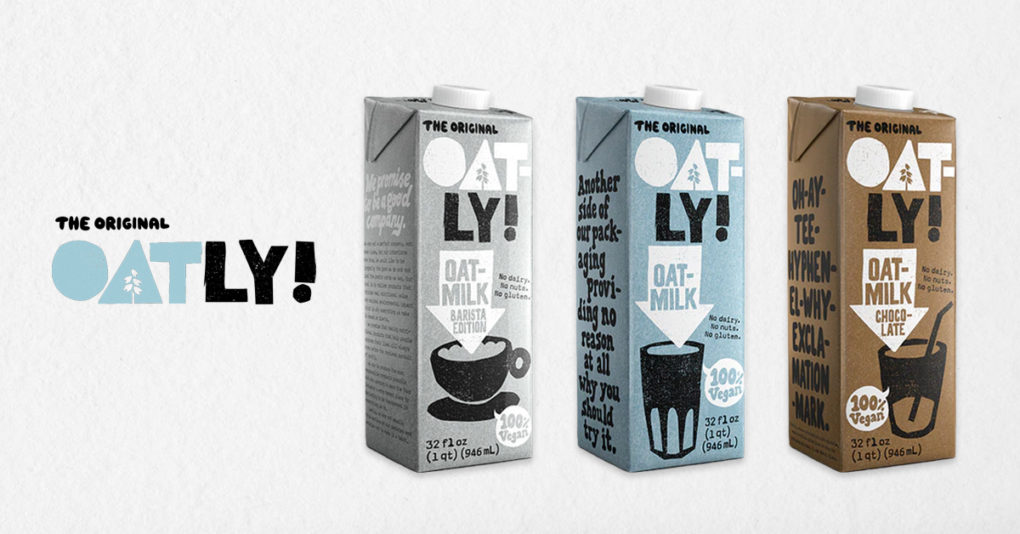
Oatly CEO Jean-Christophe Flatin predicted that the Swedish plant milk business will have its first year of profitable growth since going public in 2025, praising the company’s efforts to improve its supply chain and overhead structure during its Q4 and full year 2024 earnings report this morning.
Oatly reported Q4 revenue growth up 5% to $214.3 million, with North American sales contributing $70.6 million to that total (up 7.1% year-over-year). North America volume sales rose 5.1% to 41.1 million finished goods sold, attributed to strong performance in both retail and foodservice, with the brand’s barista line in particular helping to fuel the momentum.
In the U.S., Oatly increased its retail share by 6%, while the broader oat milk category saw share fall by 4%, the company reported, citing NielsenIQ data.
“We now have a much healthier business with clear strategies, clear accountability, stronger margins, and significantly improved profitability,” said Flatin in a statement. “I am proud of our team for embracing the challenge, making the necessary changes, and focusing on execution. All this hard work has enabled us to now expect 2025 to be our first full year of profitable growth as a public company.”
Flatin attributed the strong outlook – which prompted a more than 6% surge in the company’s stock price in pre-market trading this morning – to the company’s yearslong effort to rein in its supply chain and downsize operations.
The proclamation arrives almost four years after Oatly first issued an IPO on the public markets, and quickly saw itself the target of a stock shorting report that advised the company “will never achieve profitability.”
Addition by Subtraction
Over the past three years, the company has reduced its production locations from six plants with three in development to just five operating today, limited liquid capacity to 900mm liters, cut headcount from over 2,000 to roughly 1,500 employees, and lowered capital expenditures from over $200 million (roughly 40% of revenue) to an expected $30 million to $35 million this year, or about 4% of revenue.
The company also projects constant currency revenue growth of 2% to 4%, with adjusted EBITDA of $5 million to $15 million.
“When it comes to mindset, as profitable growth is our north star, we now make deliberate margin-focused decisions about channels, customers, and products,” Flatin told analysts and investors on the earnings call. “We have also augmented our approach to marketing to focus on relevant and integrated brand activations.”
Tackling “preconceived notions on taste” and “nutrition misinformation” will be two pillars of the company’s messaging this year, as it looks to combat perceptions that its oat milks are unhealthy due to sugar and seed oil content.
The downsizing effort has come as revenue stays high, reporting $824 million for the full year 2024 with a gross margin of 29%, up from $783 million and 19% gross margin in 2023.
Oatly has also focused on improved performance on the ground, touting 99% fill rates last year after years of supply strains causing frustration and lost revenue for the business.
“We will continue increasing our relevance, aggressively attack the barriers to conversion from dairy, and increase the availability of our products to both new and existing consumers,” Flatin added on the call. “As we are igniting this category momentum, we intend to continue our aggressive pursuit of cost efficiencies. Over the last two years, we have built a strong efficiency muscle, and we intend to flex that muscle in 2025 again to drive margin expansion, simplify for speed and impact, and provide further fuel for growth-driving reinvestments.”
During the call’s Q&A portion, Oatly COO Daniel Ordonez noted that in the U.S. new distribution opportunities will help to create growth, but that “this year’s new distribution will hit a little bit later than last year” with expectations of “a brief blip in the lapping periods between one year and the other.”
As well, discontinued innovations like its oat-based frozen desserts and cream cheese have created some drag on U.S. earnings, to the tune of 400 to 500 basis points.
“We see solid consistent velocities of our core portfolio, milks and creamers in both units and dollars,” Ordonez said. “While we register highest-ever dollar shares in plant-based milk and oat milk in the recent period and in the longer term, we expect that with the upcoming incremental ACV … we should be maintaining the steady growth trajectory that we have posted so far.”