

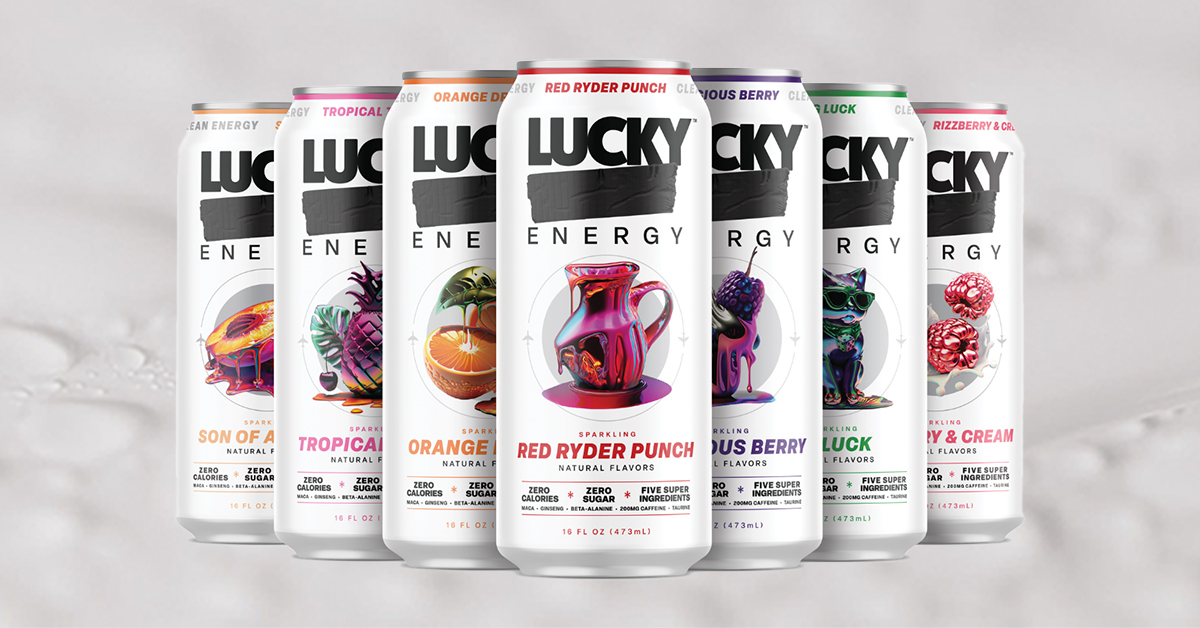
Clean ingredient energy drink maker Lucky Energy has secured a new tranche of growth capital as it looks to double down in key markets while broadening its team.
The $14.2 million Series A1 round, led by new investor Maveron with backing from DMG Ventures, Second Sight Ventures, Imaginary Ventures, Sapphire Sport, Brand Foundry Ventures and Sugar Capital, brings the brand’s total investment to over $40 million. The round marks Maveron’s first investment in an energy drink.
“First and foremost, we back people. I think Richard is a genius formulation person and a genius branding person. An energy drink that has zero calories, no sugar and tastes damn good with incredible branding and an incredible story has a lot of potential,” said Dan Levitan, co-founding partner of Maveron.
According to Lucky Energy founder and CEO Richard Laver – who also founded medical-grade meal replacement brand Kate Farms – the brand’s ability to attract a significant amount of capital early on indicates “there’s a real belief we’ll get to profitability relatively quickly.”
Launched in 2023, Lucky Energy produces a line of energy drinks in six varieties: Son of a Peach, OG Luck, Red Ryder Punch, Tropical Thrill, Orange Drizzle and Bodacious Berry. Each 16 oz. can contains 200mg of caffeine and features maca, ginseng, beta-aline and taurine as active ingredients.
Lucky’s products are currently available in approximately 10,000 doors nationwide (including 7-Eleven, Circle K, and Speedway, among others), and the brand has signed 110 DSD contracts to date. By the end of the year, the brand anticipates being in 15,000 to 17,000 doors.
“It’s an opening in DSD that never existed even five years ago, so you have to take advantage of that. This is a road to a master service agreement and I think that the name Lucky Energy is widely adopted now, it’s been de-risked [since re-branding from Lucky F*ck Energy],” said Laver.
The new capital infusion will help ensure Lucky has boots on the ground in key markets like New York City, Boston, Texas, Southern California, and Seattle while attracting “the best teammates.” It will also be deployed to support the brand’s disruptive marketing efforts like its recent “Shangry” campaign, which highlights the importance of a clean ingredient deck.
“To be able to move into markets with pure intention and win the hearts and minds of people is a relatively expensive endeavor,” said Laver. “Being able to deconstruct the energy drink to a place where it can perform and give us that superior gross margin business story [is huge].”
The brand has also added Dan Ginsberg, former CEO of Red Bull NA, to its board of directors.
“Richard’s story is unique. Indeed, he’s the luckiest person I’ve ever met. That, coupled with the efficacy of a cleaner label with great taste, sets up the brand to outperform the category,” Ginsberg told BevNET via email.
Standing out in the saturated energy drink category is no small undertaking. In the 52-week period ending December 28, category dollar sales climbed 6.8%, according to an analysis of NIQ data by Goldman Sachs Equity Research. Volume was also up 4.5% as pricing growth remained consistent at 2.2%.
Though Lucky “censored” itself by removing “f*ck” from its packaging to balance its branding with mainstream sensibilities this year, it’s still finding a way to maintain its edge in the category by focusing on three main pillars: motivation, mischief and mayhem. In the near future, the brand will continue to build up its motivation pillar with campaigns featuring former NBA number one draft pick Greg Oden and boxer Butterbean.
“We’re grateful to have this opportunity where we’re in a run to the growth phase of business, the inflection point. It’s a bit of a cautious celebration. Getting here is really fun, and the fact the world has said we deserve to be here is a great moment,” said Laver.