

Celsius shed some more light yesterday on its now-finalized acquisition of Alani Nu, though further details on distribution were notably absent.
The Florida-based company was already the third-largest player in energy drinks prior to its $1.8 billion deal to secure Alani Nu from Congo Brands in February. Now the combined entity has plans to both capitalize on synergies and expand further while giving each brand space to cultivate its own identity, per a brief presentation and Q&A session with investors by Celsius CEO John Fieldly and CFO Jarrod Langhans on Wednesday afternoon.
Here’s what we learned:
- The combined entity is heavily leveraged in energy drinks (91%); the second-largest segment is stick packs (4%), followed by shakes (2%). On a pro-forma basis, the combined portfolio generated around $2 billion in revenue in 2024.
- 50% of total year-over-year energy category growth came from the two brands, which now represent a 16% dollar share, per Cicana data through this February. That’s well ahead of its nearest challenger (C4 at 3%) but still far behind leaders Red Bull (37%) and Monster (28%).
- Alani Nu did $605 million in net sales in 2024, and increased adjusted EBITDA margin by 15%.
Making the Transition: The deal officially closed on April 1, but Alani’s full integration into Celsius will take place over the next 24 months, executives said. That includes a 12-month transition services agreement with former owner Congo Brands to provide support
The company is projecting around $50 million in cost synergies to be achieved over the next two years, most of which will come through consolidating head count. That process will start in Q4 2025 (potentially $5 million to $10 million, depending on timing) and ramp up the following year, hitting around $4.2 million per month by April 2026.
“We will utilize the hundreds of commercial team members that we have to absorb a majority of the business across sales, merchandising, key accounts, field marketing and other areas,” said Langhans. “In addition, we will utilize our ecomm and media platforms and back shop to absorb various roles and costs.”
At corporate level, both brands will maintain separate marketing teams in order to maintain their unique respective voices, said Fieldly. While creative and social decisions will be made separately, the company will combine things like field marketing and media buying, with teams moving from “one activation one day and a different activation the next day.”
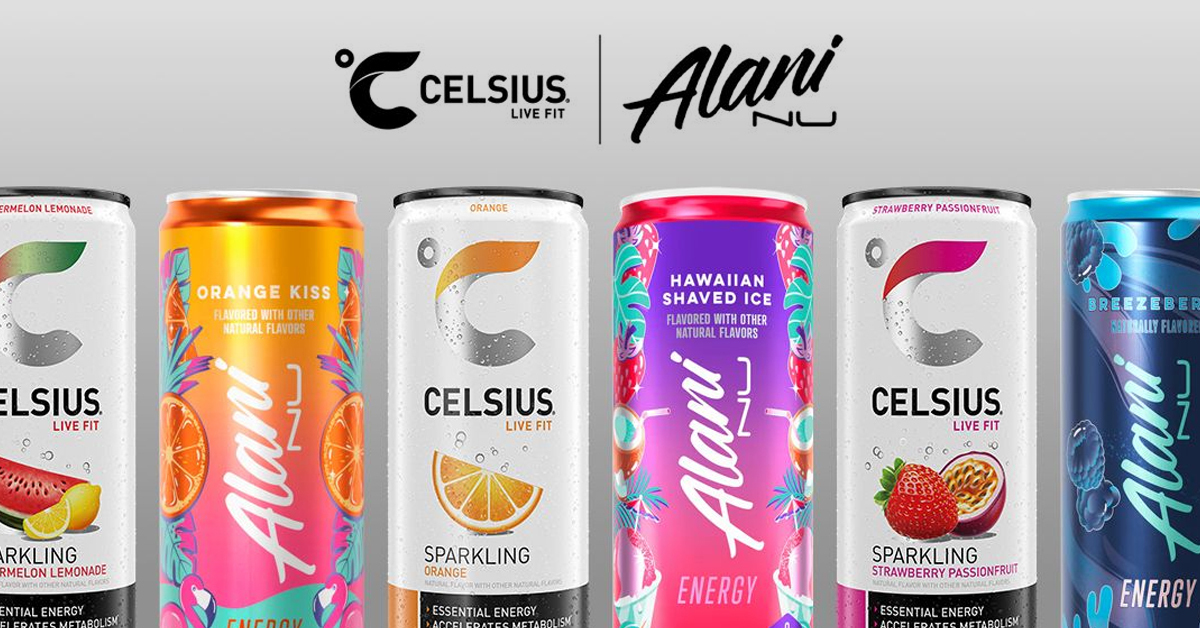
Balanced Portfolio: The two brands address distinct audiences and consumer demands, Fieldly explained, with Alani Nu positioned as an approachable, female-centric lifestyle brand. Over 90% of Alani’s 1.4 million social media followers are female, while just under half of its customers are aged 25-34.
The brand is now expanding ways in which that audience, already tuned in to health and wellness trends, can enter its ecosystem: energy (83% of sales in 2024) remains the dominant segment, but surging demand for protein could mean a bigger role for its shakes, which launched in 2021 and were just 6% of sales last year.
“Although our primary focus remains on RTD energy, we do see opportunities to expand into adjacent categories and new channels over time, alongside continued global growth for our core offerings,” said Langhans on the call. Later on, he called protein “a growing category that we’ve been reviewing for some time,” while noting that powder sticks also have room for expansion.
Alani’s growth trajectory across 2023 and 2024 is consistent with where Celsius was in 2022 and 2023, said Langhans. In terms of market share and expansion, Alani is running 12 to 24 months behind Celsius current position.
Responding to a question on marketing spend, Fieldly noted that timing will be “extremely critical” to allocate funds appropriately.
“I think the opportunity of… being able to manage portfolio in one given category is that we can create and really dial in our timing of our innovation to really make sure we’re maximizing the footprint within retailers and within specific channels for convenience and grocery so it does offer a lot of flexibility, which is really a tool we didn’t have within our tool belt prior to the Alani acquisition,” said Fieldly. “So we’re able to be more strategic and ultimately have better commercial go to market plans.”
Sugar Free Surge?: Both Celsius and Alani can credit their rise in part to consumer interest in fitness and wellness lifestyle brands, but could the real secret to success be zero sugar?
Category pioneers Red Bull and Monster established the market with high-sugar drinks, but the pivot towards — and now dominance of — sugar-free could be the defining characteristic of energy drinks’ second wave. Per Celsius, zero-sugar represented 88% of category growth in 2024.
Distribution Dance: When it was announced, Alani’s acquisition seemed to suggest an inevitable move towards Pepsi, Celsius’ distribution partner since 2022. But Celsius has avoided giving a definitive answer on its plans for Alani, outside of confirming around that the company is on the hook for around $10 million in termination fees to some of its distributors from prior to its sale. That uncertainty has sparked some speculation of possible interest in keeping Alani moving through DSD, its largest distribution channel (44%).
Fieldly didn’t offer many more specifics yesterday. “We’re focused on integrating Alani Nu and the organization at this time, and focused on our existing customers and partners. So we don’t have an update at this time, and we’re really focused on continuing to drive revenue and profitability and synergies throughout our organization and really maximizing the value of this acquisition.”