

Gerry’s Insights: The Renegade Theory of Beverage Innovation
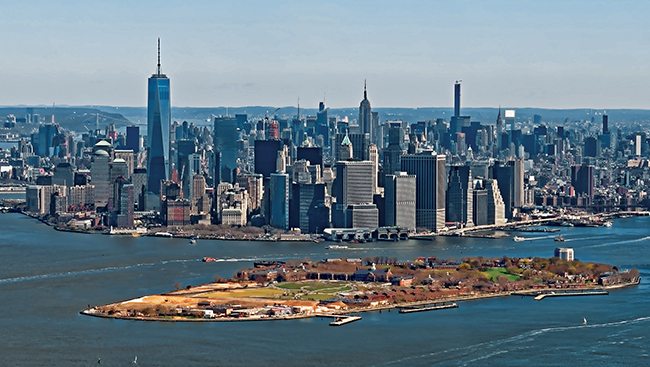
Here in New York, off the coast of Lower Manhattan, the feds sold us a longtime Coast Guard base called Governors Island that had become surplus to requirements for about a dollar. It’s a glorious spot, just minutes away by ferry but semi-barren across its 150 acres, in the most charming way for our hyperdeveloped city. It boasts panoramic harbor views, a waterside oyster-and-beer bar, a sprawling outdoor taco emporium, a jerk chicken truck and a Threes Brewing beer garden. There’s glamping, to raise dough from the city’s high rollers, and festivals like early editions of Governors Ball and lately Porch Stomp, with acoustic bands playing all over the Admiral’s Row stretch of officers’ Victorian houses from back in the day.
On my many visits there, I’ve been fascinated by its playground dichotomy. There’s a state-of-the-art, ergonomically fine-tuned Hammock Grove Play Area that features all the latest in rope climbing structures. Your own neighborhood’s probably got one too. Then there’s The Yard “adventure playground,” which is their name for what’s basically a junkyard. It’s “stewarded by trained playworkers,” according to the island’s website, which suggests the site as an appropriate spot “for young people ages 5 to 19.” (Really, 19? Is this a veiled invitation to pot consumption?) There’s also a family play area there for kids under 5. It’s totally renegade, the kind of playground you’d expect Keith Richards to design.
Can you guess which of the two is more popular than the other? On my visits, it’s never been a contest: The Yard, of course.
What does this have to do with beverages? To me, it captures a fundamental paradox in innovation: you can produce a new product that checks all the boxes of the prevailing trends, but that can be a demerit as much as it’s an advantage. God bless that mysterious consumer who isn’t satisfied with products that just deliver a comprehensive matrix of benefits but wants something more, even if it’s something she can’t define in a focus group. Caffeine (energy), protein, gut health or just plain refreshment? Sugar or no sugar? Plastic or cans? Product developers can make their choices as to which mixture of these elements will deliver the targeted consumer, but there’s a certain je ne sais quoi that’s also an integral element of successful beverage launches. That may be a reason the strategics, awash in consumer “insights” and minute retail sales data, so often fail to hit the mark. They carefully design the entries to check all the right boxes, but in a soulless way that consumers can see right through. The marketing mechanics are totally transparent. It’s kind of like comparing a strait-laced achiever with a motorcycle outlaw: the achiever likely is a better choice to marry, but life sure will be more exciting with the other guy.
And when I say strategics, even the more agile among them can struggle with this. Take Monster Beverage. Feeling it needed a play in the natural/female space, a few years ago it designed a new brand called True North that had an exemplary ingredient list and was nakedly clear about the aspirational buttons it intended to push, right down to the compass rose on the front panel. It didn’t get far. More recently Monster’s getting ready to go out with a new Alani challenger called FLRT. Though the details aren’t out as of this writing, I worry that it comes across as the kind of condescending chick drink that a roomful of (mostly male) marketers would assemble trying to score with that demo. By the same token, when Pepsi’s Mountain Dew brand appropriates the dirty soda trend with a packaged Cream Soda extension, does that actually fight the dirty soda dynamic by locking it within a permanent recipe? Isn’t the glory of dirty soda that consumers improvise the most unlikely flavor combos to see what works? By contrast, attend the New Beverage Showdown at BevNet Live, and many of the entries will exude an unpolished freshness that gives them an inherent appeal, even if further refinements will be needed along the way, as the judges are only too happy to point out.
I realize this is not a startlingly acute psychological insight. There are plenty of references to this phenomenon in other realms: the notion of swing in jazz, duende in Spanish poetry. Hard to explain but you know when it’s there. And there’s a key problem with this analysis too: it’s hard to take out what the lesson is if you’re a marketer at a sizable CPG. Intentionally make one element a bit off-key, the way oriental rug makers include a “Persian flaw” in recognition that, unlike God, they’re not perfect?
Since I’m roaming pretty far afield, I’ll filch another lesson from urban planning. Theorists like Kevin Lynch have noted how the ever-compelling charm of New York’s Greenwich Village stems from the way its tangle of narrow streets is kept from being unpleasantly disorienting by being bounded by major avenues, with distant skyscrapers also helping to orient pedestrians. In product development, you want the equivalent of those winding streets to intrigue the shopper, but you also need to bound the concept with branding and positioning that’s clear about what the beverage is trying to do.
I find this lesson continually reinforced to me in my daily life. In Riverside Park, there’s an area that drew kids who were practicing this emerging French pastime called parkour. It’s a slow-motion discipline where you find ways to traverse a series of urban obstacles like bollards and benches and railings through balance, agility and strength. From my perch at a nearby beer bar, I’ve had ample opportunity to observe this nascent sport while recognizing, even three beers in, that it’s not one I need to be participating in. Concrete is hard.
Funny thing happened. In an effort to enforce decorum while not stunting these kids’ enthusiasm, the Parks Department decided to design a parkour-specific site not far away where the kids could strut their stuff, just like the city tries to shunt skateboarders from the courthouse steps to local skateparks. At first, I didn’t realize that’s what the padded Tinkertoy-like space was. It just seemed to be an oddball setup where exercise enthusiasts contorted themselves on the unusual geometry or tots climbed it, like in The Yard on Governors Island. Then I noticed the sign carrying detailed depictions of the parkour maneuvers required to navigate the space. You won’t be surprised to hear that I’ve never seen the space used by any actual parkour kids. They’ve moved on to other locales or activities. Just as with CPGs, by the time Parks reacted to the trend, it already had a foot out the door.
Longtime beverage-watcher Gerry Khermouch is executive editor of Beverage Business Insights, a twice-weekly e-newsletter covering the nonalcoholic beverage sector.


Receive your free magazine!
Join thousands of other food and beverage professionals who utilize BevNET Magazine to stay up-to-date on current trends and news within the food and beverage world.
Receive your free copy of the magazine 6x per year in digital or print and utilize insights on consumer behavior, brand growth, category volume, and trend forecasting.
Subscribe