

NOSHscape: The Latest Food Brand News

TreeHouse Foods Acquired in $2.9 Billion Deal
One of North America’s largest private label food and beverage manufacturers is set to become a private company.
TreeHouse Foods will be acquired by an independently managed investment subsidiary of Investindustrial VIII in an all cash transaction for a total enterprise value of $2.9 billion, the companies announced Nov. 10.
Investindustrial VIII is part of a European group of investment, holding and advisory companies with €17 billion of raised fund capital.
Under terms of the deal, Illinois-based TreeHouse Foods shareholders will receive $22.50 per share in cash for each share of common stock owned at closing, representing a 38% premium to the company’s closing share price on Sept. 26, 2025, the last full trading day prior to market speculation around a transaction.
The transaction has been unanimously approved by the TreeHouse Foods board of directors and is expected to close in the first quarter of next year, subject to the satisfaction of regulatory approvals and other customary closing conditions. JANA Partners, which owns 10% of TreeHouse Foods common stock, entered into an agreement to vote in favor of the deal at a special meeting of shareholders.
Once the sale is completed, TreeHouse Foods common stock will no longer be listed on the New York Stock Exchange.
TreeHouse Foods produces crackers, non-dairy creamer, pickles, refrigerated dough, broths and stocks, hot cereal, pretzels, in-store bakery items, griddle, cookies, cheese and pudding, powdered beverages and other blends, coffee, tea, and unique candy products. It has a total of more than 85 manufacturing facilities and employs a workforce of more than 16,000. The company will operate independently within Investindustrial’s portfolio.
“We are confident in the long-term growth opportunities in private brands and the categories where TreeHouse Foods operates, as well as the company’s ability to build on its strong foundation of leadership. We look forward to working closely with the TreeHouse Foods leadership team and employees to drive its long-term success,” said Andrea C. Bonomi, chairman of the Industrial Advisory Board of Investindustrial, in a statement.
Steve Oakland, chairman, chief executive and president of TreeHouse Foods, added, “TreeHouse Foods has been executing a strategy to become a focused snacking and beverage private brand leader with depth in categories, attractive long-term prospects and an agile operating model. Our agreement with Investindustrial, a leading European investor with a strong track record in food manufacturing and related sectors, will provide shareholders with immediate cash value, at a substantial premium.”
Goldman Sachs & Co. LLC serves as financial advisor to TreeHouse Foods, and Jones Day is serving as legal counsel.
Lazard, RBC Capital Markets and Deutsche Bank act as financial advisors to Investindustrial. RBC Capital Markets, Deutsche Bank and KKR Capital Markets provided Investindustrial with financing support for the transaction. Skadden, Arps, Slate, Meagher & Flom LLP served as legal advisor to Investindustrial on the acquisition, with Paul, Weiss, Rifkind, Wharton & Garrison LLP serving as financing legal counsel.
In 2022, Investindustrial acquired TreeHouse Foods’ Meal Preparation business for $950 million.
In its third-quarter financial report, TreeHouse Foods posted net sales of $840.3 million, up 0.1% from $840.3 million in the prior-year period, and net loss of $265.8 million, which compared with a net loss of $3.4 million the year before. The result was attributed to the negative impact of planned margin management actions and broader macroeconomic consumption trends that was partly offset by supply chain savings initiatives, the Harris Tea acquisition and cost reduction activities.
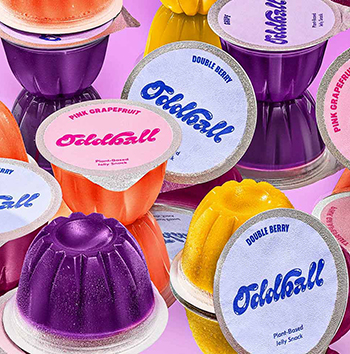
Oddball Lands $2M As It Enters Whole Foods
Jelly snack brand Oddball raised a $2 million seed round led by Springdale Ventures, as it expands its retail footprint and prepares for innovation.
The plant-based jelly brand will use the funding to support its launch into nearly 180 Whole Foods Stores in three regions (Northeast, Southern California, and Southwest).
Springdale Ventures, an early-stage investment firm founded by Genevieve Gilbreath and Dan Graham, has invested previously in insurgent food brands like Goodles, Feastables and FitJoy. Oddball is part of the firm’s Fund II, which includes Khloud Protein Popcorn, Bloxsnacks and The Absorption Company, among others.
Oddball is currently sold in about 500 locations and online. The zero-sugar, fruit jelly snack is available in four varieties: Grape, Pink Grapefruit, Double Berry and Mango. The snack comes in 2.75 oz. cups and are sold in retail for $3.59 per two-pack.
Launched at the beginning of the year, Oddball has been a passion project for founder and CEO Sophia Cheng since 2022. Cheng, who previously served as strategy director at Estée Lauder, sought to connect to her roots growing up in Singapore and Hong Kong where jelly snacks were a common childhood treat. Her goal was to create a better-for-you version of Jell-O using plant-based ingredient agar, instead of animal-derived gelatin.
The brand is expecting to double its retail footprint as it heads into 2026 with its Whole Foods partnership. Piggybacking off its success in Sprouts Farmers Market, Oddball is putting resources to its retail expansion.
“We’re not in the same era of 2019 to 2021,” Cheng said in a statement. “Meta ads aren’t as efficient as they once were, and shoppers are returning to stores. For our category, discovery happens in the aisle.”
In addition to bringing Oddball to new markets and retailers, the brand is planning innovation with its new funding.
Oddball is taking a familiar approach to reworking nostalgic childhood snacks for a modern, health-conscious consumers, similar to Goodpop and JonnyPops in the popsicle set and Flings, Glonuts and Legendary Foods taking on toaster pastries and donuts.
“Oddball is designed for families and kids who snack often, but want something fun, clean, and made from real fruit. As parents look for better-for-you options, we’re seeing that momentum reflected on shelves — and retailers like Whole Foods are catching on fast,” Cheng said.
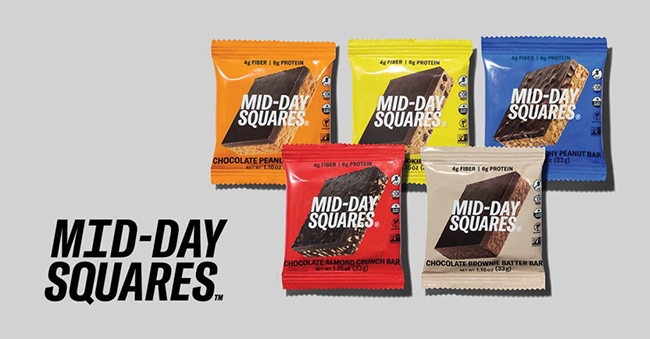
Mid-Day Squares to Triple Production Capacity, Preps Non-Chocolate Innovation
With its U.S. expansion in motion, Canadian confections manufacturer Mid-Day Squares is planning to triple the output capacity of its Montreal production facility over the next year.
According to co-founder and co-CEO Nick Saltarelli, Mid-Day Squares received a debt deal investment from the Canadian federal government and the provincial government of Quebec to help finance a facility expansion, which could bring the plant from around $75 million in product output to upwards of $300 million in output.
The brand is nationally distributed in the U.S. to Target, Costco, Walmart, Albertsons and others, and demand has been rapidly rising as the company sets a goal of achieving $100 million in revenue over the next 2 1/2 years. However, Saltarelli said the business has been “teetering on our execution plan in the U.S.” due to its limited production capacity.
“We’ve just been balancing what partnerships do we take on at the right time so that we don’t put ourselves in a cash crunch position and that we grow methodically,” Saltarelli said. “And now is go time.”
Mid-Day Squares’ facility currently employs 52 people, and Saltarelli said the expansion should create about 10 new jobs once complete.
The expansion will be finalized and online within the next 12 months, he added.
“We’ve tailored all of the demand backwards from those drop points, so we still have demand that we can put in the current production facility, and so that will get us through the next 12 months,” he said. “And then that new capacity unlocks for us, so that we can continue to launch a lot of these major retailers that are yet to come.”
The expansion is getting underway as Mid-Day Squares prepares to launch its first non-chocolate innovation in January, with an official announcement likely to come in the next two to three weeks.
Saltarelli declined to say what the new product will be, but noted it is in the confections category and has a “super nostalgic platform.”
The need to find a non-chocolate line extension came about as the rising price of cocoa – rising roughly fourfold over the last two years, Saltarelli said – has weighed on the company’s bottom line.
“It opened our eyes that we have an over-reliance on a commodity like cocoa,” he said. “We kind of locked ourselves in a room with the team for almost three months going back and forth on how we take this tailwind and turn it into a massive headwind.
“So this is a huge moment for the brand, because we are moving beyond chocolate and really focusing on the Mid-Day platform.”
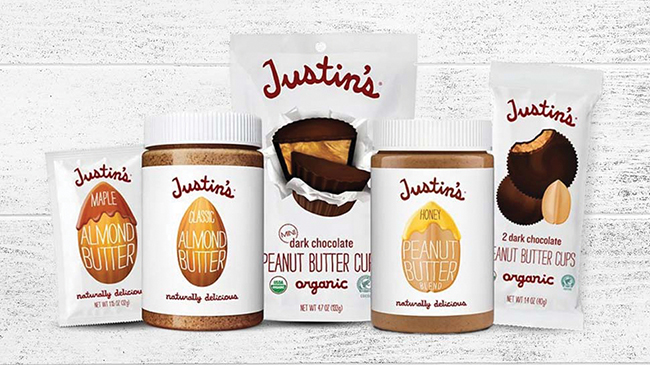
Inside the Justin’s Deal: Predicting Its Future Under Forward Consumer Partners
Nut butter and confection company Justin’s will soon return to private ownership, a move that incoming CEO Peter Burns – who previously served as CEO from 2014 to 2016 – believes will “unlock the true potential of the brand.”
Private equity firm Forward Consumer Partners purchased a 51% stake in Justin’s from Hormel, with the CPG giant retaining the remaining 49%. Forward declined to disclose the financial terms of the transaction.
Founded in 2004 by entrepreneur Justin Gold, Justin’s was purchased by Hormel in 2016 for approximately $286 million to grow its portfolio of protein-rich products. Under Hormel’s ownership, the brand expanded its offerings to include a full range of almond and peanut butters, as well as new varieties of peanut butter cups and almond butter cups.
“Hormel has elevated the brand since we sold it in 2016, launching extensions and confections. Essentially, [this transaction with Forward] is about unlocking the true potential of the brand and giving it focus and priority,” Burns told Nosh. “If we can do that in association with our partnership with Hormel, that’ll be great. There are a lot of things we can learn and leverage from our relationship.”
“Justin’s is a beautiful brand with a remarkably strong latent brand equity. It was a very small brand within a much bigger portfolio at Hormel, and so over the course of the roughly 10 years that Hormel owned it, resources inevitably were diverted to other parts of that portfolio and Justin’s didn’t get the focus it can and will under private ownership,” echoed Brandon Staub, partner at Forward Consumer Partners.
Once the transaction closes (expected in December), the biggest near-term priority is “executing a flawless carve-out from Hormel,” according to Staub. Justin’s is currently “entirely intertwined” within the broader Hormel infrastructure, including IT systems, financial reporting and supply chains.
“We’ve surrounded ourselves with excellent third-party service providers who are going to be our arms and legs, helping us execute [the carveout] alongside the [Forward] management team,” said Staub. “It’s going to be hard work and take some time. We have set relatively tempered expectations together with the management team as to the financial performance and step change we’ll see in 2026.”
Burns shared a similar sentiment, stating, “The first thing that we have to do is stand up Justin’s as an independent company. Getting the knowledge transfer, getting our hands on the brand and building our own infrastructure will take time. Once we have our feet on the ground, that’s the point when we start to build the innovation platform.”
Part of that knowledge transfer will come from another resource from Justin’s early days, or more aptly put, the source: Justin Gold.
Gold will be returning to the brand while also continuing to serve as chief innovation officer at Rudi’s (where he’s an investor), which, incidentally, recently launched a collaboration with Justin’s on its line of frozen “PB&J Sandos.”
“This gives me a chance to work with both sides of the organizations to make sure that we’re maximizing the potential for those products,” Gold said. “I can’t think of this ever really happening before. It feels really good for me because it doesn’t feel like I’m splitting myself in two; it feels like these things are unified.”
Though the process is complex, the Forward team is confident that Justin’s will become a fully independent and “truly standalone” business in the next 6 to 12 months, at which point there will no longer be linkages with Hormel across any functional areas. Additionally, Justin’s is opening up a new headquarters in Boulder, Colo.
During this transition period, one of the biggest priorities for the Justin’s team is to emphasize quality and ensure there is no customer interruption, according to Burns.
“The first thing we need to do is fix the business and this requires a lot of discipline and focus,” Gold said.
Gold will consult on how to fix “quality and distribution concerns” and recapture lost ACV, while also looking ahead to update the brand and innovate its portfolio.
“There are some places that Rudi’s can win, that Justin’s really doesn’t have a strength in and there are places where Justin’s can win where Rudi’s doesn’t have a strength,” he said. “It’s a really fun opportunity for me to go find things that can work at Rudi’s or work at Justin’s or work together.”
Once the “pick and shovel work” of the carve-out is complete and the brand establishes a solid foundation, Justin’s will double down on marketing, innovation, and consumer awareness.
During the nine years that Justin’s was under Hormel’s ownership, the food and beverage landscape – and the world itself – underwent significant changes, per Burns. He pointed to Amazon’s purchase of Whole Foods, the rise of the club channel and the influence of content creators on Instagram and TikTok.
“The first time around, Justin’s didn’t have a club presence, a c-store presence, or an international presence. You think about that today and go, ‘Those are areas of green field. How do we get to them?’ That’ll be our focus as we stand up Justin’s,” said Burns.
The potential for product innovation with the brand is “limitless,” according to both Staub and Burns. That includes extensions in the nut butter and confection categories, as well as a potential expansion into “snackfections.”
“We’re thinking about how we want to bring this brand to life in the public’s eye and what the optimal portfolio mix is between peanut butter, almond butter, confection and snackfections,” said Staub. “Justin will have great insight as to what should work based on his deep experience of having built the brand, and Peter is a fantastic leader who is strategic and very strong operationally.”
He continued, “This is an archetypal Forward investment. We see tremendous opportunity for Justin’s. We’re going to get this to a stand-alone and then you’re going to see Justin’s out in the world in a way that you haven’t before.”


Receive your free magazine!
Join thousands of other food and beverage professionals who utilize BevNET Magazine to stay up-to-date on current trends and news within the food and beverage world.
Receive your free copy of the magazine 6x per year in digital or print and utilize insights on consumer behavior, brand growth, category volume, and trend forecasting.
Subscribe