

Powder Country: Drink Mixes are Growing Faster Than RTDs

For powdered beverage brands, the outlook is a lot brighter than Crystal Light. Manufacturers have found that Mix-to-Drink beverages aren’t just for flavor. In an era where consumers are asking their drinks to deliver functional benefits, powdered mixes are taking off.
Over the past four years, the growth rate of powders and mixes has been twice that of liquid beverages, according to recent findings by retail data analysts at Circana. The broad category of was $7.4 billion in revenue last year – small when compared to the overall $221 billion retail market for beverages, but becoming increasingly important.
What’s driving powdered growth? In many cases it’s lifestyle factors, like portability, lower cost, environmental sensibility, and the ability to customize, notes Sally Lyons Wyatt, EVP at retail data supplier Circana.
When it comes to flavor on the go, “you can add as much or as little as you like,” Lyons Wyatt notes.
But beyond flavor, powders have flourished as consumers seek more functionality from their beverages.

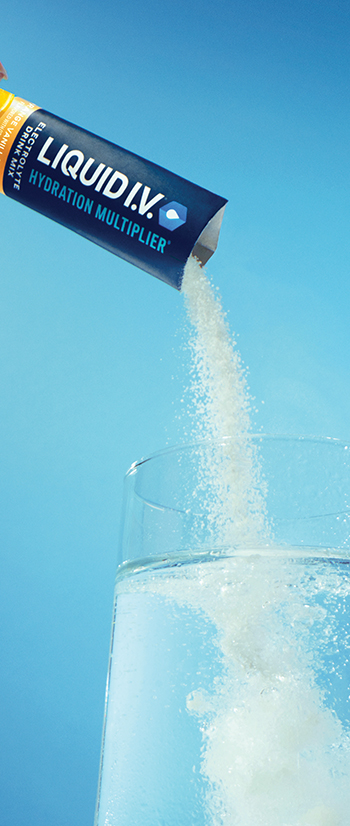
Hydration, in particular, is deep in its powder era: between them, LMNT, Liquid IV and Dry Water are each selling more than $100 million; Liquid IV, at close to $900 million, would already be the third-largest hydration drink in the country if it was in bottles.
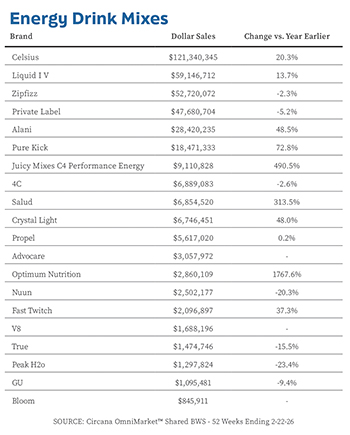
Energy drink brands have also started to reap big benefits from portable, powdered versions; mixes in that category were up 18% last year, according to Circana, with Celsius, Alani Nu and C4 leading the way among established beverage companies. Meanwhile, Liquid IV has launched its own caffeine-fortified mix and the brand is moving up in the powdered energy pack.
So what’s not moving with the customer? Protein. While manufacturers and consumers are both very interested in protein supplementation, and protein powders are up, the actual format is more tub-based than single-serve. They’ve still shown terrific growth, but they’re harder to take
Still, portability isn’t the only key attribute of the mix-to-drink set; the supplementation of drinks is increasingly popular, notes Scott Dicker, Senior Director of Market Insights at retail information provider SPINS. On-the-rise functionalities like brain health, mood support, general wellness and more are becoming increasingly popular in the mix-to-drink space because, while their audiences are growing, they’re still small enough and the ingredients are expensive enough so that daily dosage doesn’t easily fit within the packaged, RTD infrastructure.
As with other supplementation, Dicker says, from a cost and regularity standpoint for products like creatine, it just makes more sense to mix it up at home day by day.
That supplementation idea makes sense because mixes already straddle a space between the beverage cooler and the supplement aisle. Blendable products offer everything from basic wellness (Athletic Greens) to protection from yeast infections (Uqora). They straddle the line from a regulatory sense as well – really, experts note, the only thing that determines whether a powdered product destined for drinking is a beverage or a supplement is the nutritional label treatment its manufacturer chooses.
Emerging Types
While hydration, energy, and protein comprise the big three of functionality, there’s a host of products that are on the way that slot in well with the powder format. Look to the trends, the experts say.
Generally, Dicker notes, the lifecycle of many products that move from the supplement aisle to a liquid format first go through a pill or capsule format before they transform to the “ready to mix” state, moving to RTD or even food formats if they are particularly successful.
Product types that are likely to grow, he notes, include mood support, prebiotic gut health, and multivitamin/wellness vehicles like AG1.
“We’re seeing a lot more millennials doing things like green [drinks],” Lyons Watt agrees.
On the mood support front, there’s a little bit of blurring of use cases: some consumers are looking for products like magnesium, ashwagandha, L-Theanine and Vitamin D because they are drinking less. They’re also looking for a lot of those same additives to restore brain health – alongside other nootropics like choline, bacopa, and Ginkgo Biloba.
Also heading into the mix are beauty-from-within type products, Dicker notes, citing nutrient-rich powder formats, like colostrum and collagen peptides, as being likelier than protein to end up in ready-to-mix sachets. Both mix easily and are fairly taste-neutral, he added, making them a good fit for on-the-go consumption.
Take creatine, an increasingly in-demand supplement. As research has expanded the cohort to include more casual athletes, and it’s started being added to chewable, gummy supplements, plenty of beverage makers have eyed creatine. But the muscle-builder tends to be hard to maintain in solution over the long term – one beverage manufacturer we spoke with admitted he has to overdose his drinks with the stuff to be able to maintain even the smallest level in his “creatine enhanced” RTD shake. Nevertheless, when dry, it’s easily be mixed into a beverage for instant consumption.
One characteristic that keeps products in the ready-to-mix camp, rather than transformation into an RTD, is expense.
Creating efficacious doses that can still be fun to drink is an expensive prospect, and consumers often prefer to mix their own, much like a multivitamin, Dicker notes. While some functional products, like energy or hydration, can be felt quickly, it’s hard for consumers to invest in case-specific RTDs when they can get a better dose at home at a lower cost. For a lot of ‘long lead’ functions, like overall health support, some RTD brands have shown various degrees of success, he said, “but you’d need so many different drinks.”


Receive your free magazine!
Join thousands of other food and beverage professionals who utilize BevNET Magazine to stay up-to-date on current trends and news within the food and beverage world.
Receive your free copy of the magazine 6x per year in digital or print and utilize insights on consumer behavior, brand growth, category volume, and trend forecasting.
Subscribe