

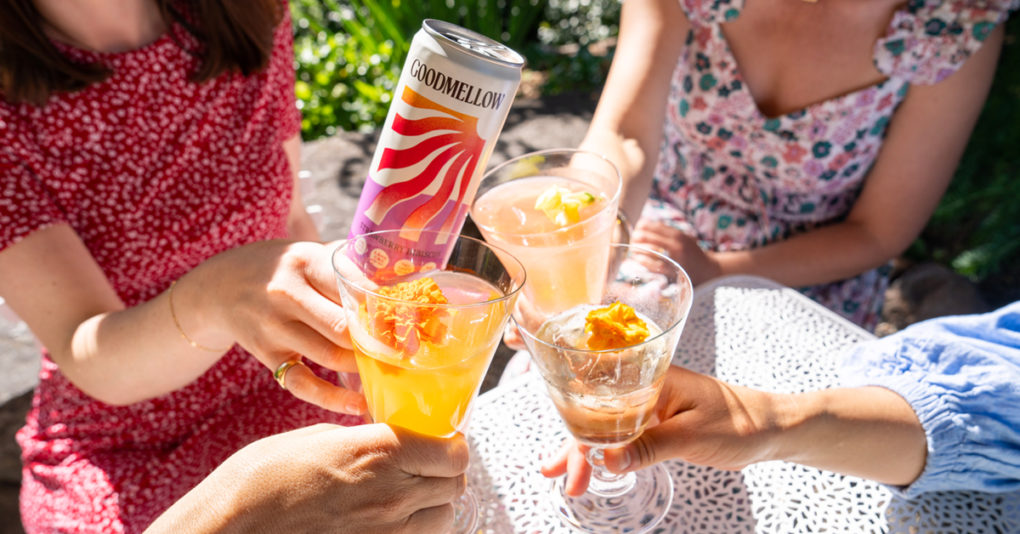
Brandon Hanson, the co-founder of a well-known West Coast distillery, is venturing into the “wild west” of THC-infused beverages.
The co-founder of Hanson of Sonoma is among the first spirit entrepreneurs to jump into THC-infused beverages with Goodmellow, a functional ready-to-drink (RTD) beverage infused with hemp-derived THC that launched this summer.
“It’s still the wild west, and all of us in this category are trying to figure it out and move with the constant changes that are happening,” Hanson said.
The Sonoma, California-based entrepreneur is no stranger to a regulated beverage category. Hanson of Sonoma was founded in 2013 by Hanson and his siblings as the first certified non-GMO spirit in the country. It has since become known for its unique vodkas infused with organic ingredients.
But as spirits sales have slowed over the past couple years, Hanson sought to put his expertise into an adult non-alc product – first experimenting with dealcoholizing spirits from the family distillery.
“I just didn’t feel like that was the future,” he said.
Without some unique positioning, like Athletic Beer established early on, dealcoholized spirits were missing a “magic ingredient,” he said.
Enter THC – and other adaptogens, which Hanson says he regularly uses. Goodmellow comes in 8oz (2mg THC) and 12oz (5mg THC) cans that include a proprietary blend of ashwagandha, GABA, L-theanine, terpenes, THC-V, and CBG. Flavors include Grapefruit Habanero, Strawberry Hibiscus, White Peach Tea and Meyer Lemon Elderflower.
But with Goodmellow, THC isn’t the mainstage of the brand, said Hanson – a concept that will be further teased out down the line, when the company launches a purely functional beverage without the THC.
A Spirits Playbook In A New Category
By keeping THC doses low in its first RTD lineup, Hanson sees potential for Goodmellow to become a sessionable replacement to alcohol, particularly on-premise.
“I really think we’re going to try and develop that [on-premise business] with this brand specifically, and that’s going to be a harder avenue,” he said.
That’s a different approach than many THC brands, and with its own set of challenges.
On-premise, Goodmellow is up against a patchwork of state-to-state regulations for THC beverages that require zero to several licensing and insurance requirements of bars and restaurants. But like a tried-and-true spirits entrepreneur, that’s where Hanson sees the most opportunity for trial. As the master blender of the distillery’s infused spirits, Hanson is confident that his ability to experiment with flavors makes Goodmellow’s taste stand out against the competition. A 750 mL bottle will roll out next.
“If we can get people tasting that in cocktails at bars, again it’s a low-dose of 2.5 milligrams per serving, but it’s a great thing to mix with whatever cocktail people like to have,” he said.
That larger format could provide further hurdles, or conversely the opportunity to plant an early stake in a channel. As retail sales of multi-serve THC beverages aren’t allowed in some states, other new brands have kicked off sales via direct-to-consumer followed by THC-friendly chains, such as Total Wine & More.
On top of helping his account partners navigate the rules, Hanson is focused on building up awareness of the category.
“Unlike going out with Hanson vodka it is completely different,” he told BevNET in between sales visits in Georgia. “It’s basically like teaching people this whole new category that has never existed before. Our biggest challenge is just the education around what these products are: How do they make you feel? How does it compare to alcohol? How much should you have?”
One potential obstacle Hanson is not facing: distribution access. Goodmellow is hitting Georgia, Alabama, New Jersey and Ohio first, likely followed by Louisiana, Florida, North Carolina, and South Carolina. Its footprint is aligned with distributors that already sell Hanson Vodka, such as Allied Beverage Group in New Jersey and United Distributors in Georgia. His distributors have been excited to learn more and bring in products from a growing category, he said.
“Having that tie-in has been really nice for us and the distributors, because they know that we’re not fly-by-night characters and we’ve been doing this for a long time,” he said.