

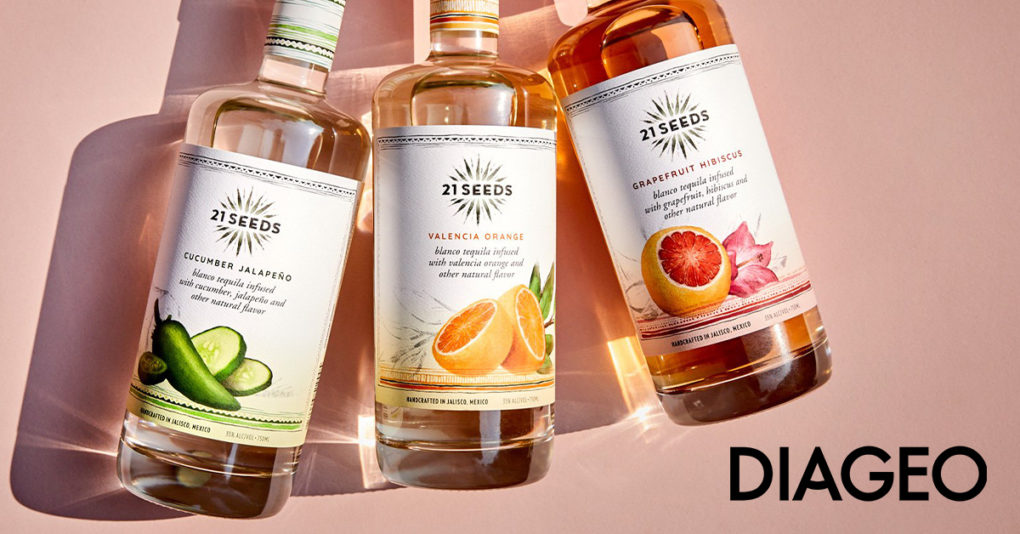
A stockholder representative of flavored tequila 21Seeds is suing its parent company Diageo for obscuring plans to develop a competing product in the category, while undermining 21Seeds’ ability to reach the sales goals tied to its earn-out targets.
The complaint, filed by Fortis Advisors LLC last week in Delaware Chancery Court, alleges that Diageo’s 2022 acquisition of 21Seeds “was the product of fraud from the outset” and that Diageo made “material misrepresentations and omissions” while secretly developing Casamigos Jalapeño Tequila, released in 2024.
Created by three women in 2019, 21Seeds found a niche in a crowded category by catering to an underserved demographic in spirits (moms) and to the at-home drinking occasion – fortuitously right before COVID-19 lockdowns. The company, which offers three naturally infused tequilas, was bought by Diageo only three years after launch.
In an interview with BevNET last November, co-founder Kat Hantas described the startup’s game plan to build the brand “in the off-premise, win with our consumer, and then utilize our strategic acquirer to go broad and into the on-premise and win.” Diageo’s strong presence on-premise and ability to drive the brand’s workhorse – Cucumber Jalapeño – as a spicy margarita solution, was part of the attraction to the global conglomerate.
“We could have the powerhouse of somebody in the tequila space, but they have nothing in flavored tequila, and they had no plans of doing anything in flavored tequila at the time,” Hantas said, describing the acquisition decision to BevNET. “So this was great.”
But according to the lawsuit, Diageo had other intentions. Backed by a marketing campaign featuring supermodel Cindy Crawford, the wife of Casamigos co-founder Rande Gerber, Casamigos Jalapeño launched in April 2024. The complaint alleges that the launch takes “aim squarely at both 21Seeds’ lead Cucumber Jalapeño flavored-tequila offering and the company’s core female customer base.”
During the acquisition process, Diageo obtained detailed information about 21Seeds’ trade secrets, required the company to obtain a written supply agreement from its distillery and – although initially not interested in the company’s IP – changed its stance and insisted “the that representations and warranties regarding the company’s IP be considered a fundamental part of the agreement,” read the complaint.
21Seeds requested Diageo to confirm that it did not have “another infused tequila brand of which we are unaware of looming on the horizon,'” to which Diageo denied any knowledge of another similar acquisition ahead. The complaint alleges that Diageo purposefully hid the development of Casamigos Jalapeño to avoid 21Seeds rejecting the deal or earn-out structure.
“Diageo, thus, would have to significantly increase the guaranteed upfront payment or risk losing 21Seeds to another global beverage powerhouse that actually was intent on promoting the company and growing its sales, which, in turn, would provide an even more formidable competitor for Casamigos to take on after its launch. Diageo was determined that neither occur,” the complaint read.
As Spicy Tequila Heats Up, Lawsuit Alleges 21Seeds “Put in Mothballs”
Meanwhile, the complaint alleges 21Seeds was put “in mothballs, where the company remains to this day,” and that Diageo has deliberately managed and operated the brand to eliminate any possibility of achieving the milestones or earn-out payments. During the three years that have elapsed since the completion of the transaction (60% of the earn-out term) 21Seeds has “completely stalled under Diageo’s control, its sales consistently flat,” read the complaint.
“21Seeds’ pole position in the flavored tequila segment, which was obtained by three beverage industry novices operating on a relatively limited budget, has been squandered, and the company has been surpassed by competitors that have obtained greater brand awareness, market penetration and industry traction,” the complaint continued.
The lawsuit is seeking damages as well as attorney fees.
Spicy tequila sales were up 22.5% in off-premise channels in the 52 weeks ended February 22, according to NIQ data assembled for BevNET by bev-alc data firm 3Tier Beverages, with tequila driving nearly all of the growth for spicy bev-alc products and accounting for 73% of growth dollars. Some of the top brands in the segment include Smirnoff Spicy Tamarind vodka, One the Rocks Jalapeño Pineapple margarita, and 21Seeds Cucumber Jalapeño, with Casamigos Jalapeño Blanco tequila among the biggest brands showing growth.
Casamigos has otherwise faced challenges this last year: sales plunged 21% in the six months prior to December 31, 2024, while Diageo’s other major tequila, Don Julio, surged 50%, according to the company’s earnings reports. The group said it is pursuing a new campaign for Casamigos after admitting its major tequilas have been “going up against each other.”
The lawsuit comes as Diageo adds another tequila to its portfolio that includes Astral and DeLeon as well. The group announced this week it has swapped out its majority ownership of Cîroc Vodka in North America for a majority stake in Lebron James-backed Lobos 1707 Tequila.
Earn-Outs ‘More Common’; Sellers Can Negotiate Buyer Obligations
At the time of publication, 21Seeds had not returned BevNET’s request for comment.
A statement from Diageo read that the company invests “thoughtfully in all brands across our portfolio and work diligently to help them grow and succeed.”
Earn-outs – a mechanism in M&A that in addition to an upfront price promises future payments contingent upon milestones – are seen “very frequently” recently, said Ann Cox-Johnson, partner of McDermott Will & Emery, while on a panel discussion last month.
“There are some hiccups,” she said. “As you can imagine, the seller will lose control of that business, even if they work for the buyer.”
But the hope, she added, is that under a strategic, “that business will flourish and grow and, frankly, just become a hit for all.”
The merger agreement for this deal was not made public, but there are steps sellers can take to avoid disputes over earn-outs. It’s fair for sellers to negotiate the obligations of the buyer as well, said Matthew Fox, a partner at law firm Benesch.
“I think the best way to protect yourself is a combination of more general obligations, but also if you’re the seller, you have the best handle on what it would take to hit these milestones and I would try and negotiate for some of those in the merger agreement,” he said.
As for how this case may go, the concern from 21Seeds over a competing flavored tequila brand and Diageo’s representations (statements of facts) could “feature heavily” in the outcome and could “cut both ways,” Fox added. That element could be deemed “material” (relevant) and show that 21Seeds was misled, supporting a claim for fraud or breach of contract. Or the court could argue that 21Seeds knew about the possibility and “didn’t secure a specific contractual representation on it.”
“I think that is a little unique here, and would probably show in hindsight that there are things sellers could do in advance to protect themselves if there are risks they’re already concerned about,” Fox added.