Search across the BevNET CPG Media network including BevNET, Nosh, Brewbound, Taste Radio, Nombase and CPG Jobs.

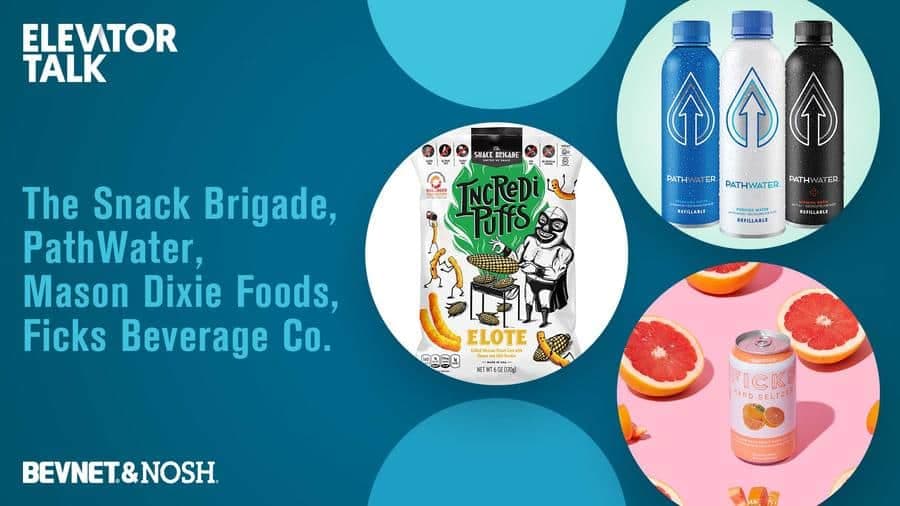
Elevator Talk Ep. 7: The Snack Brigade, PathWater, Mason Dixie Foods, Ficks Beverage Co.
Transcript
Note: Transcripts are automatically generated and may contain inaccuracies and spelling errors.
Ray Latif [00:19] Hey, folks, thanks for tuning in to another edition of Bevnet's Elevator Talk live stream. I'm Ray Latif, the editor and producer of Bevnet's Taste Radio podcast. And over the next 60 minutes, we're gonna be chatting with entrepreneurs from across the food and beverage spectrum, talking about their news and new products related to their brands and companies. With me today, co-hosting the live stream is Patrick Schwarzenegger, the actor, investor, and advisor. Patrick, how are you? I'm doing good, buddy. How about you? I'm hanging in there, hanging in there. Uh, I'm a little worried about my hair. Uh, as you know, it's difficult to get a haircut these days, and each week we do this, my hair gets fluffier and fluffier. How about yourself? Uh, well, as you can see, I'm wearing the hat to, um, to cover mine up. It's, mine's pretty crazy. My beard is getting crazy, but it's, uh, you know, it's quarantine, it's allowed. It's, it definitely is allowed. Uh, you know, you're a pretty well-known person on Instagram and in certain, uh, social circles as well as business circles. But for folks who aren't familiar with Patrick Schwarzenegger, the man, what do you do? Tell us about your investments and advisor, uh, your investments and how you advise folks in the food and beverage industry. Yeah, so, I mean, what I do, I do a bunch of different things, but, uh, you know, we'll stay on topic of, of business for right now. So I run my own kind of advising and consulting firm, which is uh Has about 16 companies underneath it, ranging from food and beverage, overall health and wellness. Um, and it's an injection of capital going on the advisory board, basically just helping kind of companies grow from A to B. I think that, uh, my first company was largely successful and I had a great exit due to the kind of helping hand that I had from my parents. I kind of recognized that early on, how much, um, you know, an advisor or a mentor or someone like that could really help. Um, a young entrepreneur, so I always kind of made it my mission and goal after that to go out and try to help other young entrepreneurs and other young companies in, in expertise and in, in age. So, um, like I said, we have 16 companies underneath that now, ones that have been featured on Bevnet from Blaze Pizza to Super Coffee or Malk or Ladder supplements. So, um, it's been, uh, a great ride and just hoping to make other entrepreneurs' dreams come true. I love that. Uh, I think I saw that on your Instagram pages, hoping to make uh entrepreneur's dreams come true. Um, you know, from an investment perspective, are you looking at early-stage companies, you're looking at ones that have traction, have been on the market for a bit? I would say 90-something% of the companies I go in are, are extremely early stage, from, uh, you know, pre-seed to seed, pre-revenue, anything where I feel like I can have the most, uh, impact and effect, both in the capital stance or in the connection standpoint, um, using my connections to help kind of, uh, you know, bring that company up, that, that's kind of our sweet spot and where we get to, um, help the most. But at the same time, we've gone into some later stage companies as well. Like a Malk Malk. Well, Malk is, Malk is, is, I would say, later stage in the sense that it's been around for, uh, for years, but I wouldn't consider it, you know, something that's extreme late stage in the sense of it's doing, you know, $60 or $100 million dollar revenue or something like that. So, I think something that's unique about Malk is that it has been around for a while. But it's one of the only companies that's really out there on the shelves, uh, that, that wasn't taking, you know, institutionalized money. They weren't going large private equity, which was something that was entertaining to me and allowed me to kind of come in. Uh, you know, throw some, uh, a capital injection on the table, but also kind of really help with their, um, you know, branding, marketing, and kind of exploding it to the next level, which would, would make it a later-stage company. Mhm. Well, we've got plenty of early-stage companies, uh, in our lineup today, and I'm sure they're excited to hear from you and hear some perspective on Things they might be able to do to tweak their branding or change their positioning or just get a nice pat on the back. Uh, once again, for folks that are joining us right now, you're watching Bevnet's Elevator Talk live stream. I'm Ray Latif and I'm joined by Patrick Schwarzenegger. And we're gonna get to our first interview guest of the show. That is Simon Seal, who is the CEO of Soli. Simon, how are you? Hi, thanks for having us. Thank you so much for joining me. Uh, you know, I've seen Soli in my local Whole Foods. Your fruit jerky bars look amazing. Um, but for folks who aren't familiar with the brand, can you tell us a little bit about, uh, how it came about? Yeah, so, yes, as mentioned, I'm Simon Sakala. I'm the CEO of Soli, and uh we've been 20 years in business, Ray. We, we are a vertically integrated company and we go from sourcing fruits and vegetables directly from farmers. To developing and patenting technologies and then we own all the manufacturing facilities and then solely is our branded part and it's how we bring clean and convenient, uh, foods to consumers. And I mentioned the fruit jerky, but you're introducing a new product, uh, that we're expecting to see pretty soon. Could you tell us a bit about it? Yeah, sure. Just a few weeks ago, we launched this new product. It's a five-minute shelf stable spaghetti squash. So now more than ever, easy, quick, and nutritious meals are so important. So, With, like, with all of our products, what you see is what you get. So, inside here, you have a whole fresh organic spaghetti squash, uh, perfectly dried and you can just pour, pour it in hot water and have 4 servings in 5 minutes. Each serving is 1 full serving of vegetables and you have like 85% less calories and uh carbs than a traditional pasta and it tastes amazing. OK, so first off, I wanna say that your, your name to me is a home run, and for a lot of people, I would think that going from fruit jerky to spaghetti squash is kind of an odd, uh, you know, new SKU and new development of, of your product line, but at the same time, to me, it works completely because your name is. Solely, right? I mean, it's going with the one, only one ingredient or a few ingredients in your, uh, in your product. The main question I have for your new development of the spaghetti squash is who are you mainly going after because for myself, I'm a customer of the chickpea pasta and the lentil pasta and how that's sold to me. Is that it's 20 g of protein, right? It's, it's now a, uh, no longer an empty calorie like a normal pasta, but it, it has the punch of the protein. So what is so, uh, beneficial about the spaghetti squash and who are you going after with that? It's a great question, and, and Just commenting on, on your first, uh, comment. Yes, solely, what we're trying to do is a platform brand and just leveraging all these verticality and the technologies that we've developed and patented to make available all these clean products and answering your question, Uh, or your two questions. So, this is a vegetable. At the end of the day, it is a vegetable with all its nutrients. It's very, um, Mildly dry just to make it easy to rehydrate with cold, hot water. So, it's not focused on, of someone, on someone who wants an increase in protein or just added things. It is what it is. It's a whole vegetable and it is a perfect substitute for pasta if you want to eat a vegetable instead with 85, 85% less carbs. 85% less carbs or calories pasta, yeah. Got it. So can I see the packaging one more time? Of course. OK, so you do advertise the less carbs and the less calories. So that's something that's, in my opinion, is gonna be the draw in to try this over the other pastas, correct? Correct, yeah. I mean, it's a, it's a different approach. It's not having the, the extruded pasta and adding something to make it healthier or just to go for something. It's just giving a real clean alternative with one ingredient, which is the, the vegetable. So, and is this living on the shelf stable or is this in the refrigeration or where? Oh yeah, it's shelf stable. It's living on the pasta shelf right now in Whole Foods. And it has a year shelf life and it's very easy to have on your pantry and then just cook it instead of having a whole fresh squash, a spaghetti squash. So I'm curious to know how you're attacking the market right now since so many people are kind of grabbing groceries that can last for a long time in their, uh, in their pantry or in their kitchen that don't have a quick shelf life. This is something that's perfect. So are you hitting the direct to consumer market hard with this or ad spend, or, or what are you doing for new customers to know about this? So, we started with Whole Foods and uh we just launched a few weeks ago. And uh it's, it's been selling amazingly well and I know it's because of everything that's happening and also because the product, uh, you get drawn into it, but, uh, I think it's self-explanatory on the shelf. It's very easy to, to do it and we'll start doing some direct sales through Amazon and other retailers very, very soon. Simon, thank you so much for sharing the story of Sole and your new products with us. Uh, you look great. What you see is what you get indeed. Uh, good luck with everything going forward and, uh, let's stay in touch. Congrats. Thanks. Thank you so much. Outstanding. All right, that was Simon Seal, who's the CEO of Soli. Uh, Patrick, would you buy that spaghetti squash pasta? I would. I'm a, I'm a big, uh, you know, spaghetti alternative type person. Like I said, I, I buy all the chickpea pasta, the lentil pasta, um, so I'd be interested in trying that. There you go. All right, next up, we have Jessica Gartenstein and Eric Nade, who are the co-founders of Fronin. Jessica, Eric, how are you? Hi. Good. How are you? Very, very good. Eric, did I get your last name right? Yeah, that's right. All right, fantastic. Fronen, and did I get that right? There's a little uh umlat above the O in the middle of Fronen. Uh, is that how you pronounce it? Yeah, you got it. It's actually the German word for indulge. Oh, I like that. Yeah. Yeah, yeah. Ah, perfect. So, uh, what am I indulging on? What is the brand all about? Yeah, so Eric and I started Cronin while we were college students. Um, I have celiac disease, but I absolutely love ice cream, probably to a fault. I was eating about 1 pint of ice cream every night while I was studying. And we we're like, wow, this is so unhealthy. Of course, you know, I felt sick from eating that much ice cream, so I started trying to eat the dairy-free options on the market and trying to stick to more organic options and still didn't feel great, and we really started investigating the ingredients that were in all of these options, despite having, you know, certain Claims. So, Eric and I quite literally like replaced our college dorm desks with chest freezers, and we started buying a ton of fruit in bulk and making ice cream for our friends at school, and then eventually won a pitch contest for the idea and everybody Loved it. And what's so great about Cronin is that it's made with just a handful of simple recognizable ingredients. We always say if a 5 or 6 year old can't draw or pronounce the ingredient, you won't find it in our ice cream. So our strawberry flavor, which we can show you guys. So this is the strawberry. It really emphasized the ingredients on the front. You know, this one, it's just strawberries, coconut cream. We use organic honey and a banana. So all of our flavors are just 6 ingredients or fewer. They're naturally lower in calories, fat, and sugar, and they're all sweetened with organic honey as well. And you have a couple of new flavors that you're releasing, right? Yeah. So you have this one, which is my new favorite. It's the peanut butter. That's just, um, and this whole thing actually is 28 g of protein as well. Um, and then another new one is the mint chip. Outstanding. 28 g of protein, that sounds pretty good to you, Patrick, or it sounds like it would be good to you. Well, I, I, I'm a big peanut butter guy, but I'm also, more importantly, I'm a massive, massive ice cream, uh, fan. I'm on the kind of uh monthly cycle of, like, 10 different ice cream companies where they send me their, their new 4 flavors every month and um I'm obsessed, you'd be embarrassed to see my freezer, but, um, the big thing I would say with this, and what I'm curious is, is The freezer department has become extremely competitive in this industry. I think that you've seen Halo Top kind of was the first person to really knock that door down. You saw Arctic Zero, stuff like that, but today you're seeing so many different ones from a keto ice cream to a less caloric one to just fruits. Anything like that. And I'm, I'm curious, what is it that you're really trying to, to hone on? Is it the ingredients? Is it the less calorie? Is it the, which aspect of it? Because I think what Halo Top did was the less calorie, get the protein, and what Arctic Zero did was just the less calories. And then there's now the sorbet ones and the vegan ones. Yeah, so we're definitely going for a clean ingredient play. Um, our products don't use gums or natural flavors or, um, artificial sweeteners or anything like that, and, um, we're the only ice cream on the market right now sweetened with honey. So we've definitely, um, seen our competitive advantage in having just a handful of ingredients that are really simple, um, and then we kind of see, you know, the calories and the added protein is just additional benefits, but, you know, ingredients being the number one thing. And where, whereabouts are you guys, uh, selling this right now? Yeah, so we're based in Chicago, so mostly in the Midwest. We're in Whole Foods division of Kroger, um, but we're also expanding to both coasts in the next few months. So we're going to be in the New York City market. We're in Wegman's on the East Coast, and we're starting to go into the San Francisco and LA area soon too. Yeah, that, that would be something that I would say strategically wise, I feel like it'd be great to go on the coast, people that, that are more probably uh interested in that, the, the less caloric or interested in the less amount of ingredients, uh, not to say that it's not viable across the US, but I feel like those are the people that will be first to purchase this kind of a, a product. Um, I'm also really curious how you decided to kind of go into this. Isn't the freezer section, you know, notoriously pretty hard to do with, uh, Um, kind of shipping and, and logistics and margins and everything like that. Yeah, well, we started this while we were in college, so I think we both were like, we're gonna just go for this and see how it goes, um, not having had any previous experience, of course, just given the fact that, um, we were in school, but I think we've learned a lot as we go and we're able to actually find a great manufacturer to help us scale up our production in a way that is profitable, and that was, I think the hardest thing that we had to come across it. At least, um, at first in order to have a business that has good profit margins and that can scale and we've seen that as we grow more and more the cost of our ingredients and the cost of tolling and manufacturing goes down significantly. So right now our margins are definitely healthy, but we see, you know, in a year or two, depending on how many more doors we can get into and increase velocities that will have an even greater margin. I think the big challenge in, um, frozen is definitely the trucking aspect. Um, because freighting ice cream across the US is not something that's cheap, but definitely something that, um, decreases in price as we scale and add more and more pallets and then eventually ship truckloads. And what is that, what is that price? Sorry, what is that, the retail price of that? So at Whole Foods, it's 5:49 and then in some stores like Wegmans that are, you know, like an EDLP type retailer, it's uh 459. 0, so that's, that's actually a good price. Yeah, indeed. Well, hopefully you'll be shipping more pallets to uh the Boston area cause I'd love to try your product. It looks great. Nice to work with the packaging and the branding. Uh, Jessica, Eric, thanks so much for joining us on the live stream and uh we'll catch up again soon, I'm sure. Thank you. Thank you. All right. Yeah. Patrick, do you have any room in your freezer for Fronen? I, I, I gotta go and show you my freezer after this is done. I don't think so, but I, I, I, I can, uh, you know, by tomorrow, there'll be a little bit of room. OK, OK, well, how many pints do you have to, to eat to, to make room? Uh, it's a lot. All right. Well, I hope you have some help. All right. Next up is Ron Alvarado, who's the CEO of Ficks Beverage Company. Ron, are you with us? Let's see, I'm missing Ron. He hasn't you're on mute, Ron. Ron's on mute. Yeah, oh, there we go. How about this? Yeah, that's much better. Ron, how are you? Awesome. I'm good. About, about as good as everyone else. Thank you. Fantastic. Uh, Ficks Beverage Company, uh, what are you guys all about? Um, so Ficks is all about making better for you cocktails. Um, we actually started this company in college when we kind of realized how much sugar was in the cocktails that we were having in the bar. And so, uh, we started a non-alcoholic cocktail mixer company which has been our product for the last few years, but, um, we actually launched a, uh, hard seltzer back in 2018 which was kind of a natural evolution of. Cutting sugar, cutting calories, um, wasn't really a thing back then, but thankfully the category is kind of taken off and so, um, our main thing these days is making hard seltzer that's flavored, uh, with real fruit juice and so we try to really win on flavor, win on the story behind our ingredients, um, and really keep our products at zero added sugar for kind of just a cleaner bar for people. Where are your products distributed? Um, so we're based in San Francisco. Um, we have distribution throughout California now. Um, we're happy we're gonna be launching actually in Texas next month, um, but we're found in retailers like Trader Joe's, um, Whole Foods, Safeway, so those grocery stores based here in California. What, what's your target demographic for this? I've got a brother that's a senior in college and pretty much all he, he does is, you know, everything is White Claw, White Claw, White Claw, truly, White Claw, you know, it's, uh, well, so is this that kind of college market? Is that price point for that, or are you going to an elevated kind of consumer? I think we're going for kind of an elevated consumer. I mean, we typically look kind of like the 25, 34 year old, um, who's looking for a bit of an upgrade in taste. Um, in college we all kind of would drink, drink whatever the price was cheapest, and, uh, so there's different hard seltzers breaking out differently where, where beer has certain echelons and we think hard seltzer is doing something. Uh, similar, and so we're trying to go for a consumer that really values taste, um, values, um, zero added sugar in their products, um, and is looking for something that tastes a little bit more authentic, um, than say like a natural flavors or extract alternative, um, given the juice that we add in the hard seltzers. You know what I find, and I'm curious to see if you would be open to something like this, but I wonder as the customer gets more sophisticated and elevated, is it the fact that it's the real juice that becomes something that's premium, or it's usually the actual vodka label and company that becomes more of the premium, because for someone like me, I'm someone that's always asking, oh, what, what tequila brand are you putting in my, you know, margarita or my uh tequila soda or something like that. So have you thought about partnering with a, I don't know, a Tito's or someone that's a more of a, you know, like you said, in Texas, um, and is that more of an attractive thing to the consumer rather than just having pure juice versus some other juice? Yeah, I think that's a really good question. Um, I think Ficks is relatively small compared to these other brands that obviously are really established and could have that, um, kind of credibility behind releasing a product. Um, I think what we're trying to do is really build the Ficks brand similar to what we're doing with the mixers, um, around that fruit juice. We do the, the same thing with our mixers source. Really good juice we call it kind of this concept of farm to fizz uh on the seltzers where we're kind of working with the farmers in different areas really trying to get a story around the ingredients and so we're trying to build, build that story into our brand rather than partnering with another one, but I, I think that's a really, really good thought in terms of how other brands are approaching the category. And can I, do you have one of your products up that you can show people? Yeah, so this is, this is our lime seltzer, um, and so we have 4 different flavors. We do lime, cranberry, uh, grapefruit, and blackberry, and we sell them either in 6 packs, uh, or variety packs, um, now in California, Washington, uh, Arizona, and, and soon to be Texas. I, I like the tagline Farm to fizz. I wouldn't mind seeing that on the actual packaging. If you're using real fox fruit that's getting fresh squeezed into the to the juices. Yeah, so we really love that tagline as well, and we're releasing new packaging actually next month as well to accompany the Texas launch, um, and so that'll be a little bit more prominent on our packaging both on the cans and on the six packs, and so, um, yeah, it's something that kind of is a play on the word, uh, farm to fork, obviously, and so we really want people to, to know what's in their drinks and, and see that you can really get better taste out of more authentic ingredients. Well, Ron, you know, I'm not really a huge Hard Seltzer fan, but I'd love to try your products, uh, you know, real fruit definitely sounds better than, well, the alternative. Uh, great, great job in your pitch. Thanks so much for joining us on the live stream and uh we'll see you soon. Great. Thank you both. All right, thank you. So your brother, Patrick, is a big hard seltzer drinker. What, what's your normal, what's your pick of? He is, man. He goes to the University of Michigan and uh anytime I go and visit him for some big football games, you know, he uh he brings out the White Claws and whatever, and I'm like, you know, whatever, let's do it. Um, you know, I'm, I'm not a massive hard seltzer fan. I, I, I would categorize myself as kind of that what he described as the elevated, uh, consumer where I, I am a little pickier or choosier about my, um, type of tequila or type of vodka or whatever that I'm drinking. Um, however, I think that that is a massive, massive market. I mean, it's exploded in the last 23. Years, um, in the college space, in the game, you know, event space, and, uh, just all around. So, uh, I think that customers are getting more and more elevated and want that, you know, real juice and, and stuff like that. So I'm keen to try it. Agreed, agreed. All right. Next up, we have Nadia Garra, who's the founder of Naya Foods. Nadia, how are you? Hi
Speaker 2 [22:57] guys.
Ray Latif [22:59] That rhymed. Nadia, how are you? Sorry, I didn't good.
Speaker 2 [23:02] It's OK. Nadia, yes, how are you Nadia?
Ray Latif [23:06] Yes, and it's Nadia. Hi
Speaker 2 [23:07] Ray. It is. So Naya actually is one of the brands, uh, that falls under our, uh, first company or the, the main, uh, company which is Argana Butter. I know you probably saw my products about a couple of years ago. We launched, um, in 2018. In Expo West, and my first product is actually this right here, which is a um Moroccan almond butter. So that was our first products. Uh, we have, uh, 4 flavors. We've got honey, coconut, cinnamon, maple, and, um, classic. We also have them in a little packets on the go as well. So I started my company actually based on my own family recipe. I was born in Casablanca, Morocco, and I grew up there and back in Morocco, there was no peanut butter in the late 80s or 90s. We had the spread that my mom made us at home, which is, you know, little almonds crushed with some raw honey and some organic argon oil, edible argon oil, not the one you probably heard for hair or skincare. You can't eat that one, but you can eat ours. So, um, growing up there, when I moved here, I was a teenager. I went to high school here last year as senior, and 10 years down to 15 years later, I wanted to bring that spread that I grew up eating and went on the market, you know, got some almond butter, mixed it up with some argon and honey, and really start making my own, uh, products, and everybody loved it, and that's, you know, um, launched it in 2018. I've been doing really well with that product. We, uh, we worked, uh, we work now with the The main distributors, UNFIKH, we, uh, launched in 2018 and 2019, we grew to over 800 stores. Uh, 2019, September, we launched nationwide with uh Sprout Farmers Market with that product and doing really well with that, uh, side of the business. Um, and I decided towards mid of 2019 to actually, um, experiment with uh Cauliflower and uh that's when Naya's uh hummus was born. Um, I don't have the products yet. It is refrigerated, so it's still in the making. This is literally brand new, so I have a little picture in here, which is um the, the, the packages that we um were coming up with. I launched a product in Fancy Food Show in 2020 at the Winter Fancy, and um just wanted to get a, you know, a feedback from the buyers and from. People out there and it was a phenomenal launch. Um, unfortunately, things, you know, kinda have been on a hold right now with the COVID, so we were gonna launch it in XOS and, you know, and so on and so on, but, uh, we had great, uh, feedback, uh, everybody loved the product. Nobody believed there was actually no chickpeas in our hummus. Uh, our hummus is 100% based cauliflower. Um, it is, uh, raw cauliflower, so you still get all the nutrients and all the vitamins that cauliflower has. And the reason I launched that is, um, my husband is from the Middle East, so we eat hummus on a daily basis, and I mean hummus, like all day long hummus in the morning lunch and as a snack. So he, uh, went on a keto diet, lost over 40 pounds, and, um, it was the only diet that worked for him. And so finally I said, OK, you can't eat hummus, that's chickpeas, it's very high in, you know, it's a, it's a bean, so you're not supposed to eat beans on, on a keto diet. So really, I was experiencing with vege vegetables, and we love cauliflower. It's one of the veggies we eat a lot in Morocco in the Middle East, and that's really how Naya hummus was born. Um, and I saw there was a lot of people out there that they love hummus, they love chickpeas. Chickpeas is healthy, super good for. For you, but it has, you know, higher carbs. Um, so, um, it worked out great because when we launched it, everybody's like, oh my God, this is fantastic. I, I love hummus. I eat hummus every week, and this will be a great addition or an alternative to what I eat if I want to lower my, um, you know, my intakes and carbs. Our hummus actually has 1 g of net carbs. So you can eat a whole bucket and basically no carbs in it.
Ray Latif [27:10] So did you, did you decide that you were gonna get customer feedback at the trade show, or did you guys do some AB testing prior?
Speaker 2 [27:18] Yeah, so we did. We, uh, I, I'm in LA. I'm in Rancho Palos Verdes, which is a little suburb of Los Angeles. So we did a little, we did a pilot, um, with, uh, when I launched it, it was actually before Christmas, so we had, you know, I'm a small company, so I couldn't afford. Big surveys of big lunch. So we kind of had, I'm a mom of two, so I had all the moms in my neighborhood. I went to a friend who's neighborhood in Manhattan Beach, and we had potluck and parties and Christmas parties. And, you know, that was feedback from around 50 people that we had kind
Ray Latif [27:51] of I guess what, what I'm most concerned or confused about is how, how do you convince someone that's not keto. Yes, to make the transfer over because for me, I, I love hummus, just like you're saying. I'm an avid hummus eater. If I go to the farmer's market, that's one of the hottest selling items. However, they always advertise chickpea, chickpea, chickpea that has a lot of protein. It's very nutritional like you said. So I, I, I, I mean, keto's massive, but I always tell every brand is, is don't just be prepared for a trend because a trend is a trend for a reason. Trends go up and they go down. And what I wanna make sure is that you're, you're prepared for the customer that's not just keto. And I know cauliflower is having a massive bug, um, you know, sorry, bug boom amongst, you know, at our Blaze Pizzas, we started doing cauliflower pizza dough, which was a massive thing, but it's a healthier alternative to normal dough. So how do you see this as being a healthier alternative or something to drop people off of using chickpea or something they're accustomed. Right,
Speaker 2 [28:50] so we, when we people taste it, actually they couldn't believe there was no chickpeas in it, and those people that are hummus lovers like yourself, they love chickpea hummus. So we're not just for keto, we are, uh, we are adding to the category. So the hummus buyer that comes every week and buys whatever brand they like, they can also buy ours on addition on top of their regular. Hummus brand that they love and eat on a weekly basis. We're a veggie-based, we're not obviously a chickpea base, so it's not competing with their hummus that they're already buying. It's in addition to their hummus they're already buying. So we're not taking away from the hummus. We're not telling the people that love or they're not on keto, they love hummus, hey, drop your chickpea hummus and get Naya's keto or cauliflower, we're actually adding uh to their basket.
Ray Latif [29:39] Nadia, unfortunately, we're out of time. If folks wanna learn more about the brand, it's uh Nayafoods.com. Yes. Outstanding. Great stuff. Uh, that cauliflower hummus really does sound amazing, especially if it does taste like chickpea-based hummus, and I'm looking forward to trying it. Thank you so much. Thank you so much for joining us on the live stream. We'll see you. Thank you guys. All right. Have you ever had a, a cauliflower hummus, Patrick? No, I haven't, and that's, that's kind of what I was really curious about because I've, I've had no, you know, issues with my, uh, chickpea, and it's, I found it that it is nutritional and, and has that protein. So that was my biggest wonder was what, what is it that you're gonna use to draw people Uh, to try the kind of cauliflower version, and I know, like I said, cauliflower is having a big boom in the industry. Um, I love cauliflower, so I definitely would try it. I just think that there needs to be, you know, an articulate message to get people to try it or the sampling process or something, um, to get people to move over. Yeah, great feedback. All right, let's move on. We got Joe Pryor, who's the founder and CEO of Rippit, I'm sorry, Rip and Sip. Joe, how are you? I'm doing well. Thanks for having me. I'm, uh, you know, it's, it's, it's wonderful to have you. Rip and Sip sounds like a really cool name for a brand. I like it anyway. I, I do. Tell us about the brand. Tell us about the products. Right. So Rip and sip is a single-serve liquid form of CBD. It's a beverage infuser. So we built the uh Rip and sip packet for two applications in mind. One is for the consumer on the go, being portable and easily, easily packed in a travel bag. Uh, and second is for the hospitality industry. So, um, typically, a tincture bottle is the way that someone would administer or dose CBD into like a beverage, and we found that that's pretty unsanitary. Uh, it's inaccurate. It could be spilled at any point, and there's a number of different milligrams those bottles come in. And so we had an aha moment and said there's gotta be a better way, and by putting it in a single-serve solution, um, it's easy to infuse in any beverage. And then also, it has a neutral flavor profile, meaning that, um, it opens up and allows consumers to, uh, continue to enjoy what they love to drink without, uh, having a specific flavor profile. So you You can mix this in any beverage, hot or cold, without affecting the flavor. So you could go in a coffee, orange juice, or even a carbonated beverage. Uh, the reason we chose a liquid formulation versus a powder formulation is due to the fact that when you mix two liquids together, they become completely homogeneous right away. So especially if you were to pour um a powder onto an iceic beverage in a cocktail, it's gonna clump up right away. But with our liquid formulation, uh, self-distributes into the beverage and becomes completely homogenous. You said self-distributed into the beverage and I'm curious where the products themselves are distributed uh in the market. Uh, yeah, so it, it, right now, we were getting ready to launch at Expo West and obviously that uh didn't, didn't play well for us. Uh, so we've been hitting the streets and, and been getting into a number of different independent uh um shops such as coffee stores, water shops, Pilates studios, um, There are some CBD only stores, and then also some uh natural food, uh, grocery stores that are picking this up, and then we're also uh just signed up with Mr. Checkout to uh get introduced to a number of different distributors across the country as well. So, for me, this seems like actually a different uh route to market than what you're, you're telling me. I, I would feel um a little odd if, if I'm at a restaurant or some sort of uh brick and mortar shop where they come out and I added, wanted to get, you know, added some uh CBD to my. My juice or drink or coffee or whatnot, and they came and handed me an individual wrapped uh CBD drink. I think that um tinctures do come at an elevated uh persona. They, they come off as higher end. Um, I think that the droppers are actually an accurate way to, um, put the CBD into the drink. So I, I'd be Curious to, to, to really think why you came up with that route. For me, if this is a rip and slip and it's on the go, uh, then it would make most sense at these convenience stores at the checkout where kind of the 5 Hour Energy is or something like that. Um, so I, I'm, I am not a true believer of this going to the B2B route. Um, so, that's my honest opinion. For direct to consumer right now, you're saying that you have a lot of product because you weren't able to do Expo West. I, I think that CBD is having a moment in general in the market, but specifically right now, I know a bunch of my friends that are in this space are doing really great because they're advertising it as the, you know, less anxiety, less stress, help you calm down, and this is a moment that a lot of people are really struggling, are having a lot of anxiety, are having a lot of uncertainty, and CBD seems to be one of those options that people are interested in trying. Um, so I would, I would be open. Minded for you to look at that tincture, look at that direct to consumer at home model to add it to the, to the cops or anything like that. Sure, yeah, and, and to reply to that and some good points obviously that you brought up. Um, the reason why, uh, this packet works well in a commercial application to, to, to touch on that point is because the bottles do come in anywhere from 300 to 3,000+ milligrams. And so for your average, uh, person, they need a calculator to figure out how much CBD they're actually dosing and then the eye drops. doesn't fill up completely accurately at every time. Sometimes it fills up half of the way, sometimes it fills up 3/4 of the way. But generally speaking, they never fill up all the way, and that would be a full serving right there. So with this, it doesn't slow someone down. It's more meant for like a barista, right, that's mixing a coffee, and then they could just rip it and pour it in for the consumer. Of course, it could be served on the side, uh, that someone could take it as well, but um, It's more meant for a quick application and it's completely accurate every time, so you're getting the 20 mg that you're selling. I, I understand what you're saying, but I also think one of the biggest trends of 2019 and 2020 and will continue on is the environmental impact of products. And I believe that if I were to see people doing this each and every time into a coffee at a coffee shop, in my mind, it brings off the persona of, of excess. Waste. Um, again, I, I, I'm not saying that this isn't a, a great idea. I just would say, look at the B2B model a little bit different, uh, you know, I think that there's ways you can solve the tincture problem of making sure that there's an accurate dose, something like that, but, but for me, that's something that's environmentally friendly. I bet that it's economically friendly for another business to have the tincture. Uh, in my mind, it comes off as higher end to the consumer. So I For me, that B2B route, I just would investigate that, um, and I think that the environmental side is gonna become larger and larger and larger as we continue with time. We're already seeing coffee shops ban single-use plastic bottles and other forms of that. Mm, great advice. Unfortunately, Joe, we gotta keep on moving on, but, uh, if you got 10 seconds, you can say what you wanna say in 10 seconds, you can do it. Yeah, absolutely. I mean, as far as environmental impact, you know, this is easily shipped anywhere across the country, uh, versus filling up. You could fit about 50,000 bottles of a packed beverage in a truck. You'd be able to fit over a million of these in a semi truck. So as far as the environmental impact on that end of it, you know, there's, there's Things that counteract um what you're doing as far as the impact that you're, that you're creating. But, um, yes, it's, it's definitely a convenient way of dosing CBD. And again, it's a flavorless uh packet that could be mixed in any beverage. So then that way consumers don't have to change what they're drinking. They continue to enjoy what they love. Well, I love the name, buddy. Congrats on everything and keep trucking. All right, thank you. Indeed, great stuff, Joe. Thanks so much for joining us on the live stream. Thank you. All right. I've definitely been uh consuming a bit more CBD of late. Uh, Patrick, are you a CBD user? How do you use it? You, you prefer the topical? I, I, I had shoulder surgery about two months ago, so, um, I've been trying anything and everything that's anti-inflammatory, that's good for joints, that's good for, uh, you know, All that kind of inflammation. So, I have tried CBD and whatnot. Um, for me, I've I've found it the most beneficial and economical to do the tinctures and, um, stuff like that. So, that's why I was a big believer in that, especially with the B2B and, um, that's just my personal opinion. But, uh, yeah, I'm, I, I think that CBD is having a big moment right now. I don't know where it's gonna go. I think there's a lot of uncertainty in that market, but it's, uh, it's definitely booming. Indeed it is. All right, let's move on. Up next, we've got Joe, I'm sorry, Alex Witt, who's the CEO of Battle Bars. Alex, how are you? Good, excellent. Great to see you. I, I love your logo behind you. You look like the Flash, you know, from the, uh, from the comics. It fits like perfectly right in the center of it, right? It really does. Uh, Battle bars, uh, tell us about the brand. Yeah, so real quick, uh, I told my daughter I'd give her a shout out for painting my nails pink. I forget about putting this up there for Patrick. Thanks guys There it is. If it jiggles, it's fat. Yeah, exactly. Um, so, you know, we felt like, uh, uh, I'm an ex-military guy and, uh, when, when you're overseas, uh, I served the tours in Iraq, and when you're overseas, you, they feed you protein bars left and right, or I'm not gonna name brands, but they feed you pretty popular brands and they all are pretty bland and boring and chalky, and they leave you with like, yeah, it's good, but I'm not really satisfied with what I'm eating. I'm just doing it because I don't want to eat what's over there. So, uh, you know, after getting out, you know, I was actually a, uh, a customer first of this product. And, uh, I met, uh, the founders and we kind of, uh, partnered up, uh, to kind of take this thing, uh, big scale. And, uh, you know, I, I felt like every protein bar, I've eaten every product on the market, and I felt like every protein bar that I ate, Uh, it, it's just like it left me like questioning like why am I eating this? Why, like this doesn't taste right, or there's a chalky, um, so, uh, and you know, like a lot of other brands like they leave you with like your, your net carbs, uh, and that's kind of like a alive in a lot of ways, and they kind of trick the consumer into saying like because this is the low carb era that, uh, you can say net carbs by, uh, changing out sugars, uh, real sugar lose, and that's not cool. To me. And you know, and, uh, for me, you know, uh, uh, with being a customer first, I, I felt like this is a great product. So we have something that's great macros. It's a perfect blend of uh low fats, uh, low sugar, which is real sugar, no artificial sweeteners ever. Um, and a great mix of carb to protein, uh, ratio. And, uh, yeah, you know, we felt like with our brand, our leadership from, uh, uh, you know, we're, we're a military-led, uh, company, ex-military company. And uh we feel like with that, you know, we can give people a sense of, uh, you know, uh, supporting our mission to help veterans and first responders with our charitable partnerships. So, it's a good duo. Well, um, let me first start off by saying, uh, I think on behalf of everybody, thank you for your service, thank you for your work, um, you know, you guys have been on the front lines, continue to do so. So, uh, we owe you everything and thank you, and, and it's great to see you navigating into another field of entrepreneurialism, um, after. So congrats to you first off. Appreciate that. Yeah, um, next, I would like to say. I love the name. I think that Battle Bars is great. What I wanna know a little bit more about is what is your product? What is making that kind of differentiated factor? I know you're saying you have some great macro carbs and some, some protein in the taste, but what is it that's gonna, gonna make the customer buy? Right, so, uh, you know, we, we feel like, uh, our model right now is direct to consumer, and, uh, if we market ourselves as this brand that has this unbelievable taste and then we lead with our customer reviews that are unsolicited, you know, we have 1,500+ 5-star reviews in 15 months, uh, and nothing really less, and, uh, one, our return rate to our site is 48%. That, that's a crazy number. Market. So, we feel like, uh, we let our, our customers and our numbers kind of do the talking as we grow. But, uh, you know, we, we, uh, our core niche is saying like, look, we have a great product that has a marshmallow center, uh, uh, crisp to it that is unlike anything else. I can't really market it this way, and I'm, I'm, uh, I'm hesitant to say it, uh, on a, on a podcast or on a live stream, but like, we wanted to make something that tasted like Everything that we've, everyone likes, what is something that everyone likes? And, you know, uh, I can compare it to, uh, I guess I could say a Rice Krispie treat, uh, but make it a protein bar. And I think that there's brands out there, Patrick, that make, make a mistake of pretending to be, uh, telling or marketing themselves as like a candy bar, and they're really a protein bar, and that's a problem. Like, you're not, don't pretend to be something you're not. We're a protein bar company, uh, but we're a delicious protein bar company and it's for everyone. So I wanna challenge you. I want you to go back after this, and, and you can feel free to message me um after, but I think that you need to have more to your, your story and about you than saying that this is a delicious protein bar. Every single person that I talked to says that their bar is delicious, right? I mean, who doesn't love their own product? And I think that if you're gonna try to grab the customer's attention, there needs to be something more than it's delicious. Everything is always delicious. And what I'm interested in is your story, your backstory. What made you wanna create these bars? What was it that was out on the battlefield that those bars weren't hitting home for you? Was it the nostalgic flavors that you were missing of the Rice Krispie treat? Was it that they didn't have the, the, the perfect nutritional value for troops to get through their missions or to survive for hours on end without food or without carbs or without sugars and proteins? What was that element that made you as a, as an ex uh Military officer, uh, that wanted to go out and actually create this bar, and for me, that is what would draw me in. Oh my God, this is a battle bar. This is something that I could have used in battle to help me sustain my energy levels, that helped to keep me strong and fit and mentally focused and, and aware. Then boom, I'm drawn in. That's something that people can take when they get to their desk at 9 a.m. That could be something at their 4:00 p.m. slump, anything like that. And when they try it, they'll know it's delicious, and that's what will make them come back. That's great advice indeed. Alex, uh, thank you so much for joining us. Just to echo what Patrick was saying earlier, thank you so much for your service and, uh, good luck with the brand. Please stay in touch. Hey, Alex, message me, man. I'm, I'm, I'm, uh, I wanna, you know, support you guys. Appreciate it, man. Thank you, man. Appreciate you guys. Thank you. Outstanding stuff. All right, let's move on to uh someone who's known to me and Patrick. That's Shadi Bakour, the co-founder and CEO of Pathwater. Shatty, how are you? Hello, guys, hello to everyone watching live. I just wanted to take a moment and say, number one, thank you so much to Bevnet because you guys have been just killing it during this time, like, you know, everyone's going through tough times. Obviously, Expo West hit us really hard, hit everyone here really hard, and we had expected to build a lot of business out of that event. And for us at Pathwater, last year, we sponsored the show. We were the first ever official water sponsors and, and we're trying to keep the momentum going, right? So it's definitely hit everyone pretty hard. Um, and so thank you so much to Bevnet. Shout out to New Hope for working with us through this time. I also wanna give a quick shout out to Patrick because he's been extremely, extremely active. I don't know if everyone has been watching him on social media, Instagram, just going out there trying to Help people navigate through this time and uh it's definitely diff really difficult for all of us. So, um, you know, I think it's a time that we need to take a step back, look, come together and, and take another look at business, the world, how things work, right? And um And, and hopefully, you know, if we stick together, we're all gonna be here to stay and, and we can get through this time together. Well said, Shatty. Thank you for saying it and I appreciate the really nice words you said about Bevnet. Uh, we're doing our best over here. Um, I love Bathwater, as you know, um, and, uh, I, it's well-known if you've been to an airport in San Francisco, you see it all over the place. Uh, tell us what's different about Bathwater. Tell us about, yeah, the, uh, the key point of differentiation for your brand. That is a great question. So, as you might know, um, from seeing us at the airport or retailers or organizations all over the nation and all over the world, bath water is the first ever refillable and reusable bottled water. So we, instead of putting our our water in single-use plastic or maybe another single-use item, whether it's any, of any material, what we're We're trying to promote is that you actually take that bottle, that container, and you reuse it. And then as we all know, plastic is one of the largest crises and after the coronavirus, everyone's gonna go back and still want a cleaner planet for our future generations. And so that's what we're trying to tackle is, is changing the way that people think about drinking bottled water and, and promoting reuse, recycling. And luckily, aluminum is the most recyclable material in the world. So, so we have a lot of things going for us, and, and I think um it really has differentiated us and allowed us to, yeah. You started out with distilled water and you've launched uh two new line extensions, brand extensions. Uh, can you tell us about those? Yeah, so unfortunately, I don't have it with me because quarantine. But you can see we had a, we had a front page article on Bevnet actually uh about a month ago, around the time of Expo West and it was the launch of our sparkling and our alkaline. So these are two new SKUs that came out. I think it's just been driven by demand. People have been asking us for this stuff, so we finally said, OK, we're gonna make these things for you guys and uh the launch was Uh, early March, and we're just absolutely killing it. People love the sparkling. It just has a really nice, uh, subtle taste to it, and it's very crisp, so. Well, uh, first off, I wanna say thank you for, for the compliment toward me. Um, I appreciate that. I'm a big fan of yours and of Pathwater, and, uh, I couldn't agree with you more that, you know, even if I'm not involved in businesses right now, or certain businesses, I still, um, I'm always open to finding ways to try to help each other. I know that this is an extremely, you know, tough time for everyone in the small business, uh, space, whether you're a direct to consumer company, brick and mortar. Um, anything like that. And, and I think one of the beautiful things that's coming out of this Corona and COVID time is that people are finding ways to bind together and to help each other, and I've seen that a lot in the business community. Um, furthermore, I think that what you guys are doing is fantastic, you know, I've, I've told you and, um, told other people our family's big in the environment and the environmental side of, of products, and, uh, what you guys are doing for the environmental, uh, community is great. I'm, I'm curious to know if this has been, um, tough or if it's been great during this kind of corona time where people are, you know, grabbing so many waters. Are they reusing your bottles all the time just at home and not repurchasing, or have you seen people uh repurchase or, or how's that been? Yeah, it's super weird, right, because Everybody's kind of freaking out and there's a lot of uncertainty. So, I mean, recently we had someone come and, and just buy a container load for us just to store it. But that being said, um, I think we are an essential item which has allowed us to kind of pivot. And work with the market and, and, um, continue to grow as a business. So we're still seeing that growth, but it's unfortunate, some of the big, large-scale partnerships, national rollouts that we had planned on the food service side um are a little bit delayed cause people are not at the gym, people are not at work, people aren't at school. But in retail, online, and in a certain avenues and channels that we've identified, we think that You know, we're gonna continue to see the business growing. Like I said, people are at the end of the day, not going to want plastic destroying the planet whether there's coronavirus or not. So one of the main things, sorry, I, I'm just curious of is, is how are you continuing to grow brand identity and for people to know about Pathwater, how most people, uh, like Ray had mentioned, have, have seen it are at the gyms, at travel, at airports, all three kind of areas are extremely down. So how do you get, how are you guys shifting and pivoting your marketing and, and, uh, kind of corporate identity to be, to be seen? Shay, we're running a little short on, we're running a little short on time. So, uh, if you could, if you could be relatively brief, that would be much appreciated. Yeah, sorry, yeah, it's OK. Yeah, I mean there's, there's definitely a lot to be said, but to sum it up, what I believe and what we believe as a company is that the companies that survive right now are not the companies that are. Cash rich or the companies that um are big or whatever it is, the companies that survive right now are the ones that are able to adapt and adapt very quickly, and I think that's the beauty of a startup is that you're able to be nimble to adjust, and some of those adjustments are harder than others, but um, it's just a part of life, a part of business, and we just kind of gotta deal with the blows and, and, and ride the wave. One day at a time is what I've been saying. It sounds like that's exactly what you're doing, Shatty. Always great seeing you. Uh, please, uh, thank you. I actually have some of your alkaline water in my, uh, in my house here, and I gotta try it. I love it, man. You Gotta stay hydrated. Make sure you're refilling it. Indeed, I will. All right, take it easy so much. Thank you. Bye. All right, uh, let's keep things moving with Andrew Ford, who is the co-founder of the Snack Brigade. Andrew, how are you? Hey, Ray. Hey, Patrick, how's it going today, guys? Doing great Uh, the snack brigade, uh, you guys, uh, sell some pretty interesting products. Can you tell us about them? Yeah, sure. So we really launched the brand in last March with our first big partner, which was Meyer, and we really exist to fill that chasm in the marketplace between the very broad products that most of us whose dads don't have a line of protein shakes. You know, grew up with guys like Cheetos and the Frito-Lay products, and then those very niche products that we see all over the place, uh, whether they be chickpea or lentil puffs. We really wanted to give the consumer an entry point into the marketplace that they're familiar with. So when they take it home to their kids, you know, their husband, who most of his snacks come from a gas station, we can offer them a better for you option. That doesn't have to taste bad. It can taste really good. It can be very familiar with what you grew up with, while still giving you a product that tastes really good. And now with the launch of our newest flavor, 60% of the line is actually vegan, and most people don't even know it. Outstanding, and, and they're called incredi puff. Yep, incredi puff. So the, the 1st 4 flavors were pizza, cheddar, sriracha, and an apple pie, which if you ever get a chance to open a bag of the apple pie, just smell it. And then at expo, we were actually launching our elote flavor. So elote is a grilled Mexican street corn with flavors of cotilla cheese and some chili powder in there. So you'll get those dairy notes while still keeping a vegan product. And it's a really awesome flavor, and unlike anything else out there in the marketplace. So what's your main attraction to, to, for customers to try your, your product? So the main attraction really is flavor. So when you open up a bag of the pizza, it's not what we all grew up with of a pizza flavor, it actually tastes like a pizza. You'll get those tomato flavors, you'll get that garlic, uh, some parsley and oregano in there. So really deep, rich flavors. On a great tasting puff. We actually uh add navy beans to the product as well. Navy beans is where the protein comes from. So it's kind of like tossing the medicine inside the dog's food that you can get something that you can really take home to your kids and kind of almost trick them into better for you. So, so if your one-liner is, is what? Are you, are you basically saying you're, you're the, the healthier, better for you Cheeto puff? So really, our one-liner is snacking doesn't have to be a dirty word. We've made in this country, into where snacking is bad for us. Snacking is really what gets us through our day. So, really, the tagline for the product is united, we snack. Everybody has to do it. It's about making a better choice when you go to do it. And, and so I, I guess I'm still trying to understand what is the main way you're differentiating from, because I know, of course, you guys grew up on the Cheetos and the Fritos, etc. and then we've seen the new wave of kind of the pop chips, the, the pop corners, those ones that are the baked, not fried, etc. So, so where is this landing? And then you said, like, the niche one. Of hippies or the lesser evils, stuff like that, which are uh protein infused with lentil or chickpea and are a whole different category. So where is this falling? We land more on the approachable side of the marketplace to where, you know, I always joke that we're after 90% of the market, not the, the 10% that has gone grain-free. Right. Uh, the elote flavor, um, you know, how do you market sweet and savory at the same time? I mean, is that, is, is that what consumers are looking for? Are they're looking for something that's a little bit more on the ethnic side and on the sweet side? Because I love the idea of an apple pie snack. Um, the elote flavor, not so much. Are you trying to reach a broad, uh, number of consumers or are you targeting specific consumers with your flavors? So elote actually has become one of the most popular trends, especially in ethnic food. When you look at what's going on with the lote carts around, whether they be food trucks, uh, the flavor idea itself actually came from uh, at the country's largest, uh, grocery store operator, and he said, man, I'm seeing lots of cool elote stuff. Nobody has an alote buff. Oh, there you go. There is one now. Uh, Andrew, this has been great stuff. I can't wait to try the new products. Uh, good luck, good luck with everything going forward and incredible puffs tag incredit puffs. Use that, everyone. I, I, I like that a lot. All right. We're gonna keep on keeping on. Hey, Patrick, how are you doing? How are you holding up? I'm doing great, man. I'm, uh, I'm ready to keep going. Like, isn't this fun for hours. I, we really could, we really could. I'd love to do that. Uh, for now, we're gonna move on to our next guest who is Asha. I'm gonna mess, screw this up. Uh, Abalachia. Abalishia. You even you go. You had it spelled out for me phonetically and everything. It's all good. Well, I can at least pronounce the name of your brand, which is Mason-Dixie Foods, of which you are the founder and CEO. Yes, thanks for having me, guys. Thanks so much for being with us. Uh, Mason-Dixie Foods, what do you guys do? So we're the number one independent frozen biscuit brand in the country right now. Uh, we're available in over 4500 doors nationwide and still growing, um, and you know we really just pitch classic clean, uh, comfort food. Um, and this year is a really big year for us. It's our, um, first time announcing that we are launching over 12 new items into the frozen set, including 4 new biscuit flavors, um, jalapeno cheddar, cheddar chive, garlic parm, and pumpkin spice, um, as well as the first ever frozen scone available in the consumer. Um, packaged goods sector, um, available in blueberry lemon, chocolate chip, cranberry orange, and coffee cake, and then we also have the first ever frozen sweet rolls in the market, so cinnamon rolls, sticky buns, orange rolls, strawberry cheesecake rolls, you know, all the, the big indulgence items that everybody is like really craving right now in the current climate. Um, and as I said, you know, all of our products are committed to being clean label, free from, um, limited ingredient, um, and they're always made with fresh, real dairy, um, including real butter, which is, believe it or not, um, a huge attribute and selling point and differentiator for us. Um, and then the other thing that we really try to, um, build our product base around in brand tenants is, um, convenient freezer to oven cooking, so there's no prep work, uh, it makes it really simple to enjoy bakery and artisan baked goods in the comforts of your own home, um, and then today. I don't know if you've seen some of the photos, but, um, we're also kind of showcasing all of our new packaging. We invested, um, into a whole new brand refresh to kind of showcase and extend our brand architecture as we go from just frozen bread into also frozen breakfast now, um, improve our shelf presence, and then also call out our wide device. Um, we think this is a real breakout opportunity for our brand, um, expanding from just that little biscuit company into, um, what will be and what we hope to be the quintessential frozen baked goods platform, um, for the modern American. um, I don't know if you saw. I don't know if you saw me and Patrick, but when we were talking about the scones and the sweet rolls, like each of us, I saw our faces. The, the, the corners just kept going up and up and up. It was cute. I liked it. Eyeballs, yes, and I've had the biscuits, my goodness, they're fantastic. Oh my God, I'm gonna go and order, you know, while we're still speaking right now. That sounds delicious. My, my girlfriend's from Alabama and she's in the corner. Her mouth is watering too. She's a big, big biscuit fan, so, uh, we'll definitely have to, to try that out. I'm curious to know as to why you started to go into other. Sections of uh kind of cinnamon rolls and other things. Have you thought about doing actual dough, uh, in the refrigerated section of the grocery stores to add your brand profile into another segment of the grocery stores, and that uh would add the level of kind of freshness where people would actually cut or put the scones fresh to bake. Great question. Um, so as a brand we really believe in frozen being the best, um, way to really ensure the lack of preservatives and the quality, um, that we have. So right now our leveling system really activates the best in frozen, not to say we're not interested in refrigerated. It's definitely something we are, um, our R&D and team is looking into and future innovations will have. But for now we really thought that we could captivate, um, our customer and continue to give. The more options by focusing in frozen, um, and the reason we really went down this direction is, um, everything about our brand has been consumer forward um, the biscuit came about as a, you know, we had a small restaurant stall and people were like, can you just sell me the dough and so the whole consumer line resulted from consumer demand and so we interviewed our consumers over the last two years and they kept saying they wanted sweet biscuits, they wanted scones, they wanted cinnamon. Enrolls we piloted them at the restaurant. They obviously sold out like hotcakes, so we were like, alright, this is it. We gotta do it. And the best part about it is, um, it's the same dough platform, so it was a really easy to launch innovation for us. Um, we wanna maintain our first to market territory. Um, there really hasn't been another independent contender in the space, and we wanna keep pushing innovation to keep up the pace that we have, um, in our positioning. All right. Well, you know, I think we could talk hours and hours about how much we love the product. I think, you know, you and I, you and, you know how Patrick and I feel about the brand. Great stuff. Well done on these products, and, uh, yeah, please stay in touch. Will do. Appreciate it, guys. Thank you so much. I can't wait to, can't wait to try it. I'll send you some, Pat. OK. All right. Thank you. Thank you. Hey, she called you Pat. We were talking about this before, uh, before we got on the air. Pat, what do you think? I'm not gonna call you Patty Cake, but that's, that's OK. Yeah, Patty Cake, Pat, Patrick. I mean, I guess we, uh, we hit it off there and, uh, you know, Pat is all good with me if I get some scones out of it and some. All right. You know, uh, we're a little over time, um, and I know this has been a lot of fun. So let's get to our last guest on the show and I, I know he's gonna be great. Uh, that's Mark Siden who is the CEO of Cloudwater Brands. Mark, how are you? Hey, right, it's really always good to see you. Uh, Patrick, nice to meet you. And, uh, a big hello to the most amazing team. I'm blessed to go to, I'll say war with every day these days, but it's great to be here. Well done. Well done indeed. Uh, thank you so much for your patience. You know, I'm familiar with Cloudwater. First saw you guys on stage at Bevnet Live and as part of the New Beverage showdown. Uh, for, for, for folks who aren't familiar with the brand, what is Cloud Water? Yeah, so, uh, Cloudwater, uh, is a brand we set out, uh, and knowing in a very crowded space to create a, uh, a premium experience, uh, a beverage. That has, you know, very simple, uh, but good for you ingredients. It's a sparkling CBD infused beverage, uh, that has 25 mg in efficacious dose. Um, it, it's, uh, flavored with, uh, all-natural botanicals. Uh, we sweeten it with organic honey. It's only 40 calories. And, uh, we have a line of four flavors, uh, grapefruit, mint and basil, blood orange and coconut, uh, blackberry, lemon, and rosemary. And our newest addition, uh, Little stray from the norm is our Aztec chocolate and strawberry. You know, true story. When I saw in our notes that you were launching an Aztec chocolate and strawberry, I immediately thought of that scene in uh in Tommy Boy, when Chris Farley was like, oh my God, you know, it, it looked, and it sounded that incredible. Yeah, yeah, um. Yeah, well, look, I mean, we, we, we knew we were launching in a crowded space. Um, you know, we're one of the first movers, you know, in this space, but we're one of the slower movers as well. And we put a lot of thought into, you know, what we're putting in our bottle, the bottle itself, which is eco-friendly, sustainable. We're one of the first brands to put a QR code for transparency. Leading to our results. We put a lot of thought into our flavor profiles and there's a lot of stuff out there. So, you know, you have to take risk and we wanted to dare to be different. And, um, so far, you know, across our portfolio, we've received a very humbly incredible feedback on the flavor profiles and the diversity of it, and uh we're very proud of that. I, I think the branding, by the way, the name and the branding is, is beautiful. I think that it definitely stands out. I've seen the product. My big question is, uh, It's so pretty and everything. I don't, uh, put hand in hand that it's a a hemp or a CBD water. Are you guys kind of minimizing the facts of that or are you really trying to get that across to your consumer? Well, uh, it's a great question. I mean, we do, um, I mean, part of our different differentiation, Patrick, is, you know, you walk by this bottle and you say, what is that? And, you know, when you pick it up and explore it, uh, it's pretty, uh, at least to us, and I love feedback, by the way, but at least to us, it spells out, you know, what it is on, you know, On the package, um, you know, we're in retail, we're, we're on direct to consumer. We're very overt about our marketing. It's very simple ingredients. So, you know, it's able to stand out with the marketing support. Um, so we've avoided, you know, what is that? I don't know what this is. What is that? Oh wow, it's, it's a, a CBD beverage type of scenario. Right. And, and speaking of, uh, what's, what's the price of that? So retail right now is uh between 6 and, and 650. Um, well, we consider ourselves a premium brand, and again, that's experience from the packaging to, you know, opening the, the, uh, the bottle and smelling like the Aztec chocolate. Um, you know, we wanted to price ourselves very approachably, you know, kind of in the mid-section of the market between some of the lower priced ones and some of the higher priced ones. And with direct to consumer, are you guys surviving margin-wise with the, the cost of shipping something that's of that weight in a pack? Uh, yes, indeed. Um, again, we've put a lot of thought into, you know, everything we do, including our margins and how we'll get a, a, a healthy blended margin between retail, which is even more strenuous on a brand, as you know, uh, and, you know, direct. To consumer where, um, you know, we're selling at these price points and, you know, have great bulk shipping, you know, built into it. So, yes, I'm, I, I would say we've been told by investors, it's a pretty attractive, you know, margin for a company our size, you know, coming through scale. Mark, you know, it's been so great to see the development of the brand since we first saw you at Bevnet Live. Uh, congrats with everything and, uh, good luck with everything going forward. I can't wait to try the product in my neck of the woods. All right. Great. Well, it's so good to be here. I can't thank you guys enough for all the support. Take care. Thank you. Talk to you soon. Thank you. All right. Bye-bye. Patrick, I feel a sense of, like, sadness now because we're done. I know. I wanna, I wanna do more of these with you. You're great. You're incredible. Uh, thank you, man. I, I'm, I'm, like I said, I'm home every Wednesday for the foreseeable future, so you let me know and uh as long as I keep getting some free biscuits and, and, and, and stuff out of this, I'm game. Well, for folks who wanna get in touch with you, uh, is it OK to slide into your DMs, as they say? Oh yeah, it is totally. By the way, that's how I made my, uh, Super Coffee investment was just through DMs. Incredible. You hear that, folks? It's OK to slide into Patrick's DMs. He'll get back to you at some point, right? I've had a, uh, a person that's come and worked for me that, that, that. pitched me on DMs that said that they would be, you know, do the work better than anybody else and they, you know, the whole thing, and I hired her right off of DM. I've done uh investments through DMs. I've done, uh, you know, giving people motivation and, and inspiration on DMs. It's, it's a, uh, it's a powerful thing and, and for a lot of people out there that are watching. People always are wondering, like, ah, is that weird? Should I do that? What if they say, the worst-case scenario is the person doesn't answer or they say no and you're back to square one. So, if you're reaching out to markets, if you're reaching out to potential investors, if you're reaching out to whoever, you know, go ahead and do it. I'm a big believer of it. That's great advice. Man, I'm telling you, this has been a lot of fun, Patrick. We, I, I am going to hit you up again. So, uh, it's Wednesdays at 3 p.m. you keep that open, please. I will, just for you. You're the best. All right, folks, thank you so much for tuning in to Bevnet's Elevator Talk live stream. We do this every week on Wednesdays. Uh, stay tuned for And for Patrick Schwarzenegger and our incredible AV team back at, at Bevnet, well, all over the place at Bevnet now. Uh, thank you so much. I'm Ray Latif. We'll see you next time. Thank you. Thank you, guys. All right. Are we clear?