Search across the BevNET CPG Media network including BevNET, Nosh, Brewbound, Taste Radio, Nombase and CPG Jobs.

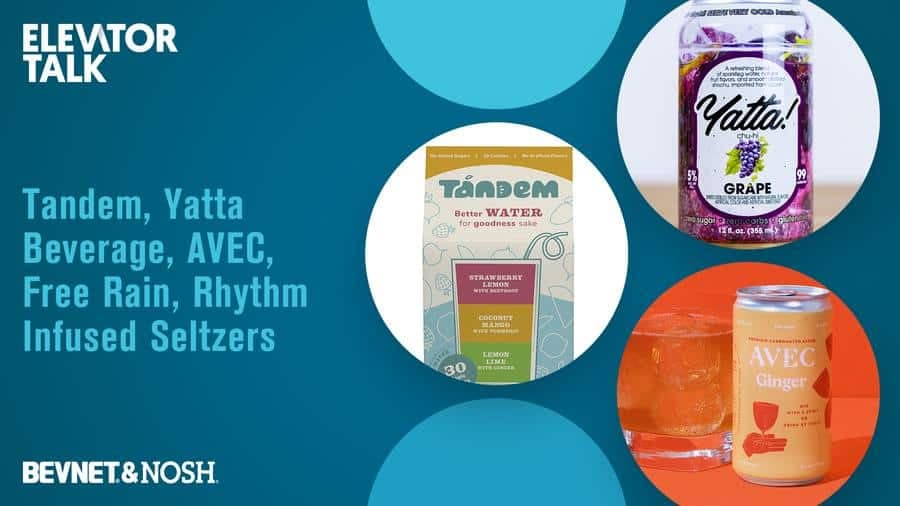
Elevator Talk Ep. 23: Tandem, Yatta Beverage, AVEC, Free Rain, Rhythm Infused Seltzers
THIS EPISODE OF ELEVATOR TALK IS PRESENTED BY | |
|

This episode of Elevator Talk features leaders from new and emerging beverage brands. Our special guest host is actor, investor and entrepreneur Patrick Schwarzenegger, who will share his thoughts, questions and feedback with the participants. He is joined by Ray Latif, the Editor and Producer of the Taste Radio podcast.
Transcript
Note: Transcripts are automatically generated and may contain inaccuracies and spelling errors.
Ray Latif [00:15] Hey, folks, thanks for tuning in to another episode of Bevnet's Elevator Talk. I'm Ray Latif, the editor and producer of Bevnet's Taste Radio podcast, the number one podcast for the food and beverage industry. As always with Elevator Talk, we're going to be speaking with some of the most innovative and disruptive entrepreneurs representing the beverage industry and talking to them about news and new products related to their brands. Joining me as a co-host for this episode is the one and only actor, model, and start-up investor, Patrick Schwarzenegger. Patrick, how are you?
Speaker 2 [00:44] I'm doing great. Thank you for having me on again. Thank
Ray Latif [00:47] you so much for joining us. So great to see you. Uh, you've had quite a summer. You became an uncle, uh, and, uh, you, uh, had a pretty big exit, uh, as an investor in Liquid IV.
Speaker 2 [00:58] Yeah, we've had a, uh, it's been a great summer. Um, thank you for that, about my, uh, me being an uncle, first time, so, uh, exciting for, for all of that to come. But, uh, yeah, Liquid IV exited last week to Unilever, so, um, exciting on that front as well.
Ray Latif [01:14] Yeah, very cool. How long have you been an investor in Liquid IV?
Speaker 2 [01:18] Oh, Maybe 1.5 or close to 2 years.
Ray Latif [01:25] Nice turnaround. It
Speaker 2 [01:26] was, it was a quick turnaround. It's actually probably the fastest turnaround I'll, I'll ever see on a company, but uh it's uh it doesn't always happen that fast.
Ray Latif [01:35] No, for sure. Uh, for folks who haven't seen you on the show before, aren't familiar with your work as an investor, uh, talk a bit about your portfolio and uh how you think about investing in food and beverage companies.
Speaker 2 [01:45] Yeah, so, I mean, I have my own company called Achilles Advisors, which, uh, you know, invests, consults, advises a bunch of different consumer product good companies, um, tends to be better for you alternatives. Uh, we have about 17, uh, CPG companies underneath my arm, ranging from, you know, Blaze Pizza to Super Coffee, Liquid IV, Malk, um, tons of different beverages that have been on your guys' show and, and different fast casual restaurants. But again, we always like to focus on companies that are, are, uh, you know, providing a better for you alternative, something that's healthier, and, um, you know, I really like to invest in companies that are gonna make a, uh, that have a mission and, uh, who's, uh, You know, entrepreneurs and leaders, I, I really believe in.
Ray Latif [02:30] Outstanding. Well, I think we're gonna see uh some of those folks here on the show today. Uh, excited to have you on once again and excited for folks watching at home to uh hear from our entrepreneurs. Once again, if you're just tuning in, this is Bevnet's Elevator Talk. We're gonna be speaking with entrepreneurs from across the beverage industry over the next 60 minutes. Joining me as a co-host is actor, model, and start-up investor. Patrick Schwarzenegger. We have a fantastic sponsor for this episode. That is Mother Murphy's Flavors. For over 74 years, Mother Murphy's Flavors has elevated flavor innovation in the food and beverage industries. Clients can choose from the company's ever-growing library of 60,000 flavors or its TTB approved flavor library of over 2000 flavors. Their in-house chemists can also help you create a custom flavor that will give your products a winning edge on the market. To learn more about how Mother Murphy's can support your product development and innovation strategy, head to Mother Murphy's.com. All right, Patrick, shall we get started? Let's do it. Let's do it indeed. Our first guest for this show is Kate Herling, who is the CEO and founder of Tandem. Kate, how are you?
Speaker 3 [03:36] I'm good. How are
Ray Latif [03:37] you? Fantastic. Uh, where are you calling in from today?
Speaker 3 [03:41] I'm calling in from Austin, Texas.
Ray Latif [03:43] Austin, Texas. I just spoke with someone from Austin. I love Austin. Isn't it great? Uh, uh, the founder of Kube Coffee. Are you familiar with Kuube?
Speaker 3 [03:51] Yes, yes, I'm always at their coffee or pre-pandemic,
Ray Latif [03:56] pre-pandemic, yeah, great stuff. Uh, Tandem, uh, talk a bit about what the, uh, beverage is all about.
Speaker 3 [04:03] Yeah, so we're a new take on the water enhancer. Um, we are, we believe that hydration should be fun, flavorful, um, and good for you. So instead of, uh, Really like the idea for Tandem came from my crazy intake of flavored water, whether it be like single serve still beverages. Um, my previous company was like ready to drink single serve, uh, still and sparkling fruit infused water. Um, and then I really was like, when we decided to go in a different direction, I realized that I was generating so much waste with just like the single serve glass bottles. So this is kind of where a tandem came to be where we thought, why not just create flavor rather than shipping water all over the country and have like an ecom brand. Uh, ready to go. So we have 3 flavors, lemon lime with ginger, strawberry lemon with beetroot, and then mango, coconut with, uh, turmeric. So we're functional without, um, and I find that we're different on the market just because a lot of the water enhancers right now contain electrolytes or caffeine or some sort of combination. And then as a new mother, I wanted to be confident I could share it with my kid. Um, as well as just like drink it. I mean, water in and of itself is amazing. You just need to drink more of it, and I just found myself not drinking enough of it throughout the day, and I think it was cause I was always looking for a little bit of flavor. Um, so
Ray Latif [05:35] what's your primary focus for Tandem? Is it flavor? Is it function? Is it hydration? How are you best getting your point across to consumers?
Speaker 3 [05:42] Yeah, so it's flavor at the end of the day. It tastes good, it's delicious. You really just want a product that like After being in the CPG world for long enough, if it doesn't taste good, you don't even have a leg to stand on, really. Um, and then I think the function does like add a little bit of, um, just, you know, you're drinking water, so it's inherently good for you and then just like the added ginger and then turmeric and like the beetroot, like I think it sweetens the deal a little, but it's not overly You know, it's not a recovery drink. You're not drinking it to um perform. It's just to feel your best during the day.
Ray Latif [06:21] Mhm. Patrick, a similar delivery method to uh a brand we just spoke about, Liquid IV, but a different approach in terms of uh how consumers use the product. Uh, what are your initial thoughts on Tandem?
Speaker 2 [06:35] My initial thoughts are I'm, I'm, I'm a little confused. Um, I'm a little in the middle of trying to understand if you're just a water enhancing flavor, like a hint water, or if you're trying to go more of the functional beverage side of saying, Let me enhance your water and you're already gonna drink water and it's gonna taste great, but let me also give you X, Y, and Z to, to give you more benefits. And I think that's, I think when Ray asked you in the book, in the beginning of where, who's your target audience? Where are you really trying to go? Because, for example, our company, Liquid IV that just sold, um, They had a very clear premise. They first started with, how can I help people with kind of anti-hanovers, right? And they realized that that was such a niche market that they wanted to really just tap in on how can we go into the hydration market of, of what Gatorade and everyone is doing, but with half the amount of sugar and we'll do it where we just have our uh Pour in powders because as you know, that direct to consumer model, your shipping is extremely cheap, your weight is uh barely anything. You're not paying for uh the weight of water or, or the liquid in, in beverages uh for shipping, and they really went after the hydration uh market before, um, you know, some of these other brands have gone after that. So I, I just think you really need to narrow in on. What are you, what are you providing that's not already out there?
Speaker 3 [07:57] Right, yeah, so when we launched the whole idea is that it, our tagline is better water for goodness' sake. At the end of the day, it is functionally like, or it's more, it's flavor focused, so, um, I consider the functional benefits more of the cherry on top of the cake, uh, where it's a little more, it needs to taste good, and I just didn't want a lot of the Like I really liked liquid IV like prior to becoming a parent, and then I just didn't know, like there's a lot of sugar in it, so I wanted something less sugar and I just wanted to drink more water. But I, yeah, that's a good point. Like, I'll definitely like work on that clarifying.
Speaker 2 [08:37] And I'm, I'm not saying you have to go down the, the liquid IV route because that's a, you know, a market that's tapped into and that's exactly what they were doing. I'm not saying to copy that, but I think there's other companies, you know, for me, you know, I know Kara at Hintwater and that's, that's her whole thing. It's like. Like, I needed to get off soda, so, and I thought, I need to drink more water. I didn't like water, how can I give it a hint of flavor? Forget any caffeine, forget hydration, that's it, just a better tasting water. And Liquid IV was completely different of how can we get hydration to be healthier and use technology to get there. So it's just two different spectrums, and I feel like you're hovering in the middle, and if you really think about what is it that you're trying to, to do and, and solve for customers, that'll, that'll make a, a, you know, a clearer route for you with your product. Got it.
Ray Latif [09:22] OK. Can, can you talk a bit about your retail strategy, uh, your go to market strategy? I assume that uh e-commerce is a big part of what you're doing right now, but, um, uh, if it is, you know, is, are, is brick and mortar also a big part of what you're planning to do in the future?
Speaker 3 [09:37] Um, yeah, so right now we're really focused on Amazon and our own website, so we're pouring a lot of money into, um, ads, working with influencers, and just getting into people's hands to try it. Um, retail is definitely there, but as a new brand and we're right now a single SKU, I think it's for when we launch our individual, uh, flavor packs, um, and we just can take up more shelf space. So I think for the immediate future, the next 3 to 4 months, we'll primarily focus on eCom. Um, as Patrick mentioned, shipping is very affordable at this moment in time. Um, and we are able to do a lot of trial just online, um, which I think makes sense in this existing like pandemic quarantine environment where people aren't venturing out as much and there's not like, I mean, I just find that Our exist are retailers that a lot of them are the ones that I've spoken to, a lot of them are going after like the tried and true, like they're not experimenting that much in new brands, but I'm not sure if you've seen that on your end.
Ray Latif [10:52] Yeah, yeah, I mean, I think it's a little bit difficult, it's a little bit more difficult to um get into established retailers, the ones that, uh, you know, have certain expectations or whose consumers have certain expectations about. You know, what's gonna be on the shelf and what they wanna see in new products. It's a little bit more difficult to, to, uh, break into a retailer that way, at least in, in the way it has been done in the past. Um, that being said, you know, what do you see as your biggest hurdle, success going forward? What do you need right now, uh, to help grow your brand? Is it, uh, is it investment capital? Is it retail relationships, distribution, um, you know, in what way can the industry help you?
Speaker 3 [11:36] Yeah, so I think right now, um, we just need to drive trials. So it's, it is gonna be retail relationships at the end, um, you know, I think 2021 is really gonna be a primary focus for us, but just getting it into people's hands. So I'm, Austin has a great CPG community so we're working a lot with our Uh, local trade groups and just trying to partake in all these virtual events, um, but, uh, I find that just tapping into an audience, usually I would be down at like every single event that Austin comes up with like South by ACL just like handing it out. Um, so it's taking a lot more creativity and just ingenuity when it comes to getting people to try it, um, and drive trials. So I find that Like what the industry, like, I think I just need to, um, like distribution would be huge event like in 2021, but I think I've got the ecom, I mean, as we navigate Amazon, which is its own beast, but our own Shopify is Kind of a seamless experience right now.
Ray Latif [12:48] Mhm. Well, I know there are folks watching, uh, at home or in their offices right now who are probably interested in your brand. Drink Tandem.com is how to get a hold of you. Uh, Kate, thanks so much for joining us today on Elevator Talk. Good luck with everything going forward and please let us know if we can help you in any way.
Speaker 3 [13:03] All right. Thanks so much, Ray. Thank you.
Ray Latif [13:06] Thank you. Patrick, as Kate mentioned, you know, it's, uh, sampling and uh getting trials from consumers is a little bit more difficult than it had been in the past. Uh, do you have any tips on, um, best practices for, uh, getting people to try, getting influencers and, uh, gatekeepers and perhaps even investors, uh, to try your product?
Speaker 2 [13:27] Yeah, you know, it's, it's, it, it's definitely Difficult. It's, it's different is how I would say right now. Obviously, with the pandemic, you know, no one is shopping how they used to. We're seeing, uh, direct to consumer businesses, you know, thrive. There's the delivery services that are thriving, but Uh, you know, I had an interesting call with, with Marcus Lemonis recently, who, if you guys don't know who he is, he's on CNBC's The Prophet and he's always on, you know, Squawk Alley and stuff, but if you really look at certain businesses that have been thriving during the pandemic of his, uh, you know, camping worlds and a lot of the outdoor activities and we're seeing our national parks get more, you know, tourism and exposure than ever before, people are still going out and doing things, and I think a product like this and enhancing water during the summer months, um, I just think you have to be very uh unique with your, with your marketing strategy. I mean, I would go to these, you know, national parks or or somewhere, I know in Austin, there's a lot of tourism and stuff going on during the summer of, of people at the lake or, or the kayaking and rowing and, and stuff like that, and I would just be going out there and handing out those products like it's uh no one's business, letting people try it because then you're really not having to spend the, the consumer acquisition costs online and And start in Austin. I mean, Austin is a hub for consumer product goods. They have a lot of hot products that come out of Austin and make it really big. Um, it's a trendy, cool town, and, and, um, I think that you could start right there and, and hit the people that are doing the outdoor activities or something.
Ray Latif [14:56] For sure, great advice. All right, let's move on to our next guest for this episode of Elevator Talk. That's Jason Rogers, who is the founder of Yada Beverage. Jason, how are you? Jason, you're uh muted, but uh we, we'll forgive you for that. My fault. No problem. Yada beverage. Uh, it's a cool name for a brand. What, what does Yada mean?
Speaker 4 [15:20] Uh, it's Yatta.
Ray Latif [15:22] So
Speaker 4 [15:23] it's Japanese slang for like ta da or voila, like we did it or I did it. Uh
Ray Latif [15:30] Nice. Yata. Uh, so tell us about the beverage. What, uh, what makes your beverage and brand special?
Speaker 4 [15:37] Yata is a canned alcoholic drink from Japan called Cuai. It's as a category, it's, uh, almost the size of beer in Japan. Uh, more women under 40 drink chhai than beer in Japan. So if you've ever been there, uh, you've probably had huai, and you've probably had a good time with Chehai. So Uh, the category did over 300 million cases last year in Japan, and it's still, it's still growing at double digits, so it's pretty crazy.
Ray Latif [16:04] What is uai? What is it? What's the base for it?
Speaker 4 [16:07] Uh, shochu. So it's a distilled spirit that's centuries old in Japan, uh. And we use a very specific type of shou that's uh continuously distilled, so it's not distilled like 5 times or 8 times or something like that. It's distilled in like a rack system, so not to give too much away, but it's it's a specific kind of of shochu, um, and we get that from uh our partners, which are 200 year old family owned distillery uh on the Kiso River in Nagoya, Japan. Uh, so we import that, and then we, uh, take it up to Sonoma, and we mix it with sparkling water and natural fruit flavors, natural colors. Um, and it's 5% ABV, 99 calories, tastes super good. And, you know, there's a, there's a small amount of people in America that know what it is, and we, when they realize that, you know, no one's done this before, so it's the first American chhai. Um, and no one imports it, really. So it's, it's crazy that a category that big, um, in Japan is. Doesn't exist here. Um, but when people find it, they're, they're really stoked, so.
Ray Latif [17:22] Yeah, that's really interesting. Uh, Patrick, you're familiar with Cuai? I've never been to Japan. I'm not familiar with the beverage, but, uh, it sounds like they drink a lot of it.
Speaker 2 [17:30] Sounds like it. It sounds like we need to try it, Ray. Uh, sounds like it'd make a great little weekend, but I've never tried it, but I think that it's, it's obviously, I mean, it's extremely interesting that you're. One of the first movers in such a large market that's, that's foreign, and, but the, the biggest thing for me is how do you, how do you bring it over to America, right? How do you educate people like you're doing to me and Ray right now, uh, on Zoom of, of what this, what this product is and why it's so big in, in Japan and how can you make it big in, in the US and, and I think How do you shift people from going on their White Claws or Truli or whatever they are, spike Seltzers over to this Yada product? Um, I think it's really interesting you're, you're, you're describing of the 200 year old, you know, family-owned business on the river, and it sounds like very artisanal, high-grade product to me. Um, the question is just how do you articulate that through branding and packaging and, and in the store.
Speaker 4 [18:27] We're, we're trying to connect with people that kind of know what it is at first and like, Um, you know, one of the few people that knew what it was is my, my cousin from Oshkosh, Wisconsin, who was in the military and was stationed in Okinawa, and I'm kind of telling him what I'm doing, and in the middle of it, he's just like, wait, are you making chhai? And I was like, yeah, you know what chuai is? And, and so we're working, trying to get into the uh military distribution, um, but, you know. You know, through skateboarding, I was a professional skateboarder when I was younger, and then I ran skateboard companies. So a lot of the people that skated for me are now like company owners or pros or legends. Um, and so kind of through them, we can, we can push our, our sort of story out through, uh, social networks and stuff like that. Um, but really, if, if the taste is just insane. So, you know, it's distilled so much that it's like you can't taste any alcohol. Um, and You know, the most popular ones in Japan are 9% tall boys. And, and,
Speaker 2 [19:34] and what's your, what's, is there, is there a benefit towards this type of alcohol versus, um, you know, I, I hear different friends of mine saying, oh, I drink, uh, you know, tequila or vodka, one's an upper, one's kind of a downer, there's ones that are, you know, less caloric or less sugar, or it's better for mixed. Is there, is there a benefit for this type of a, an alcohol or is it just kind of a, a more, um, traditional thing in, in Japan?
Speaker 4 [19:58] Um, for me, it's really taste. Like I, I'm half Japanese, so I, I, I love, you know, a lot of things with Japanese culture. So sort of those things we're going to try to bring over, but mainly it's the taste. It's just, it just tastes much better, and you can kind of lay anything over it cause it's, it's just distilled so much that it just kind of tastes like nothing. So you, you know, there's matchahai with like Japanese ceremonial tea, juice-based ones. Um, so we can run it up to, to 9%. We even made some at 15%, and it was still, it's more like a salary man drink in Japan. So you get a couple of tall boys and get on the train, you drink one on the train, you get home, you drink another one, and that's kind of your night. Um,
Ray Latif [20:42] man, I gotta get, I gotta get to Japan cause I, this is, this sounds like a pretty cool lifestyle.
Speaker 4 [20:46] Yeah, professional drinkers in Japan,
Ray Latif [20:48] man. Yeah, I guess so. Uh, you know, Jason, I'm, I'm wondering about your packaging because You know, uh, I'm looking at a can from your website, and I think right at the top it says America's first domestic chuai, but it's pretty small. Most of what I'm seeing is the brand name, um, some colorful images of the, uh, uh, of a wave and then fruit itself, um, and just some, some notes that it's, uh, no sugar, no carbs, no artificial colors. Um, but as Patrick mentioned before, you have a great story. So, In those two seconds that a customer has to pick up your product and try that great taste that you're talking about, um, you know, I guess, why did you choose not to put a lot of that information on the front of the can or I guess, amplify at least part of that story on the front of the can?
Speaker 4 [21:35] Um, well, I, I think you might be looking at the older can, like, our, our website's pretty trash right now, but, oh, OK. Um, like, I think you have to, like, delete your cache anyway. Um, the new So it looks different than this, right? Oh, I see. Yes, it is different. We started working on this in 2017, so August of 2017, we were skating, and we go and get beers in Venice Beach after, and, you know, I was like, look, we had a good session, but all those calories we just burned, we're going to put them right back on right now. Um, and so we started talking about chhai, let's go find some chuai. Um, and then we changed that because then White Claw just kind of exploded and that had a wave on it, and we're like, uh, we gotta, we gotta change this a bit, so, but like our current can is kind of busy. Um, so the Japanese cans, and I think this is why a lot of people, even if you've been to Japan, you don't know what it is, it's cause it's just fully in, in Japanese. Um, it's just really busy and descriptive, so we kind of wanted to make something that was comfortable for Japanese customers at first, and then ease into a more color blocked, uh, can art in the future. Um. Yeah, yeah, I mean, but as far as like getting people to taste it, I mean, you know, we launched like a little over a month ago, and, you know, we're in 30 stores already in Santa Monica, and San Francisco, and San Diego, and, you know, a lot of those stores have already reordered like 34 times, and, you know, a couple of them sold out in like 24 hours. So, and we're not even really sort of spinning up our social, you know, the people involved with the company, a lot of my friends and family that invested or You know, one of them was the director of the, the Snoop and uh NBA Youngboy video that was number one the other day, like, a lot of them are professional skateboarders, so really it's, it's more of us just getting it into places, and we can drive people to go. Uh, clean the stores out. That's kind of where, where, where
Speaker 2 [23:33] in Santa Monica? I'll go buy one later.
Speaker 4 [23:35] Broadway liquor? OK. All right, uh, Main Street liquor across the street from Rick's Tavern, if you know where Rick's Tavern is, one of the last one. All right, cool, I'll go support right across the street. That'd be awesome. There you go. And anyone taste it, yeah, a Schwarzenegger, that's awesome.
Ray Latif [23:51] You just, you just landed a customer. On elevators. I think that's one of the first times we've had that. Normally, it's, uh talking about products here. You're, you're, you're,
Speaker 2 [24:00] yeah, no, normally it's they, they, they send it over to me, but
Speaker 4 [24:03] I, I sent a bunch down there. I think they got there Monday, so.
Speaker 2 [24:07] OK, no, I'd like to go and, and support, but look, I, I, I just wanna end by, by saying congrats on being the first mover in a uh in a new business.
Ray Latif [24:15] Thank you indeed, Jason, thanks so much for joining us on Elevator Talk today.
Speaker 4 [24:20] Thank you. Big fan of you guys.
Ray Latif [24:21] Appreciate it and uh let us know if you need anything going forward. We'll do whatever we can to help. Appreciate you. Thank you. All right, good stuff. You know, I, I wanna try that product too, but I, uh, I, I'll be out in Santa Monica at some point, I hope. Um,
Speaker 2 [24:34] yeah, next time you come out there, we'll, uh, we'll, uh, crack one open and
Ray Latif [24:39] I like this idea, we'll have some yata. And um I don't, I'm not a skateboarder. Do you
Speaker 2 [24:43] skateboard? No, no, I've, I, I had a little phase when I was, like, 13 where I tried and um a lot of accidents, a lot of falling, it just wasn't for me.
Ray Latif [24:53] I, I, I, I can feel it, I, I hear you and I feel you,
Speaker 2 [24:56] totally. And I would always wear, like, the skinny tight jeans and I would come home and my dad would just look at me and shake his head and just be like, what are you doing? And I'd be like, oh, OK, you know what, maybe skateboarding isn't for me.
Ray Latif [25:09] Yeah, I've, I've gotten that dad look before. I know exactly what you're talking about. Yeah. All right, uh, moving on to our next guest for this episode of Elevator Talk, that's Dee Charlemagne, who's one of the co-founders of of Veck. Dee, how are you? Good. How are you? I'm also here with Alex. Oh, there you go, Alex Doman as well. I'm, uh, where is Alex? I know. Ah, there you go. OK, in the background. Good to see you guys and good to hear from you guys. Avec, uh, a mixer brand. Tell us a bit about what's, uh, what makes your brand special. OK, so, um, Avec is named after the French word for wit. We wanted, because we want to change what people mix with their alcohol. We figured customers are tired of drinking bland vodka sodas, sodas full of artificial stuff or cocktails full of sugar, so we wanted to create a mix of brand updated for the modern day, tastier, healthier and more sustainable. Think doing what Sweet Queen did for salads, but for mixers. We use all natural ingredients, real fruit, botanicals and spices to create delicious, better for you drinks, balanced perfectly for spirits. We have a range of 5 flavors, ranging from ginger beer, our, our version of ginger beer, where we use pineapple juice instead of cane sugar, to a user in lime, which is like a zero sugar, 0 calorie version of the tonic water, all made here in Brooklyn. Our flavors are all down to 20 calories and either no or low sugar. And our ambition is to work directly with farmers, improving supply chains whilst innovating around packaging to reduce waste. For example, we're in a can, unlike all of our competitors at the moment, which are in bottles, to reduce weight and waste. Uh, we say just mix in a 2 ounce shot with a single can of avec and you're good to go. And yeah, just to, to build on that, you know, um, as important as what we do is how we do it. So obviously, you know, you take your 2 ounce shot, uh, and have our can, but our brand has always taken inspiration from the revelry and decadence of the 1920s. And so we really believe, um, you know, a culture of drinking helps us connect and stay together. So we're not really made for like, you know, you can't have us by ourselves, but we really believe, you know, people that drink together feel better, more connected, and there's actual research to prove that. Um, yeah, we see ourselves as updating that spirit to the 2020. So, you know, we're different kinds of people are coming together and mixing in new and modern ways. Um, and so we're really made for the person who goes to the bar, sort of what Patrick was saying earlier, and this, you know, you've spent all day working out, you go to the bar, and you're like, uh, can I get a vodka soda or vodka neat or something like that with a splash of this to try and sort of hack your way to a healthy drink. Um, and they can simply go to the bar and say, you know, can I have a vodka, avec? Use your lime or that grapefruit and pomelo, um, and get a healthy drink. And we launched, uh, in June of this year, which is a bit crazy amid pandemic. Uh, but we're both online and in 30 retailers in New York again, made in Brooklyn, so sort of sticking locally.
Speaker 2 [27:53] I'm curious to know what your guys, um, you know, distribution kind of route is and, and where you're planning on selling this because it says, you just mentioned you got into 30 retailers, but is, is your hope that this is kind of a B2B play and you're going into bars and helping the bartender just, you know, you ask that for a little pour into your, uh, vodka soda, or is this something you're helping people buy at the grocery store for at-home, uh, beverage making?
Ray Latif [28:17] I think it's both, yeah, I think it's both, uh, we wanna be, you know, in culture and at places and spaces that matter socially right now that's at home, you know, people are mixing and throwing parties and at home and discovering drinks that way. When bars open, we think our consumer is gonna go to the bar and still be looking for an option like this. So our plan is to grow right now very much at home. Most of our sales have been online, but we're growing at retail as people, you know, the shopping. Sort of changes and people get out there more to the grocery store. So, I see on your cans, it says uh mixed with the spirit or drink by itself. Uh, how much of your business, how much of your business do you expect to be uh for this product as a mixer or as a ready to drink option? So we're positioning it specifically as a mixer because we think it's sort of our key differentiator, but like any good mixer other than tonic water, you know, it should be good to go by itself as well, and, and, you know, early signs, uh, you know, show that it's, most people are using it to mix, but a, a good like a third of people or, or whatever are, are, um, using it to have by itself. And an 8-ounce can. Why did you choose a package like that? I'm curious, um, you know, mixers and, in some cases we've seen in a variety of package sizes. Why did you choose a can? We just wanted to make our life more difficult, um, higher minimums, uh, be different, no, uh, we really wanted it again to be in that mixer category. So, you know, 8 ounce with 2 ounces of spirit and ice, you kind of have a perfect drink and it hints at that. And then also from a sustainability standpoint, we want it to be in a can rather than like a heavy glass bottle to reduce waste. And I think that packaging innovation will sort of continue in our future, but we wanted to start with this format, um, for that reason. Mhm. You know, flavor-wise, mixers run the gamut. Um, I do like some spice in my mixer. Me too. Yeah, and Patrick, I'm sure if you've been to their website, the first thing that comes up is jalapeno blood orange and it's happening again, my mouth is watering. Um,
Speaker 2 [30:17] mine's actually hibiscus pomegranate, but I was gonna mention your guys' site is pretty beautiful. Um, it's very, uh, unique and, and whoever did it did a great job with the aesthetics and kind of Different motions and stuff like that.
Ray Latif [30:34] To to hear that that's for sure. Yeah, I mean, I think part of the, part of the benefit of, you know, sites, especially for a company like yours is educating the consumer about what kind of uh cocktails they can make, etc. Um, what is your education strategy, uh, for this type of product? Um, obviously, you know, the proof is in the pudding or in the drink, so to speak, but, um, how are you getting people to understand that they can elevate their beverages with your products? So I think this is one of the things which we struggle with because of COVID and normally so much of that education goes on at the bar. So think Aro Spritz, think, you know, any of the sort of signature subs, so we, we've sort of had to take a different approach, and what we're trying to do is, is we've sort of scrambled to create a bunch of. Educational, uh, you know, um, material for the T2C, um, businesses and, and install we're, we're doing flowering and trying to sample where we can, um, to, to kind of get this message across. It's a single can and a 22 ounce shop, but it's not easy. So, in terms of, you know, how you're convincing consumers versus retailers, when you're talking to retailers, you know, the, the shelf space for mixers is pretty full, you know, if you think about, um, if I go into my local liquor store or my local grocery store, it's not a huge set, um, but it is pretty full. How are you finding ways to convince retailers to, to grant you that kind of shelf space? I think we're very much positioning ourselves. Each of our, um, mixers, so 5 different flavors are aimed at an existing mixer. So think instead of tonic water, as Alex mentioned, we have our yuzu lime, instead of grapefruit, we have our grapefruit and pomelo, each with a better for you message, and they know that's what consumers are looking for. Um, and so it's a pretty easy sell to say, you know, you can replace your ginger beer with our ginger. It's gonna have, you know, crazy less calories, be better for you, all-natural. Um, and right now, you know, Alex and I are going door to door, um, and so that founder belief and sort of conviction, even in, uh, these times, I think has been a huge, huge push for us as well. Mhm. Um, Patrick, we got about a minute left, you know, I, I'm interested to hear your thoughts on, uh, the mixture space and, you know, how you think about it in terms of, uh, investment and growth, especially, you know, amid the pandemic.
Speaker 2 [32:52] Yeah, I mean, look, it, the alcohol space has been exploding since, uh, since COVID has happened, right? I mean, Constellation Brands, their, their, you know, quarter earnings, I don't know if you guys watched that or listened to any of their, um, quarter calls, but the alcohol business, um, you're seeing the spike seltzer industry go up by 200 to 400%. It's, you know, unheard of growth, um. So I, I, I think that consumers are looking for something more than a vodka soda, adding a splash of something to give them that kind of flavor, um, and I think they want that healthy alternative. They don't want the, the sugar and the carbs, and you guys are offering that. Again, for me, the biggest thing is You know, I think, I think with you guys, you have to create brand identity, right? Because people are, uh, they're not gonna go to a bar and, and kind of know your product, um, and usually the bartender is not gonna have the time to educate the consumer right there. So I think for you right now, it's all about kind of brand identity and the marketing side, so that when bars and all that stuff do open up, um, you create brand identity. I, I would really utilize this time. And become friendly with a lot of the bar and restaurant owners. Um, it's a really tough period for a lot of, uh, retail, restaurant, bars, clubs, etc. right now, and I think that you reaching out, creating a friendship, creating a relationship, um, finding ways to see if you can help them at all, um. Anything like that, I think that people will really remember, um, you guys reaching out during a tough time like this, and, um, it could help for when things get back and moving again. Um. I, I would just think of, of doing something like that.
Ray Latif [34:35] Indeed. Uh, great advice, Patrick. And Dee, Alex, thank you so much for joining us today on Elevator Talk. Uh, I really see, uh, some great things with your brand, uh, as, uh, Patrick did as well. Um, good luck with everything going forward and, uh, I'm hoping to see your brand in New York sometime soon. Thank you. You can order it online also. There you go. There you go. All right, see, we got sales people all over the place today. I'm, I'm definitely gonna get some. All right. Thanks so much again, guys. Thank you. Patrick, that was actually interesting advice, you know, I, I haven't done the um Or cocktails to go thing yet and uh they, they, it's, it's legal now in the Boston area uh as of about a month ago, a month or so ago. But I wonder if uh if you were ordering a cocktail to go, if you could just get, say, a can of a Beck or, you know, a mixer like that, um, and maybe a nip or something like that to go with it, um, and you just kind of do your own cocktail at home.
Speaker 2 [35:33] Yeah, I mean, I, I, I think, you know, a lot of people are doing the cocktails at home, clearly, since the, the business has been booming. The, the, the big thing is, you know, I don't know if that's partnering with the Grubhub, Postmates or something like that in local, you know, New York City of, uh, or partnering with certain restaurants that do, you know, if they do a vodka soda, and you can do an add-on of, you know, You know, maybe, maybe that's a marketing strategy for a vet. They don't even charge them, they just say, you know, try this with your vodka soda, and they put it in the pack. You know, I'm not, I'm not really sure. I don't know the legality of how that all works with to go alcohol in New York and and stuff like that, but um I think it sounds delicious.
Ray Latif [36:13] Yeah, yeah, with a non-alcoholic product, um, it doesn't sound like you're gonna run into any issues as far as I would know, as far as I would think anyway. All right. Uh, great stuff. Uh, let's move on to our fourth guest for this episode of Elevator Talk. That's Colin McCabe, who is the founder of Free Reign. Colin, how are you? I'm doing
Speaker 5 [36:31] well, thanks. How are you?
Ray Latif [36:32] Very good, very good. Free Rain. Uh, is that a play on the, uh, the common, commonly known or commonly held term? No,
Speaker 5 [36:39] a bit, a, a bit, it is.
Ray Latif [36:41] A bit. All right. So, Free Rain, uh, tell us about what you guys, uh, do.
Speaker 5 [36:46] Well, free reign is sparkling water with more. I, I created it because I wanted more from sparkling water, more flavor, more function, more feeling. And we use powerful natural uh ingredients to that end, including adaptogens and nerves. A number of years ago, I stopped drinking. I was training for an Ironman. I was running a lot of marathons and triathlons, and when I did that, I took a hard look at the beverage space, um, and, and I noticed two things. One is I wanted more flavor um from what I was drinking, and that uh I still wanted to feel something from what I was drinking. So I started experimenting. I would go to the health food store and I would get adaptogens and fresh fruit juices and bring them home to my soda stream and work on different concoctions, and it was at that point that I realized, you know, I was onto something, and I found somebody here in Brooklyn to uh help me uh further produce these beverages, and we came up with 33 different flavors, 3 different feelings, and the first is energy, which is tart cherry and Siberian ginseng. The second is Focus, which is ashwagandha. It's a blood orange ginger, flavor, and the third is calm, which is blackberry with passion flower. Um, each one of these is 25 calories, no added sugar, clean label, and no caffeine. Um, we launched 7 weeks ago, only direct to consumer. Um, and an important part of the brand too. is in our sustainability. Um, everything I do is, you know, uh, for pleasure is in the natural world, and so it's important that we partner with 1% for the planet to support environmental charities. And 2 is like a, a lot of small or young beverage brands, we have sleeved cans, but on our cans, we have a pull strip, so that when you pull the strip, you can remove the label to make the can 100% recyclable.
Ray Latif [38:48] That's really interesting. I didn't know there was, uh, such a product. Um, is that common? I haven't, I've, I, OK, yeah, I didn't, I didn't think so. Um, yeah, I'm looking at your can right now. It's beautiful packaging. Thank you. And I'm really glad that for your energy products, you're using Siberian ginseng because that's the only type of ginseng I use, um.
Speaker 5 [39:07] Yeah, I mean, Pexx ginseng is really powerful, and I used to take it, but it is not a daily use, um, uh, functional ingredient. It, it, it, you have to cycle off of
Ray Latif [39:18] it. For sure. Um, you know, sparkling water, the category is expanding. Um, we are seeing a lot of brands, uh, do really, really well, uh, in that space, um, but it is becoming As I mentioned, you know, pretty crowded and competitive. Um, Patrick, what are you seeing in Free reign that you like? Uh, what are you seeing in some things that, um, you know, could help them along their journey as they're uh getting into this category?
Speaker 2 [39:47] Right, I, I, I think the functional space is, is really big. It's, um, it still hasn't hit its, it's time, I don't think, um, you know, I think maybe it has started to in LA and New York and certain divisions of, of America, but not nearly close to being mass at all. Um, but I also think that the side of, of, of the world that's growing, which you talked about a little bit, is, is this. Community of people that are stopping, stopping drink and still want the feeling, right? They want to be able to go with uh friends to go get a, a cocktail and have some sort of, you know, something else that doesn't involve alcohol but still feel socially acceptable and, and having a fun time. Um, I think that, Ray, if I'm not mistaken, on our last call, we had, uh, some, some brands kind of similar to this moment and, um, Was it Kin or or some something else that was um there. So, I think that you, you gotta go after a really targeted specific audience. Um, I think it's really interesting, like you said, you wanted to do the Ironman and you wanted to stop drinking, but you wanted that feeling, that's a big thing for me. Um. I, I, I'm, I'm on your website and I wanna just point something out. I don't know if you can see, but here's your, your homepage. Yeah. Um. To me, it doesn't It doesn't do anything. Uh, it doesn't show anything of your product or give you a feeling that you're getting from the product or the mission that you're trying to drive, or your why or your purpose or anything. It just says make you. Uh, so I I just would, would look at that. I would look at maybe putting your products on your homepage or um the feeling that you're getting or, or kind of a, a more authentic community shot of people, um, you and your friends going out to drink, but they have drinks and you have your drink. It doesn't always have to be alcohol. Something that's involving the customer in understanding what it is that they're, they're getting from your homepage.
Speaker 5 [41:47] Got it. That's a valuable feedback. If you did click that find your flavor tab, it would lead you directly to that.
Speaker 2 [41:54] But, but I, I understand that. But remember, you know, one just one extra click for a customer. You'll see the fallout rate. I mean, that's, that's like marketing people, that's all they do is how can we reduce the amount of clicks for, for our customer, because if they have one extra click, the fallout rate could be, uh, monumental. So I think you wanna have it right there, your products, an easy, quick click to shop, um, or else, you know, you could lose a customer right there. Yeah.
Ray Latif [42:24] You know, uh, I described your products as sparkling water cause that's, I guess what really resonated with me. Patrick, Patrick described them as functional beverages. Um, where do you start out when you're talking to consumers? Do you start out with function or do you start out with refreshment?
Speaker 5 [42:39] Well, what we've found in all this data is anecdotal, that people are buying us for the flavor, or they're re-buying us. Most people are re-buying us for the flavor. Um, certainly the, the functional part, um, you know, there's a segment, um, I would say, you know, as of now, less than 50% are buying us for the function. Um, but it's our job to educate people and, you know, we've just partnered with an in-house herbalist, um, named Rochelle Robinette, who's going to help us further educate people on the power of adaptogens and nerves, etc. Um, I would like to see that number, you know, we, we get Across the board, great feedback on the flavors, but our goal, our mission is to really get people to understand the power of the functional ingredients. So, you know, we're a sparkling water, we're an enhanced sparkling water though. So the idea is. Everybody's drinking sparkling water, do it with some intention, right? If you're going to drink it, have it do something positive for you.
Ray Latif [43:41] Uh, one of the other things about sparkling water is that it's usually an affordable, at an affordable price point. Um, what, what's your price point for a can? We're 299 a can. Yeah, I can. Yeah, that, that's relatively in line with the functional beverage, would you say, Patrick?
Speaker 2 [43:57] With a functional beverage, yes. With a sparkling water, uh, no. And I think that goes back to what you're saying, Ray, is, is, uh, what is the messaging? Because if you're compared to just sparkling water, a lot of people that are price sensitive might just, you know, rule you out. But if they understand that this isn't just sparkling water, it's enhanced sparkling water, I'm getting extra bang for buck, then yeah, then they'll go up that maybe that extra $1. Um. I just, I think you should really look on your, your website if you're selling direct to consumer right now of what is it that you wanna, you know, what do you want customers to understand from your product and just really go through and see is that, are, are they getting that out of this, this website? Um, it sounds like you're, you're, you're saying that you need to educate people on your ingredients and. I don't see anything about the ingredients. I mean, I would, I would love to see a, you know, a profile on Ashwagandha, what it looks like, what that is, or the, you know, Siberian ginseng, or those, those, you're, you're paying hefty prices for those ingredients to be in your pack in your, in your product. Um, if you are, then explain to the customer what it is and why it's such an artisanal, uh, ingredient and what they're benefiting from it. Otherwise, just go into the, the sparkling beverage.
Speaker 5 [45:15] Got it.
Ray Latif [45:15] Yeah. We've got about 1 minute left and uh I noticed, Patrick, you nodded your head when um uh um when Colin talked about the 1% for the planet uh relationship that they have with free reign. Um, you know, how much does that matter to, well, Colin, I'll ask you, how much does that matter to your consumers? And Patrick, how much does that matter to you as an investor?
Speaker 5 [45:42] I, I think in many ways, um, a sustainability message right now is table stakes. Um, you have to show some consideration, um, for some cause. For me, it happens to be environmental. Um, in, in especially launching a business now. So I think it is important. I think, again, in terms of educating our consumer, um, it's another area for us to educate, you know, with the idea that 1% of every purchase goes to an environmental charity is a powerful message, and, you know, the onus is on us to, to be making that, you know, clear to everybody that's buying free reign.
Speaker 2 [46:24] Um, it's, it's huge for me as a, as a customer and as an investor, um, you know, going back to Liquid IV, um, for me, that wasn't just a, you know, a hydration product that was cool or something that helped with hangovers, whatever, you know, the, the founder, Brandon had a clear mission. This was all about a mission of Of how to get, uh, you know, better hydration products out there, and, and he was doing the one for one, kind of the Tom's model of, uh, donating a stick, um, to someone that was, uh, you know, malnutritious or didn't have, um, you know, correct hydration or water in, in certain communities, and he donated over 5 million sticks of liquid IV, um. So all the companies, you know, that I like to go involved, get involved with have a mission, and I think that from data that I've read and I've seen more and more millennials are starting to purchase uh based on companies that are B corps or have a mission-driven, um, product, and, um, I, I just think that business, entrepreneurialism, products are such a great medium to continue to push a mission and educate consumers about other aspects. Um, so I'm, I'm a really big believer in, in having a mission as part of your, your company.
Ray Latif [47:36] Outstanding. Uh, Colin, uh, so great to meet you and speak with you. Uh, as I mentioned, love your packaging and can't wait to try your product. Uh, Free reign is the name. What's the website?
Speaker 5 [47:47] It is Drfreereign.com.
Ray Latif [47:49] All right, fantastic. Thanks again for joining us on Elevator Talk today and, uh, please stay in touch. All right, thank you guys. All right. All right. Uh, down to our final guest for this episode of Elevator Talk. That's with Ian Monet, who is the co-founder and CEO of Rhythm Infused Seltzer. Ian, how are you?
Speaker 6 [48:09] Hey, I'm doing good, Ray. How about you? Nice to, uh, to speak with you and
Ray Latif [48:13] Patrick. For sure, nice to speak with you as well. Did I get your last name, uh, correct?
Speaker 6 [48:18] Uh, Ian Monet,
Ray Latif [48:19] Monette, OK, that's what I thought. Um, you can tell you're a beverage entrepreneur because in your office you got the cases to the right of your desk there. I love it. That's
Speaker 6 [48:30] the sample stash.
Ray Latif [48:33] I saw you drinking some of your product. Is, was that, was
Speaker 6 [48:36] that, check out that color.
Ray Latif [48:38] There you go. OK, so we know you make seltzers and we know they have a nice, beautiful color, uh, but what are, what are they? What do they do? What do they make? What, what makes them different than other seltzers on the market?
Speaker 6 [48:49] Sure, yeah, rhythm is a better for you, functional CBD seltzer brand that tastes amazing. Uh, I come from the wine and spirits industry. By day, I'm a musician by night. And, uh, when my founders and I set out to create rhythm, um, we, uh, we really want taste to be the number one priority. Uh, Rhythm is a health and wellness brand. So our drinks have a clean label, all natural ingredients, uh, 5 calories, no carb, or excuse me, one carb, no sugar. They're vegan, gluten-free, non-GMO. Uh, we're brand new. We just launched last month. We're selling, uh, Rhythm Awake, which is a CBD energy drink, uh, with, um, uh, caffeine from green tea. And we've got a CBD sleep aid, uh, that is a blackberry lavender flavor with CBD and melatonin. Um, both drinks have 15 mg of CBD in them, uh, and they're infused by, uh, Vertosa, which is, um, uh, out of Oakland, California, and, uh, one of the leaders in the infusion space. Um, we, uh, aside from selling, um, on e-commerce on our website, Drink Rhythm.com, uh, we have, uh, secured, um, a handful of distribution, uh, in the Bay Area where, where I am, in some CBD stores, and as well as in, um, the Phoenix, uh, Arizona market where my business partners are. Um, and, um, Uh, actually, if, if you don't mind, Ray, I have an announcement. We, uh, we just secured our, our first, uh, distributor. Uh, very exciting. It's, uh, uh, Pod Foods in San Francisco, which is gonna help us, uh, break into the natural and independent grocery channel, which we think, uh, is a really good fit for rhythm.
Ray Latif [50:40] Outstanding. Congratulations on that. Uh, Pod Foods, I've heard good things about them. So, uh, well done. Um. You know, uh, I, I have seen a lot of CBD beverages over the past year. Patrick, I'm sure you've seen your share as well. Um, you know, what's the story? Uh, you know, obviously, you're, you said you're a musician by night. Uh, I'm, I'm getting that there's a, a correlation between the brand name and what you do for your night living. Um, but, you know, how do you talk to people about this product and why it's different, why it's better than other CBD, uh, products in the market?
Speaker 6 [51:18] Sure, yeah. Your first question about the story and and why rhythm is um I uh created the concept of rhythm using CBD when I would play live music at shows, uh, the CBD. would help me with, uh, focus, anxiety, and uh anti-inflammation in the hands. Um, but I would, I would, you know, I would try tinctures, but it tastes like grass. I would try, uh, lotion, but it would get, get my base all greasy. Uh, and so, uh, and I'm, and, you know, just in general, I'm a, I'm a seltzer fan and so, uh, so when I was coming up with a, uh, uh, with the product format, Um, I really wanted a ready to drink seltzer, uh, with, uh, with, with that was infused with CBD. Um, so I was born, so rhythm is born from music, but it also has to do with, uh, like the rhythms of our bodies. So like that, and that's why we decided to go with, uh, the functional aspect to it, is because we want to enhance your, your circadian rhythm, your biorhythms. We want to help you sleep better. We want to help you, uh, perform during the day better.
Ray Latif [52:25] Uh, yeah, it's pretty hard to slap the bass when uh you've got a topical that's really greasy. I, I can't imagine. Yeah. Um. You know, the, the energy product that you have is kind of interesting. I don't, I don't recall hearing or seeing too many CBD infused products that have a, an energy component, a caffeinated component. Uh, does that, is that something that interests you, um, Patrick? Because. Yeah, yeah.
Speaker 2 [52:49] I actually was just gonna bring that up. Here's the, the thing that's, that's interesting and I wanna, I wanna know from you, Ian, is, is do you see a sale discrepancy between the energy one and the sleep one? Because I think that a lot of people are starting to get educated about the idea of CBD. However, I would say probably 90-something% of people, when they think of CBD, they think of calming, anti-anxiety, something that's kind of a down, um, and it, to me, it seems kind of counterproductive with, uh, the energy. So I totally understand the sleep side and calming down, um, and I'm just curious to see if people are a little confused on, on the idea of CBD with caffeine.
Speaker 6 [53:32] Yeah, so your first question in terms of the, the sales, uh, mix, um, you know, we're, we're so new, we see a lot of people just trying the variety packs, so I can't really got it tell you point to one or the other. But, um, you know, the, the caffeine and the CBD, um, I've heard that, that question from a number of people and really what we're doing. Uh, is, is, um, providing clean, calm energy. So it's, it's caffeine without the jitters. Um, and, uh, you'll, you'll, you'll find that pitch from a lot of the CBD infused coffees that are out there and CBD infused teas. And, um, yeah, we do it
Speaker 2 [54:08] with uh super coffee with L-theanine to try to balance out without the jitters. So I, I, I get that, yeah. Mhm.
Ray Latif [54:16] Uh, from a category perspective, Patrick, um, you know, what interests you most about CBD? Are you a regular consumer, I should ask, first of all, of
Speaker 2 [54:24] CBD? No, I'm, I'm not. I, well, sometimes, actually, I, you know, I had shoulder surgery a few months ago, so I started to, to try to take it for, um, I've heard of the benefits of anti-inflammatory, um, and I, and I work with a company called Beam. Um, that does, um, CBD products and, and why I bring that up is because we found that their most, you know, their bestselling products were the ones for night, the night powder for your tea or for, um, pills for, for athletes, for anti-inflammation and stuff. But look, I, I live in LA, um, you know, we see the trendiest of the trendiest stuff. Our, our, our markets are, are stocked with all the different kind of CBD, this thing, that thing, functional, this thing, that thing. Um. So, I, there's tons of people that get it. Um, I've never felt the immediate kind of, like, the, the benefits, so I've never really continued. Um, but that's not to say that there's the, the market's huge. I know that a lot of people are using them for their, their pets and that a lot of people are using them for creams, topicals, and, and drinks, so I'm sure that this is a space that's interesting. Um, I just have never really invested in, in many cause it's It's, it's a really saturated place right now, um, at least in, in LA, so, um, but you, I love your packaging, your packaging looks really great and clean, and, um, I don't know anyone that's doing it in the seltzer, or maybe recess was, or I, I can't remember. Who is, uh,
Speaker 6 [55:54] they're, you know, recesses of seltzer. They, they, they use L-theanine and, uh, ginseng and as their functional ingredients, and, uh, but we, uh, we gotta, we gotta change that. We gotta get you some samples, Patrick, so you can, yeah,
Speaker 2 [56:07] we got it. And what's your, what's your price point?
Speaker 6 [56:10] Uh, the SRP is 599.
Ray Latif [56:14] OK. Pretty much in line with uh what we're seeing for CBD products too. Um, you didn't call it a seltzer uh you called it a seltzer, not a sparkling water. Why?
Speaker 6 [56:24] Um, it's a, you know, one less, um, syllable, uh, that's, uh, you know, it's the, the seltzer category is hot now and, and, and because, and it's because, um, of the, um, basically the connection with the cocktail community. So we, you know, we, we, we love that rhythm is a great healthy CBD infused drink on its own, but it also plays well, um, with the on-premise. Um, uh, channel, and, uh, we'd love to see, you know, beautifully colored cocktails, um, you know, in bars all around, uh, the country once, uh, uh, once we're out of, uh, COVID land.
Ray Latif [57:05] Yeah, that was definitely something that was on the rise, CBD infused cocktails for sure. Well, I'm rooting for you, Ian. Uh, Rhythm sounds like a, a great brand. It sounds like you're off to a great start. Uh, good luck with everything going forward, and uh I'm sure we can figure out a way to get Patrick some samples.
Speaker 6 [57:20] Thank you very much to both of you.
Ray Latif [57:22] All right, thanks again for joining us today. Congrats Well, Patrick, uh, that was great. I really enjoyed taking some time to speak with our 5, well, 6 entrepreneurs if you include our two co-founders, um, uh, from Avec. Uh, you know, we, we really ran the gamut in terms of, uh, you know, beverage types from, uh, flavor enhancers to, um, uh, is it chewy? I, I, what was Yata again? Chewhai, Chew Chehai, I think so, um, mixer.
Speaker 2 [57:54] I've had hai chew. Have you ever had hai chew
Ray Latif [57:56] candy? I have had hai chew, yes, that's interesting. How about that? There's a hai chew and there's a chewhai, yeah. Um, you know,
Speaker 2 [58:04] collaboration potentially.
Ray Latif [58:05] Yeah, hey, I see you're on to something. You, you could, you could have another career as a marketer there.
Speaker 2 [58:10] There you go.
Ray Latif [58:11] Um, you know, I heard you talk a lot about, uh, function today, and this is something that's been a consistent theme with you, uh, joining us on Elevator Talk in the past. Um, and it seemed like some of the brands had a more difficult time, I guess, um, Amplifying the message of functionality. Uh, how have you seen it done in a really intelligent and impactful way and what are some of the ways that they can incorporate our entrepreneurs, they can incorporate that message into their packaging?
Speaker 2 [58:38] Yeah, I, I think, look, if, if you're going down that route and you're a functional beverage, then you got to lean into that, right? You're paying that premium for those ingredients like I've said, uh, then show it on your packaging, show it on your website, show the artisanal ingredients and where they're from and why you chose to do that and what's the impact on the customer. Um, or go the other way. I, I just wouldn't stand in no man's land because then you're paying for those high priced ingredients and then you're not articulating it, then it's like, you're just another one of those companies. Um, how I've seen it done magnificently, and of course I'm biased, but is our company Super Coffee. Um, you know, they keep it very simple of adding the L-theanine. You know, they do the protein, no sugar, L-theanine, so you don't get crazy jitters. And that's a functional ingredient. That's something that people didn't really know too much about, but they started to educate the consumer, this is something that you're getting 200 mg 250 mg of caffeine. That's a huge punch. But then we give you the L-thenine so that you're not, you know, tapping your legs every day at, at class or at the office. And I think that's a, a clear way of saying, we're paying for something a little bit more. You're getting a great benefit, and this is what it's doing for you. Pure, simple, clean, and that's that. Um, and I think they, they do a great job of articulating that and, and making it as a differentiating product and something that people want to go to because of that. Um, so, for my advice for a lot of the companies out there is just, you know, either lean in one way or the other, I wouldn't stand in no man's land, and, um, yeah.
Ray Latif [1:00:10] Well, it's great advice, uh, and you've been providing great advice, uh, for every episode that we've, uh, had you join us and, uh, particularly today. I, I, I don't know why I, I guess I forget, uh, how, uh, terrific you are on this show, but, uh, every time you're on, I'm, I'm so appreciative of you being on. So, Patrick, thanks so much again. Uh, I, I gotta ask, can we have you on again at some point?
Speaker 2 [1:00:33] Let's do it. Next week, I'm there.
Ray Latif [1:00:36] Outstanding. I love it. Uh, well, signing off for our fantastic, uh, co-host, Patrick Schwarzenegger, uh, our amazing team at Bevnet and Nash, and thank you so much to our sponsor, Mother Murphy's Flavors. Check them out at Mother Murphy's.com. I'm Ray Latif, the editor and producer of Bednet's Taste Radio podcast. We'll see you next time.