Search across the BevNET CPG Media network including BevNET, Nosh, Brewbound, Taste Radio, Nombase and CPG Jobs.

New Beverage Showdown Finals - Round 2 - The Bad Tea Co.
Transcript
Note: Transcripts are automatically generated and may contain inaccuracies and spelling errors.
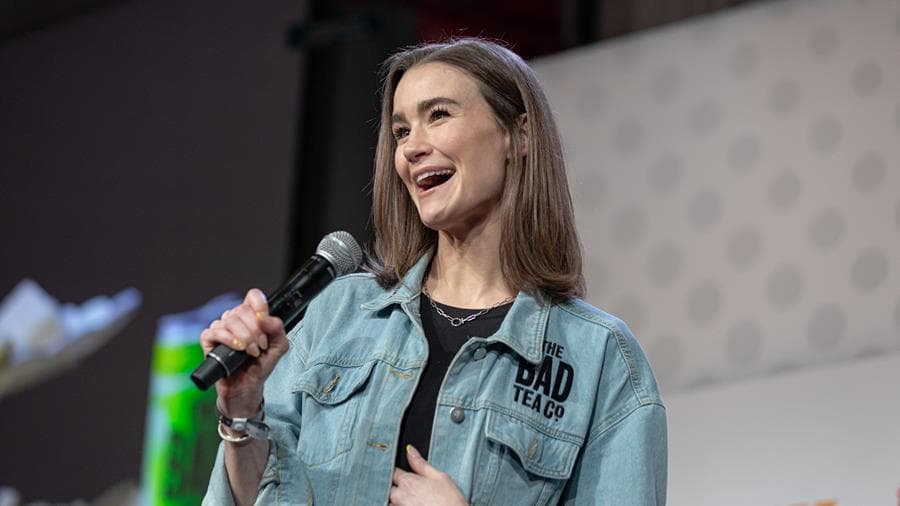
Speaker 1 [00:18] All right. Welcome back. Hope everyone enjoyed lunch. It is now time for part two of the final round of New Beverage Showdown 25. Let's get right to it with our first presenters, Elise Eilerman and Rohan Tangri, the co-founders of the Bad Tea Company. Come on up. you. And please just keep an eye on your timer.
Elise [00:51] Hello Bevnet, I'm Elise
Rohan Tangri [00:53] and I'm Rohan, and we are the co-founding couple giving tea a bad makeover.
Elise [00:58] During the pandemic, like many Americans, we experienced stress and anxiety, which was exacerbated by a few too many espressos. There's a huge group of Gen Z and millennials, 46% to be exact, who are stuck in a love-hate relationship with coffee, needing that level of caffeine but hating. The upset stomach or anxiety spiral that follows. There are many better for you options on the market, but in an age of ever evolving definitions of health, it can be hard to keep up. Tea is a great source of natural health benefits and caffeine, but legacy players have not evolved to changing consumer preferences, especially among young folks. It's clear that there's an opportunity to modernize tea from both the flavor and functionality perspective.
Rohan Tangri [01:43] It's been said that millennials are responsible for the death of Ice-T, but really we think that they, along with Gen Z, are a catalyst for something new. Starbucks has really popularized flavors like matcha and chai and all over the country you'll find people that are excited about and regularly consume those flavors. Beyond that, 40% of customers already drink. Uh, drink tea in place of less healthy beverages, such as, you know, it moderates the anxiety levels of compared to energy and, uh, energy drinks and coffee. In fact, I distinctly remember a conversation with my mom back during the pandemic who's both a doctor but also a classic Indian mother where she suggested drinking tea as a way to moderate our stress levels. We did and it really improved our quality of life and that's when we started bringing caffeinated teas into our daily lives.
Elise [02:34] There are 3 things that make us different. 1, we've enhanced the natural caffeine and L-theanine of our products so that they're a real functional replacement for coffee. 2, we've modernized both the flavors and production methods of our products. More on that later. And 3, we're bringing a playfully irreverent persona to the tea aisle that appeals to coastal and non-coastal consumers alike. And we're the first in what we've defined as a new subcategory of beverage called extra caffeinated teas that combine the functionality of coffee with the health benefits of tea. All of our products have a 1 to 1 ratio of caffeine to L-theanine, 80 mg each.
Rohan Tangri [03:12] And in terms of where we sit on shelves, we are not an energy drink, and we see the biggest opportunity in appealing to dissatisfied coffee drinkers. Tea is the 2nd most consumed beverage on Earth, and so educating consumers on using tea as an alternative to coffee is a pretty simple hill to climb. This is also where our packaging comes into play, as you can see, when you put us next to tea and coffee, the colors, textures and fonts we use really pop. Specifically, the use of the word bad serves as a fun point of entry to our brand and moment of discovery on shelves. We've tested this extensively, and when consumers see the word bad, they're probably thinking what many of you are thinking, why is it bad? Then when you pick up the can, you can clearly see in the wavy text on top that bad is an acronym for bold and delicious. This makes sure that all of our customers are in on the joke with us, uh, and become part of our brand world.
Elise [04:02] And when a consumer opens a can and takes a sip, they'll experience our unique East meets West flavors that are an extension of the beautiful fusion of cultures that our relationship represents. I'm corny. That's my favorite thing about bad tea. Our tie features a bowl masala blend that's based on Rohan's family recipe. It's smooth, ginger forward, and crisp. The black teas we use are sourced from. India and Kenya and the agave is sourced from Mexico. It's also nitro infused, so there's no dairy or dairy alternatives. This reduces our environmental impact and also lowers the calorie content, so everything's just 35 calories. Our matcha is also nitro infused and complements matcha from Japan with a touch of vanilla for a velvety taste that's reminiscent of ice cream. And our Yuzu Palmer is a modern twist on an American classic half Yuzu aid with yuzu juices from Korea, Japan, Korea and Japan, and half iced tea. MSRP is 3.99, and we're currently working on 4 packs and variety packs for specific retailers.
Rohan Tangri [05:01] We launched our mana in a market test late last year where we spent nearly every day of a 3 month span in store talking to consumers. Not only did we validate that there was demand for caffeinated teas, with over half of consumers saying that they were trying to cut back on coffee, but our matcha also did the highest unit velocity of any matcha in the natural channel nationwide and was also in the 86th percentile of velocity for ready to drink teas. This makes us really excited about the launch of our rebranded and expanded lineup of skews coming later this fall. And also gives us the ability to address the 60 million Americans who are currently dissatisfied with their caffeine source.
Elise [05:40] Take it from us, being bad has never tasted this good. Thank you so much.
Speaker 1 [05:50] Right, well done. Let me just have you guys stand over here so that the cameras can get you. Perfect. And you can hold on to your microphone in case the judges have any questions for you. Here you go. Uh, John, let's start with you. Um, you know, a lot in that presentation, a lot to communicate about the bad tea company. Do you see it articulated in the front of the pack?
Speaker 4 [06:09] Um, yeah, I think so. I mean, I think, um, just in terms of like what we saw and what we tried, I mean, I think, you know, we've tried the. Matcha and the Yuzu, uh, lemon both are, you know, quite tasty. I mean, I think, um, what I would sort of caution, I guess is that chai, matcha, and, you know, kind of an Arnold Palmer like seem like three very different types of products for three different consumers, um, which I think a lot of times like beverage strategies are like, you know, have a couple of different SKUs that are kind of appealing to the same consumer base, but. Um, you know, I think I, I like where the brand's at, you know, playful, fun, did a nice job of, uh, conveying that too, so.
Speaker 1 [06:56] Dan, uh, Elise and Rohan articulated a clear and unmet need for a different type of RTDT. Are you convinced? Yeah, I mean, I, I actually love the idea of it. Uh, I, I agree with the idea that there are maybe trying to do too much across the tea brands or across the tea flavors, starting with the idea of Yuzu Palmer, and I would make that the signature flavor. I would just do that. Um, I think you've got a great concept and, and, you know, I'm a sucker for a good 2x 2 and so that was, uh, that was really great, um, and it, and it showed where it could be placed on in coffee but be very different. And cheese. So I love the idea of bad tea energy. I love the idea that bad tea energy feels good with L-theanine versus caffeine, um, which is good. It sort of gets me into an Ed Sheeran song somehow. But then the idea around this, um, it's a drink, it's a drink for and by millennials. There were, there were 3 brands today like Life Cider, Gutsy, Bad that we looked at it. Those are the best position. On trend beverages for consumers today, so I just think it's a little bit around, I'm not trying to trying to do too much in the tea category. Just do the bad thing, you know, I think, um, oftentimes you get the, the beverages that are, um, we start from function and we, we try to get to the edge, get your edge up on. Bad tea, you know, the, the crushing of the, the, the, the, the coffee pot and so forth. I mean, that's, that's right on. It's, it's some people are looking for, for more different energy, and there's a lot of that out there, and you can start with tea. Thank you. Yeah, Greer, I didn't know that millennials killed iced tea, and sorry to hear if anyone really loves iced tea because millennials apparently killed it. But, uh, you know, when you're thinking about this new type of functional beverage, this new type of beverage made with L-theanine and caffeine, I mean, is this something that you see consumers trading their coffee for?
Speaker 5 [08:41] So I'm actually a consumer who drinks mushroom coffee every morning, so yes, um, but I think that having that, um, the amount of caffeine that you need to feel it without getting that, you know, anxiety that people get from caffeine is actually exactly what the consumer is looking for. The Arnold Palmer kind of confuses me in terms of like that whole strategy, but the obviously matcha and chai make a lot of sense there.
Speaker 1 [09:11] And Charlie, you know, in terms of the tea category and the set, I mean, how do you see bad tea as fitting in that set?
Speaker 6 [09:19] Yeah, um, I, I was actually really excited to see your products. I, I think something that's been on my mind a lot lately is when you are shopping the RTD coffee set. This is really obvious and straightforward, but there isn't anything for the tea customer right now, and that actually is something meaningful, meaningful to me because I, I am that customer. I love, uh, a London fog or, um, a really good matcha ice latte and so. When I'm thinking about the trade over between cafe to RTD, where is that for that customer? and I think that you are headed in the right direction. I, I would love to see you lean into that more, that, that idea, and the reason that I'm a, I'm a tea drinker is, is for the caffeine piece, right? I feel crazy when I drink too much, uh, cold brew, so I, I, I want to see you really play that up even more. And I'm, and I'm with you on the matcha chai. Those things feel cohesive to me with that cafe experience. The, the, uh, the Arnold Palmer piece feels like the piece that's not so cohesive, but I love what you're doing, so.
Speaker 1 [10:28] All right, thanks. Great feedback, great presentation. Well done. Thank you.
Related Videos
From Finance to Fizz: Yoni Schwartz's Refreshing Journey
Taste Radio Studio interview with Yoni Schwartz, Founder of Fresh Fizz Sodas - a journey from finance to crafting unique, clean-label beverages.
Refreshing Origins: Hal's Journey to Seltzer Stardom
Taste Radio Studio interview with Stephanie Reda, Director of Brand Development at Hal's New York. Discover the story behind their iconic seltzer and snack brand.
Taste Radio Studio interview with Ryan Lewendon
Taste Radio Studio interview with Ryan Lewendon, partner at Giannuzzi Lewendon, discussing their expertise in consumer goods and beverage brands.
Taste Radio Studio Interview with Dino Sarti
Join Taste Radio Studio for an exciting interview with Dino Sarti, Co-Founder of L.A. Libations, discussing their portfolio and partnership strategy.
Chamberlain Coffee: CEO Talks Brand Growth and Retail Expansion
Chamberlain Coffee CEO discusses brand growth, RTD line, DTC strategy, Gen Z focus, and retail expansion in Taste Radio interview.