Search across the BevNET CPG Media network including BevNET, Nosh, Brewbound, Taste Radio, Nombase and CPG Jobs.

Not Your Nonna’s Parm. Farmer Foodie's Plant-Based Path.
Transcript
Note: Transcripts are automatically generated and may contain inaccuracies and spelling errors.
Speaker 1 [00:02] Hey folks, it's Ray with Taste Radio. Right now, I'm honored to be sitting down with Allison Elliott, who is the founder and CEO of Farmer Foodie. Allison, great to see you.
Speaker 2 [00:10] It's wonderful to be here, Ray. Thank you for having me.
Speaker 1 [00:12] And we're here in Providence, Rhode Island at Naturally New England's Naturally Rising Pitch Slam, of which you're about to take the stage in about 45 minutes or about, about 1 hour or so. So I really appreciate you taking the time out of your busy schedule. Are you nervous? Are you excited? Are you all of the above?
Speaker 2 [00:30] All of the above. I'm very excited. I feel like I have a great community here that I've built up over the years, so I'm grateful that I'm gonna be pitching to people that I know and that know my products.
Speaker 1 [00:42] OK, that always helps when people know your products and you're telling them, just sort of reiterating what you're doing. And what is it that you do at Farmer Foodie?
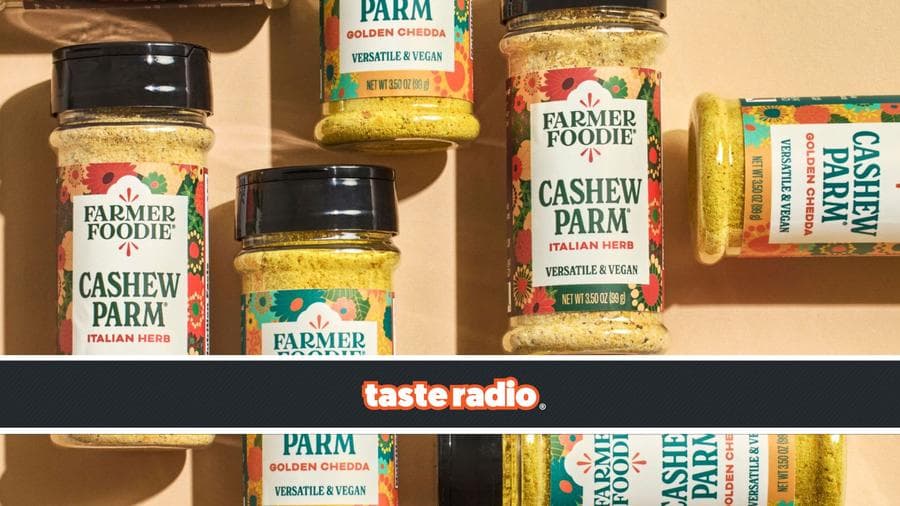
Speaker 2 [00:49] Yeah, so Farmer Foodie, we make deliciously memorable cashew palm products that are shelf stable, sustainable, and free from dairy and gluten. And we have two different flavors, golden cheddar, which emulates a cheddar-like flavor with an umami peppery punch, and Italian herb, which consumers actually report tastes like pizza in a jar.
Speaker 1 [01:11] Cashew pm, is it as intuitive as I would think? Uh, do, do people get it?
Speaker 2 [01:15] People do get it, although some consumers do call it cashew farm, which I understand the mix up between farmer foodie and cashew palm when you're reading it quickly at a Whole Foods demo, for example. But yes, it is intuitive. The reason why I named it Cashew Parm is because, you know, growing up I would order. Eggplant parm or something like that at a restaurant, Chicken parm, before I became a vegetarian. So I feel like people understand parm means Parmesan and obviously being a dairy-free product, legally it can't be called Parmesan.
Speaker 1 [01:44] Hence, uh, the cheddar as well,
Speaker 2 [01:47] exactly, yeah, which a lot of people think is a Boston accent at markets and demos. And I'm originally from New York, although I have been in Boston for 5 years. So it's quite funny, especially when you are speaking to a true Bostonian, that mix up.
Speaker 1 [02:02] I never would have guessed you're from New York. I've known you for what, 4 or 5 years at this point. What part of New York are you from? Are you from?
Speaker 2 [02:07] I'm from Westchester, New York. It actually says Scarsdale, New York on our packaging because my LLC is filed at my parents' home.
Speaker 1 [02:15] I'm sure they're very happy and proud of what you're doing. How do you, how do you get into entrepreneurship? Was this something that you always dreamed of doing, or is this something that just came out of a need in your own personal life?
Speaker 2 [02:24] I have always dreamt of entrepreneurship. I do think I'm really creative, and my background is in farming, hence the name Farmer Foodie. So I was the education director. On an organic farm for 4 years. That's when I created Farmer Foodie as my plant forward food blog. And really I did that because I was already making all of these new delicious recipes with, you know, all of the fresh produce that I had grown from seed to table, and family and friends just encouraged me to start, you know, my own food blog. I did and then decided to actually get my MBA in social impact from Brandeis University. While I was there. I used all of the class projects as opportunities to explore various business opportunities and eventually settled on Cashew Parm. My initial idea was box mac and cheese because. You know, I was in grad school during COVID, so every Thursday I would make my vegan mac and cheese recipe, which is actually now in powder form, our golden cheddar flavor. You can simply add water, mix it into a mac and cheese sauce in 2 minutes. Who
Speaker 1 [03:24] are the people that are consuming your products? Who are the people that are buying your product? I would assume it's mostly people who live a dairy-free vegan lifestyle. Um, is that the majority of your consumers at this point?
Speaker 2 [03:35] Not necessarily. We do definitely cater to vegan consumers, vegetarian consumers, people who are lactose intolerant. Actually, a third of the US population are lactose intolerant, so there is a big market for that, and you know, people who legitimately have dairy allergies, but a lot of non-vegan consumers love our products and actually consistently report baking it on top of chicken and fish. Oh
Speaker 1 [03:59] wow, OK. Now, when it comes to retail, retail buyers are always looking for brands and products that are going to drive incremental, uh, foot traffic and revenue to their stores. How do you talk to those retail buyers about the fact that Farmer Foodie will open up a new lane for their customers, open up a new lane for those, uh, retail locations where customers are gonna be looking for your product and saying, hey, I'm coming to your store to buy this product and then, you know, fill my basket with other products as well.
Speaker 2 [04:34] That's a great question. So currently our industry, you know, plant-based alternatives to Parmesan, we have minimal competition. So in retail, in the natural channel, we have a few competitors on Amazon we have a few competitors, but this is definitely sort of an untapped market. So we're excelling when it comes to flavor and footprint, which is really great. I think our packaging really stands out. It actually has botanical elements of cashew apples and cashews coming out of them. Consumers consistently report. Generally, with the plant-based cheese industry being dissatisfied with taste, texture, and meltability, and with cashew parm, we've solved those issues. So you can simply, like I said, add water to the products and mix them into a sauce, or you can sprinkle it onto something like frozen pizza, put it in the oven, it will absorb, it will disintegrate, it will sort of melt and add flavor into whatever you're baking, and it can withstand high temperatures for long periods of time. So part of the value proposition to a retailer is really the fact that it's something innovative that people love the flavor of and it can be stored on your, you know, in your pantry. It doesn't have to be in the refrigerator, so it's inherently sustainable. It's something different from what you typically see in the plant-based cheese set or even the plant-based set in general, so it is sort of like. A new opportunity, a new, a new market. Um, in fact, when I initially started applying to Whole Foods, their category review schedule, I didn't know what our category was, so I was applying to plant-based cheese, and then I was applying to seasonings, and then I was fortunate to learn that we're actually the pasta sauce category, which is wonderful because we're positioned next to dairy-based Parmesan, and actually that's a $4 billion industry in the United States. 68% of that are shelf stable Parmesan sales.
Speaker 1 [06:29] OK, if I'm a retail buyer, you just convinced me. I want to know more. I want to test the product in my stores. I want to see how my customers use your product or at least think about using your product.
Speaker 2 [06:39] Well, whenever I'm at Whole Foods, I'm sampling on top of popcorn, which I actually am here today. Consumers love popcorn. I think that's just kind of known. People want to try it and then they ask. Ask, oh, what else can I use it on? So they think initially, oh, a popcorn seasoning, this is innovative. There's nothing like this really in the retail set. I mean, maybe you can order it online, but like there's no cheddar powder in retail that you can purchase unless you buy a box of mac and cheese, right? So although our product line is called Cashew Parm, the flavor profiles are very innovative, and I think that's what really draws the consumer in. Because our competition, although minimal, they typically have just a standard Parmesan-like flavor. So, you know, you can use that in various ways, but it doesn't always add. All of the flavor that you want to what you're making, people love popcorn, but traditionally what I've said and what I do continue to say is this goes great on pizza, pasta, popcorn. You can mix it into super risotto, bread, chicken, fish, veggies, you can. Bread, um, you can put it on smashed Parmesan potatoes, for example, and that's actually in the Sam Adams brewing the American Dream cookbook, our smashed Parmesan potato recipe. So we're getting the word out via social media. I have a wonderful team of consultants who help us day to day and also, you know, through opportunities like this podcast, pitch competitions, the whole nine yards.
Speaker 1 [08:06] Outstanding. This is a difficult business that you're in, uh, CPG and. The learning curve just keeps going on and on and on. What's been the most challenging part of this industry for you? What's been the most rewarding?
Speaker 2 [08:21] The most challenging part is really getting into retail. So, obviously retailers have category review schedules, so it's not like you can just get into a retailer, launch your products a few weeks after your initial conversation. Of course we all know buyers are very, very overwhelmed. Everybody wants to talk to them, pitch them their products. There's new products coming out left and right all the time, so just getting into those new retail accounts has been. Not necessarily a struggle, but it's just difficult in the sense that it takes a very long time. We found out we were gonna launch in Whole Foods last July and then we launched this January, so that's a multi-month timeline where we were gearing up production. Fortunately we have a great co-manufacturer, but it's a long time to wait. Similarly, we found out in July that Thrive Market was interested. We just launched in March. That's a very long timeline, so it's kind of. You know, for a pitch competition like this, you need to think about your financial projections and where you're growing and sometimes you don't know what new accounts you're gonna launch into just simply because an opportunity hasn't hasn't risen yet.
Speaker 1 [09:33] Yeah, uh, and it's funny because I'm, I'm on LinkedIn right now and, um, it was big, you know, you launched Farmer Foodie in, uh, 2022 and You know, everyone wants to get into Whole Foods, or at least people, uh, that operate businesses like yours wanna get into Whole Foods, and you, you're like, oh, you know, I saw this brand there, I saw this brand in there, and it might take you 3 years to get into one region and you're in the North Atlantic region here, um, in the New England area. When it comes to the changes that you've seen in grocery over the past 3 years, um, how have you been able to keep up? And I know you talked about the consultants that you work with, but how have you been able to. Um, maintain the focus and vision that you've had, uh, you know, despite all the changes that, that we're seeing in this industry.
Speaker 2 [10:21] So it's interesting that you bring this up because when we first met, golden cheddar was being advertised as everything cheese with a Z in a raft brown stand up bag. So the first thing that I did just to even get onto the retail shelves was rebrand and expand the product line, right? So naming the product line Cashew Parm as mentioned. So that consumers immediately knew what the product was and strategically innovating an Italian herb flavor that tastes like pizza so you know, OK, this is something that you put on Italian dishes you put on pizza, pasta, that kind of stuff and so early on getting that feedback was fantastic. I think you know the retail industry, there's constantly new products coming out and obviously new competitors are rising and just. Thinking about the future of farmer foodie, I'm strategically thinking about sachet applications, so using this maybe in a box of mac and cheese. I've discussed a few co-branded opportunities with various brands that are also in Whole Foods, and you know it's something that can be. It's something that can be put on popcorn as well, so you know there's opportunities when it comes to private label, and I think as this category grows we're gonna see more opportunities with the Trader Joe's of the world, for example, or Whole Foods private label that want to. Use our products on snacks in that category.
Speaker 1 [11:47] Very interesting stuff. Uh, I'm curious as to what those private label opportunities will look like, but I think we'll save that for another conversation. Allison, I'm so excited for you because Farmer Foodie has come a long way and, and just getting to this point of 3 years in, we're in Whole Foods. 3 years in, you know, we've understood what the customer wants, what kind of packaging needs to be out there in retail for them to appreciate what you're selling. Um, it's really remarkable. So congratulations on everything that you've accomplished to this point. Good luck with the pitch slam. I know it's gonna go well, and, uh, let's do this again soon.
Speaker 2 [12:19] Thank you so much. I appreciate it. Thank you.