Search across the BevNET CPG Media network including BevNET, Nosh, Brewbound, Taste Radio, Nombase and CPG Jobs.

From Campus Kitchens to Publix Shelves: Monsoon Kitchens’ 20-Year Journey
Transcript
Note: Transcripts are automatically generated and may contain inaccuracies and spelling errors.
Speaker 1 [00:04] Hey folks, it's Ray with Taste Radio. Right now I'm honored to be sitting down with Swati Olavia, who is the president of Monsoon Kitchens. Swati, great to see
Speaker 2 [00:14] you. Thank you, Ray. It's great to see
Speaker 1 [00:16] you too. Yeah, thanks so much for joining us, uh, here at the Naturally New England Naturally Rising pitch competition. Uh, is, uh, this something that you were ever interested in, in? You guys are pretty far in. You don't need to be in a pitch competition right now. We,
Speaker 2 [00:28] we probably don't need to be in a pitch competition, but you know, our big business is food service. So in retail we could actually come and do a pitch competition, but we didn't, we are not participating in today's. Yeah,
Speaker 1 [00:39] but Monsoon Kitchens has been around for a long time, 20 years, 20 years. Incredible. Um, Tell us a bit about the origins, the history of the company.
Speaker 2 [00:46] So the history starts with me. Uh, my background is in nutrition and food science, and I came to America to do my PhD in nutrition, and then I came, did my PhD in nutrition, became a registered dietitian, and then I worked for a large CPG company, General Mills. Um, my husband moves a lot. And uh when we moved to Boston from Minneapolis, I wanted to do something that I really enjoyed and I was good at and that was Indian food and I loved CPG Company. I mean I loved the business of CPG so I thought why not combine my skills. With what my experiences and around that same time in 2001, my daughter went to college. And when I went to the parents' weekend at that time, I asked the chef, I said, you are serving Mexican cuisine, you are serving Chinese food, but you are not serving Indian food even though there are so many Indian students. What university is this? University of Chicago, and he said, you know, we would love to do that, but we don't really know how to do it well. It's complicated and there are no good products that are turnkey. Uh, that we can use and I was like, what is turnkey? I mean really at that time I had to think about what was turnkey. There was no Google at that time, so when I found out what turnkey was, it took me 34 years to figure out what my mission was going to be, and I figured I would try and create a product line that would be wonderful, um, assistance to the chefs that they could serve their customers whether it was colleges, hospitals. And that's how it began.
Speaker 1 [02:23] That's fantastic, and I'm so. Excited, I know this is in the past, but I'm so excited for the opportunity for food service operators to have high quality Indian food without the kind of preparation that it would necessarily take to start from scratch. Typically we see CPG brands go from retail and then maybe introduce a food service line. For Monsoon Kitchens, it's the opposite. That's right. Why get into CPG?
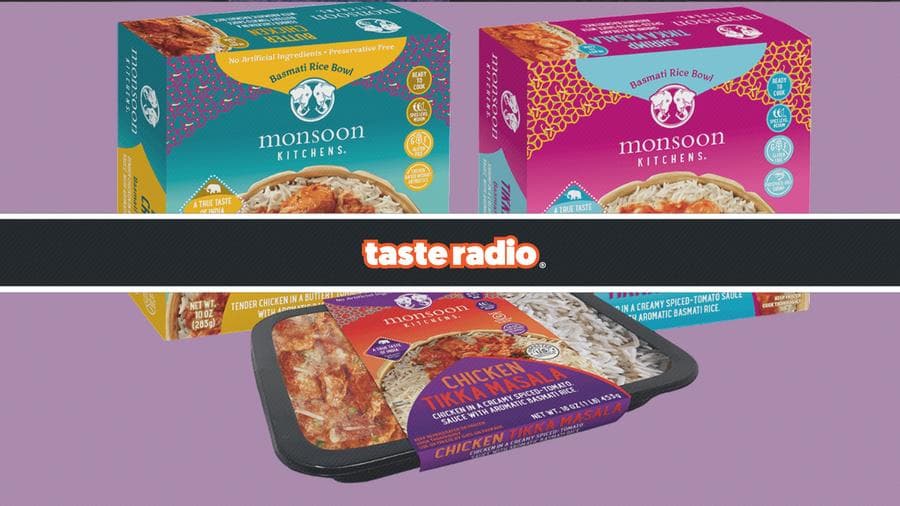
Speaker 2 [02:51] I think the brand name has been recognized by a lot of people in the food service industry. When we go and do the trade shows, everybody says, where can we buy this? And they can't really buy our food service products because they're big, so, uh, they're like big boxes, so we thought we are going to go ahead and introduce some retail products and when we decided what to introduce in there because we have just now 32 food service products and we decided we were going to do some fresh products. So just now I've brought you two of the items. I did not have a third one, in our warehouse, but we have a chicken tikka masala which is a 16 ounce meal and this can be sold either frozen. Or this can also be sold as slacked out in a fresh,
Speaker 1 [03:35] yes,
Speaker 2 [03:35] and then there is a butter chicken here, same, uh, 16 ounces, and we actually have a coconut shrimp curry. Which no other Indian company is doing it. We are the only ones who do seafood, and, um, these are just now selling in
Speaker 1 [03:51] Publix,
Speaker 2 [03:52] Publix markets. So these are in about 1000 Publix markets.
Speaker 1 [03:57] That is an interesting retailer for you to, I mean, was that your first retailer, or that
Speaker 2 [04:01] was our first retailer for these products. And guess what? We just got this on a Kuwait military base. Oh
Speaker 1 [04:06] wow. So
Speaker 2 [04:08] the 1st 1st order just delivered yesterday.
Speaker 1 [04:10] You have some interesting first-time retailers, uh, Publix, which is, um, as most folks know, primarily, primarily based in the Southeast. They're really well known for Florida, and then a Kuwaiti military base. Um, I would not have guessed that in 1000 years. That was one of your retailers. Um, when you were thinking about your retail strategy and where you wanted to be, why was Publix an interesting or a, a, a key primary retailer for you guys?
Speaker 2 [04:35] So it was not because we wanted to. It happened because we introduced our products just before COVID in 2019. By the time we were ready to start getting buyers meetings, COVID hit. It was impossible to get any buyer to look at anything new because they were struggling with what they currently had. But then when they started doing Zoom calls, the public's buyer got very interested in it. So whoever at that time would be interested in it, we could ship the product, and they said fine, we are going to launch it at the following October. So this was launched in 2021 October in Publix. Why would we say no, correct? And we had not even shown it to anybody else at that time. We were just trying to basically throw the mud on the wall and see which one sticks, uh, but then we also had frozen items. We had lovely frozen samosas with a packet of tamarind chutney. We got quite a bit of national distribution with that, uh, during COVID and after that, but. The prices kept going up. We didn't understand how to do it right, and I will completely agree on that, that people have to know how to get into retail and try and make money. We couldn't make money on the frozen, so we decided to pull back for a while and we will go back with a better assortment of products because there are a couple of Indian companies that are doing well. We don't want to be the same old, same old, so we will go back, but we will go back with something more unique.
Speaker 1 [06:05] I feel like Indian food, branded Indian food is having a moment. We're seeing a lot of new, uh, Indian-centric brands come to market, and those that are already existing on the market seem to be doing quite well. But then that also means you have more competition. You are seeing more, uh, frozen entrees on shelf in primary retailers like a Whole Foods, uh, Wegmans, uh, Target, uh, Walmart, what have you. Is that competition good or is it, has it made it a little bit more difficult for you to kind of stand out and explain why you're different?
Speaker 2 [06:40] But that's where the skill comes in, correct? Because I always feel that if. You didn't have competition and if you felt that all Italian restaurants have opened in the world, there will be no other new Italian restaurant, so there is more competition for those kinds of cuisines. Indian is still starting. It's a, it's a very big pie, and we haven't really just, I think we have just basically scratched the surface. So yes, the competition for another tikka masala would be hard. But then there is something else, so for coconut shrimp curry that we do, we have no competition, and everybody seems to be interested in it because it's differentiating, but I think. I don't know if you know a lot about Indian food. OK, so Indian food is so varied. I mean we have such incredibly delicious vegetarian items, and I don't think anybody's selling those. There are some shelf stable products, but in the frozen there is hardly any vegetarian that is just promoting health. That is still not the case. We are just doing traditional Indian cuisine, but being a nutritionist, I think there is something to be said about how our products or how Indian food can be extremely helpful for people, especially given what today is happening. I mean. If you see what's happening is all these new products are coming, healthful products, but for the first time there is a negative correlation. Heart disease is again increasing. Obesity does not seem to ebb at all. Something is not right here. I mean, we, we are eating healthy. We have healthy products on the shelf, but the population is not getting healthier.
Speaker 1 [08:26] You just blew my mind right there. I, you're totally right.
Speaker 2 [08:29] I mean it's a 20 year reverse for, for heart disease.
Speaker 1 [08:34] Well,
Speaker 2 [08:34] uh, it's, it's amazing what's going on. So as a nutritionist, my first love is nutrition, my second love is CPG, but I do keep my credentials as a registered dietitian, and I read a lot about it, and it just boggles my mind that we have a lot of good healthy products, but we are not seeing. It correlating with the health
Speaker 1 [08:55] improvement. So as the founder of a brand like Monsoon Kitchens, how do you walk that line between saying our products are healthy and our products are also very delicious? I would think delicious is probably the, the thing you lead with. Absolutely. So how do you talk about health or how do you want to start talking about health?
Speaker 2 [09:10] So, so we talk about health in some ways that, OK, our products have first of all very clean ingredients. It has moderate amounts of fat. It doesn't have a lot of fat. Our sodium is moderate, which is considered to be not low sodium, but it is moderate that people who are trying to improve their health can be consuming it, but we need to come up with new products. That's where our goal is. We do sell those in food service just now like we have lentil-based dishes and we have beans dishes like pulses. We have a lot of those. We haven't brought them to the market in retail, and that's what my next 5 years will be.
Speaker 1 [09:50] When you do have innovation or innovation pipeline, you have new products that are, you know, potentially coming to market. Who's the first call? Is it, do you, do you start talking to retailers way, well ahead of. That the potential launch
Speaker 2 [10:05] we would like to start doing that and this is my very first month I just joined naturally in New England because you know before that I was focused on college and university associations, all the other food service trade agencies, but now if I want to be playing in this arena I have to be a part of Naturally New England because that's where my heart is. Well, I, I think salmon would be a great addition to our product line.
Speaker 1 [10:31] I think, I think what I'm looking at right here on the, on the table that we have is a really delicious product or products, you know, cause you have your chicken tikka masala and your butter chicken that I want to eat right now, and I can't obviously, but you know, if I had a microwave, I can. Yes, OK, I'm gonna, I'm gonna get back to you, Swati, and talk, talk to you about my experience with these and I hope that folks in the region. Where stores are located, uh, get a chance to try Monsoon Kitchens as well. But in the meantime, thank you so much for taking the time to sit down with me. I really appreciate it and very, very excited to start seeing Monsoon Kitchens maybe in the Northeast pretty soon.
Speaker 2 [11:09] Well, we hope so. I mean, if it can go to Kuwait, why not Northeast?
Speaker 1 [11:14] That's a really good point. I'm really glad we had this opportunity to sit down and talk. Thank you so much.
Speaker 2 [11:18] Thank you for inviting me. Thank you.