

For an industry that’s supposed to emphasize relaxation, cannabis has surprisingly zero chill. This year marked another 365 days of high excitement and anxiety, specifically in relation to the explosion of legal hemp-derived THC, as the push-and-pull of economic opportunities and legal hurdles combined into a dizzying cocktail that left us all feeling, well, a little high. Let’s recap some major themes:
♻️ Regulatory Run-Around
This year proved that no assumptions around cannabis were safe – even in weed-loving California. The Golden State has been one of the leaders in legalizing and professionalizing a new marijuana economy, but the arrival of hemp-derived THC products pushed liberal leaders into something of a bind: turn a blind eye to a rapidly growing and unregulated channel, or seek to incorporate intoxicating hemp-based products into the existing state cannabis bureaucracy, which governs regulated licensed sales.
The result: an emergency ban on hemp-derived THC products that’s in effect until March, not so much a solution as a way to buy some time. Vowing to “not sit on our hands as drug peddlers target our children with dangerous and unregulated hemp products containing THC at our retail stores,” Gov. Gavin Newsom announced in September an emergency ban on any detectable quantity of THC from industrial hemp products meant for human consumption — which includes food, food additives, beverages and dietary supplements.
While halting business for the immediate future – the ban is in effect until March 25, 2025 – the long-term viability of Gov. Newsom’s move may come down to economic factors: according to an analysis by cannabis research firm Whitney Economics, the total potential market (TAM) of California’s hemp-derived market is $3.65 billion and accounts for over 41,000 jobs, while an industry survey found that 83.3% of respondents said they would either go out of business, move to another state and/or transition their business online. In Virginia, a similar ban has been linked to a 0.1% increase in state unemployment, another potential third-rail for legislators to confront.
The patchwork of state-by-state rules means some markets are breaking ahead of the pack: Minnesota, where beverage sales have been legal for several years, is thriving: hemp THC drinks jumped from 20 SKUs to around 400 between 2022 and 2023, Minneapolis dispensary owner David Gonzalez told BevNET this year. He’s been active in organizing and presenting that growth story – over 3,000 retailers in the state are now selling hemp THC drinks – to stakeholders and decision makers.

💻 Market Moves Online
As government officials stroked their chin in search of ways to corral the runaway hemp market, cannabis beverage entrepreneurs (as well as more big players) continued to find plenty of white space online.
Florida-based Brez, named a Rising Star at BevNET Best of 2024 Awards, exemplified the trend, taking an inventive and disruptive approach to slanging cans of low-dose, cannabis-and-mushroom-infused sparkling drinks. With outspoken founder Aaron Nosbisch chronicling the company’s growth on social media, the brand has helped underscore how consumer demand – influenced in part by declining alcohol consumption and lack of retail availability in many states – is strong enough to make an online drink business economically viable, to the tune of around $25 million in sales (per Nosbisch) since formally launching in summer 2023.
They’re not the only ones seeing that connection: this summer, both Wana Brands (a subsidiary of Canopy Growth) and Curaleaf launched their own online hemp-derived THC stores to sell their own respective products, including beverages.
🤩 Make Way for the Stars
If George Clooney can make a credible tequila, then surely Snoop Dogg can be trusted with weed drinks.
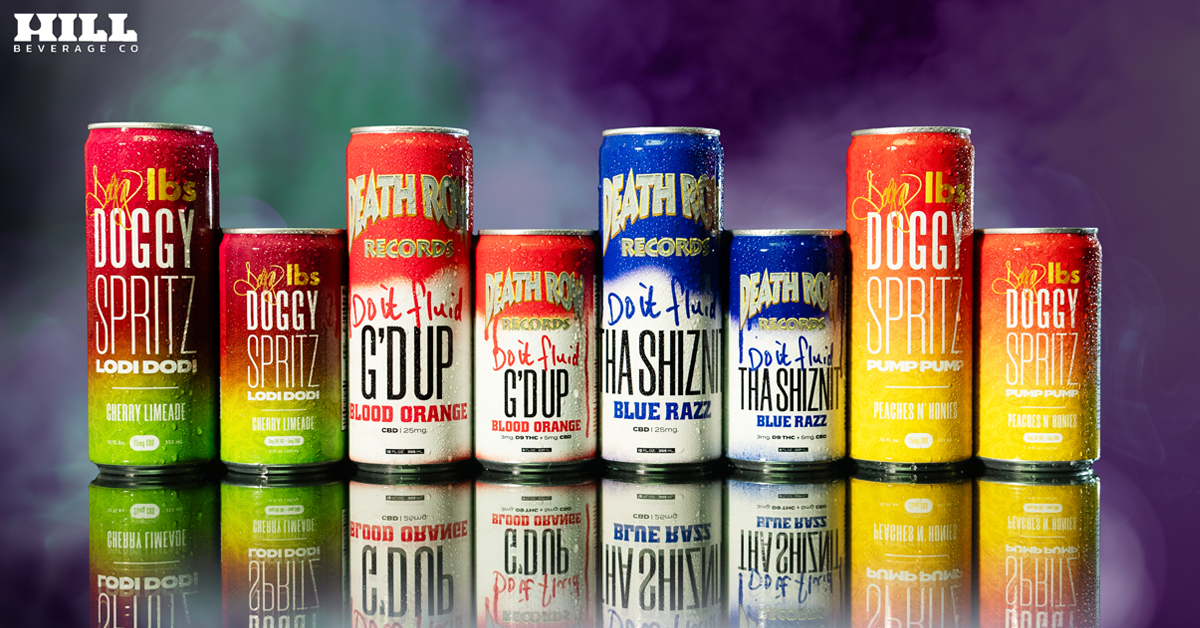
That seems like a safe bet, both for consumers and Snoop himself: the legendary rapper and prodigious pitchman teamed with Texas-based Hill Beverage Co. to enter the cannabis beverage game with Do It Fluid (available in THC/CBD and CBD-only versions) in late 2023. He’s one of several stoner superstars who are leveraging their credibility within cannabis to launch drinks, reflecting both the mainstreaming of marijuana and the wide spectrum of potential positionings within that space: Do It Fluid, for example, is co-branded with Death Row Records, the legendary 90s rap record label for which Snoop produced some of his biggest hits. Then there’s the drinks from actor/producer Seth Rogen’s Houseplant, which sports an aesthetic in line with the brand’s curated lifestyle (see: fancy handmade ashtrays).
As noted in Brightfield Group’s most recent hemp-THC report, celebrities and influencers are becoming more prominent as the category matures, giving space for everyone from Mike Tyson to former Minnesota Gov. Jesse Ventura to new homegrown public figures to have a voice.
It’s something of an echo of CBD’s moment from several years back, when names like Martha Stewart and Whoopi Goldberg served as familiar ambassadors to consumers encountering a new category.