

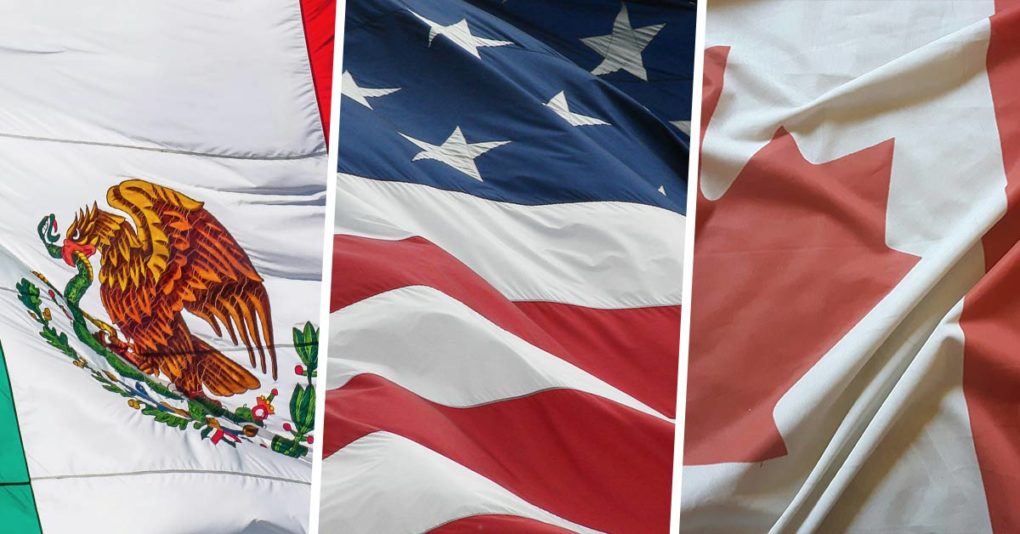
 President Donald Trump’s plans to levy 25% tariffs on goods imported from Mexico and Canada have been postponed, temporarily avoiding a trade war that put American alcohol in the crosshairs.
Duties on goods imported from Mexico received a one-month reprieve on Monday following a border security deal brokered in a phone call between Trump and Mexican President Claudia Sheimbaum. That announcement was followed by a call between Trump and Canadian Prime Minister Justin Trudeau, also resulting in a 30-day pause as the two countries negotiate their own border deal.
Trump also proposed 10% additional tariffs on China, which he said would likely be discussed with China’s leader, Xi Jinping, within the next 24 hours.
The tariffs, originally set to go into effect Tuesday, triggered bold responses from Canada and China, which each promised retaliatory duties on U.S. goods.
Before the second conversation on late Monday afternoon, Trudeau issued 25% tariffs on $155 billion CAD ($107 billion USD) of U.S. goods, with $30 billion CAD set to go into effect Tuesday and the rest to follow in three weeks. Beer, wine and bourbon were included in the tariffs, along with fruits and juices such as orange juice along with other consumer goods.
Canadian provinces also responded by targeting American bev-alc products. In Ontario, the country’s most populated province, the Liquor Control Board ordered all U.S.-produced alcohol products – roughly 3,600 items valued at almost $1 billion in annual sales – removed from stores by Tuesday. Nova Scotia, British Columbia, Newfoundland, Labrador, Manitoba, and Prince Edward Island and Quebec are also pulling U.S. brands off the shelf, with British Columbia Premier David Eby pointedly referencing a halt on buying “American liquor from red states” in his comments.
Canada ($262 million) and Mexico ($139 million) were the second and third top U.S. spirits export markets in 2023, according to the Distilled Spirits Council of the United States (DISCUS).
Trudeau announced Monday via Twitter/X that he had a “good call with President Trump” and that Canada would be implementing a $1.3 billion border plan to stop the flow of fentanyl.
Meanwhile, Mexican President Claudia Sheinbaum wrote in a Twitter/X post that the U.S. had agreed to pause tariffs following negotiations Monday.
Sheinbaum added that Mexico will “reinforce” the border with 10,000 National Guard members “to prevent drug trafficking” into the U.S., and the U.S. pledged to help “prevent the trafficking of high-powered weapons to Mexico.”
That’s at least some temporary relief for an industry that has been driven in major part by Mexican spirits. Tequila and mezcal represent 13% of the total U.S. beverage alcohol marketplace by volume and 22% by revenue. In the on-premise it’s even more leveraged at 20% of the market by volume and 27% by revenue. An economic analysis by John Dunham and Associates (JDA) indicated a 25% tariff on Mexican wine and spirits products (including agave-based spirits), could cost 14,000 American jobs and $2.5 billion in lost U.S. economic output.
Industry Fears EU Tariffs; Impact on Slow Spirits Market
On Sunday, Trump told reporters that U.S. consumers may experience “short term, some, a little pain, and people understand that, but, long term, the United States has been ripped off by virtually every country in the world.”
The tariffs would likely mean increased prices for U.S. consumers. Tariffs are levied on importers, who typically pass those costs to retailers, who then raise the price of goods to consumers.
In a joint statement, DISCUS, the Chamber of the Tequila Industry, and Spirits Canada on Tariffs said the proposed taxes will weaken an already slowing North American spirits market and “significantly harm all three countries and lead to a cycle of retaliatory tariffs that negatively impacts our shared industry.”
Spirits industry advocates are particularly concerned that additional tariffs may be in the offing, as Trump has also threatened duties on goods from the European Union. Tariffs on American Whiskeys at 50% are already slated to return April 1 if there is no agreement on steel and aluminum or the EU does not extend the suspension of its tariff.
Total American Whiskey exports dropped by 18%, and total spirits exports fell by 12% from 2018 to 2021, when the tariffs were originally imposed by the EU and UK on American Whiskeys and other U.S. spirits. Approximately 40% of U.S. spirits were exported to the EU in 2023 (totaling $883 million), making it the largest export market.
Major spirits brands could be impacted across the board if the delays aren’t made permanent. Nearly half of U.S. Diageo sales are imported from Mexico and Canada, and 35.5% of Campari’s U.S. sales are imported from the two countries, according to a Jeffries analysis. Following Trump’s inauguration, Bernstein analyst Nadine Sarwat wrote that tequila maker Cuervo – which may face a 20% to 30% hit depending on pricing – and spirits producer Brown-Forman (1% hit) are brands to watch. Although Bernstein noted Brown-Forman, the largest exporter of U.S. spirits, could be slapped with a 10% hit should retaliatory tariffs from the EU come into play.
In December, Lawson Whiting, Brown-Forman president and CEO, described the possible tariffs as “a very painful situation.”
There are some actions bev-alc suppliers can take to mitigate the impact.
“The key to navigating this current situation is risk management by planning ahead, keeping an eye on supply chains and being proactive about renegotiating contracts and adjusting your pricing, so you can keep your business competitive and resilient,” said Adriana McKinnon, director of logistics at Park Street in a video published Monday for suppliers.
McKinnon suggested diversifying sourcing, storing goods in U.S. Free Trade Zones, as well as locking in favorable rates or renegotiating contracts with producers.