

While the company was reticent to discuss recent reported investment, Tractor Beverage Company still has a lot to say.
The organic, non-GMO drink maker, which has established a foothold in fountain service at QSRs like Chipotle and Potbelly through its partnership with Keurig Dr Pepper (KDP), pulled in $15 million on March 7, according to a quarterly investment report from The Bank of Montreal (BMO).
When we spoke with Tractor last week, chief brand officer Duke Stump and chief revenue officer Brian Barbara declined to comment on the BMO report. A representative from Tractor confirmed that the company is “in the midst of a small raise” and that the figure cited by BMO is “generally in the right ballpark.”
“Here’s what I will say: We’re always desirous of capital if we feel like we need capital for the right reasons,” said Barbara. “And so being in conversations with likeminded investors is also a key piece for us. Then it becomes a function of strategically where we want to invest and what makes the most sense.”
The brand is eager to talk about its “grow strong” strategy, however, as efforts to transcend beyond its roots in foodservice converge with a new guerilla-style nationwide marketing campaign emphasizing Tractor’s connections to independent farmers and regenerative agriculture.
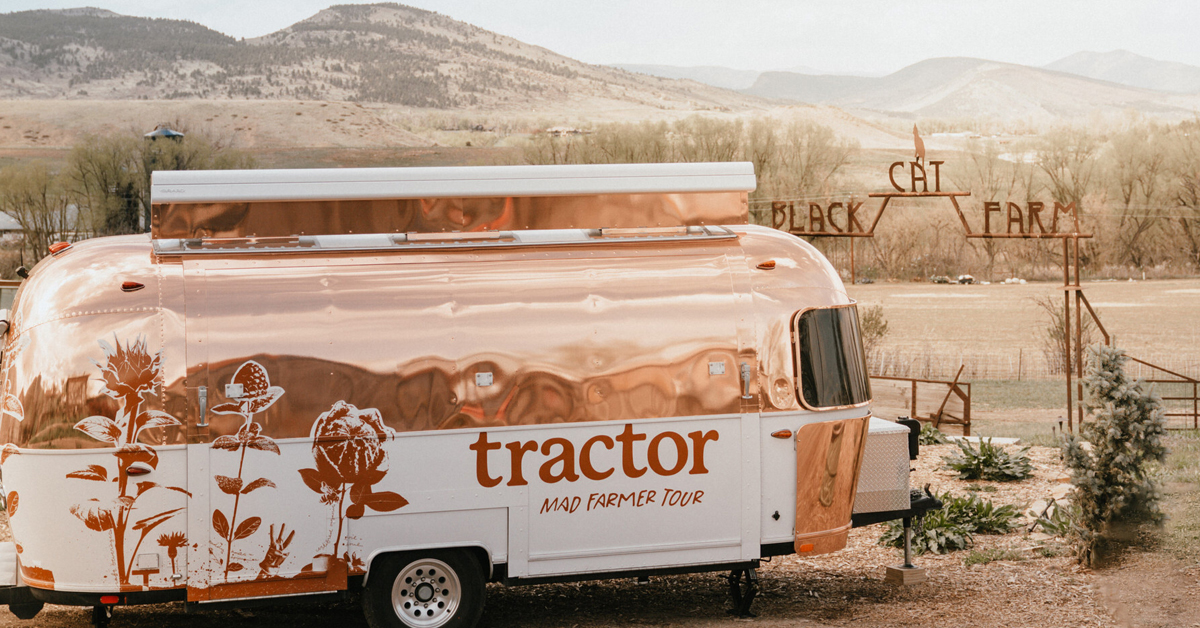
That mission is reflected in Tractor’s Mad Farmer Tour, a seven-month road trip across the U.S. which this week pulled its retrofitted Airstream trailer into the National Restaurant Association (NRA) show at McCormick Place in Chicago this week. The trailer was essentially Tractor’s de facto booth on the show floor, dispensing cold drinks (and cocktails) while acting as a physical space for “immersive brand storytelling.” The broad theme of promoting stronger engagement with parties across the food system aligns with the Farmhand Foundation, an organization promoting and supporting the transition to sustainable and organic farming that was headed by former Tractor chief brand officer Justin Herber (he’s since departed), alongside brand co-founders Griffin Barkley and Justin Schneir.
During a prior tour stop in Chicago last week, Tractor awarded a pair of $5,000 community grants to two local community leaders who have revitalized vacant lots into garden spaces growing food, part of a $20,000 investment in South and West Side Chicago gardens. That kind of high-touch, message-first activation — the brand’s quarterly online literary magazine Tractor Beam, launched last November, is another — is critical to building traction with consumers outside of the soda fountain, said the brand’s leaders.
“I like to say that this brand needs to be out in the wild,” said Stump. “It’s our ability to connect so that people understand the essence and the DNA of this thing called Tractor. It goes beyond just the beverage.”
Innovation is coming in the second half of this year, when the brand hopes its deliberate, exploratory approach will pay dividends. At last year’s NRA show May, Tractor introduced four RTDs — Lemonade, Strawberry Dragonfruit and Farmer’s Punch, plus a new flavor, Mango Peach — aimed exclusively at foodservice, part of an effort to make the consumer experience “multi-dimensional.” Speaking this month, Stump called the RTDs a “beta exploration that has allowed us to really learn a lot,” the results of which will be seen towards the end of 2025. It’s unclear as to what role KDP may play in RTDs.
Mixers, also introduced at NRA last year, will be less of a focus moving forward, Stump added, but underscore Tractor’s versatility in providing beverage solutions for its customers.
On a personal level, Barbara and Stump are part of Tractor’s corporate evolution; Stump, a seasoned veteran of consumer brands including Nike and Lululemon, arrived last March to succeed Herber, while Barbara, who joined this March, brings experience from Califia Farms and ConAgra.
Yet company leadership has integrated its core mission to improve agriculture and support farmers directly into its corporate development, as Stump can attest. Rather than a planned sales meeting in New Orleans, CEO Kevin Sherman last year organized a “farm camp” in Ojai, California, where employees planted crops, worked the land and reconnected with the brand’s “soil and soul” mantra.
“It feels like every day there’s a new beverage company popping up,” said Stump. “And I think for us, it’s [important] not to get intoxicated with the noise around us, but to be really clear and true on who we are and just lean into that.”