

BodyArmor In Focus
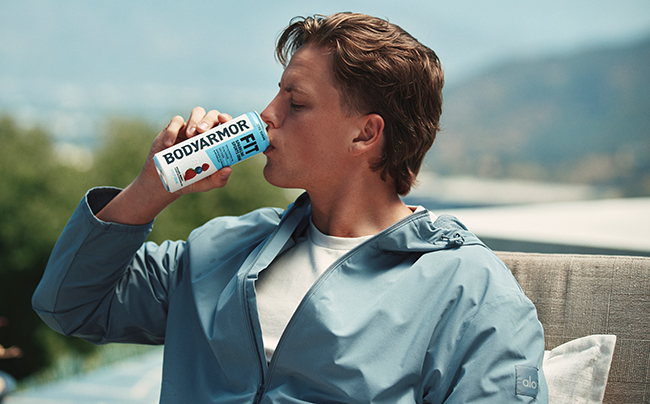
In the five years since The Coca-Cola Company paid $5.6 billion to purchase next-generation sports drink BodyArmor, it hasn’t always been smooth sailing for the brand, which was famously started by serial entrepreneurs Mike Repole and Lance Collins, along with co-founder Kobe Bryant. But with new innovation, refocused marketing strategies and a veritable bandwagon for better-for-you products to ride, BodyArmor is hoping it’s ready to deliver a revival to its parent company.
For those who’ve seen the brand splayed across NCAA games and receiving desirable cooler placements in retail in recent months, the challenges BodyArmor has faced over the past few years — navigating a dysfunctional market economy in which most beverages have had to supplement declining incomes with inflation-induced price spikes — may not be immediately clear. However, since the purchase, Coke has marked down its valuation of the brand by more than 25%, reporting multiple nine-figure write-downs, including one in 2024 that slashed the reported value by $760 million, and a 2025 year-end write-down of an even steeper $960 million.
In Coke’s Q4 and full year 2025 earnings results, released in February, the company offered mixed reasons behind the massive cut in value: the additional write-down on BodyArmor, they said, was driven by revised projections that foresee “a slowing of the projected long-term growth rate for the category, an intensifying competitive environment, and more focused innovation and international rollout plans.”
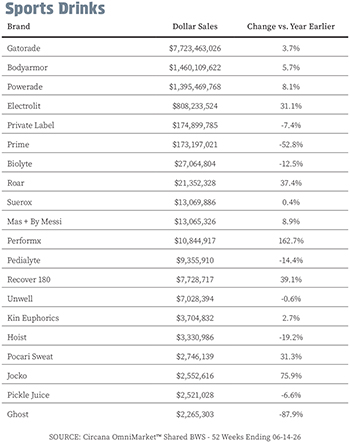
Despite this revaluation of Coke’s would-be Gatorade slayer, fast-forward four months and BodyArmor looks to be doing quite well for itself in an increasingly competitive and rapidly evolving sports hydration category. According to market data firm Circana, in the 52-week period ending April 19, 2026, the brand’s core aseptic line grew 4% in U.S. retail to over $1.4 billion, netting a 12.3% category share, while outpacing Gatorade, which reported just 1.3% growth (albeit to a much larger $7.6 billion/65% share; it takes more than a billion dollars to take down a giant).
Changing Field
If BodyArmor was built to take down Gatorade, there are other brands that were built to expand the category – and they’re creating profound change in how consumers and retailers see the hydration space overall, while also offering obstacles to the BodyArmor core mission.
As Coke said, the category is indeed diversifying: enhanced hydration formula Electrolit is fast-catching up to the category leaders, growing 31.5% to $775.2 million. In contrast, the once-hyped influencer brand PRIME has continued a year-long sales freefall, plummeting -52.1% to $202.5 million.
Although there are other fast-growing brands in the set – like Roar Organic (+63.6%/$21.2 million), PerformX (+194.2%/$9 million) and Jocko Fuel (+240.5%/$2.8 million) – none, aside from the aforementioned Electrolit, have proven themselves to be a true challenger for Coke and Pepsi’s market share in the cooler.
Outside the cooler, however, another challenge has been mounted: Liquid IV and other just-add-water brands have taken the dry ground in the battle, to the tune of 15.6% category growth to $1.7 billion. BodyArmor also competes in this space, up 33.2% to $31.2 million, but it remains a bit player in the set when compared to Liquid IV’s $965.4 million.
Meanwhile, BodyArmor’s legacy stablemate, Powerade, is catching up to it at 5.9% growth to $1.3 billion. In Coke’s most recent Q2 2026 earnings report at the end of July, the company reported Powerade volumes jumped 8% globally
amid a robust FIFA World Cup marketing campaign: “We translated the tournament’s momentum into powerful consumer experiences, placing Coca-Cola and Powerade at the heart of national pride and fan celebrations,” CEO Henrique Braun said during the earnings call, highlighting an “integrated execution across our system” that helped drive “average incidence of over 80% at venues across 16 host cities.”
Sports Marketing Fundamentals
Sara Weaver, VP of marketing for BodyArmor, says she’s highly optimistic for what the brand has in store.
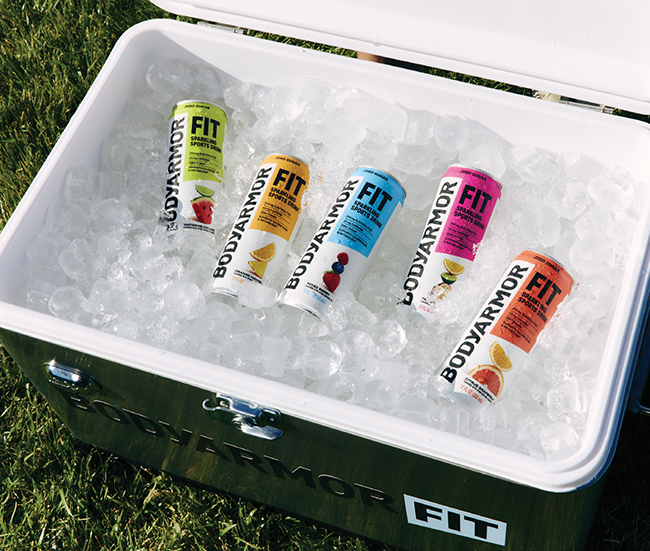
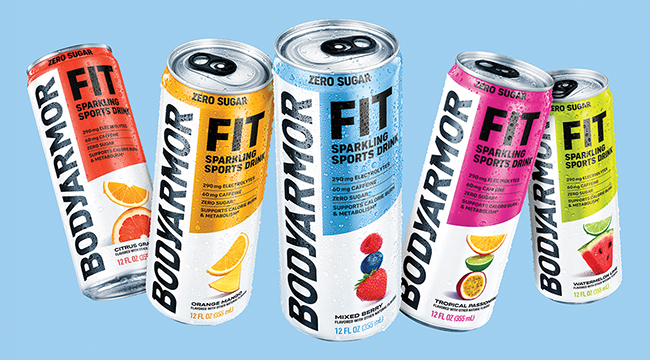
Internally, much of the hype is around BodyArmor FIT, the brand’s latest launch, a caffeinated sparkling sports drink line that looks to broaden the brand’s use occasions. Packaged in 12 oz. cans with 290 mg of electrolytes, potassium, choline and 60 mg of caffeine from green tea, the multi-function brand is currently receiving the all-star treatment from brand leadership.
“We’re trying to answer what consumers are looking for,” Weaver said. “They’re not necessarily always needing something with the extremes, and the ingredients that we have in here are really unique for the category.”
“As we designed the product, we knew that consumers are looking for products with less or no sugar, so we designed it with zero sugar, and of course with the BodyArmor Promise — no artificial flavor sweeteners or dyes, so this gives consumers a really good option as they’re looking for beverages to fulfill that niche in their day.”
FIT slots well into a strategy that is focused on expanding the sports drink category’s consumer base. Like energy drinks, the category has historically indexed towards men and only recently caught a new wave by tapping into the female demographic. Weaver says BodyArmor, through both FIT and its existing Lyte line, is making inroads with women by crafting a brand identity that speaks to both sexes, while targeting women where they shop and where they work out.
“Pilates, strength training, running — all of these activities that are now seen as need states and occasions where you need to hydrate,” Weaver said.
“Rather than creating products that are specifically for women, we have created a portfolio that’s really built around wellness occasions that attract the female consumer. While we kind of want to make sure that our products are available to everyone, my goal as the brand lead is to always expand penetration and be building the business for the long term.”
Weaver said that Lyte “already over-indexes with women and has seen significant growth year-over-year,” representing a “proof point” that the company’s branding approach is working as intended.
Top-Down Support
While the repeated write-downs may have raised some observer’s red flags for BodyArmor’s future, Coke is
demonstrating this year that it’s ready and willing to put its full support behind its landmark acquisition. In February, BodyArmor replaced Powerade as the official sports drink of the NCAA, giving it prominent placement during the March Madness college basketball tournament this past spring. It’s also procured a partnership with NASCAR to also serve as the motorsport league’s official sports drink.
Forbes reported at the time that the move is part of a conscious effort to position BodyArmor as Coke’s primary domestic hydration brand, focusing on U.S. partnerships, while pushing Powerade more as a global product – hence its heavy World Cup presence through June and July. That approach has even led Coke to reshuffle its athlete sponsorships, with college basketball star Flau’jae Johnson (now in the WNBA) going from promoting Powerade to BodyArmor.
Weaver said that athlete ambassadors continue to play a major role in BodyArmor’s marketing strategy, with the brand touting an all-star roster that includes recent NBA champion Jalen Brunson and NASCAR star Ryan Blaney.
While “March Madness feels like it’s right around the corner,” Weaver said, the brand is also preparing to have its first major presence in college football via its NCAA partnership, with plans to work with “NIL talent” in the sport in the coming months.
“We’re working on the sidelines with a lot of schools, and so this is our next step in terms of how you’ll see us show up with sports and live sports,” she said.
On March Madness, Weaver said “you can expect something even bigger and better than we did last year,” adding that “we’re looking always for up and rising talent that has the mentality that fits the BodyArmor brand, to always working to be better than yesterday and that spirit of you, as yourself, as the competitor.”
Brand Building Basics
While many beverage brands across categories have taken their pricing up to offset declining volumes, The Coca-Cola Company has only mildly increased the price of its sports drink portfolio in the last year. In the 52-weeks ending July 11, 2026, NielsenIQ reported Coke raised the price of its sports drinks by just 1.5%. Still, PepsiCo lowered its price in the category by an average of -0.3%.
Weaver says pricing is not going to be the go-to growth driver, instead the company wants to grow via retail expansion.
“From my vantage point going forward, the bigger opportunity than price and overpricing is really growing our total business by adding new consumers, new occasions and new points of distribution,” Weaver said. “So that’s where I believe our next chapter of growth is really going to come from. And we’re already seeing that with Fit coming into the market and Flash expanding significantly. So I think that’s the playbook that is going to work for us moving forward.”
Innovation will also continue to be an important piece of BodyArmor’s strategy moving forward. Weaver hinted that flavor extensions are in development, including “more LTOs with some new partners that we haven’t worked with before,” as well as expansions for multi-pack offerings as part of its omnichannel growth plan.
“The whole goal is to drive trial with these LTOs,” she said. “We know that the base business that we have, the flavor lineup, those are the hard working parts of our portfolio. By adding LTOs, it gives us a way to get on display. It gives us a way to bring energy, to get consumers to try us for the first time, and it’s the playbook that will continue for next year.”


Receive your free magazine!
Join thousands of other food and beverage professionals who utilize BevNET Magazine to stay up-to-date on current trends and news within the food and beverage world.
Receive your free copy of the magazine 6x per year in digital or print and utilize insights on consumer behavior, brand growth, category volume, and trend forecasting.
Subscribe