

Brewbound Live 2025 Recap: Finding Opportunities Amid Risk
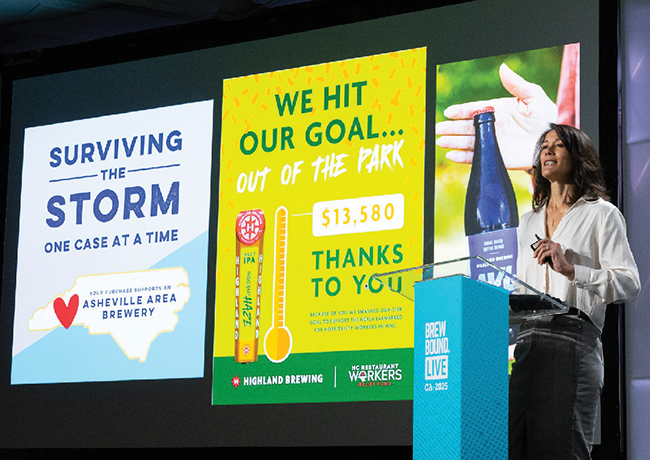
Beverage-alcohol leaders shared strategies for driving sustainable growth, establishing stable foundations and attracting new drinkers during the 2025 Brewbound Live conference in Los Angeles.
As the industry seeks to steady itself through the turbulence of slowing sales and consumer shifts, Highland Brewing president Leah Wong Ashburn explained how she’s embraced the chaos during the conference’s keynote speech.
Ashburn shared that a pair of hand-painted Chinese symbols adorn the doorway to her office that read together mean “crisis,” but independently translate to “risk” and “opportunity.” A gift from her late father – Oscar Wong, who founded Highland and kicked off North Carolina’s craft brewing industry – Ashburn often ponders the symbols’ message.
“‘You’re always going to feel the risk,’” she said, quoting her dad. “‘Look for the opportunity.’”
Ashburn chronicled the personal and professional journey, including Highland’s response to Hurricane Helene wreaking havoc on her hometown of Asheville, North Carolina, in 2024.
The world watched as Ashburn, her husband Brock Ashburn and their Highland Brewing co-workers transformed their brewery into a staging area for necessary supplies for the Asheville community.
While Ashburn was leading Highland through a challenging time in her professional life, her family was enduring twin health crises. Wong, who was diagnosed with terminal cancer in 2022, died in May 2025. Ashburn described her father as “charismatic, optimistic, playful, mischievous, brilliant, people-centered and strong.”
“He was given six to 12 months when diagnosed, and he lived for three years, most of it quite fully, and all of it courageously. He embedded within the brewery a purpose that only starts with beer. He wanted Highland to be integral to the community.”
Around the time of Wong’s memorial service, Brock Ashburn was also diagnosed with cancer, for which he is undergoing treatment: his prognosis is “great,” Ashburn said.
“Reflecting on this year, I am filled with gratitude and pride – gratitude for the opportunity to help our community, pride in our response to Helene,” Ashburn said. “I’m most proud of the foundation set by my father and how our team builds on that foundation in new ways every day. So, crisis is risk and opportunity, and crisis reveals character.”
Wong Ashburn set the tone for the event, with speakers sharing their own triumphs, pain points and tips for navigating the future.
Firestone Walker CEO Nick Firestone offered a pulse check on the nation’s second-largest beer market – California – from the state’s second-largest brewery.
“Affordability in California is tough,” he said. “There’s been net migration out of the state over the last couple years. Beer is really expensive, and a lot of those things aggregate to impact a brewery like ours.”
Firestone explained how the winds have shifted for craft breweries since the COVID-19 pandemic.
“For 25 years, it was ‘throw whatever we can at the wall and see what sticks, and if that doesn’t work, then just do it again next year,’” he continued. “It was a timely strategy for us to really be focused – a lot of SKU rationalization. We went from over 130 SKUs down to 60, but really meaningfully only a handful.
“That strategy has really paid off for us in the last couple of years, as shelf sets have moved around, and there’s a lot of noise and competition in the category,” he said.
Increased competition and the need for scale has led several breweries to create regional platforms. At the forefront of the movement is Massachusetts’ Hendler Family Brewing Company (HFBC) and Colorado’s Wilding Brands.
“We started with contract brewing and as you get into these conversations of people trying to solve real business challenges – and contract brewing was one lever – quickly, certain conversations went to a place where an acquisition just made more sense,” HFBC co-founder and CEO Sam Hendler explained on the creation of the platform that bolted on Massachusetts craft brands Wormtown and Night Shift to Jack’s Abby Craft Lagers.
“Relationships are really important,” he added. “This isn’t something where these brands were some investment banker coming in and getting a million bids, and us being the high fly-in winning bid.
“These are deals that came from long-standing relationships where we could have a really open, honest conversation about how to best utilize our collective resources.”
Wilding Brands, which markets itself as a craft beverage platform, is the combination of Denver Beer Co. (which Berger co-founded), Stem Ciders, Upslope Brewing, Great Divide Brewing, Station 26, Howdy Beer, Funkwerks Brewing, Formation Brewing, Cervecería Colorado and a handful of non-alcoholic (NA) beer brands.
“We have a clear strategic vision about what we’re trying to achieve,” Berger said. “And it’s a little bit different than the M&A of craft beer, craft beverage in the past. We’re small, but what we’re trying to achieve is a strength in our home market.”
Decoding modern consumers was a theme woven throughout Brewbound Live’s stage conversations, from reality-checking Generation Z behaviors with Rabobank analyst Bourcard Nesin to making real-life connections via experiential marketing with Athletic Brewing director of marketing Rosalie Kennedy and Boston Experiential Group founder and managing director Sophia D’Angelo.
Kennedy and D’Angelo shared how the NA beer maker has used activations to form stronger bonds with its consumers, from leveraging nostalgia at music fests to properly measuring the effectiveness of marketing events. Those experiences shouldn’t just be limited to consumers.
“Definitely go to the events that you’re putting on,” Kennedy said. “You’re not going to learn as much behind a computer.”
Reaching those consumers also requires going where they frequently are – social media. JuneShine Brands president and CCO shared how the company’s Willie’s Remedy+ hemp-derived THC-infused social tonic built a name for itself through social media advertising.
“You can literally walk into a market with no POS, no nothing – we haven’t launched at all – and because of the investment that we made on social [media], people know about us before we even get there,” Stevenson said.
“People want to try THC beverages, they want to see what it’s all about, and then when they try it, they’ve told us that they love it,” she continued. “Our retention rate right now is 45%, which is really high in the world of where we’re at. We know we need to have a really good product. We know that we need to speak to other customers outside of Willie Nelson’s fans, but we know that we can’t rest on the celebrity laurel at all. You have to have a really strong brand.”
Garage Beer, which brought on investment from NFL stars and hosts of the popular New Heights podcast Jason and Travis Kelce, is working to strike a similar balance between consumers who know the brand for its famous backers and those who don’t.
“The brand was growing very fast before Jason and Travis came in and invested in the business,” CMO Kevin George said. “They wanted it to be Garage Beer, they didn’t want it to be ‘Jason Kelce’s beer,’ so it was really important for us to be Garage Beer and invest the dollars in building that brand.”
About 70% of Garage Beer’s marketing activities do not feature the Kelce brothers, which is by design, George said. One tactic Garage Beer has deployed is building relationships with niche content creators, who often have highly engaged audiences, including remote control truck captains and action figure enthusiasts.
“The goofier, the more entertaining, the more niche, the better,” he said. “Because it’s not just the niche watches that it gets, it sets the vibe for the brand and what you’re trying to do out there”
Similarly, Rupee Beer, which brothers Van and Sumit Sharma launched to pair with Asian cuisine after helping in their family’s Indian restaurants for decades, has developed relationships with relevant influencers.
“We wrote the playbook ourselves, since a lot of our predecessors never really engaged with that type of community,” Van Sharma said. “We’re looking at things like Bollywood influencers, cricket influencers, things that really make sense to a South Asian specific brand on top of the culinary angle as well.”


Receive your free magazine!
Join thousands of other food and beverage professionals who utilize BevNET Magazine to stay up-to-date on current trends and news within the food and beverage world.
Receive your free copy of the magazine 6x per year in digital or print and utilize insights on consumer behavior, brand growth, category volume, and trend forecasting.
Subscribe