

NOSHscape: The Latest Food Brand News
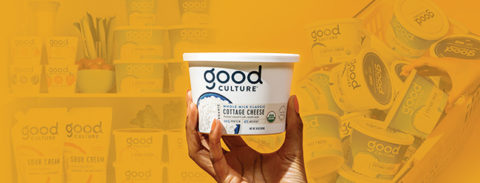
Good Culture Eyes $1B Future With Catterton-Added Capacity
Gut health-friendly “real,” high-protein foods secured the federal government’s endorsement in January – and on that very same day, a disruptive insurgent brand aligned with all three of those attributes got an arguably even bigger boost.
As cultured dairy brand Good Culture comes under the wing of PE firm L Catterton, the opportunities that have been sitting on the horizon are now within reach. Founder and CEO Jesse Merrill told Nosh that the company’s new majority shareholder will enable the already profitable business to “do more, faster and better.”
That means meeting demand – which has outpaced its supply for nearly the past three years – growing brand awareness even more through both digital and in-person activations, and leaning into a robust innovation pipeline that has been constrained due to those supply issues.
“Good Culture has been on a tear,” said Merrill. “Our sales have almost quadrupled in the last three years, the category’s up 60% over the same time period, the demand has been insane. We have not been able to keep up from a supply standpoint, so we’ve had a lot of out-of-stocks. That’s obviously not something that we want to have happen.”
Good Culture will continue to produce through co-manufacturers and is now working to secure dedicated production lines with strategic partners, Merrill said. Founded in 2015, the brand’s explosive growth over the past three years, which was spurred by a viral recipe videoand brought incremental gains across the category by introducing younger demographics to cottage cheese, quickly began to attract institutional attention.
‘This Is Like Kodiak All Over Again’
Banking on a bigger exit, Manna Tree, which invested about $50 million into the company in 2022, right ahead of the boom, re-upped its commitment alongside L Catterton’s majority share. The firm’s managing partner Steve Young said the business is now pulling in nearly $200 million in sales and claims that nearly every private equity firm and strategic has been asking about the brand since its viral moment turned into real sales momentum.
“This is like Kodiak all over again,” Young recounted saying to L Catterton managing partner Andrew Taub nearly a year ago when discussing Good Culture; Young worked on the sale of that high-protein breakfast brand to L Catterton back in 2021 in his former role as an investor at Sunrise Strategic Partners.
However, the company wasn’t necessarily looking to sell when it first began talking with L Catterton, Merrill and Young emphasized. Although manufacturing constraints were a real barrier to scale, the team was “heads down” focused on the business amid this period of extraordinary growth.
But the inquiries kept coming in, and with the consumer goods investment landscape starting to thaw, both Merrill and Young said they felt it was worth taking stock of their options. After nearly a year of conversations, the deal began to come together just a few months ago, Merrill said.
“Aside from their impressive track record, which, from my standpoint, is table stakes, I was looking to partner with a team that was values-aligned, and really underscores what Good Culture is trying to do,” Merrill said. “L Catterton checked all those boxes. Their team is authentic, passionate, incredibly talented, and that combination gave me a ton of energy. It made me want to run through walls to get to the top of the mountain with them.”
Young, who also worked on kombucha brand Health-Ade’s sale to Generous Brands-owned Butterfly Equity last year, believes there is currently “a much broader exit and acquisition landscape.” He emphasized that private equity buyers are very active in the current market, making this an opportune time for the small brand to unlock capacity and press on the accelerator with a team that is “best in class and best in business.”
Young, who was a leader in General Mills’ yogurt portfolio on the cusp of the category’s boom in the early 2000s, said that he believes the opportunity ahead for the brand is the same as what yogurt captured more than 20 years ago – and, as with Good Culture, that category was energized by insurgent brands like Chobani. With less than 50% distribution in U.S. retail at the moment, Young believes Good Culture can become both an “80% distribution company” and a billion dollar brand.
“Yogurt looked a lot like cottage cheese does today – roughly a $2 billion category, fairly one dimensional, meaning, it’s just cottage cheese in a package,” Young said. “Yogurt was, once upon a time, that same thing before kid yogurts and drinkable yogurts and whip yogurts and all these other things took shape to turn it into the $8 billion category that it is today.”
Once the capacity is unlocked, the consumer is there, ready and waiting.
“Consumers look for our products in a maniacal way,” Merrill said, and that “scarcity mindset” is creating hoarding behavior. Young added that sometimes they’ll purchase “six or seven tubs” at a time if they happen to find that many on shelves (although that same scarcity has, of course, led to complaints from dairy category managers).
The brand recently leaned into the scarcity dynamic with its latest campaign “The Obsession is Real” and plans to go deeper on growing awareness both with its influencer network and with real world activations in a holistic way.
“There’s increasingly more research coming out that Gen Z really loves IRL, because they grew up in such a digital environment,” Merrill said. “To actually do things that create human connection is really novel and exciting for them.”
When Good Culture first launched, he said, it did so with the goal of making “cottage cheese sexy… [but] Gen Z, at the time, was not a focus.” As they aged up and gained more purchasing power, the demographic became a key contributor to the “groundswell” moment that made Good Culture a viral sensation. As the brand now maps out its distribution strategy and works to fill gaps in the market, Merrill said college and university campuses, as well as foodservice broadly, is “low hanging fruit.”
Even more exciting, Merrill – the parent of two Gen Zs – has seen cottage cheese gain clout within his own home. He said for years his kids had no interest in what he was building, but after that viral video, even they were bought in.
“I went from being the lame cottage cheese dad to being the cool cottage cheese dad and that was very gratifying for me.”
There’s no telling how popular being a billion-dollar dad might make him.
B&G Foods Acquires Soup Brands In Del Monte Foods Auction
After voluntarily entering Chapter 11 bankruptcy proceedings in July, Del Monte Foods has agreed to sell off a number of assets as part of a court-supervised auction process.
The 138-year-old company announced in July it was seeking bankruptcy protections as it restructured its debt.
“This outcome represents a successful result in our sale process and demonstrates the enduring value of Del Monte Foods’ brands and operations. These transactions will create an opportunity for our beloved brands and businesses to thrive under the ownership of three of the leading companies in the food industry,” said CEO Greg Longstreet in a statement.
B&G Foods was the winning bidder on Del Monte’s “Stock and Broth” segment, which includes the College Inn and Kitchen Basics brands. The Parsippany, N.J.-based food company will pay approximately $110 million in cash for the shelf-stable broth businesses.
In 2024, B&G announced it would be divesting portfolio brands as it restructured. Between May and October, B&G offloaded its canned tomato brands Don Pepino and Sclafani to Violet Foods LLC, a newly formed subsidiary of Amphora Equity Partners LLC. B&G followed that with Le Sueur canned vegetables to McCall Farms, Inc., and the Canadian Green Giant and Le Sieur frozen and shelf-stable vegetable product lines to Nortera Foods in October.
Del Monte’s auction also sold off its vegetable, tomato, and refrigerated fruit business assets to Fresh Del Monte Produce Inc. The brands include the Del Monte and S&W packaged vegetable brands, Contadina and Take Root Organics canned tomatoes, Del Monte refrigerated fruit brand, and the JOYBA beverage brand.
Global ownership of the Del Monte brand and related intellectual property will also go to Fresh Del Monte Produce.
Finally, Del Monte’s shelf-stable fruit business assets went to Pacific Coast Producers. This segment includes the Del Monte and S&W shelf-stable packaged ambient fruit and fruit sauces brands.


Receive your free magazine!
Join thousands of other food and beverage professionals who utilize BevNET Magazine to stay up-to-date on current trends and news within the food and beverage world.
Receive your free copy of the magazine 6x per year in digital or print and utilize insights on consumer behavior, brand growth, category volume, and trend forecasting.
Subscribe