

Another Round for Adult Soda
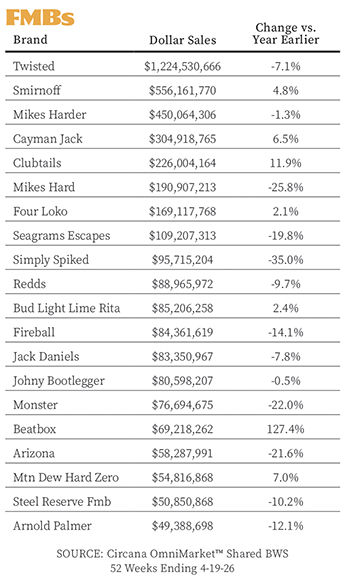
The “beyond beer” or “malternatives” space looks similar to a bowl of jelly beans these days.
At one time there were just a handful of choices that were simple to understand, like cherry, green apple and orange – or, in bev-alc’s case, hard cider, wine coolers and malt-based hard lemonade. Now, in the continued era of “everything can be an alcoholic beverage,” what you pull from the bowl has become harder to define.
Akin to how buttered popcorn, chili mango and toothpaste entered the mix, beyond beer now consists of beer-, wine- and spirits-based ready-to-drink cocktails (RTDs); THC infused beverages; spiked versions of big name non-alcoholic (NA) brands; new creations like hard tepache and hard kombucha; and more.
As such, “malternatives” may not be the most accurate descriptor for this annual category overview of ours anymore – some participating in this piece have even labeled the terms malternatives and FMBs “trigger words” (more on that later). “Fourth category” may be the least offensive term, though admittedly vague.
If the category itself is hard to name or define, imagine the difficulty of choosing one trend within it for highlighting.
This year there appears to be even more fourth category offerings on trend than the prior few innovation-heavy years:
• Spirits-based hard teas such as Stateside Brands’ Surfside and Boston Beer Company’s Sun Cruiser have become a driving force within RTDs both in the on- and off-premise, and are expanding with lemonade extensions;
• High ABV flavor-packed punches such as BeatBox and BuzzBallz continue to connect with consumers, with bigwigs such as Sazerac and Anheuser-Busch InBev to back them up;
• And vodka-based versions of sports drinks such as Spiked Ade and Stateside’s Super Lyte have hit the scene with a fervor as the latest evolution of hard refreshers.
Additionally, there’s one trend resurfacing, despite a checkered history: hard soda.
The mention of hard soda in any related new product announcement post-2020 has often been met with scoffs. Choruses of “Remember that?” and “Didn’t we already try this?” typically followed. Admittedly, even in our own media, we’ve poked fun at the segment, reminiscing about Not Your Father’s Hard Root Beer, the Small Town Brewery (and later Pabst) FMB that has become the No. 1 flash-in-the-pan reference for hard soda.
The main criticism of Not Your Father’s and similar ilk was the sickly sweet nature of the syrupy beverage, which – once paired with an ABV – led to head-numbing hangovers. The novelty of having a familiar, nostalgic soda flavor in an alcoholic form wore off after a few years, when consumers started paying more attention to what they were consuming and how they were feeling.
That better-for-you attitude turned into the hard seltzer craze, where consumers sought out lightly flavored, low calorie drinks. The introduction of spirits-based offerings had consumers questioning what alcohol they were drinking in FMBs, and turning to spirits-based seltzers and RTDs instead of malt-based alternatives.
Like all consumer trends, the circle came back around and consumers started craving flavor again and before we knew it, hard soda was back. Producers are hoping this time the trend is stickier (but maybe less syrupy).
If It Works As a Non-Alc, Why Not Add Booze
Owl’s Brew co-founder and CEO Jennie Ripps has been patiently waiting for
hard soda to have its moment again. “Over a decade ago” she started experimenting with a “better for you soda” made with botanicals and “real ingredients,” and created “an entire book of functional sodas.”
“And then, of course – because what we like to do at Owl’s is make things that are functional and really good for you [and] spike them – we started messing around with making them alcoholic,” Ripps said.
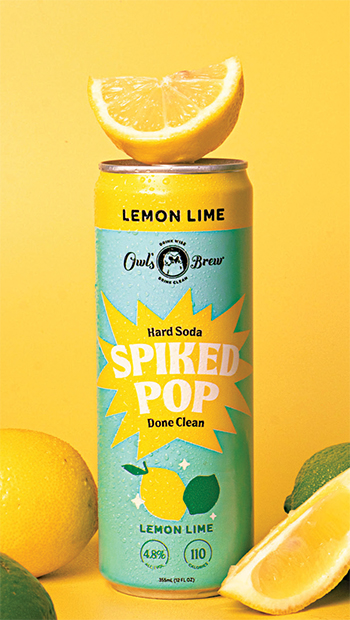
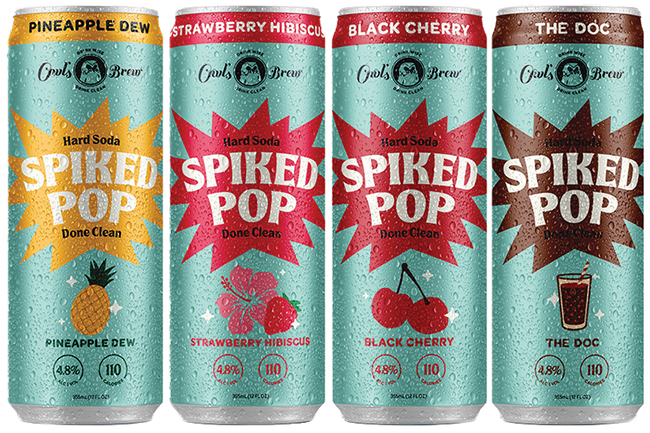
Ripps fellow Owl’s Brew co-founder and CMO Maria Littlefield was Ripps’ “earliest test tester” for the spiked sodas, which then sat waiting for the right moment to launch. Fast forward to 2026, that time was this spring, as hard tea maker Owl’s Brew launched Spiked Pop, a line of FMBs inspired by classic soda flavors, recreated with real fruit juice, teas, herbs and no artificial flavors or coloring.
“I feel like in some ways we were a little early with boozy tea,” Ripps said. “We were so early that I think we actually missed the consumer moment. So one thing we wanted to do with [Spiked Pop] was we actually wanted to figure out exactly when the consumer would be ready.”
“One thing we’ve learned over the years is it’s very hard to educate the consumer on something in alcohol, and then tell them it’s spiked,” Littlefield added.
Enter: functional sodas. The recent popularity of better-for-you soda brands such as Olipop and Poppi educated consumers on what a modern soda could look like: same bold flavors, without being, as Littlefield put it, a “sugary chemical bomb.”
“We watched this renaissance of sodas,” Ripps said. “When Poppi got acquired [by PepsiCo], we were like, ‘We think the customer is educated, let’s go.’”
Spiked Pop has arrived with a robust lineup of seven flavors. The offerings are available in a variety 12-pack (Black Cherry, Pineapple Dew, Watermelon Lime and Cream Soda); variety 6-pack (The Doc, Lemon Lime and Strawberry Hibiscus) and single-flavor 6-packs of Black Cherry and Lemon Lime. Each 12 oz. skinny can is 4.8% ABV and 110 calories, packaged with the tag line “Hard Soda Done Clean.”
Owl’s Brew is so confident in the strength of Spiked Pop, that the company has shifted its focus away from hard teas and almost solely to the new hard sodas. The company has sunset its Boozy Tea brand, keeping only its spirits-based RTDs, including Chelsea Handler’s Vodka Lemonade.
The confidence to make the big switch came from conversations with both on- and off-premise retailers and distributors, who expressed “extraordinary” excitement for the commercial opportunity and spiked better-for-you soda could have.
“It was a huge change for us, but the process was actually very thoughtful and tactical, and we didn’t decide to pull the trigger until we had gotten buy-in from every tier,” Ripps said.
“It’s the perfect blend of everything we’ve always stood for at Owl’s Brew, but it gives us a much bigger platform than maybe Boozy Tea did,” Littlefield said.
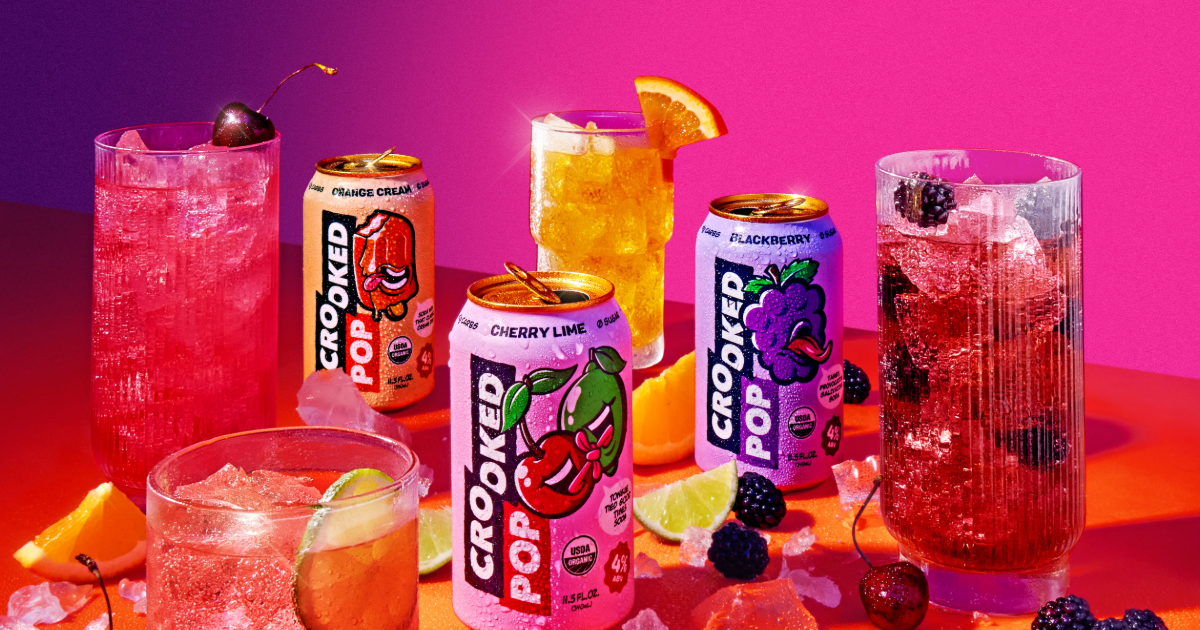
Another brand trying to capitalize on consumers’ desire for better-for-you sodas is Crooked Pop, also launched earlier this year. The lineup of 4% ABV hard sodas (Orange Cream, Blackberry and Cherry Lime) was created by Bai founder Ben Weiss, who is on a mission to disrupt how bev-alc categorizes beyond beer offerings.
Crooked Pop is created with a “organic super dry alcohol” that Weiss has trademarked as OSAVA. It’s a proprietary fermentation derived from quinoa, amaranth, millet and cassava root that creates a clean neutral alcohol base. The proprietary base addresses consumers’ alleged distaste for malt-based offerings, which Weiss claims they associate with malt liquor, low-quality ingredients and negative effects. By still being fermented alcohol, Weiss hopes his creation will “put the growth engine back in beer.”
“I feel like beer historically has owned refreshment in alcohol – that low ABV sessionability space,” Weiss said. “Legally it’s been carved in a way where you almost have to be a ferment to thrive in that [beer] space, and that space is challenged by both malt, as well as distilled spirits.
Weiss emphasized the importance of not categorizing his innovation as a “malternative,” labeling the phrase
“triggering.”
“‘Malternative’ is a part of going beyond beer, but it’s still beer, because beer legally is defined as malt and hops,” he said.
“I’m trying to find a solution to bring consumers back to ‘brew,’ and I’ve resisted every temptation along the way to create a base that’s not brew, because I’m so passionate about carving out a space within brew that speaks to a consumer that’s no longer drinking beer.”
That challenger product, according to Weiss, is Crooked Pop. The certified USDA organic spiked sodas have zero sugar, less than 1 gram of carbs and are gluten free – all attributes that are highlighted on every can and package. Cans also include the beverage’s nutritional facts and ingredients, which are not mandated in bev-alc, attracting Gen Z and millennial consumers seeking “transparency” when it comes to their food and beverage, Weiss said.
“Not Your Father’s Root Beer, people loved because of its taste, and they left it because of calories and sugar,” Weiss said. “The holy grail, and I remember being told this in the non-alc space, is to deliver low calorie without anything artificial in it. If you can do that, they’ll be loyal.”
“This idea that sober curious means they don’t drink, I dispute that,” Weiss added. “I think sober curious means they don’t trust. I think everybody ultimately wants to have a drink, they just want to maybe drink less, drink better, drink without consequence. They’re not lost consumers for beer, they’re rejected consumers of beer.”
This isn’t Weiss’ first foray in hard soda. In 2019, his now-defunct Crook & Marker brand launched Spiked Sodas. What makes this round different is Crooked Pop is leaning into the ingredient transparency, as well as the flavor variety that consumers have shown they’re looking for through their non-alc purchases, Weiss said.
“We’re a better version of what we were three, four years ago – we’ve evolved and I think the timing is great,” Weiss said. “Crooked Pop’s been out for less than a month and you already see it, it’s pretty impressive. So I’m super bullish.”
Sometimes Indulgence Is Necessary (And Nice to Look At)
Not everyone in the modern hard soda game is leaning into health and wellness trends. Yet, they’re still finding consumer demand, and a key reason why is the on-premise.
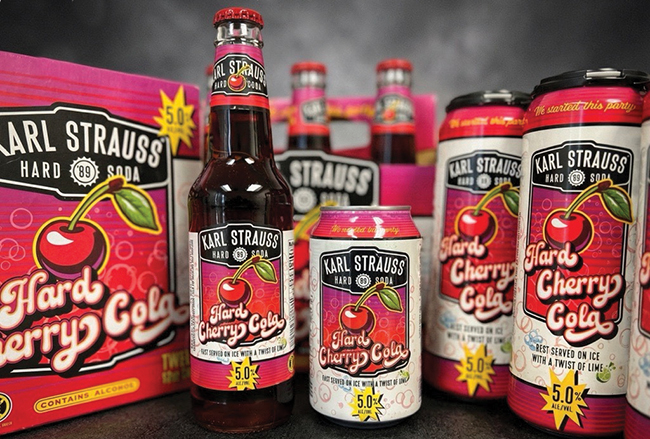
In 2024, San Diego-based craft brewery Karl Strauss was tasked by Disneyland Resort to create a hard soda for Pym Test Kitchen, a casual food stop located inside Disney California Adventure Park’s Avengers Campus. The Karl Strauss team obliged, creating Hard Cherry Cola, and before long, the beverage “went crazy,” beer division COO Chad Heath said.
“It went viral,” Heath said. “People started posting about it and it sold really well, it was just a hit right out of the gate.”
The theme park success led Karl Strauss to add the 5% ABV FMB on draft at its own nine brewpubs across Southern California, and the offering became one of the brewery’s top five items sold.
What followed was a snowball effect: retailers tried the product and asked for it in stores, including the beer buyer at Albertson’s, who asked for “every SKU you make in every one of our stores,” according to Heath.
Karl Strauss packaged the hard soda in 19.2 oz. single-serve cans, 12 oz. can 12-packs and 12 oz. clear bottle 6-packs, marking the release of the craft brewery’s “first ever non-beer beverage” into market.
“We really wanted the clear glass bottles to have sort of a nostalgic theme to it, that Mexican Coke sort of vibe,” Heath said. “And we felt that, from a user experience, the glass would really be an interesting way to induce trial.”
No matter the package, Karl Strauss encourages consumers to pour the beverage over ice and add a lime wedge, showing off the red-tinted liquid. The company is also actively working to add the beverage on draft at bars and restaurants, particularly at
establishments that may not have a license to serve hard spirits, but what to give consumers an alternative to beer or wine.
The bright red cherry liquid is certainly not a health and wellness play – Karl Strauss wants consumers to feel the nostalgia for the old syrupy soda of old. Their target consumer isn’t the Olipop fan, but rather the one looking for familiar, bold flavors and simplicity – picking up a Hard Cherry Cola instead of a Mike’s Hard Lemonade (Mark Anthony Brands) or an AriZona Hard (Molson Coors).
Some fans are even using the beverage to create “dirty sodas” – the dairy, syrup and soda combinations that have achieved their own virality.
“People are just hearkening for a simpler time, going back to things that were less crazy,” Heath said. “People are yearning for that.”
The importance of the liquid is also a guiding star for The Nations Brewings’ Bravazzi Hard Italian Soda. The 4.2% ABV sugar-based FMB, launched in 2017, is made in-house in Nashville and is available in surrounding markets on draft, as well as in 12 oz. cans, with flavors such as Blood Orange, Clementina, Limonata and Mango with Lime.
Bravazzi is made with real fruit juice and is gluten free, but the brand isn’t trying to pretend it’s a better-for-you beverage (neither is the 160 calories per can). Bravazzi CEO Josh Buckley acknowledged that for a few years, particularly during the height of the COVID-19 pandemic, consumers were “very health conscious” and would frequently ask about calorie count or sugar content.
“Now at festivals, nobody is asking,” Buckley said. “There’s definitely been a noticeable decrease in people with concerns. The health conscious questions don’t pop up anymore.”
As a result, Bravazzi had its best year yet in 2025, reaching 100,000 cases. On a rolling 12-month basis through the first quarter of 2026, the company is up 30%.
A key driver of that growth is from the on-premise, where Bravazzi has positioned itself as “the first choice to go onto the draft handle” in its core market when a distributor wants something beyond another beer.
The brand has also been able to expand occasions for itself by positioning the beverage like “a soda or mixer” rather than another FMB. Bravazzi lists cocktail recipes on its website and in marketing material, and is actively working with on-premise accounts to educate retailers on best practices for pouring and presentation.
Bravazzi’s partners are buying in. In a single month, the offering can claim 150 handles in its home state of Tennessee, as well as up to 70 draft buys in Alabama, and between 20 to 25 in Florida, which just launched in January.
“We’ve gained a lot of popularity just because we’re the easiest thing in distributor houses to sell,” Buckley said. “Would you rather sell an IPA right now, or this Italian soda that looks great, tastes great and is more fun to sell?”


Receive your free magazine!
Join thousands of other food and beverage professionals who utilize BevNET Magazine to stay up-to-date on current trends and news within the food and beverage world.
Receive your free copy of the magazine 6x per year in digital or print and utilize insights on consumer behavior, brand growth, category volume, and trend forecasting.
Subscribe