

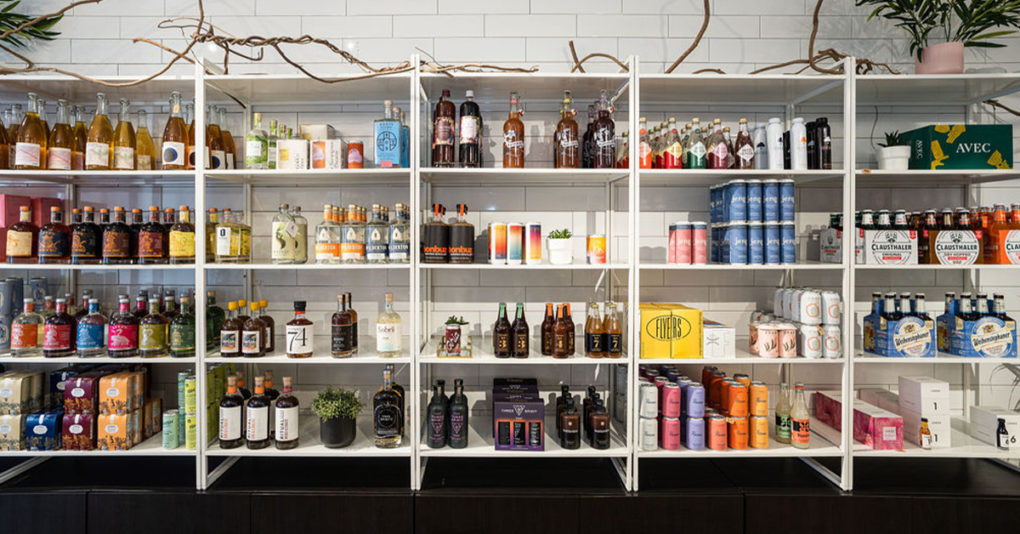
 Once at the forefront of the Adult Non-Alc (ANA) industry, pioneering retailer Boisson is now clawing its way back from bankruptcy. Since April, when the company shuttered its nine physical stores and began navigating a financial crisis, the industry has been piecing together the catalysts of the company’s downturn. Now founder Nicholas Bodkins, who doubles as chief brands operator, is opening up about what went wrong.
Just three years after its launch, Boisson rocked the non-alc industry when it filed for bankruptcy with little word to its suppliers on the future of their partnership. While that closure sparked ripple effects, Boisson’s leadership was putting together a plan to rebuild under the type of bankruptcy that allows small business owners to reorganize debt and pay back creditors without ceasing operations.
With NIQ projecting the ANA sector will grow to $1 billion off-premise in the next two years, Boisson’s failure was certainly not due to lack of customer demand. With the help of a new financial partner and leadership team, Bodkins is aiming to update Boisson’s business model to the fast-moving state of ANA by exclusively focusing on e-commerce and wholesale import and distribution operation. But the founder is still tasked with building back suppliers’ trust and engaging them in the future of the company.
What Went Wrong?
Boisson began raising money during the COVID-19 pandemic, at a time when Bodkins said CPG founders were looking for alternative routes to market as grocery buyers rebuilt their core supply chains. That meant limited shelf space when ANA products emerged, which allowed Boisson to take a three-pronged approach: building a retail environment for these alternate products, an e-commerce site for direct orders, and eventually a wholesale business to help brands enter the U.S. mainstream market.
In 2023, the company generated a combined revenue of $10 million from its retail and e-commerce operations, alongside more than $1 million in wholesale revenue and an additional $175,000 from Boisson-owned brands. But ANA’s eventual move into mainstream retail channels made Boisson’s competitive position tougher to defend. When faced with escalating operational costs, particularly from its nine retail locations across coasts, Boisson was eventually unable to pay its debts.
“Midway through 2023 it became really clear to me and some others that the retail strategy of building a national chain of non-alc retailers is not a necessity anymore,” he said.
The initial strategy was born out of the “world of the Warby Parkers and Brooklinens and Erewhons,” a different business from local founder-run ANA bottle shops, he said, which don’t have as intensive warehousing and operational needs.
But with operating capital tied up in store leases and warehouses, an attempted pivot into wholesale arrived too late. When Boisson raised a $5 million bridge round from Pernod Ricard and Connect Ventures in September 2023, Bodkins said the team thought they could still turn the corner.
“My failure was maybe seeing that the market was going to turn around and that we’d be able to extricate ourselves from some of the retail environment and raise more capital to redeploy into these other things,” he said. “Understanding there’s going to be a slow ramp down on the retail revenue side and a ramp up on the wholesale revenue side, and you’ve got to make all the investment on the wholesale side ahead of time with cash before it turns into revenue.”
In retrospect, Bodkins said the company should have signed one- to three-year leases, versus ten-year leases, or partnered with malls that were looking for very short-term tenants and holiday pop-ups, and “come up with a way for us to be able to scale in October, November, December and January, and scale back throughout the rest of the year.”
Bodkins emphasized another top lesson: margin dollars matter.
“Everything above that is noise, because margin dollars are ultimately what anyone is going to look at when it’s time for the cash machine to turn off and for you to turn into your own cash machine,” he said.
Instead of growing slower but with more efficient margin dollars, Boisson’s stage gates were predicated on more investment. But Bodkins hopes that in the end, the fast-moving nature of the business results as a net positive for the ANA category, and compared the strategy to Uber, which raised billions of dollars before turning a profit.
“Getting people to go from raising their hand for a taxi to looking down at an app is an incredibly expensive thing,” he said. “Early on in this category, getting sips to lips was an incredibly expensive thing.”
A New Focus: Distribution and Importing
When it was clear the company was going into bankruptcy, Bodkins shared an update on LinkedIn, and then took a pause.
“After that I turned my phone off, had a good cry, and didn’t do anything for a few days except hang out with my daughter and my family,” he said.
When he turned his phone back on, among the many messages was one from a potential investor that was interested in a new version of Boisson without the retail component. In order to reorganize the business, step one was to get the new financial partner on board. Step two was to convince the new partner to grant Boisson’s investors who held a secured debt position – which meant they would receive the first $5 million if the company were to ever go into liquidation – to grant them an equity position in the new business. Step three was to then convince those investors to waive their secure debt position in order to allow Boisson to pay back suppliers.
“All three of those things had to happen in sequential order before anything else could actually happen, and so that’s what I started working on from my house,” said Bodkins.
The fourth piece was “over 100 conversations with founders of brands” and other creditors to agree to the reorganization plan.
Boisson is now free to move forward without further court oversight, but it still has debts to cover. Non-alc suppliers who lost revenue are supposed to be given a one-time payment that comes to an estimated distribution between 7.5% to 10% of their claim. Operating under strict cash terms, Bodkins hopes to “start to make it right,” noting that the company is back to buying from about 95% of the same suppliers it used prior to filing bankruptcy.
“And we are now looking at ways that we can use our platform and other ways to commercially make it make sense for them to do business with us,” he said.
Boisson’s e-commerce business will continue, as well as a more of a “hub and spoke” model whereby the company will import and help power brands’ direct-to-consumer sites and any other third party sub-distribution. On and off-premise distribution will remain part of the business operation, with a team on the ground in New York.
Bodkins is also now aiming to focus on the analytics that could serve their own distribution and other distribution operations, something he wishes he would have done sooner.
“Ultimately, our consumer business online still shows smoke before fire, well before a national distributor is going to get any detail about a brand that could do well,” he said.
The company is now run by Arie Gurevitch, former director of e-commerce for Southern Wine and Glazer’s national accounts as CEO and Clyde “Tripp” Rea. The founder is now an employee focused on building back the Boisson brand and supporting relationships with its partners.
In the meantime, other non-alc distribution sources are growing their businesses, in addition to major strategics and distributors putting muscle behind their non-alc portfolios. Barrie Arnold, co-founder of Boisson, announced last month he is raising money for bardelia, an e-commerce platform and retail stores coming in Q4 2024, according to a press release.