

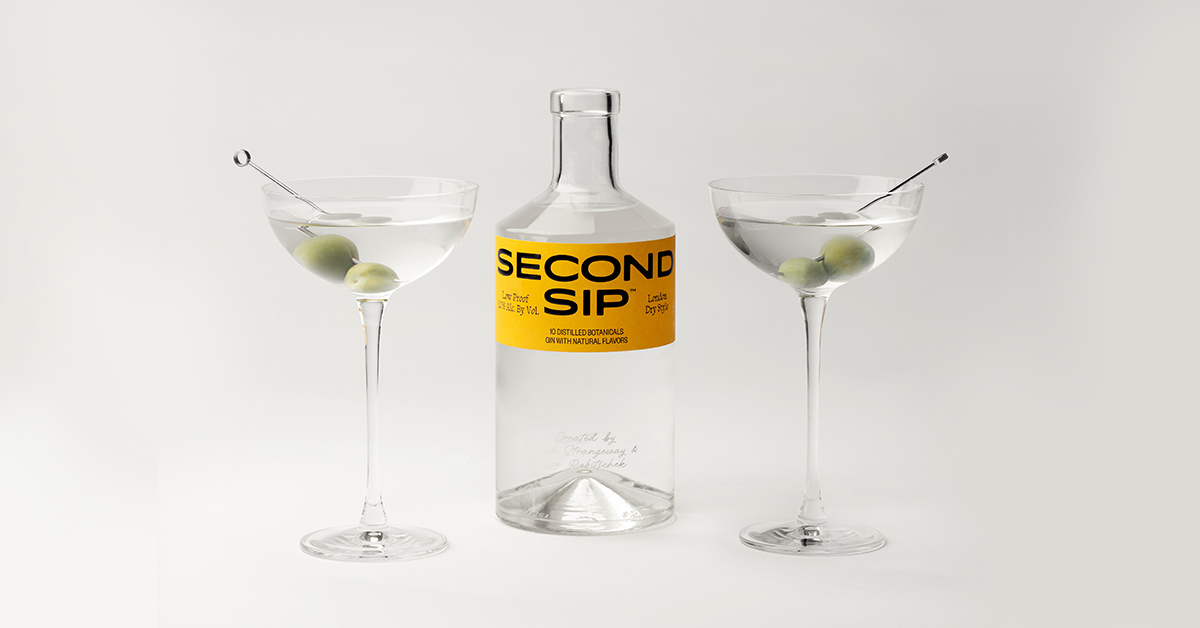
Sharelle Klaus Azeroual might have founded trailblazing adult non-alcoholic (ANA) drink brand DRY Soda over 20 years ago, but that’s not to say she doesn’t still love a good gin martini.
Some two years after handing off the day-to-day operations at DRY to general manager David Lynch-Clark, that desire has now pulled Klaus Azeroual back into the trenches of beverage entrepreneurship, and away from ANA. Inspired by the goal of making a martini-worthy gin that would allow her to “drink twice as much” without overindulging, Klaus has created Second Sip, a 20% ABV gin co-developed with beverage-alcohol veterans Leo Robitschek, the former bar director of Eleven Madison Park and NoMad, and Nick Strangeway, a longtime category consultant and the creator of Hepple Gin.
“We made a pact with each other: If it doesn’t taste good enough to go into a martini, we won’t launch it,” Klaus Azeroual told BevNET last week. “The bottom line is we are a gin company, I’m not here to be the poster child for low-ABV [spirits].”
After Klaus Azeroual tapped her about the idea, Robitschek brought in Strangeway to begin formulating in the UK before a test run in Warwick, N.Y. New York Distilling in Brooklyn distilled the first batch in January, and the brand soft-launched in March.
Second Sip is targeting customers starting in New York City, where it sees the potential to establish a beachhead in fine dining restaurants, high-end cocktail bars, and “high-touch” wine and liquor stores. The brand is already in over 30 cocktail bars in New York City, thanks to the connections and “reputation” that Robitschek and Strangeway carry in that space.
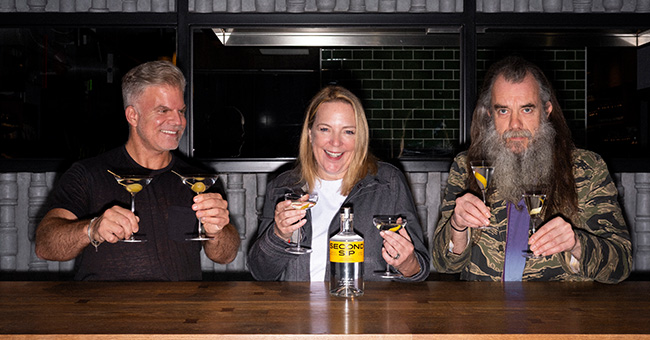
“Eleven Madison Park was our very first account,” Klaus Azeroual said. “On-premise is the major focus. You have to build a spirit brand there. You have to be in those top bars and have the bar trade behind you.”
How To Grow The Small Low-ABV Subcategory Of Spirits
Although the low-alc category is too small to track with normal retail sales data, low-alcohol options in the on-premise are a growing opportunity to develop and market towards. In bars and restaurants, 32% of consumers say they are drinking or planning to drink alcohol less frequently than they were a year ago, according to a CGA by NIQ report. But they still want to venture out.
“No alcohol and lighter drinks are a great option at bars now,” said celebrity bartender Remy Savage in the CGA report.
By offering those consumers a low-alcohol option that tastes similar to, if not the same as a full-strength version, not only hits that on-premise consumer but also increases the odds the brand will be picked up in retail.
Playing to the martini drinker is not a bad strategy either. About 20% of cocktail consumers drink martinis in bars and restaurants, according to CGA’s On-Premise Cocktail Report.
“Brands that generate trial in bars and restaurants are laying the ground for success in the Off Premise too, as three in five (about 60%) of those who enjoy a new drink in a venue say they actively seek it out for home consumption as well,” reported the CGA by NIQ research.
Despite the growing popularity of the low-to-no-alcohol category, low-ABV spirit options are still relatively rare. That may be partially due to low-proof spirits’ marketing quandary — in order to legally call themselves spirits like “vodka” and “whiskey,” they have to be distilled to a certain proof. Consumers likely need to be educated that intentionally produced low-ABV spirits aren’t just watered-down gin or vodka. Aperitif makers have found an easier time translating their naturally lower ABV products into moderation opportunities.
Although it’s still a small category, Second Sip joins a growing cohort of the low-alcohol set. U.K. import Quarter Proof launched its 3-SKUs in the U.S. last summer, joining smaller brands in the subcategory like BODY, Sommarøy and Rhode Island-based KEEL.
Capturing a consumer base that is seeking options to moderate alcohol intake but is unfamiliar that there are low-ABV options will take education and investments in brand-building that stretch from digital marketing to in-store sampling.
Union Square Wine and Spirits, one of Second Sip’s five retail partners in New York, sees the opportunity in broadening its selection into the low-ABV set.
“Given the current state of the spirits business and the popularity of non-alcoholic beverages, it makes sense to have something available for the consumer looking for an alternative to higher ABV spirits,” said the store’s general manager Jim English.