Search across the BevNET CPG Media network including BevNET, Nosh, Brewbound, Taste Radio, Nombase and CPG Jobs.

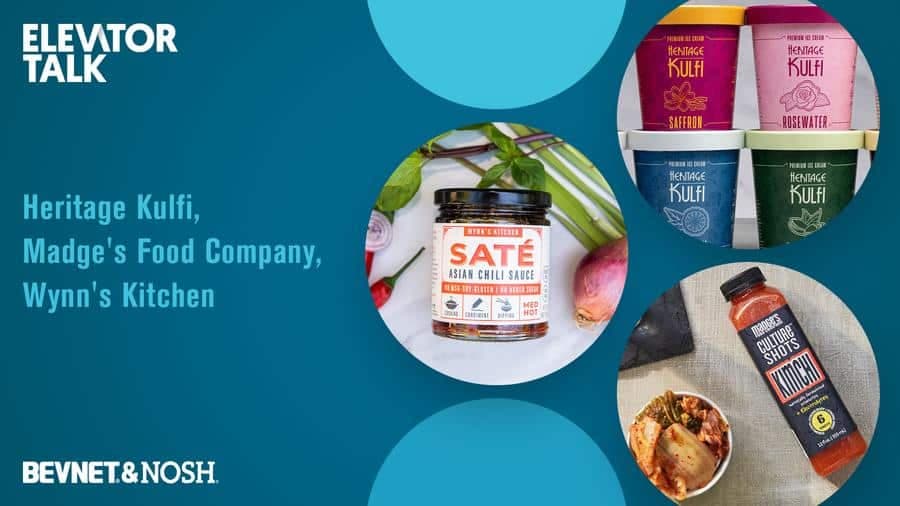
Elevator Talk Episode 69: Heritage Kulfi, Madge's Food Company, Wynn's Kitchen
Transcript
Note: Transcripts are automatically generated and may contain inaccuracies and spelling errors.
Ray Latif [00:06] Hey folks, I'm Ray Latif, the editor and producer of Bevnet's Taste Radio podcast, and you're tuning into the latest episode of Bevnet and Nash's Elevator Talk, a series that profiles early-stage and disruptive brands from across the food and beverage industry. Today's episode will focus on three food brands whose entrepreneurs will have an opportunity to hear feedback and advice from our co-host for this episode. That's Rifle Hughes, a business partner with JPG Resources. Rifle, so great to see you.
Speaker 2 [00:39] Hey, Ray, good seeing you too. Thanks for having me along.
Ray Latif [00:42] Yeah, of course, and it was so great to see you, uh, in December at Nosh Live Winter 2022 where you participated as a uh co-host, expert, industry guru for a live version of Elevator Talk that we hosted at the event, and, uh, I thought you did such a fantastic job. I was like, we, we gotta have you back, and you so graciously, uh, said yes. So thank you again.
Speaker 2 [01:05] Yeah, glad to. It feels like that was last month, feels like. More than literally last year. Quite, quite a quick start to the year.
Ray Latif [01:15] Totally, totally. Uh, you've been in this business for a long time. I think I've known you, jeez, at least 7 or 8 years at this point, and, uh, you've, you've done some great work with early stage and emerging brands in this business. Um, please tell us a bit about your background and your work with JPG.
Speaker 2 [01:33] Yeah, sure, I've been focused on largely the consumer packaged goods space with specific focus in food and beverage, but I'd say my experience is sort of at the intersection of what is commonly known as design thinking and then just more traditional business strategy, and so I've been been applying that trade in, in the, the service side of, of CPG and food and beverage uh at, at some great agencies, but then also at consulting practices like where I am now at JPG. Um, the work I've been doing is, as you alluded to, is, is pretty broad with both founders and startups, but then all the way up to some of the largest companies in the world, uh, household names that we all know. Uh, you know, for those, those startups and founders, we help them, um, you know, start off their business. They've got a great idea, but they, they are, you know, early on in the process and there's a lot to be done to, to build a brand, uh, create a product, and then launch that into the market and can help them out in a lot of ways. Um, really my expertise is, is kind of helping them capture the flame of their idea and then get the brand up and running and how it's expressed ultimately into the market and then for larger, more established brands, help them see white space, identify unmet consumer needs. Ultimately they've already got a brand that's well known, but they're looking for that next innovation, that next product, and can help them see where the opportunity is and then Chart a path to uh to build it and deliver it.
Ray Latif [03:12] I mean, it sounds like the work you're doing is really, really helpful to brands of all sizes, and in 2023, or at least in January of 2023, I think there's a lot of uncertainty. About what's, uh, what's coming, what's on the horizon for our industry, um, you know, what are some of the things that you're really focused on, or at least advising brands to be really focused on to be buttoned up for the remainder of the year?
Speaker 2 [03:37] Yeah, I think a common theme is just really smart business practices. This came out when I was at Nosh, as you alluded to earlier. There were a number of speakers that hit on that. Like there's one thing that I can take away from, from that event, it was, you know, have good margins, have good partners, really think ahead, don't do too much, don't overstretch. When times are tough, you even like you do in your personal life, you, you get to the basics, hold the true. And I just got back from Fancy Foods yesterday. Same themes, you know, don't be going to market with a product that the P&L doesn't work from day one, you know, have strong margins, have, have a manufacturer that you can rely on, have a, a sales strategy that isn't about opening all the doors, it's about finding good partners that, that you can get into, that'll help you scale. And then you can, you can, you know, expand velocity and grow the health of that particular account rather than let's open all the doors tomorrow. So just sound fundamentals, I think that's where everybody is trying to focus since, since things are uncertain.
Ray Latif [04:46] Yeah, the fundamentals are so important and it's hard because I think sometimes, sometimes you see these stories about brands that Get into 1000 stores, but then you need to fill that order. You need to support the brand on shelf at all those locations, and it's pretty tough. So saying no and, you know, staying true to what your business model and your business strategy are, uh, is really, really important. So, but I'm excited because, uh, I, I'm not familiar with, uh, with all, well, I'm familiar with a couple of these brands, but not familiar with all of them, and I'm excited to, uh, to hear about their business strategies. Are you, are you ready to meet our first guest of the show? I'm excited. Let's do it. Fantastic. That person is Mansoor Ahmed, who's the founder and CEO of Heritage Kulfi. Mansoor, great to see you. Mansoor, we need you to turn your video and audio on. There you go. I think you're still muted.
Speaker 3 [05:46] Uh, can you hear me now?
Ray Latif [05:48] Yeah, let's, let's, uh, let's take that from the top so that we can just get that all flushed out, flushed out, not flushed out. Alright, in 32. All right, that person is Mansoor Ahmed, who's the founder and CEO of Heritage Kulfi. Mansoor, great to see you.
Speaker 3 [06:06] Hi, hi guys, uh, excited to be here as an emerging brand. I'm a big fan of elevator Talk, so thank you for having me.
Ray Latif [06:13] Well, it's an honor to have you on the show and I love your sweater. 1 pint equals 16 ounces, and I think I know what the pint refers to, and I certainly know what 16 ounces are, but folks who aren't familiar with your brand, tell us all about it.
Speaker 3 [06:27] Uh, absolutely. Um, Heritage Kulfi is a premium ice cream inspired by my South Asian background, and for those who may not know, kulfi is a very common style of ice cream found in South Asia, and it has key attributes such as uh really high creaminess, higher density, which means it has very low overrun. There's a slow cooking process and the use of ingredients such as saffron, rosewater, mango, and pistachio. And so what makes us unique and kind of innovative in the world of frozen desserts is our extremely smooth, almost velvety texture and the particular ingredients that we use. And so we launched a little over a year ago and are currently in about 200 retail locations within the New York City area. We recently started up at Cinderella and are working to being available. In certain key cities throughout the country, uh, this year, hopefully, and um I have two new flavors that I'm launching very soon as well, as well as a vegan line later this year, which I'm particularly excited about.
Ray Latif [07:32] Very cool. Uh, we've had a few ice cream brands on Elevator Talk. I think this is the first kulfi brand that we've featured on the show. Um, as I typically ask folks, uh, when it comes to, uh, you know, an ethnic food, I mean, who is this for? Are you looking You know, for Heritage Kulfi to speak to a broad audience, or are you looking forward to speak to, you know, the South Asian community?
Speaker 3 [07:56] Uh, a bit of both, and this was a very big consideration in the R&D stage of creating each of the flavors and the brand. So the, the particular flavors do speak to my own background, um, flavors that I grew up with, ingredients that I found in various dishes that I ate. But overall, um, a big portion of creating each one of these flavors was to Keep it authentic and true to the concept of kulfi, but at the same time make them accessible. And um and so I'm hoping to uh actually appeal to quite a broad audience. Anyone who enjoys good ice cream, essentially.
Ray Latif [08:35] Rifle, do you like ice cream? You're a fan of some premium ice cream?
Speaker 2 [08:40] Oh yeah, oh yeah, definitely. So, uh, were you, uh, were you sampling at Fancy Food last summer in New York? I was, yes, ah, I knew it. I got to, I tried both the saffron and the rosewater, and I, I thought they were, they were fantastic. So thank you. Yeah, it was quite a lucky, lucky to have had the product, so
Ray Latif [08:59] yeah. Yeah, you know, rifle, when you tried the products, were you, was it easy to understand what it was? I mean, given that it does come in a familiar pint, you know, it does obviously look like and taste like ice cream, you know, did you have any questions about cofi in the same way that, you know, a conventional or mainstream consumer might be like, Oh, what is this? I need to know more. Is this even ice cream? Or, you know, was it easily understandable, do you think?
Speaker 2 [09:25] I, I don't know that I picked up that it, it wasn't just ice cream at the, at the moment. Part of it's, you know, you're at a show and there's lots going on, but the, the flavors, um, and I think it was your wife that was sampling them at the time, I mean, and she's a great salesperson if that was who it was, um, it was the flavors that really, really stood out to me because they're not common, you know, and that's why I went in for the, the, the atypical ones with saffron and rosewater, but Um, yeah, I remember it being, you know, dense but smooth, definitely a better experience than, than a lot of the mainstream ones. So, on the, it, it really was premium and gave me something different that I know a lot of consumers are craving for, especially as more and more, you know, people that look like me are, are seeking more international flavors and experiences through food. I think that's, that's the secret here. So, um, You know, whether or not the uniqueness of kulfi versus what most people know from ice cream, I think is something that may or may not be what ultimately unlocks the interest, but the very expressive flavors is it could be appeal for people that are looking for adventure within the category.
Ray Latif [10:37] In terms of label hierarchy, if you can see the package, I believe it says heritage premium ice cream at the very top. And then it goes down to Heritage Kulfi, the logo being the next largest, the next part, and then the flavor name, um, you know, given that again, you know, if someone sees this in the freezer aisle, do you think that's the right hierarchy for this type of brand, for a brand that is selling something that's a bit more esoteric?
Speaker 2 [11:02] Yeah, I think especially within the, within the freezer where you've got, you know, a layer of glass may or not be frosted depending on the quality of the retailer that's there, and then the product's often sitting back maybe under shadow. This is a category where I really favor impact over all else. So, um, weighing out, do you need to tell me that it's premium? I mean, if it is, it is, you know, um. Tiffany jewelry doesn't, doesn't say, you know, whether it is, and then the price likely speaks to it as well. So that could be something that works in the existing design, but really I would weigh out every piece of communication just because it, it, it fills up space that you could use for overall impact when you've got that whole. Frozen door situation of, of trying to get to clarity and um so I think that the overall hierarchy made sense. It was brand first, even though that the premium, the premium was at top. I mean, the brand's the biggest thing and then the flavors are clear and there's different colors. I can say there's an. Opportunity to even make it more um culturally true from, from your inspiration too. There's, their, uh, their, like the flavors are bold and the design is, is, is atypical, but it could possibly go a little bit further.
Ray Latif [12:21] Yeah, Mansoor, how did you think about the design elements and what is the price point for a Heritage Kulfi?
Speaker 3 [12:27] Uh, our suggested retail is 799, so you can comfortably find it between 799 and 899 at most retailers. And um, the idea behind the design, I mean, I designed it all myself, and um, the main idea was to capture a few elements. So you'll find some Art Deco theme in the logo itself and um being a New Yorker, that was important for me to kind of convey that. And then you'll also find South Asian elements such as the floral patterns, the particular colors that are used are pretty saturated, and this, uh, I think that You know, just in, in terms of graphics designing the world that you have, just because you designed something a certain way, how it actually conveys onto the printing press and goes from there and how it all proves is, is, it's just kind of a nightmare situation to always work within it. Um, so yes, this is the first iteration and um always figuring out ways to be different, but also accessible, stand out among that shelf and um yeah.
Speaker 2 [13:33] I think it's a good, it's a good out of the gate effort, you know, the things that I'm thinking around are like optimizations like you're, you're moving in the right direction from what I can see. It's just You know, taking the learnings as you, as you get the shelf and what, what you're finding that consumers respond to or even buyers in some ways and just, um, to your point, whereas you go to different runs and you can optimize it, make it better and better, but it's a great, great first start.
Speaker 3 [13:59] Thank you so much.
Ray Latif [14:00] Mansoor, how are you getting the product in people's mouths? How are you getting people to try this and then become consumers become loyal consumers?
Speaker 3 [14:09] Uh, prior to starting my brand, I did have some experience in the distribution of frozen desserts. I'd worked with a bunch of other manufacturers, so I, I had a network and community built up of South Asian stores that I've been servicing, and so as I expand to more mainstream markets, I work with the sales team and I'm having active conversations with distributors. And oftentimes, um, as the founder, I will be doing in-store demos and reaching out to retailers, buyers myself, and trying as much to connect with the average person, um, to really, you know, show my passion about the project, uh, about the product, and, um, take it from there.
Ray Latif [14:52] Yeah, those connections are so important and on the manufacturing side as well, and I know Rifle knows this as well as anyone, you know, having strong, solid manufacturing is so critical. Again, part of that fundamental as we were talking about earlier, but sort of navigating the frozen aisle, you know, and navigating frozen manufacturing can be pretty tricky. What are, you know, what are some of the pain points that you're finding right now and how are you addressing them?
Speaker 3 [15:19] Uh, I, I think that, uh, what's understood is that there is some education that is required on what GI is overall, and, um, so that I think is an aspect of marketing and placement. And just seeing where things need to be fine tuned. Oftentimes it's placement within a particular shelf or an in-store demo. And um, but I feel very confident that the product itself is very delicious and great, so I can put a lot of work behind promoting it.
Ray Latif [15:51] Well, you heard it right from Rifle that these products taste amazing. So I'm excited for the future of your brand. I'm excited to try it sometime in the near future. Are you, are you going to be in the Boston area anytime soon?
Speaker 3 [16:02] I can definitely ship to you, but I'm hoping to actually be there.
Ray Latif [16:07] Well, perhaps we'll have to exchange some information after the show, but in the meantime, Mansoor, thank you so much for taking the time to be with me. So interesting to hear about your brand and excited for the future of Heritage Culfi. Thank you for having me. Thank you. All right. Up next on this episode of Elevator Talk is Mike Miller, who's the co-founder of Madge's Food Company. Mike, how are you?
Speaker 4 [16:32] Doing wonderful yourself? Doing
Ray Latif [16:33] fantastic. Uh, I'm excited to speak with you. I met some members of your team at an event that uh Bevnet hosted in Austin last year with, uh, the Super Coffee team at their Super Coffee headquarters, and, uh, you know what, actually, I had stumbled upon one of your products at a Whole Foods prior to our event, and I'm like, wow, this is really cool. Um, you've been in business for a bit, but I believe those products are relatively new, right?
Speaker 4 [16:59] Yeah, absolutely. Yeah, they're all an upcycled product that we just recently launched in Whole Foods, I think October. So yeah, they are really new to the market.
Ray Latif [17:11] So let's back up for a second. What is Maggie's Food Company?
Speaker 4 [17:15] So Im Madge's Food Company, we're, we are a, a creator and a manufacturer of gut-healthy fermented food and beverages. Um, me and my wife founded the company. We were, I was a midlife crisis working in South Texas oil fields. She's a special education teacher, and we fell in love with fermenting. We caught the bug, uh, pun intended. And, uh, we started fermenting anything and everything, and I was actually selling kimchi to rustabouts and rig hands and And company men, and I was like, hey, you know, maybe there's something here. So I was able to walk away and leave, leave the oil field to make pickles for a living, as I told everybody. And so it's, it's been a blast. It's very fulfilling when you get all the emails about how you change people's lives. Um, and helping the people in different, you know, whether it be post chemo and things like that, it's really kind of gives you more than just, hey, this is about a business, we're really affecting lives here,
Ray Latif [18:17] so yeah, and you sell a pretty wide variety of products. Um, can you talk about your portfolio and then the most recent line that we were just talking about.
Speaker 4 [18:25] Yeah, so, uh, we're known for our vegan sugar-free kimchis. Uh, we're kind of dominate the Amazon space with that in that niche. Um, so we do a line of kimchis, lines of sauerkrauts, we do fermented vegetables. I've probably fermented anything and everything. It's just, uh, you know, you can't focus on, it's, it's already quite a bit, keeps my production people very busy. Um, and we also had a very innovative, uh, fermented. Tomato juice or Bloody Mary mix. It was probably the first on the market. Excited about that, but I think the timing on that was a little too early. And then the recent ones have been our upcycled products as far as all the brines, the kimchi brine, the pickled brine, and our carrot ginger brine.
Ray Latif [19:13] Yeah, I, I think the first thing I encountered was your, uh, and you call them culture shots, and I think I first encountered your kimchi. And what's the serving size of those because I think they are 12 ounce bottles. Is that right?
Speaker 4 [19:25] Yeah, so that's, uh, our partner wanted a multi-shot bottle, so, uh, we worked with them, and that was a 6-shot. So it's about 2 ounces a shot. As I always say, if it's a hard workout or a hard night drinking. Drink too. Um, but otherwise, if it's a, you know, just a 20-mile bike ride and you're a little sore, uh, you know, or just your daily intake of probiotics, you know, 2 ounces is fine.
Ray Latif [19:52] Rifle, uh, I think we've both seen, uh, a few companies with both beverage and food, uh, lines of products, and, um, it's, it's sometimes kind of challenging. Um, you know, what are your thoughts on the, on the two and sort of make them work together?
Speaker 2 [20:07] Yeah, and again, back to that fundamentals is some of the topics that that's been discussed, um, you know, really in this season of, of focusing on sound business practices where um you can definitely get too broad. You do too many things, um, you know, consumers can lose track because if you're in, in categories that don't necessarily have a, a great point of connectivity, it doesn't add up for them as a brand. From a manufacturing standpoint, you could end up You know, you know, using, it sounds like you self-manufacture, but it sounds like you could use, um, you know, multiple different contract manufacturers that gets, gets a lot, uh, a lot to manage, so. Um, I think the self-manufacturing makes this more viable than that. So, um, you know, clearly, clearly this is a space where awareness around gut health and the value and the impact it can have has been on the rise for a while, and then fermented products leaning straight into that makes, makes a ton of sense, so. Um, yeah, I'd be curious to understand, are there like winners and dogs in your line? Are you thinking about simplifying as you learn forward, um, you know, what's going on across the, the product line?
Speaker 4 [21:20] Yeah, I abs, I agree. Um, you know, I would, I would love to drop a few products. We, we mainly keep some products only for e-commerce just because we are about overall gut health, trying to bring people in. We still do local, a couple or just one local farmer's market now, and that's all I can handle. San Antonio is not a big farmer's market city. Um, so, it's, but we still do that. So we keep some of the products but not mass, mass, you know, make, we're not gonna manufacture, uh, our, our winners are kimchi. Uh, that's what we're constantly getting, um, you know, Goop picked us up about that and some other magazines have picked us up. So we always get lots of accolades for kimchi, so that's definitely a huge winner for us. Um. Sauerkrauts, I think there's a lot of competition on that, um, so I would. You know, right now we just do it again for a website and a couple, a distributor that specifically wanted it, but I kept telling them, no, the kimchis, I'm telling you the kimchis will sell and I'm usually right. So, uh, and then our Bloody Mary, I think it was just ahead of the, the market, you know, we opened up a lot of Total Wines and we were getting into, I think 185 HEBs. Uh, but that was the day of the COVID lockdown. So, literally our product got refused because it was non-essential, sat in the warehouse for 3 months. Um, so that was a disaster, but hey, that's, the kimchi took off, so we just kind of pivoted and went that route. And I think the culture shocks, I think, uh, those go hand in hand just because it's uh an upcycle product. Um. Even though it's kind of, you know, like the kimchi and the kimchi brine, you know, they have to kind of scale up together because if we scale up the juice too much or the brine, then I got to make more kimchi. What am I going to do? So, we've got to scale together. So, but that's where we're kind of putting our future, the kimchi, the tomato, and then these brines.
Ray Latif [23:25] I imagine merchandizing is really important for your brand too, Mike. You know, I found your beverages, I believe, in that sort of A refrigerated section where there are pickles and fermented products as well, and it was sort of on the on the base of that cooler. I can see them, you know, also positioned alongside kombucha and other probiotic beverages, but I guess where do you want these beverages merchandis and how are you talking to buyers and the merchandizing team at stores, you know, to get what you want.
Speaker 4 [23:59] Yeah, it's a good question. Um, you know, thus far we, we think Whole Foods has got a great job of the way they merchandise. They do kind of categorize all their fermented foods together, except kombucha, which is typically more in the, you know, the ready to drink section and the coolers. We're not there. Um, you know, we, we did try at least the tomato in right with the Bolt House fresh fruit, fruit juices. And I thought it would be great because we're in the produce, we're all-natural, whole vegetable, uh, but yeah, that wasn't really a winner either. So I think there, there is some challenge there as far as uh these brines, whether it be in a kind of like a refrigerated healthy living section. Um, or, you know, if that store has a fermented section, I still think that would go along, kind of, you know, along with the kimchis and kind of building that gut health platform, which is our ultimate goal one of these days. I think that's kind of where we would feel is the best bet, but.
Ray Latif [25:03] Well, you know, I think people are looking for these products in all parts of the store, especially because gut health is a sort of trendy kind of thing for consumers, especially in the natural channel, you know, rifle, is there something that you would lean into when it comes to gut health and, you know, what Maggie's is doing? I mean, I think for someone who's pretty familiar with things like kimchi and Um, well, like if you're drinking pickles, you know, as an example, but you know, to go beyond that, to sort of try to reach that conventional mainstream consumer, you know, what are some tips in terms of expressing gut health.
Speaker 2 [25:39] Yeah, I think, I think part of it is the You know, kimchi by nature is, let's call it, you know, a natural association with gut health, so people kind of get it. It's, it's a food product unto itself. When you get into the brines and drinking them, they're more like the derivative of gut health is, is a priority for you as a consumer, and now you're trying to add a product into your life that accomplished it. So the quick analogy I would use is like if you remember the original. Rocky, he's eating raw eggs to bulk up on protein and stuff because they didn't have like, you know, um, you know, convenient powdered protein products and things like that like we do today if, if you're looking to get that into your diet. So I think that's, that's the journey consumers are going to be on. It may be a little bit early for the brines to really connect. I think it's probably about the time where that, that'll start to show up, but the, the, the foods themselves that are functional is, is what consumers are going to get. So I think part of it's How do you build a brand that stands for gut health and, and fermentation together because right now Madge's Food is, is, you know, built on, built on the manufacturer, but how can you begin to shift toward a, uh, you know, a purpose-built brand that can carry that message?
Ray Latif [26:54] Mike, we're out of time, but I, I gotta ask just to follow up on that. How are you sharing the message? What's resonating with consumers about, you know, your mission and your brand?
Speaker 4 [27:03] Uh, you know, it's, it's all about gut health. I mean, um, if you talk to me, I'll nerd out and go really deep into the microbiology, but luckily I have a younger marketing person. She keeps it more kind of energetic, more to the demographic we're targeting for, but it's still about the gut health and how you can enjoy the, especially in Texas, you know, introducing people that have never tried kimchi in their life. Um, I definitely try to, you know, convey that bucket list. Um, and then, hey, let's, let's make a difference in your life, and, and that seems to be resonating, the, the gut health.
Ray Latif [27:37] And if you like fermented foods and beverages, at least the taste of them, you'll love Madge's because I know I do. And uh when I first tried your products, I was just blown away by how fresh and flavorful they are. So, well done on that front and well done. I, I think throughout, uh, everything you've built, Mike. Uh, thank you so much for taking the time to be with us. Please stay in touch and let us know how we can help in any way.
Speaker 4 [27:59] Yeah, thank you and thanks for having me.
Ray Latif [28:02] All right, up next we have Wynn Austin, who's the founder and CEO of Wynn's Kitchen. Wynne, great to see you.
Speaker 5 [28:09] Great to see you too. Uh, thank you, Ray and Rifle, for having me on the show. I'm a huge fan of the show and the podcast.
Ray Latif [28:15] Oh, thank you so much for saying that. I really appreciate it, and, uh, I appreciate the fact that you're in your kitchen talking about Wyn's kitchen.
Speaker 5 [28:22] Yeah, I keep it, I keep it real around here.
Ray Latif [28:25] Absolutely. Uh, please, you know, tell us all about your brand.
Speaker 5 [28:30] So my story began actually in 2016. Um, I was on a healing health journey and my background is Vietnamese, so Asian sauces and condiments are a huge part of my daily life. And my happiness. And, um, you know, I, I just had some health issues and I had to cut out sugar, soy, and gluten from my diet. And when I, you know, I went to some of, a lot of the big brand health stores to look for Asian sauces that didn't have sugar, soy, or gluten, and I found it impossible to find any. So, I luckily I love to cook, so I went back into my kitchen and started kicking around and I created a healthy version of my favorite Vietnamese sauce. It's a satay sauce, so I grew up eating that sauce my whole life and I love it and using some of the ingredients I learned from, you know, just from reading books on eating healthy and eating clean, which is newer to me at the time. I created this sauce and shared it with a lot of friends, and Next thing you know, the whole neighborhood, my tennis team wanted a jar. So, and 3 years later, um, I took it from a side hobby and took a leap of faith and when's kitchen was born.
Ray Latif [29:47] You know, when your tennis team wants your food, you're onto something.
Speaker 5 [29:52] Right, right, they're still my, they're still my biggest fans. So shout out to the tennis girls. Well,
Ray Latif [29:58] you may have some pretty big fans after this show airs too, because you do have some fantastic products.
Speaker 5 [30:03] Um, thank you.
Ray Latif [30:04] Please tell us about your portfolio and, and your newest product, which I know you've been working on for a while.
Speaker 5 [30:10] Yeah, so I started out pretty conservative, um, you know, I was, I was worried. I didn't come from a food background. I've never gone to a cooking school or anything like that. Um, Originally, I was a banker, so I started out with a sautey sauce. And I just kept that one skew, uh, for, you know, the first couple of years just because I was still trying to learn the business and how everything worked. And so my new sauce is the peanut sauce was just launched the end of December and um of course we did small batches, 17 cases just to make sure everything turned out OK, um, and to get feedback from the consumers and it luckily it sold out in less than 2 weeks. Um, because I've done a lot of research and I haven't found a peanut sauce on the market that doesn't have sugar, that's keto-friendly. It looks amazing. Very exciting. Thank
Ray Latif [31:05] you. Yeah, and you're right about peanut sauces. I think sort of better for you ones are pretty hard to find, yeah.
Speaker 5 [31:11] Yeah, and, and, you know, it, it goes with the sautey sauce. So I've been trying to, I have another skew too, the spices. So, and I, I include like a recipe on the back that has um like a healthy recipe where you don't add sugar to it as well. And so that's more of an e-commerce product right now because of the packaging, but um You know, I'm just kind of trying to stick with the 3 SKUs, talking, going back to what you guys were talking about, keeping it to the fundamentals and just really focusing on the velocity of the 3 SKUs.
Ray Latif [31:46] Rifle, let's, let's talk about labels here because I think the last time or previously we're talking about having a logo be the biggest part of your label and for Wynn's Kitchen, it's definitely the product itself first and foremost, you know, what do you think about the package design?
Speaker 2 [32:03] Yeah, um, I'm going off on memory here. I should have pulled it up as I was doing my research earlier. Um, I, yeah, I remember it being straight on point, and, and part of it, um, I think in some ways I was just struck by the simplicity of the idea, um, because as I watched some of the videos that you have on, on YouTube, you're really telling your inspiration and story, and it's like, oh yeah, I love all these flavors, but you're right. You know, Asian cooking, especially the sauces, usually have a lot of sugar, a lot of salt. Yeah. Um, and, you know, this is a convergence of trends where people are seeking out those flavors, but then they're also trying to reduce sugar and so forth. So. Yeah. This is like head smackingly simple, like, yes, incredible, but, Um, I think that's the challenge within this is what I remember from the label is, is how do you tell an authentically pure story like the inspiration from your heritage and for others that are, you know, seeking a great flavor experience for that, but then also, you know, it, it doesn't include, include the bad stuff and finding that right balance of this is an amazing product that has a great culinary inspiration. But then without, without all the bad stuff and uh as I recall from it, it, it, uh, it treads that line fairly well, but maybe trying to find a way to, to, to speak a little bit more loudly on the, I always hate trying to market an absence, but it's, it's, that's what the game is here.
Speaker 5 [33:36] Uh, I, I completely agree with that, and I think that's one of my challenges in pitching to some of the retail stores. Some, some buyers totally get it, and they were, they're super excited about it. Um, some buyers kind of say, oh well, this market's already saturated, when, you know, I try to put on the label that it's like, for example, the peanut sauce is vegan, it's no added sugar, and so both, both of the jars both have the no added sugar right on the front and kind of like tagline. So, so I'm hoping that it sticks out. So, but, but I agree with you that I would say that's, that's where I'm I'm kind of trying to do more videos and be really active on social media to push the healthy lifestyle and healthy eating.
Ray Latif [34:25] You know, it's funny to hear that retail buyers think that the category is saturated, or at least, you know, that sort of part of the story is saturated because it feels like there have been a lot more products coming to market. There's been a lot of excitement about, you know, other brands that are marketing chili sauces and chili crisps and things like that. Are you getting the sense that those brands are getting that space, or are they, or is, am I wrong, is that space? More closed off than it had been because I feel like it would open up a little bit more because again there is more consumer interest in these products,
Speaker 5 [34:57] right? So I think that the chili oil has been huge and even though my product has an oil base, I don't market it as a chili oil and more of a sauce just because it does have a, it's more of a saucier, like there's like shallots and lemongrass, so there's a lot more stuff. Substance to it than just fried garlic, and it has a different flavor profile, but, but I think that unless they're willing to try it or at least meet me, some buyers do tend to think that it kind of goes to, oh, like we already have, you know, some chili oils on the shelf, we don't want to add another one. Um, and that's why I didn't want to put that it's a chili oil, and, you know, satay is not as well known as sriracha, so that's, that's a little ode to my Vietnamese heritage, and I think that it helps stands out, but it also requires a little bit more time for people to pick it up.
Ray Latif [35:54] For sure that education component though is always um helpful for direct consumer and doing the videos that you're doing and doing the social that you're doing you can reach that consumer I would think a little bit more easily um how, how, what is your D2C strategy you know so how are you looking at that as part of your overall growth strategy?
Speaker 5 [36:12] So my D2C, um, I started out with Amazon, so I got it on Amazon, and I think because it's keto-friendly and no sugar, it, it kind of took on a life of its own. Like I don't pay for sponsors or, or advertisement on Amazon. And then now with, you know, I've just, I'm in about a little over 100 stores right now, so I'm just trying to work on scaling the retailers and through direct to consumer, I just got a new website last year that has the e-commerce capabilities and, and there's a lot of learning curve there. Like, I'm not quite busy enough to have a 3PL. Um, so I'm still packaging everything myself, so it's kind of, I'm in that growth space for direct to consumer, but I get a lot of orders there just from my community, being out and about with, you know, my peers, my tennis team, the moms group at school, and And social media. So I post a lot on social media and I've started doing email lists as well, like just like sending out, you know, updates either it's about the product or a recipe or my entrepreneurial journey, and I have to say the email has been really effective.
Ray Latif [37:25] Rifle, I'm curious about your thoughts, you know, on the, the potential for D2C. Now, you know, I know you're just meeting Wynn and her company for the first time, but, um, you know, is this something where you think it would, you know, be a benefit to, you know, the brand to be a little bit more aggressive when it comes to direct to consumer?
Speaker 2 [37:43] I think you nailed it earlier, Ray, when you started asking the question because you know this is a small item and the label, it, it, that educational component is a lot to roll out in a, in a standard retail setting, but given online and clearly you're, you're chasing all the things and doing a lot of great stuff. the aided sale approach as well as the SEO around, hey, I want a keto, you know, chili crisp or something like that that's ultimately going to land people at your door, I think you've got a long, you know, got a long runway of, of going the D2C route and and leveraging what, you know, online and keywords and all that can do for you before you really need to do the retail strategy. I don't know, that's my gut, but just because it is. It's, it's, it, it's, it feels more of like a Google search than it does like a, uh, meet it in person and just get it. So, um, I, I think you're moving in the right direction. That feels, that feels like it's a long way to go there.
Speaker 5 [38:44] Thank you, thank you. Um, and I think I, with the retailers, it's, I've seen more velocity with, um, just doing a lot of demos and hiring a couple other, you know, ambassadors to do demos. So, so I do agree, like some of the retailers, it definitely requires more effort, like face to face and trying the product, but, um, but yeah, so I think the direct to consumer is something that I'm really. Looking to grow and and through the email list and LinkedIn and kind of just sharing my message and sharing my journey. That's kind of how I'm going out about it.
Ray Latif [39:19] And we thank you for sharing that on Elevator Talk. This has been such a great conversation. Thank you so much for taking the time. My mouth is watering just looking at your products and some of the things that you can make with it. So, um, I'll, I'll have to check out your Amazon page. Well, actually, no, it says add to your cart right there. Maybe I'll just do that the show is
Speaker 5 [39:36] over. Yes. To go through the website, it's better, better margin. I, I've heard, I've heard. Yes.
Ray Latif [39:45] Uh, once again, thank you so much, Wynne. I really appreciate the time.
Speaker 5 [39:48] OK, thank you both for the opportunity. Thanks.
Ray Latif [39:52] Well, you know, I love elevator talk, and I always talk about this because it just opens up a whole new world of brands and products that I'm not familiar with and that are doing some pretty amazing things in a variety of categories, and I think that's just something that, you know, I'm really humbled and honored to be able to sit down with these entrepreneurs and sort of how they're going about their businesses, you know, from your perspective, Rifle, I know you see tons of brands all the time, but I mean, You know, we saw, you know, a relatively new company in Heritage Culfi. We saw a more established one in Madge, but one that's, you know, really getting into, you know, sort of a brand new world in beverage. And then Wynn Wynn's Kitchen taking on, you know, a product that is not so familiar with other people, with, with a lot of folks, but Um, can sort of be that market educator or leader in so many ways, you know, in general, what are your thoughts on all these strategies and how these brands are going about again developing their companies?
Speaker 2 [40:49] Yeah, what I, what I love about these four today is they're all, you know, unique and expressive in, in sort of new ways. Each one of them has You know, a clear understanding of an opportunity and an angle. You know, they're usually, I think almost all of them are hitting on at least two trends, if not more, so it's not like, oh, just another keto bar or something, a little bit of a me too. So I think that, that speaks volumes for, for these founders and these, these business managers that You know, they've got good ideas. They put a lot of thought into it. They're doing the hustle and it's, it's, it's, you know, they're, they're finding ways to offer something to consumers that they can't get anywhere else, even if it's just slightly different than other than other products and other brands, but I think that's, that's what's compelling and gives, you know, gives me a lot of hope because you're right, Ray, we do see a lot of stuff and we see a lot of the same. We go to these shows and it's like, yep. How are you different than the than the product right across the aisle, and then they don't have a good answer for that.
Ray Latif [41:57] It is funny sometimes actually when there are two brands that are in the same category and essentially the same sort of product across from each other in one of these aisles at say the fancy food show or Expo West, and you know we're coming up on Expo West and there are so many brands and so many exhibitors and Um, this is sort of a little off topic, but, you know, from, from your perspective, you know, what are ways that brands can really stand out at these shows and, you know, how can they be most effective in reaching, you know, the folks that are walking those aisles?
Speaker 2 [42:27] Yeah, I, I think it's about being brutal on differentiation, kind of what I was alluding to before. Have an extremely strong perspective on what makes you unique, and it's not just better ingredients or higher quality or something. I mean, you, you've got to have more than that because This every year we get more and more products, more and more brands. It's an extremely entrepreneurial area of, of the larger industry in our country, so competition is fierce, and if you don't have a clear point of difference. You know, how can you explain that to when that that dream buyer that you were hoping to meet that you set up a meeting with prior to the show, and then they walk up and they start to hit you with some hard questions because they're a little unsure, you got to know what makes you special, and I find that the brands that go far, they've got that down, the ones that, you know, tread water or worse disappear, that. They're missing that. So being ready for that when you're exhibiting is, is the most important thing.
Ray Latif [43:28] Is it really leaning into the backstory of the founder? Is it leaning into, you know, a flavor that people aren't familiar with? I mean, what, what is that point of differentiation that really resonates with folks like yourselves?
Speaker 2 [43:39] Yeah, I mean, like, like humans, it's, it's unique in every situation, you know, there we are, all the brands are literally special snowflakes, so for some it is that founder's story, like, you know, Gayle Becker being able to talk about her inspiration from her son's. You know, sensitivity to gluten that inspired her to create, um, you know, the cauliflower-based, based pizza, cauli power, or, um, you know, others, it is a technology. They've got special access to an ingredient or maybe it's a farmer. Maybe they grow this amazing, this amazing crop, and they want to translate that into a food. I mean, they're all valid, so it's, there's, there's no one, you know, set path. It's just really doing the assessment of what's your point of inspiration, why are, why are you led into this, but then understanding, you know, how is this going to connect with consumers that are beyond the ones that you can, you know, interact with in your close circle, like, like Wynn's tennis team, like how does it work beyond the tennis team? So I'd say there's there's so many paths, but just finding what's unique to you is what's key.
Ray Latif [44:47] Absolutely. Well, Rifle, uh, it's been so great having you back on the show. Um, we've had you on live. We've had you on virtually. We have to find a third way to do this. I don't know how we're gonna. But we've got to have you back regardless.
Speaker 2 [45:02] Thanks. Uh, I always, always, uh, appreciate the opportunity to, to help out with, uh, with Nash and Bevnet. The whole team there does, does, does such a great job and your, your events, your publications are, are, are at the top of the class. So, however I can help, I'm here.
Ray Latif [45:18] I really appreciate you saying that and I appreciate all your help and your advice and wisdom. sharing it with the community is so important. So thanks so much again. And thanks so much to the entrepreneurs that joined us on this episode of Elevator Talk. Uh, I just once again love speaking with all of you and look forward to future episodes of the show as well. In the meantime, uh, thank you to our incredible team at Bevnet, Nash and Taste Radio. Let me try that one more time. 32. And a huge thanks to our team at Bevnet, Nash and Taste Radio, as always, the best in the business. Signing off for everyone. I'm Ray Latif, and we'll talk to you next time.