Search across the BevNET CPG Media network including BevNET, Nosh, Brewbound, Taste Radio, Nombase and CPG Jobs.

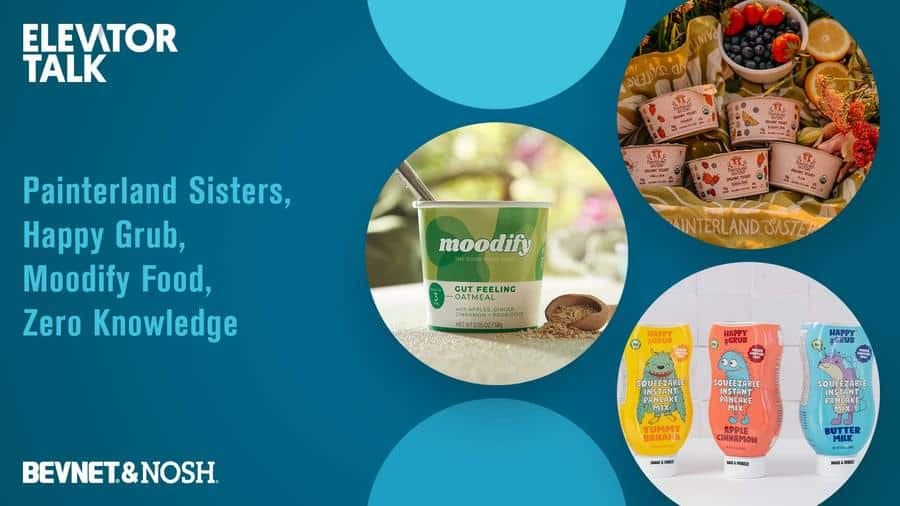
Elevator Talk Episode 71: Painterland Sisters, Happy Grub, Moodify Food, Zero Knowledge
Transcript
Note: Transcripts are automatically generated and may contain inaccuracies and spelling errors.
Ray Latif [00:06] Hey folks, I'm Ray Latif, the editor and producer of Bevnet's Taste Radio podcast. And you're tuning in to the latest episode of Bevnet and Nash's Elevator Talk, the series that profiles early-stage and disruptive brands from across the food and beverage industry. Today's episode will focus on 4 food brands whose entrepreneurs will have an opportunity to hear feedback and advice from our co-host for this episode, that's the one and only Melissa Facina, the co-founder and general partner of City Capital. Melissa, it's so great to see you.
Speaker 2 [00:37] What's up, Ray? Thanks for having me back. One of my favorite shows to be on. Thank you so
Ray Latif [00:42] much for saying that. And once again, thank you so much for being on the show. You and I finally got to meet in person a few months ago at Expo East 2022. Truly an honor to meet you. Uh, you've been such a great partner to this, to this entire industry and a great friend to Bevnet and Nash and Taste Radio. So thank you so much again for all that you do. Uh, for folks who aren't familiar with City Capital, please tell us a bit about the company.
Speaker 2 [01:05] Yup, for sure. Um, really briefly, we are a growth equity firm in the space, uh, very uniquely positioned in that, uh, I married our operating business, uh, which was called City Ops, uh, with a capital vehicle which is called City Capital. We are now All under one roof of a growth equity firm, 25 teammates, 1/3 investors, 2/3 operators and strategists. We have just over 80 portfolio companies. We are operating out of our second growth equity fund. Um, and yeah, we've supported just under, I think I counted the other day, 397 brands we've built on the operating side. And so, uh, super stoked to just continue to be here in the industry, help support growing brands and obviously put operating. talent and capital to work here.
Ray Latif [02:01] Yeah, you've aligned with some pretty fantastic brands, innovative, um, sort of high profile in terms of that entrepreneurial emerging brand stage of businesses. Talk about the size of investments that you make and the, you know, at what stage of development you're making them.
Speaker 2 [02:17] So it's probably no secret. Like almost all growing growth equity firms in the space, we've moved upstream some. What that means for us is we tend to inject capital post 10 to $15 million in annual revenue. Every now and then there is a company that is very fast growing, has stolen a ton of consumer interest, um, makes a lot of noise, that does slightly less than that, and we will ultimately start, start to look to partner, um, but I would say most often we Entering in after the 10 to $15 million in revenue on an annual annual basis. What I would say in terms of our check sizes is they range massively. We inject capital both in CPG and in IP food tech processing. I would say $3 million to $10 million first checks for us with lifetime values of 10 to $20 million depending upon obviously the business and the capital needs of it. Um, every now and then we write a check to a very small business that we can attach our full team to, take co-founder status in, effectively help, you know, grow and scale that business almost incubator style, but, but that is few and far between.
Ray Latif [03:36] Um, how much of the, you know, how much of your investment strategy is related to the founder themselves and, and the kind of person that you're looking for has what kind of qualities?
Speaker 2 [03:47] Well, I have a smirk on my face because I am thinking of the one brand that probably everybody is currently thinking of with three very well-known reality TV star founders. Um, uh, and I won't take the status of well-known, but I will say, uh, I certainly have a loud, uh, personality myself, and so aligning with folks who are unafraid. And really able to be articulate in where their passions are driving them and solving problems for the mass market seems to be areas, frankly, that we get attracted to. Investment in general is a bet on both the business and a bet on the leaders of the business, and you know people often mistake the leaders of a business just being founders because obviously every business starts with a founder, but the truth of the matter is ultimately those businesses grow and mature and need to have, you know, kind of folks in the management team that we also look at from an investing perspective. But frankly, Look, you know, our check sizes now require us to take a look at business fundamentals really significantly, so that's probably 80% of the of the pie, quite frankly. Um, but the other 20% is, if I can't get along with you, if I don't trust you, if you don't trust us, if you don't want my team in your business, uh, and we can't go and have dinner together or pick up the phone and call, like I'll tell you right now, every one of my founders could call me in the middle of the night and they know I would move mountains to do anything possible to help support them personally or professionally. Uh, if we can't build that dynamic, you don't belong taking our capital.
Ray Latif [05:30] I like the way you put that, you know, it has to be 100% trust across the board, and, you know, the kind of people that feel like they're all in this together. It's not just a question of, am I going to get my, you know, money back at some point. I'm going to get a certain type of return on investment. It's how can we make this brand grow. You know, as an equity shareholder, as someone who actually feels like they're part of the business rather than just an investor, so that's so great to hear.
Speaker 2 [05:56] It's
Ray Latif [05:56] a
Speaker 2 [05:56] long game, right? Too many investors come in here and think that they're going to invest capital and leave in 2 or 3 years. CPG just does not work like that. It takes a long time to build a business that has substantial value. And so you're getting in bed with people for a really significant amount of time, um, and you better make sure that you like your investor, uh, just the same way as they're interested in you. I, and sorry to steal so much airtime here, but a piece of advice I have for you guys or anyone else is, you know, capital partners often have most of the power, uh, when they're having conversations with brands. Obviously, they're the ones writing checks. Don't give away all of your power by just saying, you're the one here who's willing to write me a check. That might be true, but frankly, those end up in really bad relationships and dynamics a lot. Uh, and, and, and, and, you know, in, in kind of bad shifts of power, uh, when you are partnering with somebody purely for the capital. Make sure that you're partnering with. It's better to not take capital, frankly, and grow at a much slower pace than take capital from a partner who doesn't align with your ethos and doesn't align with your business and who you don't have a good fundamental connection with, because this is a long time coming, and they're the people, by the way, who are going to, you know, bat for you next time around and the time after that when you're raising capital from larger and larger players. And so if you don't have the right people in the seats early on, it's a very challenging experience.
Ray Latif [07:31] Well, I, I told our entrepreneurs in this episode, uh, prior to us getting on the mics that, uh, I was so happy to have you, uh, offer advice and insights and feedback, and you've already done quite so, so much. You're just in early into this episode. I'm so excited for you to meet all of them. Are you ready to meet our first entrepreneurs of this episode of Elevator Talk? Hell yeah. Let's do it. All right, those folks are Haley and Stephanie Painter, the co-founders of Painterland Sisters. Haley, Stephanie, so great to meet you.
Speaker 2 [08:01] Wait, and it's Haley's birthday today. It is
Ray Latif [08:03] Haley's birthday today. Happy birthday, Haley.
Speaker 2 [08:05] Birthday to have a conversation like this. Way to
Speaker 3 [08:08] go. Oh yes, the best party I can have.
Ray Latif [08:11] Absolutely. Painter Land Sisters, love the name, love the sort of vibe that you guys give off. Tell us all about your brand.
Speaker 3 [08:20] Yeah, definitely. So I just wanted to say that the entire time we're talking, Melissa, Haley and I just looked and we're like shaking our heads like, yeah, that's an awesome invite. So yeah, thank you, but I'm Stephanie Painter. Haley and I founded Painterland Sisters. We're 4th generation on our family's organic regenerative crop and dairy farm in the rolling hills of Pennsylvania, so they call it the Pennsylvania wild now. When we were growing up, they just call it the middle of nowhere. So as we got out into World, we realized that people were completely disconnected from the source of their food, which is the American farmer, and we were constantly explaining why it's so important to, you know, support agriculture, support sustainable agriculture, and we always knew since we were barefooted little girls that we wanted to bring light to our family's farm and basically connect the world to the farm and the farm to the world. And as we've gone out, like I said, you know, we would just notice everyone's so disconnected, so We're like, OK, like what can we do? First of all, we have an organic dairy farm like I mentioned, so we're like, what can we create to basically control our own destinies as 4th generation on the farm to sustain it basically not just the land but for generations to come. So really being the caretakers of that land and understanding it and the animals. Um, so anyways, we went through a lot of, a lot of different phases, but we partnered with a 10th generation Icelandic yogurt maker here in Pennsylvania, and we make Icelandic style skier yogurt. It's organic, certified woman owned, of course. It has 6% milk fat, so we're dairy girls. We're like cream of the crop, literally natural girls. All the cream, all the good fat. Like we're in. So 6% milk fat, billions of probiotics. It's also also lactose free. So you know, being dairy farmers, we don't want to give people a reason to not consume dairy. So we wanted this to be accessible and great for everyone. The cool thing about this product, not only are we giving a really nutrient-dense product, so it has 16 to 18 g of protein in every single. Um, but every time we are able to get that cup into someone's hand, it opens up a conversation about the importance of agriculture. So everything to do with our marketing has to do to educate about ag, about dairy, and about the benefits of sustainable agriculture, especially roaming animals. There's a lot of debate on that right now, so we, we put a lot of heart into that. Um. And we do it in a fun loving millennial woman type of way, something we try to relate to the general public in a way that, you know, maybe our parents' grandparents could not do. So we're, you know, we add that like wild, free, just vibe to everything. So Hayley, do you have anything to add to that? I think you hit everything on the head. Other than it is simply yummy as well. It is so thick and creamy. People are like, Oh, does it taste like Greek yogurt? No, Greek yogurt is gritty. I don't eat Greek yogurt. I don't eat plain yogurt. So I had to make a yogurt that, you know, Stephanie and I both like, so it's like a very yummy mousse. You could actually put the entire thing upside down and it probably won't fall down for a couple minutes. So yeah, it's just simply yummy, and we forgot to say that.
Ray Latif [11:43] It looks yummy. I love your flavors. I'm excited to try it. Uh, hopefully I can in the near future if you are distributed in my area in the Northeast. Um, Melissa, uh, I'm sure you're familiar with SKER. What do you think of the approach of, uh, Painter Land Sisters?
Speaker 2 [11:58] Well, ironically, besides sitting in the same state, I happen to sit in the mushroom capital of the world, as we've, um, but I also, uh, my, my, my family is in massive food manufacturing. Half of that happens to be yogurt-based. Uh, so I come from a very similar background, although not, uh, from the actual farming side, from the, you know, kind of production and manufacturing side of the business. Um, I think that Nutritionally, you're headed in 100% of the right pathway, right? We, we, we, as a, for whatever reason, as a, as a country, somehow identified yogurt as this sugar filled, you know, virtually no fat, uh, you know, kind of very poor, um, you know, ingredient composition. I mean real garbage, quite frankly, I hate to say it. When you look at, you know, yogurt in general from other cultures, it is a really nutritionally dense, rich, you know, wholesome, hearty meal, and we just don't use it like that anymore. I think the consumer is turning their attention for a variety of reasons of macro, you know, nutrient content. Obviously Greek yogurt set that path off. It's OK, no problem. I hate on Greek too, by the way. But I do think it's going to still take you a little bit more education for people to understand why there's value in the cup, and it sounds like there's a lot of it, right, in terms of literally high caliber ingredient content, what you're offering from, I'm guessing, a full suite of macro. I didn't look at the macros, but it sounds like we've got a significant portion of healthy fats in a 6%. Milk fat ratio, uh, and obviously a significant amount of protein depends on how much sugar you're putting in, which leads me to the question, what are you doing with preps?
Speaker 3 [14:05] Yeah, so the sugar we put in, we add organic cane sugar in because we want something that, you know, everybody's bodies know how to digest, so no non-nutritives. We do, we try to minimize our preps as much as possible. We do have to thicken them because our product is so thick, and obviously strawberries are never going to be as thick as like a mousse, and so we thicken it and everything else we just try. To tailor it to be as naturally sweet as possible and so the sugar content is considered low in sugar. It's only 7 g added. Would you
Speaker 2 [14:41] say? Sorry to interrupt you. Is this like a fruit on the bottom style or is this a blended style?
Speaker 3 [14:46] It's all blended, and I did all the blending myself. I'm very picky with flavors. Like I am a snob and so I went through. 50 different strawberries and now I feel like it just tastes like strawberry fields. We also have meadowberry is named after Stephanie's daughter Meadow. It's a mixed berry with elderberry. We have a blueberry lemon, one of the only blueberry lemon yogurts on the market in our country, and of course we have plain because you can use plain instead of sour cream and cream cheese. And the last one is vanilla beans, Stephanie's personal favorite. Yes,
Speaker 2 [15:21] so I heard y'all say that you leverage co-manufacturing support, and I want to call out something you said to teach other people, which is you're dealing with the 10th generation. Uh, is that right? Is that what I heard? Yeah, partner. Why that's important, uh, for those who leverage co-manufacturing is there's a lot of crappy co-manufacturers that exist right now for small businesses. Uh, that are literally cropping up on a daily basis or who've been around for a handful of years trying to grab volume, uh, that's available from, you know, brand new product offerings. Those are where you, and, and by the way, I, I don't want to say all, uh, but that is often where you get a lot of the horror stories, uh, of people who have really bad manufacturing. Partnerships. Perhaps yours isn't perfect. None are, uh, but certainly knowing to lean into people who have material expertise is a really big part of the equation, uh, both for quality control metrics, but also oftentimes those people have the greatest level of operational efficiency, which means you're getting the greatest cost structure that you. Get in your size business now. Can you tell us what y'all are selling for and where you're selling, please?
Speaker 3 [16:33] Yeah, so we are definitely a premium yogurt. So we're selling, um, we're selling nationally now. So we launched in March of 2022 and we're in about 1300 retail stores. So across the nation you're seeing it from 249 to like 329. Um, but you know, normally it's like 299, so we're launched nationally with Sprouts. We're in Mid-Atlantic Whole Foods. We're in Kimberton Whole Foods Moms. We launch with some local distributors because we come from the nooks and crannies of the world and we want to make sure we get into the nooks and crannies of the world. We're in natural grocers. We are in Central Market. We are in, so yeah, we just launched, we launched nationally with, uh, we have a great broker Greenspoon, so we launched nationally with them in December. So honestly like our emails are lit up and they're super good, yeah, so they're awesome. We, we also. So I work with a great distributor here in Penn or a great broker here in Pennsylvania, MPS. Got us into Giant. So Giant obviously in Pennsylvania is a local company, so we're basically, you know, working with them to support Pennsylvania agriculture, which was a great partnership with us. So we're in Giant Carlisle, Giant Food. We're also in Giant Eagle, like Market districts, the specialty stores. I think that's like some of the bigger accounts
Speaker 2 [17:56] and you said March 2022,
Speaker 3 [17:58] yeah, so we'll hit a million dollars in revenue before, I mean like right now, so 10 months
Speaker 2 [18:05] so that's how it's done, everyone, congratulations. That is a really impressive story for being just 12 months old. How are you funding?
Speaker 3 [18:18] Yeah, so we partnered with our, first of all, we like, of course maxed out every credit card we ever had. We got, we got a ton of grants, you know, because we're Just Pennsylvania agriculture. So we started with grants and then we worked with our family's farm to basically get a loan to start rocking and rolling, and now we're right on the brink of doing another capital raise and it's insane. So I was just We're like Hayley and I are taking mental notes of everything you're saying right now because it just feels, feels a little bit overwhelming, but that's, you know, it just grew like so much more than we thought and now we have to kind of figure out a way to, to keep it going, so it's very exciting, but yeah.
Ray Latif [19:01] It is very exciting and I, uh, man, I, I feel like we could chat for like another half hour with you guys. Um, thank you so much for taking the time to be with us today. Um, please stay in touch. Let us know how we can help in any way. Uh, and please let us know when you do complete your raise. It's something we definitely want to write about for Nash and, uh, and cover as you continue to grow. Um, but in the meantime, thank you so much again for joining us.
Speaker 3 [19:25] Great, thank you, we appreciate it. Thanks for the opportunity. We'll, we'll be at Expo West, so maybe we'll see you guys there.
Ray Latif [19:31] We will stop by for sure.
Speaker 3 [19:33] Sounds good. Thank you very much. Appreciate
Ray Latif [19:35] it. All right, what a fantastic way to start the show. Let's keep it going with Ashley Davies, who is the founder of Happy Grub. Ashley, so great to see you.
Speaker 4 [19:44] Yeah, great to see you too. Thank you so much for having me on. It's definitely an aha moment of mine. I'm super excited to have this conversation with you, and I cannot wait for the future of Happy Grub now that we are able to be talking to you. Yeah,
Ray Latif [19:59] absolutely. I first met your brand or was introduced to your brand at the 2023 Winter Fancy Food Show in Las Vegas that happened in January. Uh, really impressed by what you guys do and really excited to have you on the show. So please tell our audience all about your brand.
Speaker 4 [20:15] Yeah, thank you. Um, yeah, my, uh, the employees that we have there said it was great to meet you as well. So, um, like Ray mentioned, my name is Ashley Davies, and I am the founder of Happy Grub, the only squeezable instant pancake mix in a bottle. Uh, Happy Grub is About making memories and not messes. We want to make sure that families have enough quality time to spend with their kids. So that's why we wanted to create something that would make it easy for kids and parents everywhere to simply add water to the bottle and shake it and squeeze it onto the pan. And one of the wonderful things about Happy Grub is we have a patent on Happy Grub and our bottle. It took a long journey to get to this point, but I wanted to make sure that we could put memories into parents' hands as much as possible, uh, by creating a line of Grub products and what we've done here is our squeezable instant pancake mix. We again are the only ones on the market, so we are really hitting up every grocery store in their innovation showcases. Everyone is loving this product because there's nothing quite like it on the market. Currently, we're sold in over 400 retailers in the US nationwide. Next month, we will also be launching with World Market nationwide, and we will be in Walmart stores in California and in Texas, over 500 locations, and hoping to grow with them more by the end of the year. You'll also find us in Costco, uh, and their roadshows will be in Sam's Club as well by the end of this year, and we're on an amazing path of growth, and I could not be more excited to share Happy Grub with the world. And with all the excitement that we have going on and all this wonderful growth, we've had so many interested investors that we've decided to open up our first round of capital raise. So this will be our first time going into it. We're very excited, and I would love to have Happy Grub in everyone's home within 5 years. That would be amazing because that just means that there are families making more memories and less mess with Happy Grub. So I look forward to answering any questions you may have, and I love the advice that we've been getting so far on the show. So I look forward to
Ray Latif [22:32] it. Fantastic.
Speaker 2 [22:33] I'm just too excited. I need to jump in. Sorry. Um, so first of all, really love the characters you have. Uh, aren't they cute? They are, they are very grabbing, uh, and so please trademark them. I did, OK, um, 2, I'm super stoked because the concept is very obviously like, aha, uh, but no one really think about it. Uh, so when I saw this, uh, by the way, before I was like, damn, that's a freaking good idea. Um, so way to go and pulling, you know, an innovation together. Um, also, I, I noticed when you were sharing kind of where y'all have started distributing, you've picked what I would consider to be a pretty Atypical path for a small business. Usually people are pursuing, you know, kind of small natural grocers and going through that channel. What one, what made you go, you know, more of the larger conventional retail partners and club, uh, and two, in tandem with that, it takes a lot of working capital to support that and a lot of operational infrastructure. Curious, you know, how you're navigating that because that's, that's fairly large scale right in the very beginning. Sure, yeah,
Speaker 4 [23:51] and from the beginning we've always wanted to have manageable growth. So we are with Kay and we will be launching with Unify as well, and we started with some small mom and pops through Fair and as we continued to grow, we just had more and more companies wanting us to launch with them because there's nothing like this. We are the first pancake on the market. To really, I guess, rock the shelves, as I've been told by Target, that we, there's been no change to the pancake category. So we knew that we were definitely on to something and we wanted to just keep growing. So when I say manageable growth, we were also offered opportunity with Walmart to go larger scale with them, uh, more. 500 stores, but again, manageable growth is something that's always in the back of my mind because we don't want to get into the position where, well, any company, you don't want to get in that position where you have so many POs you're not able to fulfill them. So what we wanted to do was start small. We wanted to make sure that cash flow started coming in and as it started to continue to come in, that's when we started to grow with larger companies.
Speaker 2 [25:00] Mhm. Got it. And so, is that why you're in pursuit of your first capital raise now? Cause obviously you've got players in the market that have much larger POs and, and, and OE opportunities to fill.
Speaker 4 [25:12] Sure. And when I started this, uh, it's all self-funded. So, we did this bootstrap the entire thing, and now we're getting to the point where we want to be able to grow because it is such an opportunity that we've been given. And we shortly also So I, I can't really talk about it too much, but shortly within the next few months, we will also have Happy Grub on a national stage. So there will be plenty of opportunity for Happy Grub to grow in multiple retailers, and we're also preparing for that launch as well.
Speaker 2 [25:43] So I know the direct to consumer market is not like the hottest thing ever anymore because it costs considerable dollars to acquire customers these days, you know, and that's kind of turning businesses on their head who had that model over the last handful of years. It seems like if I heard you correctly, this is a dry mix inside here that you ultimately add water to, so it seems to be the perfect setup for direct to consumer because you're not spending dollars shipping heavy, you know, product. Do you have a direct, I mean, I'm looking at your site, so clearly you can, you can purchase online, but like what percentage of your business comes from D2C versus on the shelf?
Speaker 4 [26:22] Uh, on Amazon too. We, we do great sales on Amazon as well. Uh, so I would say about 20%. The rest is direct to consumer, and it's growing very quickly, especially on Amazon. We offer multiple, multi-packs. So we have a 2 pack and a 4 pack on there where customers are offered additional savings. So once we launched with Costco and we did the roadshows, uh, we had a large turnaround onto Amazon because they automatically went onto Amazon, saw additional packs, and they've been extremely interested and we get multiple reorders a month, monthly per individual customers.
Speaker 2 [27:01] Um, so level with us, Ashley, because clearly you've hit it out of the park in a variety of contexts. Uh, what are you struggling with and what would you say is the biggest area of opportunity to support both you and the business so that you have the ability to achieve the goals that you've got in front of you?
Speaker 4 [27:21] Sure, and I've only been able to hit this out of the ballpark with the help of everyone that's behind me, like the employees that I've had since the very beginning. I think when it comes to having such an innovative product, the problem that a lot of entrepreneurs and small businesses can see is the growth, and it's the cash flow when it comes to it. So I think like many other companies, you want to expand, but that's when that manageable growth comes into play. So Ultimately what we want to do is go into this fundraising round so when we do have these opportunities to expand with Walmart, Target, Sam's Club, and go nationwide, we want to be able to have that cash flow and that equity behind us so we are able to expand and get into homes everywhere.
Speaker 2 [28:06] Have you unlocked a purchase order financing yet or anything? Inventory financing?
Speaker 4 [28:11] Yes, we have, so we're in the process of doing that. But when it comes to, like I said, such an innovative product, the demand has been so high, and we've had to hold back because we are looking for that strategic partner with us to help us grow. So that's another reason that we haven't necessarily gone down 100%, the PO financing, but we have done that as well. But again, we're looking for that strategic. Partner in the CPG space to help us grow.
Speaker 2 [28:39] Those are good things to have anyway, just so you know, I don't have to use them or leverage them, you know, out in its entirety, but they're nice to have as fallbacks as securities, you know, as through negotiating with investors. You don't have to share an exact number, but I'm curious, a range would be OK, where, you know, where your projected revenue falls in 2023.
Speaker 4 [29:01] Um, so with our projected revenue, it depends on how many retailers that we get into. If we still wanna launch in Sam's Club, that's, again, why we are looking to do the capital raise. And I would be more than happy to have a conversation with you offline. Uh, but yeah, it just honestly Depends on the expansion that we are able to grow on this national stage like I also mentioned that we'll have in the next few months. So the variables are definitely working in our favor and we're excited to bring this to
Speaker 2 [29:30] everyone. You're very smart. That was a very good answer.
Speaker 4 [29:34] Thank you.
Ray Latif [29:36] That was a great answer. I was, and you, and you handled it so, uh, so smoothly, Ashley. Well done. Thank you.
Speaker 4 [29:44] I have, I, I have two little babies, so I have to handle things smoothly. If not, the whole house falls apart, so.
Ray Latif [29:51] Well, I'm sure that they are very excited that their mom is, uh, a pancake entrepreneur because that sounds like the best mom to have in life. Especially when pancakes are pretty hot right now. I feel like, uh, they're, they're definitely on trend for sure. Um, Ashley, thank you so much for taking the time to be with me today. I'm so glad I got to meet your team at the Fancy Food show and very excited to see the future of Happy Grub. Please stay in touch.
Speaker 4 [30:17] Yes, we absolutely will. Thank you so much, and we'll see you at Expo West as well.
Ray Latif [30:21] All right, see you
Speaker 4 [30:22] there. Yeah, thank you. Have a nice day.
Ray Latif [30:27] That actually brings up a good point. A lot of folks are asking us, well, you know, how do I get your team to come to our booth at Expo West, and the best way to do so, please, if you can, is to send us that information via upload. Just go to bevnet.com/expowest if you're a beverage exhibitor or nosh.com/expowest if you are a food exhibitor. That way you can tell us exactly where your boot. is what you're going to be exhibiting, whether it's new products, or revamp, you know, talking about new distribution, new retail placement, or new team members. It just gives us a reason to come to your booth and ask the right questions and also for our AV team to come and visit as well, to take the right photos, to take videos. So please once again, if you are exhibiting at Expo West, let us know via our website bevnet.com/expowest or nosh.com/expowest. All right. Let's meet our 3rd entrepreneur, or 3rd brand for this episode of Elevator Talk. That's Christine Keller, who is the co-founder and CEO of Moodify Food.
Speaker 5 [31:31] Hey, how are you guys? Great to see you too, and thank you for having me. It's so nice to meet both of you today. And also, what a great company I'm in. I can't even believe it. First of all, all women, yay, women, and also all breakfast foods, which is just, you know, kind of funny. I don't know if you guys plan that, but I think it's pretty great to have breakfast foods in bars and, um, pancakes. Love pancakes and yogurt. So, um, I'm super happy to be here today. Um, I am the CEO and co-founder of a company called Modify Foods. And we're a brand of instant oatmeal that's thoughtfully crafted with all natural ingredients to naturally boost your mood. Um, this idea was born from the mental health crisis, frankly, that we're facing in America today. Um, it's all over the place. You see it in almost every newspaper and magazine that you pick up. You have all the sports teams thinking about it, schools and businesses are also putting in mental health support groups. So I've been seeing that. I've been witnessing my own struggles. I see other people witnessing their struggles, big or small. And I thought because one, I have a large, long background in the food business, um, what can I do to help? Well, I'm certainly not going to just change my career and become a psychotherapist, although I, I, I would, I think it's super interesting, um, people's challenges that they have. But I leaned on my background in food and, and the information that I know about how food can benefit your mental health and your brain and boost them. And I thought, OK, well, wait, this is a great idea. So how do we want to do that? How do we want to think about it? Um, there are tons of beverages out on the market right now are starting to become more emerging beverages in the market right now, um, and functional foods, um, around this space of, of mood food. But, but our idea was really around the idea of like, well, how do we start the day? Like, we need to be in breakfast, we're talking about breakfast category. So our idea is to start the breakfast with something right, something that can impact your brain, but also with some intention that's out there. Um, so we launched our oatmeal. We looked into all the different foods. We're certainly not going to put salmon or avocado in a breakfast food, maybe avocado in a breakfast food, but certainly not in an oatmeal. So we looked at different ingredients that are good for your mood, and we, we love oats. Oats are great for your brain. Um, we started making combinations, really interesting flavors, um, combinations of ginger and bananas, and excuse me, nuts. Um, put them all together and we've launched our brand, um, and are starting to talk a lot about it and get a lot of recognition for this place and the space of mental health. Um, we're really going to add that voice, um, to help destigmatize mental health and really start talking about it. So it's sort of a functional thing, but it's also an idea of just starting the day right. Um, we all know that there are many ways to approach your mental health, and food is just one of them. Um, but the awareness of mental health is the thing that we're most excited about, and our products are really interesting too. Um, I come from a long food background, um, so our products are Little Buzz, Gut Feeling, Gone Bananas, It's Nuts, Berry Bliss, and Golden State. And we started with texture in mind. So all the oatmeals that we see out there have so much sugar, and they have little tiny particulates, and they're kind of mushy, especially instant oatmeals. And so we wanted to think about texture first. So we started with two types of oats that we've got in the product. We're working with puffed amaranth and flax. Um, we're zero added sugar. We're just sweetening with dates, and it's lightly, lightly sweet. So we love that as an idea because sugar is not something you want to put in your body in the morning. Um, and then we're adding really large particulates of nuts and fruits. And so it's, we like to think about, about it like a Ben and Jerry's type of idea. So it's actually got pieces in it that you can get your teeth on that don't just turn soggy in your mouth. Um, we have just launched our products in 2021. We're in about 70 retail locations and food service, and in our test market we did in Denver, we, we launched all over the place. We wanted to understand how are people reacting to the brand, what, what places are going to be selling. And we noticed that we're doing really well in grocery stores. Obviously, that's our main channel of distribution that we're looking at right now. And then we're also noticed that college campuses, bookstores, um, cafes, all of that food service, and so we said, OK, well, we better pull up the food service channel. Um, and then we've got some direct to consumer that we're doing online and through fair as well. And then, um, Farm Fresh to you out here in California is working with us too. So we're excited about that. Um, our product is 329 at shelf, 329 to 349. Uh, we're distributed by Kay. Um, we won the golden ticket last year, um, at Expo West with Kay, so we can open up all of our distribution with Kay. Um, we've chosen just to open up Southern California right now because, and, well, it's Utah, Southern California, and Hawaii right now because we want to kind of keep things contained as we're self-funding right now. So we're launched into, um, we're launching into Gelson's, we're launching the Safeway Denver, um, this spring, and, um, also Bristol Farms. So that's exciting for us. And then on the distribution side for food service, we are nationally launching, I mean, we're trying to figure the national launch out right now depending on where it is, but um with VStar and with US Foods, and that's launching later this month. So we're really excited, we're focusing on college campuses, bookstores, all the places that we've seen success. Um, there's some funny ideas about gyms for us, but we're not quite sure because our consumer is really active lifestyle. Um, mental health is something that people are thinking about. And we really believe that you're not just what you eat, but you're also what you think and feel. And so we're thinking about things in that idea too. So people who are really active and healthy are our main targets.
Ray Latif [37:09] Christine, that, that is fantastic. I, I have a million questions. That was such great information, but I feel like the questions that Melissa's gonna have are better than mine. So Melissa, take it away. Oh
Speaker 5 [37:20] my God, great question.
Speaker 2 [37:22] Uh, I've taken the mic from you like this entire time. So if you have a question, please take it back. Um, well, so first of all, on thank you for all the information. 2, the colors are beautiful. They're grabbing. Uh, yeah, that was. I think that was a good move. I'm sure very intentional in order to make people feel a certain way per product. Um, quick question on, um, does this have a charity component or just an awareness component? Just want to understand.
Speaker 5 [37:54] So right now it's an awareness component, um, but the overall goal is the charity component. Absolutely. That's where I want to be. I don't talk about that much yet because I want to put my money where my mouth is, and right now there is not money to put in my mouth. So, um, but yes, absolutely 100%, that's where we're trying to go. And that's really the genesis and the and the core of what we are as a company.
Speaker 2 [38:15] Cool. Um, and while you didn't ask for it, I'm going to give you the unsolicited advice. Uh, when I heard you mention gyms, please don't chase all of these alternative channels yet.
Speaker 5 [38:26] Thank you.
Speaker 2 [38:27] Extraordinarily costly to try and find out where your consumer actually is, and that takes significant dollars, significant, you know, marketing power and agenda trying to get them out of the woodwork. If you can meet your consumer where they are, which is the grocery store, I agree 100%, then invest in that first because that will give you back data and information ultimately for a little bit stronger of a demographic of what the consumer who cares about this actually is, so that then you can target the appropriate alternative channels instead of chasing what you think, where you think they may be and spending a lot of dollars doing that.
Speaker 5 [39:12] Great advice, great advice. I have the same gut feeling, not to reference one of our product names, but I have the same gut feeling about that. They're there. I see it. We've sold well in some of the gyms that we've been in, just because we have a broker that was like, oh, let's put them in there. But I'm, I'm 100% on board with that.
Speaker 2 [39:30] I mean, look, if it's easy and it's around the corner, sure. Uh, but, but, but don't go and, you know, try and create this explosive national unfolding of gyms because they, it's a totally different distribution channel. But um. Uh, co-manufactured, I'm imagining
Speaker 5 [39:45] we are co-manufactured, uh-huh.
Speaker 2 [39:47] OK, got it. Um, and you are self-funding. Just out of curiosity, what's your trigger to look for outside capital, or you'd like to self-fund for as long as you possibly can?
Speaker 5 [39:57] We're, we're looking for outside capital right now. We're doing our preseed round, um, friends and family precede round, so that's how we're looking at it right now. Cool.
Speaker 2 [40:06] Um, and what are you struggling with?
Speaker 5 [40:10] I'm struggling with the distributors, frankly. Also, we're opening UNFI, um, the distributors are so tricky for us, um, as we all know, just navigating that whole thing, um. And like I said, I come from a food background. I, I've worked for many big food companies and grocery retailers, and that's what I do. And when you're on this,
Speaker 2 [40:32] isn't it, when you have like a small emerging food brand, it's almost like you're in a totally different world.
Speaker 5 [40:38] Well, it's a different world because before when I launched brands, there was a whole highway in front of me and there's a whole bunch of wind behind me. Um, right now I'm laying the highway and trying to make the wind come behind me, so. It is a lot different, but it's so fun, and I'm learning so much about it. But that's the biggest struggle right now is trying to decide how fast to go and, you know, managing that. And I, what I have a very, very specific goal in our next fundraise is to really get the big data, you know, 70 stores, being in 70 stores, and we'll go up to about 200 in the next 2 months, is not enough stores for me to really understand how our velocities are working, how our pricing is working, all of those different things. So my goal in this next round is to get that. Those numbers under my belt so that I can really speak to it intelligently and then raise the next round and with some really solid foundation.
Speaker 2 [41:27] And just out of curiosity, you said you got the KeHE golden ticket, right? Can, can, can you, KeHE's under some scrutiny and fire right now, uh, in our industry, as you can appreciate, I would send you linked in to look at some very well known, uh, entrepreneurs who are voicing concern. Um,
Speaker 5 [41:46] I have the same one.
Speaker 2 [41:48] Uh, as do all of us, um, but what, what, what I would ask you is, can you go and negotiate with them, for not taking on and opening all of these layers of distribution that they originally offered you, because you, you, you don't want to do that. You don't have the cash to support building structures to, you know, open up all those warehouses. What you want is their data. Is there a way for you to partner with them and give up some access elsewhere, uh, in order for you to get uh visibility into what's selling now so that you guys can make an appropriate decision on what to unfold in the future? I wouldn't have told you. To do this if they weren't under scrutiny elsewhere, but I think they're in a really unique position right now to need to show that building small brands is an important part of their business, and I think I would run with that as hard as I can and see if there's an opportunity, uh, to get the things that you need now virtually for free.
Speaker 5 [42:48] You know what, that's the best advice I've ever heard. So thank you for that because I, I think that is so smart. Um, we are being very select in which ones we open and, you know, they're matching our promotions and doing great things for us, but I love that, and I, honestly, you know, with all of the, the struggles around Kay and all of the things that they're coming under fire, what I do know is that there are good people that are there. And they're easy to reach out to. They're very open, and so I'll take that advice and, and push it forward and hopefully let you know how I do and maybe share that with some of the other entrepreneurs that are out there.
Speaker 2 [43:20] For sure. It may not work, but it's worth the leverage. Sorry, Ray, go for it. No,
Ray Latif [43:24] no, I, I think you're 100% right, both of you, and I, I, I, please do tell us, Christine, you know, how it does work out for you because I think it is an important topic. And one that everyone, you know, seems to be talking about, at least on LinkedIn. So, um, hope it goes well for you, but please let us know in any case. In the meantime, thank you so much for being with us today. Really excited to learn about your brand, uh, and, uh, you are you, will you be at Expo West as well?
Speaker 5 [43:48] I will be at Expo Ay West. Fantastic.
Ray Latif [43:50] We're 3 for 3. All right, yeah, uh, once again, please stay in touch. Let us know how things are going, and, uh, hopefully we'll see you soon.
Speaker 5 [43:57] All right, thank you so much. Have a great day. I can't wait to hear the rest of the show.
Ray Latif [44:00] All right. Well, we do have one more entrepreneur for this episode of Elevator Talk. That's Seema Shenoy, who is the founder and CEO of Zero Knowledge. Seema, great to see you.
Speaker 6 [44:11] Great to see you too, and thank you so much for having me here. It's an honor.
Ray Latif [44:15] Well, the honor is ours. Thank you once again for being with us. Um, Zero Knowledge, it's more than just a food brand, but please tell us all about what you guys do.
Speaker 6 [44:24] OK, sure, yes. So Zero Knowledge, our our latest product is an um Organic, vegan, and gluten-free bar, and this is launched just last month, so it's brand new in the market. We are very excited and it's literally a dream come true for myself because I'm from Northern California Bay Area, and everybody around me is just In high tech, so was I. So for many, many years I've just been in high tech, and this is the first time I have my passion. Made into a business because my entire life I have been very passionate about cooking and food. So actually 2019 May, I started the company. But first couple of products because we were right in the middle of uh COVID, so first couple of products were food um containers as well as um cookware. And we launched our first product on Kickstarter and had it just blown up in one month. We were backed by 2900 people and we raised like $321,000 when we were looking for just $10,000. So that was the first product and we were very happy. It was going really well. We had one more food container product. But in my heart I was not very happy. I wanted to do food from the beginning. So for the past 14 months I've been working with this with all kinds of professionals in developing this bar. Just took a long time to develop because for me personally, taste is everything. I mean, we have all kinds of certifications. We are certified organic. We are vegan, gluten-free, because we want it to be inclusive and have our bars reach out to everyone and be able to accessible for everyone. At the same time, the taste, taste is it for me personally. So it just took a really long time to get all the numbers right and the taste together. So at last we have it ready, just launched last month.
Ray Latif [46:42] Uh, it looks really delicious. I'm just looking at your website and looking at your package, and you know how sometimes you can just tell when the food is gonna be tasty? That's kind of what it looks like in, in your photos. So, uh, very excited and congratulations on living your dream. I mean, what more, you know, what a, what a, what a great way to live your life is to actually achieve the thing that you've been chasing for so long. Uh, Melissa, you know, the bar category, very competitive, uh, but what are your initial thoughts on Zero Knowledge?
Speaker 2 [47:11] Well, first of all, thanks for just saving me here. I had a whole bunch of dogs barking at my kid. right away. Thanks for that read. Um, so, um, Sima, I'm totally, uh, uh, known for honesty and transparency, so I'm gonna follow me here a little bit, uh, which is one, I'm stoked that you're doing your passion and chasing food. Please don't also give up on the other side of the business. I'm looking at it now. It looks pretty exceptional. I hope you have patents on the product, but in addition to that, it is a costly business to go after perishable food products. If you keep the other one in tandem, while I understand they're not exactly the same business, you may be able to have some margin structure to support what you're chasing in food, which obviously is your passion. I hear and. Don't give up your passion, but you have an easier business model attached to this that you may be able to use as a funding mechanism for, you know, food has a much longer cash cycle, right? And obviously it's a perishable product line. So, so the bar category, yeah, it's definitely competitive. Probably not as competitive as 3 years ago. I don't say that with any material data in front of me right now. I say it having seen a lot of people shift away from that space. And so as a result of that, obviously there's some chasing. This is not a refrigerated concept, right? This is in the center aisle. OK,
Speaker 6 [48:39] yes, yeah, shelf stable for 6 months, and we are actually going through the testing, so it will be most likely 1 year very soon, OK.
Speaker 2 [48:47] That's awesome. So yeah, you know, there's been a lot of movement into the refrigerated bar category, right? And so maybe not as many new entrances into the traditional bar structure that there were before. So, so in terms of competition, I actually think it's reduced a little bit, but as I'm sure you can tell when you walk. The, the aisle in the supermarket, it's consolidated a lot in the sense that there are a, you know, much smaller number of large businesses that have acquired some of these smaller brands and kind of rolled them up. Um, just out of curiosity, what, when, and sorry if I missed this, when did you just come out with the bar?
Speaker 6 [49:28] Just last month, Jan 2023. Yes,
Speaker 2 [49:31] awesome. Congratulations. That's an awesome feeling. Um, all direct to consumer sales right now, or you have some entrance into retail?
Speaker 6 [49:40] OK, so we have direct to consumer through our Shopify site, and that's doing pretty well. Uh, but we are also going into high-end grocery stores. So we are in right now, uh, there is a small chain called Zanotos in the Bay Area. So we are in those stores, and I've hired a couple of really great experienced salespeople who are going after larger accounts, going after Southern California. We are talking to different grocery chains, natural food stores, gyms. So we are, we are really entering into about 2 or 3 major, um, markets, yeah,
Speaker 2 [50:21] and thank you. And is the, um, the, sorry, I'm just looking at your site, hence not, not looking at you here, is the chocolate chip cookie flavor the only skew that you have right now in the bar, or you have more?
Speaker 6 [50:32] It's actually that's the only one, yes, we want it to be conservative because we are looking for financial. But other than the initial uh financing that we raised through crowdfunding Kickstarter, we did not get any outside funding. So it's just that and my own finances, that's what is supporting, but we are very much looking for outside funds right now.
Speaker 2 [50:56] Got it. Um, there, to be honest with you, there's only a handful of products out there on the market right now that are one skew phenomenons. Uh, and I would encourage you, uh, and I, I can send you some notes, uh, outside of the show of maybe who to look at. It is an unpopular tactic because when you're talking about the larger retail partners, they want to give you some level of shelf space, right, so that they can see your brand clearly on the shelf. One SKU doesn't offer you that, so you may want to think through instead of sending the salespeople into larger account structures right now. And by the way, I'm not a salesperson, I'm an investor and an operator, so I'm giving potentially terrible advice here. So you may not. Want to listen to it at all, but instead of paying these capable salespeople to chase traditional accounts, you may have more value in having them chase the independent grocers who have an opportunity to put, you know, a few of these boxes on the shelf side by side, or it doesn't matter if it's just a one SKU product because they're not kind of caring about filling 234 SKUs. Sets of a business that they're replacing you with, right? Every large retailer has to replace someone else to put you on the shelf. Most independent grocers can, you know, fit you on the side, put you on the, you know, front by the register. They just find all these random places. And frankly, I would also tell you New York City, while I typically tell people to stay out of New York, it's a beast in and of itself, may actually be a very Appropriate place for you to get customer trial and understand, you know, what the customer thinks about the product and how well that sells because there's such a high volume of very active, kind of fit people. They're similar to San Francisco but just much more volume and many more bodegas and independent shops there that you can very easily convince 30, 30 bodegas to carry the product in, you know. I don't know, 4 small, you know, streets effectively.
Speaker 6 [52:59] Yes, that's a great advice. Yeah, absolutely great advice. Uh, in fact, I can very well see that working for us. And one thing that, um, like the other women on the show here, we are also women-owned minority women. and we have certifications so we are hoping that that would help us to open some more doors hopefully after the doors open, you're on your own. I understand that those certifications do not get you the actual business, uh, but that is. Uh corporate, um, snack market we are looking into it because since the people are returning back to the offices, so we are hoping that that would be a good market for us also so that's where we are right now.
Speaker 2 [53:46] That's a fair point. And the high tech office, the high tech community that you referenced that you, you know, are currently from, frankly, they have, as you know, campuses effectively that want to continue bringing in emerging brands in very large volume. And so that seems like another appropriate solution. I do want to fit in here really quickly. I understand you're being cash conscious in terms of developing products. I think, I don't know, I haven't looked at the ingredient profile. I think that the base that you've made this product profile in could probably be interchanged very easily for the inclusion parts of the chocolate chips and very quickly filling in peanut butter chips or something else that allows you to keep the base exactly the same, not reformulate it, and just add a few other inclusion elements so that you can very quickly get a new skew set for. If any of these other retail partners ask you to do that, I think you can do it very affordably.
Speaker 6 [54:43] Yes, yes, that's, that's definitely it, and our base is such that we can literally take out chocolate chips and put anything and also keep it vegan, gluten-free, because there are so many great ingredients available right now, certified organic, that we can replace very easily, but that's a great suggestion. And I do realize that we need to have at least a couple of more SKUs. I see most of our competitors with like 3 to 4 SKUs, so I don't want to have us fall behind. Yes.
Ray Latif [55:17] Well, Seema, you're off to a great start. So, uh, really excited to see how you continue to progress. Um, if you need help in any way, shape or form, please let us know. We will do our best to connect you with people that we trust and we feel like can help you grow your business. So, uh, thank you so much for joining us today. Congratulations on the launch of your bar brand and excited to see where you go from here.
Speaker 6 [55:39] Thank you so much. I really appreciate that. Actually, the real help I would need is getting to the good distributors. So any help you can provide there would be very helpful for us. Thank you so much. And by the way, we are also at expo, so we'll send you that information and would love to have you visit us.
Ray Latif [55:57] Absolutely. Please upload it, Naj.com/expowest.
Speaker 6 [56:01] Yes, I made the note. Yes, thank
Ray Latif [56:03] you very much. All right, Seema, thanks again. Yeah,
Speaker 6 [56:06] thank you. Yeah, bye bye.
Ray Latif [56:08] Well, you know, I love every episode of Elevator Talk. I really do. Uh, this, however, might be one of the top episodes we've ever done, and I think, you know, for so many reasons. Uh, it's been exciting speaking to all these entrepreneurs. It's been exciting and really informative hearing from you, Melissa. Thank you so much. Yeah, I, I hope you have just 2 more minutes so we can do a quick recap here, um. You know, we heard a lot of really great stories. We heard a lot of really great approaches to building businesses. Just, you know, in general terms, what are a couple of things that you really liked hearing from these entrepreneurs and what are a couple of things that you think they really need to focus on to avoid those kind of pitfalls and, you know, tripping up where a lot of folks end up tripping up at this stage of development?
Speaker 2 [56:52] Well, wow, this was a power episode. All these women are very clearly self-starters, and in, you know, in this economic climate, and I don't think it's any secret, funding has very significantly dried up even for really great businesses, quite frankly. As a result of that, people are putting less dollars in, putting them in later stage businesses, and being able to self-fund and be innovative, which is why some of the suggestions you heard me giving today were not really around taking huge influxes of capital. And being able to build, you know, a very top line high growth story like we've heard about for the last handful of years, which is what the industry ultimately was after, being able to build an efficient operating business, not that everyone's going to get to cash flow positive in the food business, you know, just starting, that's nearly impossible. That's not what I'm suggesting, but I am suggesting thinking through ways to get operationally efficient. For financially efficient products on shelves see as a great example of that. Having created a base, by the way, the, the, the, the organic yogurt also, same difference, right? White mass, same base. You can literally just change out the prep and be able to get a very efficient product and have your co-manufacturers run very long runs that ultimately are just getting new flavor profiles added along the way. Um, so I think that was my favorite part was that everyone here is a self-starter. No one here went out and said, Hey, Mr. Investor, can you fund my seed idea? Give me a million dollars, and, you know, put a $5 million price tag on my business, and I'm going to go create a product. They are all getting and generating sales in various formats, you know, having done it on their own. The thing I would caution everyone here with is exactly the same topic we're talking about here now, which is finances, but finances in a different regard, which is food is expensive. We are in an inflationary environment. We are in a supply chain constrained environment. Things cost more money and take longer to handle or solve for or fix than anybody ever expects it to. You have to be able to have cash in the back or a line of credit secured or PO or inventory financing that I'm referring to. There's a vast majority of ways you can help solve this problem, but growth in food is very, very costly. And so, you know, truly understanding your numbers and your operating expenditure values right now, in my opinion, is the most important thing you can do as a food and beverage entrepreneur right now. If you don't know your numbers down to precision of exactly what it takes you to make every single product, every flavor, what your warehouse charges you, what it costs you to move a pallet of. Product, what it costs you to ship it, what your distributors charge you. It might not be that the investors don't follow you. It may be that you lose sight of your business and can't financially support it because you've underpredicted cash flow. This is not the environment that you can go out and knock on some door with and say, please inject another $250,000 to $500,000 or a million dollars into my company because I accidentally miscalculated. Um, so look for resources. There are plenty of excellent entrepreneurs in this space who have made mistakes, who have fixed those mistakes, who desire to give back, uh, who want to help growing brands, and who want to mentor. Literally there are thousands of them, and you will find them on the floor of Expo, which is right around the corner. There are also investors who are happy to build relationships and help you along the way with questions that you have. So please don't try and do it alone. This is not the climate to just take a guess in.
Ray Latif [1:00:59] Excellent advice as expected, uh, Melissa, and thank you so much for sharing that. To your first point, it was funny when you were talking about, you know, ways to operate a business without raising capital. It reminded me of a post that we just put on Instagram today from a recent episode of. Radio where we profiled Natalie Schmulick, who is one of the operating, one of the leaders of an incubator called the Hatchery Chicago, and she said the first thing we always talk to entrepreneurs about is how to sustain your business first and foremost before seeking funding. So I feel like that is exactly what you're talking about. And then, you know, when you do finally get to that point where you're trying to raise money, it reminded me of another Instagram post that we had from a from a while back from someone you know quite well, Paul Vogue, who is the co-founder and CEO of Ara Bora. He said if we rely on investors to continue to grow and operate our business, the least we can do is to know our numbers really well.
Speaker 2 [1:01:59] Awesome. Totally, totally aligned. Two great quotes. Both said much better than I could and much more.
Ray Latif [1:02:06] I, I bet they took their cue from you a couple of times. So, but, uh, and, you know, Melissa, thank you so much again for joining us today. I sincerely appreciate it. Um, for folks who may want to get in touch with you watching this episode, is the best way via LinkedIn? What's the best way to get in touch with you?
Speaker 2 [1:02:21] Uh, LinkedIn's great, although there are tons of LinkedIn requests that come through, so sometimes I miss them. Uh, email is also great. My name, Melissa, M E L I S S A at citycapital.com. City is S I D D H I. Capital.co. Please do not send it to .com. It will not get to me.
Ray Latif [1:02:43] There you go. Well, once again, Melissa, this has been our honor. Uh, we've got to have you back on again, um, hopefully in the near future. Uh, we'll see you at Expo West.
Speaker 2 [1:02:53] Not me, but you will see a handful of our team. OK,
Ray Latif [1:02:55] fantastic. Um, well, As to this episode, just another fantastic episode of Elevator Talk. Thank you to all of our entrepreneurs who joined us today. Thank you to everyone watching at home or in their office or perhaps in their cars. Thank you, of course, to Melissa Facina and our amazing team at Bevnet, Nash and Taste Radio. Signing off for everyone. I'm Ray Latif. We'll talk to you next time.