Search across the BevNET CPG Media network including BevNET, Nosh, Brewbound, Taste Radio, Nombase and CPG Jobs.

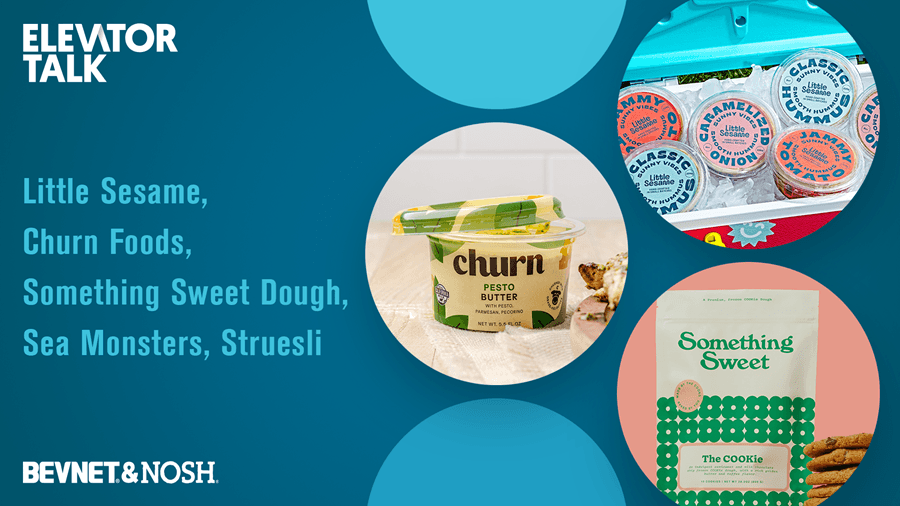
Elevator Talk Episode 77: Little Sesame, Churn Foods, Something Sweet Dough, Struesli, Sea Monsters
Transcript
Note: Transcripts are automatically generated and may contain inaccuracies and spelling errors.
Ray Latif [00:05] Hey folks, I'm Ray Latif, the editor and producer of Bevnet's Taste Radio podcast, and you're tuning into the latest episode of Bevnet and Nash's Elevator Talk, the series that profiles early-stage and disruptive brands from across the food and beverage industry. Today's episode will focus on 5 food brands whose entrepreneurs will have an opportunity to hear feedback and advice from our co-host for this episode. That's Tom Speer, who is the founder and managing partner of BFG Partners. Tom, so great to see you again.
Speaker 2 [00:37] Thanks for having me, Ray.
Ray Latif [00:39] Well, you know, I said again because you have co-hosted at least 2, maybe 3 episodes in the past and every single time, uh, it's been fantastic. You've been in this industry for some time, invested in a lot of really amazing brands. Uh, I just know this business inside and out, which is why I'm so excited to have you today. Um, please tell our audience a bit about yourself, your work with BFG Partners, and some of the, uh, some of the companies in your portfolio.
Speaker 2 [01:06] Yeah, it'd be my pleasure and yeah, thank you again for having me today. Uh, I've been in the industry since 2004. I started with a granola company uh called Bere Naked, so I think we're gonna be talking a little bit about some granola type products today, so I look forward to that, but, uh, that's where I started and, and then I worked on a frozen food business that's now part of ConAgra called Evolve Foods. Uh, which was a great run. And then following Eball Foods, was fortunate to launch a venture capital firm called BFG Partners, which has been actively investing in the space for the past 9 years. We've made about 30 investments since inception, and those investments. Across many categories in food, beverage, personal care, and then also a number of service businesses that are helping to support our industry. So we're, we're, uh, yeah, proud to be deeply embedded and, uh, obviously, uh, really believe in, in the industry in general and where it's still headed.
Ray Latif [02:11] Tom, you mentioned that BFG Partners is an active investor in food and beverage. Um, at what stage of development, what size of these, what size in terms of, uh, sales and revenue do you invest in? What, what are some of the check sizes? Yeah,
Speaker 2 [02:25] we, we're pretty much stage agnostic at this point. We definitely lean towards early stage and we try to, to, to get involved early when it makes sense, but we also realize that, you know, some of the, the later stage brands are, you know, have, have a lot of potential and They've often de-risked uh relative to the early brand, so we try to, you know, weight some investment in both later stage and early stage, and then check sizes really sort of reflect where the company is in its stage and, uh, you know, we're unlikely to go really big into something that's super early, uh, just because, you know, it's, it's hard to really have that much risk into something uh that you don't, you know, really know what the trajectory is going to be uh at the outset.
Ray Latif [03:09] Now, entrepreneurs have been hearing for months now that the funding environment is a lot different and it's a tighter market for capital than in years past. Uh, has your assessment of food and beverage brands, has your evaluation of the industry changed, you know, given that we have seen this sort of shift toward a focus on unit economics, profitability, etc.
Speaker 2 [03:37] Yeah, I think we'll be talking a lot about unit economics and gross margins, things like that for the next hour or so, and yeah, it has shifted in some ways, but even before things tightened, we, we were pretty sure of the fact that things were going to tighten, so we had taken an approach of You know, yeah, just being really disciplined around trying to, you know, Deploy capital in the companies that can really have, you know, a lot of growth, not just for a couple of months or a couple of quarters, but, you know, year after year after year, and uh I think that that's probably the right way to do it, whether you're talking about this environment or a different environment. Obviously it's easier said than done, especially when, you know, everything is up and to the right, but yeah, I think, you know, I'm trying to keep my eye, my eye on the prize, and I think the prize is still a really big industry that is leaning towards better for you products, better for you, better for the planet. So I do think some of these Secular trends are still in place, and even though there are some storm clouds out there, I still think the opportunity is tremendous for a young brand to come in and steal a disproportionate amount of share in a category if they have a better, better concept. Um, so, you know, we're, we're focused on that and uh yeah, obviously that's why I'm here today and I want to hear about these exciting brands.
Ray Latif [05:03] Absolutely. Last question, and you know I typically leave this to the end of the episode and You know, a lot of the people watching are early-stage entrepreneurs. We're talking to 5 emerging brands today or entrepreneurs representing 5 emerging brands today. When someone wants to initiate a conversation with you or someone from your team at BFG Partners, what should they be bringing to the table?
Speaker 2 [05:24] Well, we hope they bring a lot of um information ideally, you know, it's, it's, it's tough to ask us to evaluate, you know, opportunities if there's not a lot of, of information for us to, to chew on. So, uh, we usually ask for, you know, information upfront and then, you know, in terms of the type of, of individual they are, you know, we look for people with a lot of grit, determination, discipline. Uh, you know, the ability to, to, you know, be competitive in this industry, which is a tough industry, uh, and there's a lot of, uh, a lot of knowledge that you have to, to, to learn over time and, uh, someone who's willing to learn and learn from their mistakes along the way.
Ray Latif [06:05] Absolutely, uh, well, as I mentioned, we have a fantastic group of entrepreneurs to speak with. Are you ready to meet our first?
Speaker 3 [06:13] Let's do it.
Ray Latif [06:14] Fantastic. Let's do it indeed. That person is Nick Wiseman, who is the co-founder and CEO of Little Sesame. Nick, great to see you.
Speaker 3 [06:22] Hey, good to see you. Thanks for having me.
Ray Latif [06:24] Thank you so much for joining us. Uh, anyone who's listened to Taste Radio knows that, uh, we enjoy our little sesame whenever we can get our hands on it. Um, so, uh, we're big fans of your brand. For folks who aren't familiar with what you guys do, tell us all about it.
Speaker 3 [06:38] Yeah, so my name is Nick Wiseman. I'm the co-founder and CEO of Little Sesame. We make freshly spun hummus with 100% regeneratively farmed chickpeas, which we source from our farmer, Casey Bailey out under the Big Sky in Montana. Ron and I were partners. We started Little Sesame. Me in 2016, we had met on the New York City fine dining circuit as line cooks almost 10 years ago. Uh, we started spinning hummus in a 500 square foot pop-up in DC back in 2016, went on to open our flagship restaurant in 2018 in DC. Um, and as we started to scale that concept, pandemic hit and um kind of had an opportunity to, to take a step back and it was one of those existential moments and at the centerpiece of what we did was always this freshly spun hummus, and we decided to, to ready it for grocery store shelves and we launched into Whole Foods in July of 2021, uh, in the mid-Atlantic region. Um, still producing nights and weekends out of our restaurant, uh, did really well in Whole Foods, um, and so doubled down and, um, stood up our own manufacturing just outside of DC, 10,000 square feet, uh, which really gave us the power to, to start to scale the operation and so. Um, this past year now we've launched into Sprouts Nationwide, uh, launched a pilot partnership with Sweet Green Nationwide, and we have another, uh, major sort of national partner coming online this summer. So a lot of great growth, and, you know, for us, we kind of want to disrupt the hummus industry. There's obviously a couple of legacy incumbent players who have kind of held the space. Uh, there hasn't been a ton of innovation. We feel like we can kind of bring energy and, and build for the future. Um, kind of indicative of that of it is our, a new SKU we just launched with the team Fly B Jing. It's a pumpkin chili crisp hummus. That's the type of like energy and excitement we want to bring to the category, um, as we build for the future.
Ray Latif [08:22] So I can attest that that Fly by Jing collab is really delicious. It's a fantastic product. Um, Nick, what's the price point? Uh, what's the average price point on your products?
Speaker 3 [08:32] Um, depends on the region, but it's somewhere in like the 499 to 599 for the 8 ounce cup, um, somewhere in that range. So we're, you know, we're premium price, but not at, not at the super high end.
Ray Latif [08:44] Tom, as Nick mentioned, there's some pretty good sized legacy players in the hummus space, and, uh, you know, it's, it's going to be incumbent upon early-stage brands to be really disruptive in how they're packaged, what they're bringing to the table in terms of formulation. Um, are you familiar with Little Sesame and, you know, just based on what Nick is talking, has been talking about, you know, do you see that potential to really disrupt that category?
Speaker 2 [09:07] Yeah, I'm not intimately familiar with it. I'm here in Colorado, so I don't, I don't believe you have distribution out here by the sounds of it at this point. We're in Sprouts,
Speaker 3 [09:15] we're in Sprouts out there,
Speaker 2 [09:16] OK.
Speaker 3 [09:17] You wants into Choice Market any day now, so we,
Speaker 2 [09:20] OK, all right,
Speaker 3 [09:21] starting to build on the summer, obviously with the sort of the last, last launch I announced there. So,
Speaker 2 [09:26] OK, all right, well, I definitely I'll get my hands on it in that case, and no, it's, it's good to know about it. I think the categories. A pretty big exciting category overall, uh, you know, some of the pain points to me seem like they have to do with maybe things like shelf life. Um, I, I'm curious what your shelf life looks like.
Speaker 3 [09:46] So we use, you know, kind of one of the main attributes is we only stabilize with fresh lemon juice, but we go through a process, um, through HPP, which is we get shelf life, so we have 90 days, uh, after production.
Speaker 2 [09:59] OK. Yeah, and so, so that's pretty, pretty decent, uh, certainly for a refrigerated product, but when you go into distribution, uh, with, you know, United Natural Foods, KE and, and others, usually, you know, kind of, those, uh, Yeah, just getting to shelf still takes time, and I'm curious sort of how that, you know, how that plays out and what, what things look like on the side of shrink and how much loss you actually are having
Speaker 3 [10:27] at this point, minimal, you know, we, we self-manufacture, so we're able to produce the forecast. We're not doing it like sort of at the helm of, of commands and kind of minimum order quantities. So to that end we're, we're pretty tight. Um, you know, we're also actually in an extension, shelf life extension study now with Cornell University, which should get it to 120 days, so that will certainly help, but pretty minimal shrink, our, you know, high velocity category, we've been high velocity in the store footprint we've been in, so that, that certainly helps as well. Um, you know, velocity solves all problems, but, um, you know, it's definitely top of mind how we can, you know, how we can extend shelf life as we go.
Speaker 2 [11:01] OK. In terms of those uh velocities, what, what is the category average for, for Hummus?
Speaker 3 [11:09] It obviously ranges really depending on, on, on channel, um, you know, we're 2xing our buyer projections out of the gate at Whole Foods in our region, um, so we're doing around like 12 units per skew per week per store.
Speaker 2 [11:21] OK. And how many flavors do you have?
Speaker 3 [11:25] So the, the sort of the debut lineup was 4 flavors. It was a classic caramelized onion, um, jammy tomato, and Herbie jalapeno. Uh, we have a large size of the classic as well. Um, and then we just launched this pumpkin chili crisp, which will, um, again, is gonna have sort of its national debut this summer.
Speaker 2 [11:43] Great. Well, I love the fact that you self-manufacture in certain categories, you know, it probably doesn't make sense, uh, in your category, given the shelf life issues and, and the quality piece, uh, seems like a pretty smart thing to do. Um. I'm curious, how big is your team? How many people are running the facility today?
Speaker 3 [12:03] So we still operate the Legacy restaurants. There's about 10 folks there. We have 10 folks in the factory doing day to day only on the production floor, and then we have about 5 or so on the corporate team. So we're sitting between like 25 and 30.
Speaker 2 [12:15] And is the plan to ultimately wind down the restaurant operations or separate those, or yeah,
Speaker 3 [12:20] probably spin it out as like a de facto franchise of the of the court, you know, of the Little Sesame Inc. um, but
Speaker 2 [12:29] it's all one company today.
Speaker 3 [12:30] Well, it's Little Sesame Inc. it wholly owns Little Sesame Restaurant, Little Sesame wholesale, um, so it'd be pretty easy to spin it out, and then again it could kind of function as like a franchise where it's paying up some sort of royalty to the, you know, the corporate entity that owns the IP, etc.
Speaker 2 [12:46] And just from a financing standpoint, what are your goals and objectives just since that's probably part of what you're curious to talk about?
Speaker 3 [12:53] Yeah, no, I mean, we're, we're kind of, we wanted to get to break even want to get past 5 million in run rate, and then it was kind of, you know, looking for to secure a Series A and start to look to, you know, more institutional funding. We've been lucky to have a little bit of institutional money in so far, um, but I think we're kind of like ready for that big injection pretty soon here. So, yeah, no, I think for us it's, it's an exciting opportunity. I think, you know. Kind of Ray's point is like we're going into a busy category, so how do we make a splash and continue to like tell our story nationwide and obviously that just, that takes money and resources and, you know, we've had a lot of wins in the retail side and now it's sort of like part two is making sure we perform on shelf and so, you know, we spend appropriately to do that and kind of build our brand as we go.
Speaker 2 [13:34] I mean, in the manufacturing environment, are there still a lot of opportunities to gain efficiencies with more equipment and all that type of stuff? Yeah,
Speaker 3 [13:42] you know, we bootstrapped our way through so far and now we're starting to add, and we have a, you know, clear path to get to north of 50% gross margin, um, you know, we've, as we've started to scale. Supply chain, especially we're just seeing like huge savings, you know, we, um, with our same chickpea producer just increasing volume, increasing shipping, you know, to full truckload versus half truckloads we've we've gotten like 12% savings just on our chickpea input which obviously is a major one, you know, our HPP, the tolling for the processing the product. That's come down almost 25% as we've gone from like 5000 pounds a week to 20,000 pounds a week. So, um, of product being processed. So, yeah, I mean, we're starting to see the savings and again, like we're, we're, we're definitely in this environment, you know, hyper-aware of, of, you know, gross margin as it's obviously a big driver for, for profitability.
Speaker 2 [14:28] It's it's good to hear that, you know, you're Have a line of sight to 50% plus. I, I think that's, you know, it's margin is just everything really at this point and uh it always has been, but now there's a hyperfocus on it as Ray already mentioned, so, uh, that's, that's terrific that you're already, you know, looking that, that direction. When when your product goes to HPP, does that, does, is it already prepackaged or
Speaker 3 [14:56] yep, so we, we basically so cook the chickpeas, fill and seal the containers, and then ship them to HPP and then from there they do all the cold chain logistics as well, so all the packing, palletizing and shipping to KEUNFI or other DSD rainforest distributors, etc. like they everything from there, once it leaves our facility, it's gone, so the final QC step is, is with them.
Speaker 2 [15:18] Is that pretty close, pretty close to your manufacturing? Yeah, it's
Speaker 3 [15:21] like 2 hours from us in Pennsylvania, and they have facilities all over the US. It's, um, it's Universal Pure. They're one of the biggest HPP, you know, facilities in the US.
Ray Latif [15:29] We do have a few more seconds left. I got to ask about your packaging because one way to disrupt within a category is to have that kind of standout packaging. You have like a sort of 60s go go kind of vibe going. Um, talk about that strategy. Talk about what went into that package design.
Speaker 3 [15:44] You know, I think it was like a bit of nostalgic fun, you know, we put our flavors in the bottom too. It was the same idea, that sort of nostalgic fun, you know, I think for us, like Ronan and I came from fine dining, you know, it was a pretty rigid environment. We both want to kind of break out of that, and, you know, I think we've sort of been chasing fun and that's what we want to like build into the little sesame brand, into the packaging, the design and the feel of the whole brand as we grow. And so hopefully we communicate that through our packaging.
Ray Latif [16:07] I mean, it definitely looks different than what's on the shelf or what has been on shelf previous, so. Um, great job, Nick. Uh, thank you so much for taking the time to be with us today. I can assume that we'll be hearing more from you about that next big retailer, maybe perhaps about that Series A later down this, uh, down the line this year. So, uh, please stay in touch. Let us know how things are going.
Speaker 3 [16:26] No, thanks, thank you so much. I appreciate the time and the opportunity to spotlight a Little Sesame.
Ray Latif [16:30] So thank you. Yeah. All right. Let's keep it going here on Elevator Talk with Michael Tashman, who is the founder of Chern Foods. Michael, great to see you.
Speaker 4 [16:43] Great to see you too, Ray. Thank you, Ray and Tom, so much for having me. Um, yeah, I'm, I'm Michael Tashman, I'm the founder of Churn. We make, uh, very flavor forward chef crafted cooking butters. We're based here in LA and really everything about what we do is about the flavor. It's about cooking with whole fresh ingredients. We don't use any powders, preservatives. We're slow roasting garlic and shallots in-house. We're using fresh herbs, fresh cheeses. Um, it's really different from some of the competitors in our category. Um, and really what the mission is to empower elevated cooking at home with a true chef to shelf product. Uh, it's really about providing a product that someone with limited knowledge about cooking can take and make a restaurant quality steak, or a restaurant quality piece of fish, pasta, vegetable, anything it may be at home. Um, and that kind of leads into my background is similar to Nick. I, I worked in fine dining for several years, um, kind of just fell in love with butter. I loved the product as a kid, you know, I'd spread it on bread and didn't really understand it so much. But when you work in fine dining, you get a formal education, a lot of things. Um, and it was there where I really just fell in love with butter, and I was making compound butters and um learning about the category and saw a huge misrepresentation of the products in, in category, in the category. It's, you know, mostly dominated by big dairy and You don't see much variety in in flavor, certainly with flavored butters, but even within the butter set, you're seeing unsalted, salted, you'll see some European varieties in there too. But um I just saw this huge potential for a brand to come in with innovation, with um some enthusiasm, different branding. And that's really what I sought out to do about 3.5 years ago. Um, we started right before the pandemic. So, um, The challenge to get to the market, you know, initially we started in farmers' markets here in LA just very bootstrapped. I was working all the markets, I had a very small team, um, got a lot of great feedback, built out the recipes. We started with 9, sorry, we started with 7 flavors. We now have 9. So a lot of different SKUs, um, and really just worked hard in, in getting that feedback. And eventually some retailers came on locally, Arawan, Bristol Farms, Gelson's. You know, you're, you know, more top of the line retailers. Um, and since then, we've grown a lot. Uh, our biggest account is Costco in the LA region. Um, and that's really where we have a better opportunity to get the product to the direct to consumer at a really competitive price. Um, something that we're actually really looking forward to is, um, launching a smaller ounce. We're calling them churn minis. Um, it's a 3 ounce cup instead of a 5.5 ounce cup. And so we'll hope to get to more of a 5, sorry, 499 to 599 price point instead of what it currently sits at at a Gelson's, for example, at 999. Um, we really want this product to be accessible to everybody. We don't want it to be limited to someone shopping at a Whole Foods or Bristol Farms, in this case, Gelson's. Um, so we're really excited about that, and yeah, looking forward to your questions.
Ray Latif [19:51] Fantastic. I have a bunch of questions, but so I'm just gonna ask like one right off the bat, um. Where are you merchandise in store? Are you in the dairy set or are you more with like the meat section given that your focus is for the products to be used in that sort of in that in that way?
Speaker 4 [20:08] It's a good question. Each retailer does it differently. Typically, you know, mostly we're in the butter section and dairy, um, and Like any product, you don't have much control over where it sits. Sometimes we're next to the margarines, right? Because it's in a tub. But um when a retailer cross merchandises it, whether it's in the meat section below the meats, um, sometimes they'll put empty containers near the seafood section. You know, that's where it provides a little bit of that context to the consumer, where they're Imagining it with that certain piece of protein, for example, or a vegetable. They're seeing it, they're envisioning putting it on their steak rather than in the butter section. Um, it really belongs in the butter section. Um, and certainly, I think there's more potential there as we get a bit more brand awareness. But I think it works both places, but oftentimes, you, you know, you don't have much control over the retailer to put it in both. You're fighting for both that shelf space. So, um, we've seen, we've seen success in, in both places, for sure.
Ray Latif [21:07] And price point, what's the average price point for the products?
Speaker 4 [21:10] Um, 899 and 9.99 in retail. But with Costco, our largest account, they sell 2 for 10.99, so it's a really good deal.
Ray Latif [21:19] I should get a membership. I don't have one currently. Uh, Tom, do you have a membership to Costco? Are there Costco's out there? They've got to be Costcos, I don't
Speaker 2 [21:26] know. Yeah, we do. And, and yes, there's one pretty close by, about 2025 minutes away, so, uh, reasonably close. I, I really like your brand. Uh, so, so first off, congrats on that. I think it looks good, and I think the The churn named, you know, fits within the category, so that it sort of stacks up and makes sense to me. So, so good job on that. Um, I'm, I'm curious, um, what's your bestselling SKU? Is it savory or sweet?
Speaker 4 [21:53] The savory garlic and shallot is by far
Speaker 2 [21:55] the most popular.
Speaker 4 [21:57] It's because it's a garlic butter, right? So people are really understanding that it resonates garlic butter, it, it exists, you know, in a lot of different ways, whether you're at a steakhouse and you're, you're seeing a garlic and herb butter on your steak, or even in retail, you see Kerry Gold has a garlic and herb skew. So it's the most approachable. It's the most, um, you know, has the most applications. Um, so that's, that's the most popular.
Speaker 2 [22:23] Right. And you self-manufacture. I think that's sort of what you alluded to.
Speaker 4 [22:27] No, we actually use a Coman.
Speaker 2 [22:29] The Coman
Speaker 4 [22:30] is in San Diego.
Speaker 2 [22:32] OK, great. Yeah. And uh how much capacity do you think there is there?
Speaker 4 [22:38] We actually just invested. We're very excited. We invested in some new equipment. So right now we are pretty maxed out, but we're in about 4 to 5 months, we'll be able to do about 10 times the amount of production. Just really exciting for scaling, Costco for scaling. We do a lot of, I didn't mention this, but we do a lot of business on ecom. So scaling that, um, you know, nationwide distribution through, uh, direct to consumer is really exciting. We do that on, on our website on Amazon. Um, and then obviously through the smaller 3 ounce cups, um, expanding that through retailers.
Speaker 2 [23:11] In in Costco, what kind of uh expectations are there for this category from a, from a performance standpoint? Anytime
Speaker 4 [23:19] you're selling Costco, you want to hit about 100 units a week. Uh, and we're, we're hitting that for sure. We do, uh, as a smaller brand, we do roadshows with Costco. I don't know if you know what that is. So it's well beyond that. We're actually, the expectation is basically in a, in a weekend, Thursday through Sunday, we're there open to close, and the expectation is to sell about $12,000 worth of product. And we're hitting about $13,000 every single weekend. So we're moving a lot of products, it's a lot of work, right? Labor. A lot of overhead, but it's worth it because as a smaller brand, you get a lot of opportunity to get it, you know, at the end of the day, get an order, whereas otherwise you might not get that shot.
Speaker 2 [24:02] And so are you just on the road shows, or are you also,
Speaker 4 [24:07] they'll buy a lot of product to where you'll have inventory left over. So, you know, we do one a weekend. And so like last weekend we were in Irvine out here in LA and so they bought enough product to where now they have about 10 cases left on the shelf. So they're at this point really looking at, OK, it sells really well on a roadshow. How does it do when we're not there to support it?
Speaker 2 [24:28] Yeah, yeah, that makes sense. And what's the shelf like?
Speaker 4 [24:32] Shelf life is about 3 to 4 months on average. Some of our skews, the maple, cinnamon, the everything lasts about 5 to 6. The garlic and shallot, 3. It depends. We're putting a lot of fresh ingredients in, just like Nick mentioned. I mean, we use fresh lemon juice. We don't use any preservatives, anything like that. Uh, we don't preserve the products in any way at all. So, um, we're really happy about the 3 to 4 month shelf life. Um, but it's certainly, like you mentioned, Tom, with your question about shrink, like it's something as we scale this into, uh, you know, retailers, we're with you NFI now, we're launching a Kahi, but it's definitely something that's top of mind, um, as we scale.
Speaker 2 [25:10] Yeah, there's obviously a fine line between growing and, and uh You know, not growing, so, so growing is great, but if it's really expensive growth, unless you really have the capital to support it in this environment, it's, it's, you know, you got to be real careful and especially when you're talking about shelf life issues because that's, uh, that, that, that's real tough when that goes bad. Yeah, absolutely.
Ray Latif [25:34] Michael, um, you know, I love that you led off with we're all about flavor because I feel like taste really is that it's never gonna go away in terms of, uh, priority for consumers. Taste is always going to be important, but how do you communicate taste to that consumer when you're not doing demos? How do you communicate taste and flavor, you know, via Um, you know, an online ad or a coupon. I mean, what, what is really moving the needle in terms of people seeing something and saying, wow, I associate flavor with this product, with this brand. Yeah,
Speaker 4 [26:06] I think obviously through demos, you know, that's the easiest way, right? But that's not as scalable as an ad. So with an ad, we're trying to evoke, invoke emotion into it, you know, whether it's a video of, you know, butter basting a steak. Um, doing creative things where people can really see the product and imagine them making something like that pretty easily, you know, with churn at home. And so it's, we, we see a lot of success with, with that kind of strategy with ads. Obviously, in a, in a demo, whether it's at a Costco roadshow or at a retailer, it's all about getting this product in their mouths, trying it. Um, and then from there, we kind of go on about the flavor, it's locally made, whatever it is. Um, but taste is everything. And, and we certainly, top of mind is letting them know, look, this is made with whole fresh ingredients. We don't use any garlic powder, onion powder. It's like slow roasted. Everything is whole and fresh. And so, I think when they taste it, it resonates with them for sure.
Ray Latif [27:08] Well, uh, I'm excited to try it. Uh, hopefully you'll be out in our neck of the woods, uh, in the near future. Until then, please stay in touch. Let us know how we can help in any way. Uh, I would love to know more about the brand as you continue to scale and grow in 2023 and beyond. So thanks so much, Michael.
Speaker 4 [27:23] Thanks so much for having me.
Ray Latif [27:25] All right, on to our next guest for this episode of Elevator Talk. That is Brittany Cook, who is the co-founder and chief growth officer of Something Sweet Dough. Brittany, great to see you. Hi
Speaker 5 [27:37] everyone. Thank you so much for having me. I'm so grateful to chat with you guys today.
Ray Latif [27:41] Yeah, it's so great to see you. Thank you so much for being with us. Something Sweet Dough, uh, love the name. Tell us all about your brand.
Speaker 5 [27:49] Thank you. Yeah, so we're Something Sweet Dough, a direct to consumer frozen cookie dough company, and we actually launched this last November on the 1 year anniversary of our dad's passing. Um, when you lose someone, you have two choices. You can either drown in your grief or you can put your grief into something bigger. Um, one of my dad's dreams, um, for my mom was to share her baked goods, and that is what we're doing today. As a family, um, we created a brown butter. Chocolate chip frozen cookie dough that we share um in a direct to consumer space right now. We ship nationwide, um, we do farmers' markets, we're still in the beginning stages of our company. Um, our cookie dough is about 80 g, which is about 3 times the size of your average refrigerated grocery store dough. Um, we still hand produce it ourselves, but we are actually transitioning to a co-manufacturer in the next couple of months. Um. But yeah, that's what we are, that's what we're about.
Ray Latif [28:49] Very cool. Uh, I am a buyer of refrigerated cookie or pre-made, uh, cookie balls and just an easy way to just stick them in the oven and have fresh cookies, so I love this idea. Um, who are your customers? I mean, I'm, I'm, I'm probably a consumer of your brand, but who's your target consumer?
Speaker 5 [29:06] Yeah, definitely. Our, our range is pretty wide, but our normal consumer is a family-based um target market right now. Um, it's easy, it's convenient, there's no cleanup, um, and you can have a sweet treat in minutes. Um, it's a convenient option for any sweet treat, um, lovers, which that's also another target market for us, so.
Ray Latif [29:29] And one more question, uh, before we get to Tom, uh, in your notes that you, uh, included with your application, you had said that you will be in retail soon. Um, are you actively pursuing retail or is it something that you're looking at in the second half of the year?
Speaker 5 [29:43] Second half of the year for sure, uh, we are on the higher end of the, um, market for our direct to consumer space, um, product, and for us, we need to do a lower scaled down, um, price point for retail and we are also building out our investor portfolio. Um, like I said, we're in the beginning stages of our company and we still are learning as we go and, um, are excited for the future in retail.
Ray Latif [30:10] Tom, making that leap from direct to consumer to retail can be kind of rocky, can be, uh, challenging. I mean, uh, what are your thoughts on uh Something Sweet Dough and it's opportunity to do so?
Speaker 2 [30:21] Well, I guess, uh, first of all, I, I, your founding story, obviously, it's meaningful and certainly appreciate that, so I wanted to just comment on that. So good, good for you for going after it and, uh, doing this in, in your father's honor, um, and more. I, I would say that, you know, I'm a little bit apprehensive hearing about, you know, kind of frozen. Type, type operation, uh, going into retail. I know that's where you've started for direct consumer, which I think is, has its own challenges, but when you think about expanding into retail, I believe the bigger opportunity may be Outside of frozen, um, in the refrigerated aisle or perhaps in the shelf stable ambient aisle. Uh, I'm just curious how you're thinking about that because I just think the category is a lot smaller on the frozen side for, for cookie dough.
Speaker 5 [31:13] Definitely. I mean, we see the challenges and we are, we are ready to embrace them. We understand that frozen is a beast in and of itself as a category, um, but we also see the opportunity for high-quality homemade style desserts. Um, obviously, as you know, there's a huge category for ice creams and premium, convenient frozen foods, um, but the dessert category is for sure a market that I believe that there's growth in. And that we really want to take on. We understand the challenges, we've heard it from a lot of people and, um, you know, our goal is to bring a premium frozen dough so that people can bake it in the convenience of their home and also there's no Preservatives, um, in it, uh, the freezer component of our business, um, makes it really a different, um, and something new in the market for people.
Speaker 2 [32:11] So where would the product merchandise, which brand would you be merchandizing next to?
Speaker 5 [32:17] Um, there's a lot of different ones right now, the edible cookie doughs, um, there's Ben and Jerry's, um, there's a newer, um, brand as well. And then there's also like the Marie Callender pies, there's pie crust, there's, um, Uh, croissants frozen, um, so there is a market in that, um, that I see fit. So,
Speaker 2 [32:39] and your product is in a stand-up gusset bag, is that, that right? So it's in a
Speaker 5 [32:44] resealable
Speaker 2 [32:45] bag, yeah. And are there other gusseted dessert products that I, that you can think of? I mean, I just think about the merchandizing again and just trying to make it make sense for consumers based on what they're looking for. Any comment on that?
Speaker 5 [32:59] Um, I mean, no comment right now, we're still learning as we go, um, but, you know, The fact that you can't think of one is an opportunity for the market.
Speaker 2 [33:11] OK. And obviously, the, the frozen side traps in, you know, the, the taste and maybe the nutrition uh for, for many frozen products. Um, what's the shelf life for the products frozen? It's probably also a couple of year or longer, right?
Speaker 5 [33:27] Yeah, definitely. So it's a longer shelf life in comparison to a refrigerated dough, um, which is also a standing point for our customers, which we've heard feedback from, is that you can keep it in your freezer for a longer time. Now, the willpower to keep it in your freezer that long, um, That's something as well that we've found um that most people can't do, it becomes a habit, um, but you know, in comparison with the refrigerated dough, like I said, shorter shelf life, um, and some people who are looking for the convenience factor in our product, appreciate the frozen dough, so.
Speaker 2 [34:02] Is there any reason why it couldn't be so frozen and then slacked out in a refrigerated case? Is there, does there become a shelf life issue if it does get refrigerated? Is it super short?
Speaker 5 [34:13] Yeah, yeah, the comparison of the um refrigerated dough and frozen dough is quite different.
Ray Latif [34:21] Um, I'm looking at your Instagram page right now and, um, as a potential consumer, I'm just like, my mouth is watering looking at some of the videos and some of the pictures I'm seeing, but I mean, how do you get people aware of your brand? How are you getting, uh, customers of your brand?
Speaker 5 [34:37] Yeah, definitely, great question. Right now we're doing influencer marketing, um, organic content strategy is also another part for us. We are definitely bootstrapped and we're trying to be as smart as possible um in building brand awareness for our company. Um, a lot of the times our products are gifted, um, with, you know, we've had a really great Turn in those gifted um influencers uh marketing strategy, um, but right now, that's kind of where we're at, we have to be bootstrapped, we can't do paid ads or anything like that. Um, so for us, it's building a community as well through our social channels, sharing our story, and having community building strategy within it.
Ray Latif [35:18] Are you, are you paying, so to speak, the influencers via free product or is it just people who are big fans of your product?
Speaker 5 [35:27] Free product, yeah.
Ray Latif [35:28] Brittany, when you're talking about, uh, your product, what are you talking about first? Is it taste? Is it the fact that you can, um, have a pretty easy cookie in a relatively short amount of time? Uh, is it the fact that you are made with high-quality ingredients? What's, what are you talking about first and what's really moving the needle for your customers?
Speaker 5 [35:46] Yeah, it definitely is taste. We do a brown butter cookie which is not on the market right now, and we use actual real butter. We brown it ourselves, and that is a unique point in the taste of our cookie. We're not a traditional chocolate chip cookie, and that's what people think of, but you know, with the ways we are getting people to have cookies in their hands, the taste is the number one thing that we've had through and through with our returning customers and our new customers.
Speaker 2 [36:14] I is there a raw egg in your product, or is it? Yeah. OK, and is that probably to deliver the taste because, you know, a lot of consumers obviously like to just eat cookie dough raw and that's probably wouldn't be the safest thing for yours. Um,
Speaker 5 [36:30] no, yeah, we do not advise people to eat the dough, um, just bake it in their homes, um,
Speaker 2 [36:37] good, good, good luck stopping people from, you know, doing that.
Ray Latif [36:43] Yeah, I can imagine, uh, chopping up some small pieces or chopping up a bowl into small pieces and putting it in with your morning granola or something. That's probably not the best idea, but yeah, I, I, I, I think you got a great product. I'm looking forward to trying it. Um, in the meantime, Brittany, thank you so much for being with us today. Excited for the future of Something sweet dough. Um, please let us know how things are going and if, uh, we can be helpful in any way.
Speaker 5 [37:08] Thank you so much guys.
Ray Latif [37:10] Alright, on to our 4th guest for this episode of Elevator Talk. We have Adrian Lufkin, who is the founder of Strusly. Adrian, great to see you.
Speaker 6 [37:20] Hi, Tom. Hi, Ray. Thanks for having me. Nice to meet you guys.
Ray Latif [37:25] Nice to meet you as well. Uh, I became aware of your brand, uh, I want to say a little less than a month ago, um, because you have some big retail news, um, and I'd love to hear about what that retail news is and a bit more about the brand.
Speaker 6 [37:42] Well, the big retail news is we just launched in Irwan, which is really exciting. Um, and so I'll, I'll tell you a little bit about Strus Lee. It's uh a premium chef crafted granola, um, made with the base of tiger nuts and superfood packed, and we have no added sweetener or sugar whatsoever. So that's sort of our Differentiating factor. Um, and yeah, we, we launched early this year and we had sort of a soft launch in the fall. Uh, we, we went to FinCy in Orlando and had a really great, um, we were received really well from all the nutritionists and dietitians, and it gave us motivation and, and strength to kind of forge ahead and, and we had our official launch in early uh 23.
Ray Latif [38:41] You have a beautiful package and um I think we commented on this on the show on Taste Radio. It, it almost looks like the package or the container for a super premium bottle of whiskey and then there, there you go, there it is right there. You've got all your ingredients in the front. Given that premium packaging and given the premium ingredients, I assume there's a premium price point as well.
Speaker 6 [39:04] Yep, it's 11.99 for 9 ounces. Um, and, and the price is consistent with the ingredients. We have really only the highest quality organic ingredients and no fillers, um, no flavorings, so you're really getting only the good stuff and, and nothing that you don't want.
Ray Latif [39:30] All right, Tom, uh, given your days and time with Bare Naked, uh, the floor is yours, my friend.
Speaker 2 [39:36] Are you making this product in your own facility or are you doing CPAC?
Speaker 6 [39:40] We have a co-packer in Vermont.
Speaker 2 [39:42] OK, OK. And, um, in going into this type of package, obviously it's probably pretty expensive compared to, you know, a gusset or something like that. Um, are you planning to stay in this packaging, or are you gonna, gonna shift over to something else?
Speaker 6 [39:57] Well, we are in the process of um Looking at a, a similar paper tube package, but one where the granola would get packed directly into the tube. So right now it's packed into a bag that's resealable, but to save on, as you, as you mentioned, um, sort of the repacking, um, we're looking at a tube where the granola goes directly in and it's sealable. And that'll just have a product ready to go right from the co-packer, and there's no kind of rework involved.
Speaker 2 [40:36] And and today you're entirely online or you also have sales and retail.
Speaker 6 [40:41] We're in over a dozen retail locations and and growing, including Irwanwan, OK.
Speaker 2 [40:49] And then in terms of velocities, how are you doing on shelves so far?
Speaker 6 [40:54] Um, well, we're, we're getting tons of reorders, um, and adding to our retail base, you know, on a weekly basis, so that's promising and exciting, um. And we're, we're also available on Amazon, which is really, we do very well on Amazon and, and very well on our website as well.
Speaker 2 [41:20] And, and the price point, I mean 12.99 on on Amazon, it's similar price point in retail, it's sort of in that same
Speaker 6 [41:27] 11.99 and, and yes, on the shelf,
Speaker 2 [41:31] so that's that's like the very, that's the most premium product at all. I mean, is there anything more expensive than
Speaker 6 [41:38] there are other brands that are similar in price, um. That are packaged maybe and I've, I've seen a few. In in a glass jar kind of packaging, um, similar small batch crafted chef crafted uh granolas we just launched in the tin Building in New York City and they also carry similar premium granolas.
Speaker 2 [42:07] Yeah, in general, I think, you know, there's nothing wrong with being a premium product that you can deliver hopefully a ton of quality by being premium price. It just is limiting in terms of how far you can go with the brand and how much stretch it has in retail. Uh, are you hoping to eventually be able to bring price points down,
Speaker 6 [42:26] or definitely, yes, yes, as we scale, the hope is, yes, to bring the price down. Um,
Speaker 2 [42:35] yeah, I, I like you haven't, you haven't sacrificed. I mean, being organic as well, obviously commend you for that, and, uh, you know, that does carry additional price premium, um, which is, you know, would you ever sacrifice something like organic for, for better price?
Speaker 6 [42:51] No. Uh, I mean, I feel really strongly about the organic certification, the gluten-free certification, um, a little bit of background. I, I suffer from autoimmune disease and that was sort of the inspiration to crafting this granola was my own struggle with health and some of the clients that I cooked for and their struggles, so, Having it gluten-free and grain-free, and having that, those certifications really are important to me. And so that's not something I would sacrifice.
Speaker 2 [43:29] OK. Yeah, I, I'm, I'm, I'm a huge believer in organic. Uh, we try to back organic brands, uh, when we can. It just, you know, price point certainly is a challenge and for businesses that are, you know, venture-backed, um, obviously, there's usually some growth expectations and, and that can, it can be a challenge. So, uh, I don't know, I guess. Uh, you should consider, you know, everything, right? If there's real opportunities that might be available where you maybe are not 100% organic seal but have a couple of organic ingredients, that's still better than, than nothing, and if it could deliver a huge customer, you know, maybe it's even worth considering.
Speaker 6 [44:09] It's good advice, yeah.
Ray Latif [44:12] Adrian, how are people consuming your product? I see a few different ways on your website of people mixing it into a parfait. Um, when I typically eat granola, I use milk, I mean, but what, what's the typical way that people use your product?
Speaker 5 [44:25] It's a really good
Speaker 6 [44:26] question, Ray, because that, that speaks to the The title of or the the name of Struce Lee, which is granola redefined, and we kind of came up with that because it really does redefine how you eat granola. It's not just A cereal or something you put on your yogurt. It's very delicious that way, but you can also have it in a savory application because it has no added sugar or sweetener. So, especially the original and the few more flavors that I'm about to launch can be eaten in a, in a savory slant, so on a salad or soup or avocado toast. And in addition, um, you can Mix them into your smoothie. If you have a high powered blender or Vitamix or something, they kind of blend deliciously into a smoothie, so you're getting all your superfoods, your chia, your hemp, your flax, your coconut, instead of individually scooping all those things, one scoop of Strucele, and it's, it's pretty convenient. So that's just a few ways that you can enjoy it.
Ray Latif [45:38] I mean, I love the, the, the fact that there is a wide, uh, wide way of using this product, um, in terms of sort of communicating that, I would assume, you know, explaining why you are at that price point might be hard for some, you know, might be hard for some consumers, it might be hard for you to explain to consumers, um, you know, what is that communication strategy like, how are you? You know, getting what you are across this idea of granola redefined, how are you making it very clear to consumers that that's what you're selling?
Speaker 6 [46:11] We use a lot of Instagram, um, and some organic posts from some really diehard Sruce Lee fans, so that's been great, and then some paid influencer partnerships and, um, some collaborations along the way, um, with Uh, real food dietitians is a real big supporter and partner of ours, and, um, lava yogurt is, there's an up and coming collab with Lava. So really just doing our best to put out recipes and content that showcases how you can eat it and, and how versatile it is.
Ray Latif [46:55] Well, uh, I, I have to say when I first encountered your product, I was like this is, it's, it's really beautiful to the point where when I open it, it's got to be like a special moment. It's gotta be a special time for me because it, it does feel very precious, but I use that word in a very positive way. It feels, um, very precious and premium. So I'm excited to dip into the cacao and coffee variety, uh, later this week, but uh. As I mentioned before, thank you so much, Adrian, for taking the time to be with us. Uh, excited to hear more about your brand and the weeks and months to come. Uh, please stay in touch.
Speaker 6 [47:30] Thanks so much for having me.
Ray Latif [47:32] All right, on to our final guest for this episode of Elevator Talk. That's John Lee, who's the co-founder and co-CEO of Sea Monsters. John, how are you?
Speaker 2 [47:42] Yeah, great to be here, guys. Um, uh, it's been a long session, huh? How, how are you guys doing?
Ray Latif [47:47] Outstanding. I'm, I'm doing fantastic. Tom. I hope you're enjoying yourself as well.
Speaker 2 [47:51] No, this is great. It's, uh, I wish I could do this more, honestly, just because it's, it's, uh, it's more fun than other stuff actually, so.
Ray Latif [47:59] Sea Monsters, uh, I first encountered this brand, uh, in March just before Expo West. Really interesting stuff. Tell us all about what you guys do.
Speaker 2 [48:07] Yeah, so we're the world's first seaweed puff. So, you know, uh, we're on a mission to normalize eating seaweed. Uh, I am the co-founder along with my wife, GA, and we are both the co-CEOs, CEO of those, and we basically do everything um in the brand. Uh, we don't, we've worked in the CPG space for quite some time. Uh, for the last 20 years or so, we have run a creative agency servicing some of the biggest brands in the world. And we'd always dreamed about creating a delicious, impact-driven snack brand, and this lifelong dream was, was really reignited in around 2017 when we tasted a delicious seaweed chip at a local restaurant. Both of us growing up in Korea, seaweed was already a long time staple for us in our diets, so making it an obvious choice to explore is a hero ingredient. So we set out to fill a gap in the market for a brand featuring seaweed in an innovative and approachable way, and puffs, which are, you know, my favorite. They're fun, familiar, they're ubiquitous, um, and as parents and surfers, um, we're on a never-ending quest to find foods that our kids will eat without being terrible for the planet. So we were delighted to discover that seaweed. A really yummy staple from our childhoods was actually a very climate friendly option. Seaweed is regenerative, it's zero input. Requires no fertilizer or irrigation or pesticides and works to rebalance water acidity to help other sea creatures thrive. Eating seaweed is not just delicious and nutritious, it may even help save the planet. We also use sorghum, which we call our super grain, which is a carbon reducing gluten-free, ancient grain. It's mild, nutty flavors, pairs really deliciously with the umami of the seaweed, and our punchy and savory seasonings. The Monsters comes in 4 flavors, sour cream and onion, cheese pizza, sweet chili, and spicy cream barbecue, and that one has a real kick. Uh, we debuted at, um, at trade shows this year, and the response was overwhelmingly positive. Uh, we, we've been selling B2C, uh, since the end of last year, uh, and it's selects specialty retailers, but, uh, we have some exciting plans to launch in major retailers this summer. And the ultimate goal for us, for the brand is to have everyone's pantry stocked with with Sea Monsters as a snack staple.
Ray Latif [50:45] Outstanding. Can you reveal any of the retailers that you will be in later this summer?
Speaker 2 [50:49] Yeah, so we're a part of Casey's Elevate program, and through that we are actually going to be in Sprouts. We're going to be launching in 400 stores in Sprouts in July.
Ray Latif [51:00] Outstanding. Congratulations.
Speaker 2 [51:02] I forgot to mention we're also gonna be in Thrive, Araw, DoorDash at Dashmart, uh, Cebo, so a lot of stories for some reason. I, I, I shouldn't neglect to say that. Yeah, just a few questions similar to the other, uh, other folks that were on. Uh, you're a coman in this case, I assume, correct? Yes. OK. And I, I, I did notice, uh, the font for your brand does look like the font for another, uh, popular, uh, you know, kind of iconic show, SpongeBob, uh, at least to me it kind of felt like that was similar. Is there intentionality there or did it? Well, you know, I used to be the creative director at Pokemon, the kids' friend, so, um, I, I mean, Having come from that world, I don't think there is that much similarity, but I, I, I can see what you mean. Not necessarily a bad thing, but yeah, how's that working for consumers? Obviously it's very child oriented and it's positioning. Is it, how does that, you know what I, I mean, the way, the way I like to say it is for kids of all ages. So anyone that's young at heart, and so when we, we've had a bunch of events where we've tried, you know, tastings and You'd be surprised how many people that aren't little kids are drawn to the brand simply by the, the wow factor of the packaging and also the unusual nature of the puffs, and also, you know, they're just drawn to the brand, you know, with the storytelling and the colorful nature of the characters, and we're just fun, you know, and that, that's what kind of brings people in. And any of the key competitors, um, in, in the, you know, similar categories of snacking, uh, do you see kind of coming out with a competitive product here? I mean, the innovation cycles are so short in our industry now. Yeah, I mean, I, I would, I would say a lot of people probably have tried to make seaweed taste very, you know, palatable, and that's, it's a very interesting challenge. We've been developing this product for over 5 years now, and we've had, we've run many trials. We've tried all kinds of seaweed. We've tried all kinds of bases, and We've done our homework and I encourage people to try because the more people that use seaweed in their ingredients, the better it is for the planet, really. I, I hope more people use seaweed in their in their ingredients. Um, as far as competitive landscape, I mean, there really isn't anything else like us on the marketplace. There are usually seaweed comes in sheets or, you know, has some sort of batter and then it's fried, or, you know, I've seen some, some chips come out of Europe as well, and I totally encourage it. I mean, the industry really needs new innovation, and I think seaweed is on trend. I'd love to see more competition. You, you probably will just given the nature of our industry. So yeah, but I'm with you. I think it's, it's terrific. I think your positioning looks really fun and playful, and I definitely would love to give them a try. So, oh yeah, happy to send you some samples, commend you for the innovation. Thank you.
Ray Latif [54:09] John, did you say you were the former creative director for Pokemon?
Speaker 2 [54:12] Correct, yes.
Ray Latif [54:14] OK, well, that's, uh, that's something to, to put on your resume for sure. I mean, that's pretty impressive.
Speaker 2 [54:19] I have some stories, right? We should, uh. I can tell you offline. Well,
Ray Latif [54:23] you know, Taste Radio is always looking for good stories, so let's talk after the show. Um, you know, it's interesting when I, when I do see sea monsters, and Tom brought this up, it does feel very playful. It feels like very young. Um, who are the consumers you're trying to reach specifically? I know you said it's kind of for everyone, but right now, who's buying your product?
Speaker 2 [54:40] I would say it mostly appeals to two main subgroups. So the millennial families, uh, people with young children that are looking for that, you know, they're trying to get their kids to eat healthier, and then, you know, they turn over the packet and they're like, 0, 1% for the planet, actually made with sorghum and blah, blah, blah. So all these things that we have going for the product, you know, that appeals to a lot of young families. On the other end of the coin, Um, for distributors like our Dashmarts, um, you know, DoorDash's Dashmart, uh, they, they stock our spicy Korean barbecue and our sweet chili fuses, which would appeal more to the A, you know, non-PG-13 set, let me say. Um, and, and that would probably be for like midnight snacking, like closer to colleges and that sort of thing. So that's, I believe those are the main, two main sort of factions of, of consumers right now.
Ray Latif [55:39] And is the healthy part of it why um parents are buying it? I mean, is it, you know, in those millennial families that you're talking about, um, or is it just that it looks like a fun product first and foremost, I guess what is what you're selling more about fun and flavor than it is about, you know, health and the environment?
Speaker 2 [55:58] The health and the environment are important, but it all comes from later on. I mean, the first thing people look at is the packaging, right? So that process, you know, we feel like we've devoted endless hours to making sure everything on the packaging is presented exactly how we want it. And then when you open the pack and you try the puff, the first thing that we want people to take away is, oh man, that's, that's actually really tasty, right? Because before, if you can't get to there, No brand is gonna succeed. Like, no matter how, uh, you know, environmentally friendly or how much you do for, you know, whatever the cause it is that you're going after, if you can't get past that point, You're done, right?
Ray Latif [56:43] I think Tom would agree that's very true, and I'm glad you were direct and to the point about that because it is sometimes get lost. It does get lost in the mix somehow. That taste is the first and last reason that most people buy your product.
Speaker 2 [56:58] So absolutely, it's still a snack. I mean that, you know, a snack has to be fun. You know, it's like a little, a little vacation in your afternoon where, you know, you're kind of bored of doing homework or you're bored of, you know, doing stuff, and you just want like You know, 10 minutes to just enjoy a snack and think about something else, and that's, that's what we provide.
Ray Latif [57:19] A little vacation for your afternoon. I love that. I'm gonna, I'm gonna use that, John, with your permission. All right, well, thank you so much for taking the time to be with us today. Uh, really great job with Sea Monsters. Excited to hear about how you guys are doing at Sprouts and Beyond. Please stay in touch. Let us know how we can help in any way.
Speaker 2 [57:39] I really appreciate you guys having me.
Ray Latif [57:41] Tom, just a fabulous lineup if I, uh, don't, if I don't mind saying of uh brands in this episode of Elevator Talk, uh, you know, just some really interesting and innovative concepts, um, just, you know, in general terms, I mean, what are some of the things that you really liked hearing and seeing out of this group? What are some of the things that all the entrepreneurs that participated really need to pay attention to as they're scaling?
Speaker 2 [58:05] Yeah, it was a, you know, diverse, unique lineup of, uh, companies, so it's good to hear from the founders. Uh, I still have a lot of questions about each company, of course, uh, we didn't go that deep, but, uh, I'm curious about how large some of these businesses are, uh, what their overall performance looks like. I think that most founders out there are aware of the, the overall market and the, the fact that everyone's sort of staring at profitability as a, as a really important metric more than ever before. Uh, so that felt like that was good. Um, you know, I just, for all these founders, I would just highly recommend they stay focused and not chase growth just for the sake of growth. It has to be healthy growth, and I think I have a sense that, you know, this group realized that. So, uh, yeah, I'd love to follow up with, with some of these companies down the road and uh see where they are.
Ray Latif [59:01] Outstanding. Well, I, I, I would think some of the folks want to follow up with you and some of the folks in our audience as well. What's the best way to get in touch with you and your team at BFG?
Speaker 2 [59:09] You can email our team. Uh, there is a uh uh address, uh, feel free to use. It's uh deal team at BFGpartners.com, and, uh, yeah, we're typically pretty quick about providing a response. Uh, the more information the better, clearly we appreciate. Uh, you know, a fair bit of information, uh, understand that sometimes, uh, we would have to sign an NDA depending on the situation. So, uh, yeah, I look forward to hearing from, from folks and, uh, the deal funnel is sort of our lifeline, so, you know, please keep them coming.
Ray Latif [59:43] Deal team at BFGpartners.com. That's right. There it is. Tom, as always, just, uh, thank you so much for being with us today. You are just a wealth of information and insight and advice, and I, I sincerely appreciate it, as do our entrepreneurs, I'm sure. Thank you so much, and I am going to take you up on the offer to have you on more often because uh it's just, it's just fantastic when you are with us.
Speaker 2 [1:00:09] Thank you, Ray, really appreciate
Ray Latif [1:00:10] it. Thank you and thanks so much to all the entrepreneurs who participated today. To everyone who's watching at home or in their offices or perhaps in their cars, and thank you so much to our amazing team at Bevnet Nash and Taste Radio, the best in the business. Signing off for everyone. I'm Ray Latif, and we'll talk to you next time.