Search across the BevNET CPG Media network including BevNET, Nosh, Brewbound, Taste Radio, Nombase and CPG Jobs.

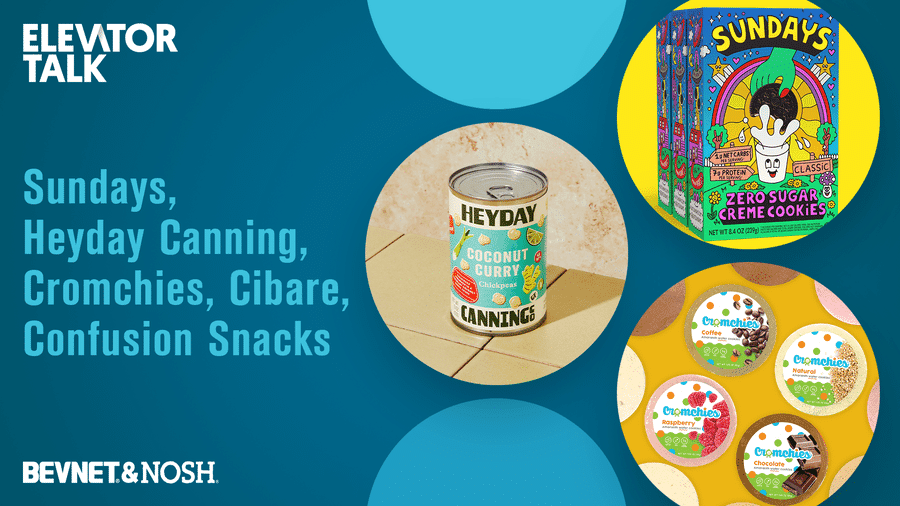
Elevator Talk Episode 78: Sundays, Heyday Canning, Cromchies, Cibare, Confusion Snacks
Transcript
Note: Transcripts are automatically generated and may contain inaccuracies and spelling errors.
Ray Latif [00:06] Hey folks, I'm Ray Latif, the editor and producer of Bevnet's Taste Radio podcast, and you're tuning into the latest episode of Bevnet and Nash's Elevator Talk, the series that profiles early-stage and disruptive brands from across the food and beverage industry. Today's episode will focus on 5 food brands whose entrepreneurs will have an opportunity to hear feedback and advice from our co-host for this episode. That is Amrit Richmond, the founder of NDCPG. Amrit, so great to see you.
Speaker 2 [00:36] You too. Thanks for having me back on the show.
Ray Latif [00:38] Exactly back on the show indeed. Uh, this is the 2nd time you've joined us for, I guess, an official episode of Elevator Talk. We also sat down with you for a live episode at Nosh Live in December, which was fantastic. For folks who are not familiar with you or what you do at NDCPG, please give us a brief bio.
Speaker 2 [00:58] Sure, so since 2017 I've been researching food and beverage and wellness trends for clients across every aisle at the grocery store. I've also interviewed hundreds of consumers about how they shop for groceries, and I also connect founders to each other through events and education programs that are always free.
Ray Latif [01:16] Outstanding. And so NDCPG, I mean, how do you, how does the company work with early stage brands?
Speaker 2 [01:23] Sure, so that's the community side of what I do, and we host a couple events a year, usually do a summer education program that I call summer school or cart camp, something like that, where founders around the world can can log on and learn how to launch a brand, how to get into retail, how to raise capital, things like that, um. We also connect founders to each other behind the scenes and imagine if you're traveling to a different city and you're looking for friends or you're looking for a co-packer, uh, we're just trying to, to be helpful and friendly with other communities as, as well. There's a lot of folks out there that want to help brands, and I think the founders are the lucky ones.
Ray Latif [02:00] Yeah, I mean it seems like there's a lot of great opportunity for founders to connect with the community with each other. Um, it is still an uphill battle. It is still very difficult to launch a CPG brand, particularly in food and beverage. In 2023 in July of 2023, what are you seeing as some of the most pressing issues for food and beverage entrepreneurs?
Speaker 2 [02:22] I think the the most pressing issues are staying on the shelf. And making sure that you can retain the distribution that, that you have, uh, it's still difficult depending on your size and stage and maybe what category you're in to, to raise capital, um, or I guess it's harder to raise capital than it was a few years ago, but it's still possible. Uh, those have been ongoing challenges. I haven't noticed, uh, any new challenges since the last time we spoke late, late last year.
Ray Latif [02:51] Yeah, I mean, it's interesting, you know, I think you bring up a good point about staying on shelf because It seems like getting on shelf is not even half the battle. It's just, you know, one part of the battle, but staying on shelf, making sure you're turning, making sure you have those velocities that will keep you in stores and help you get into new ones is something that is often overlooked.
Speaker 2 [03:14] Yes, and, and staying on shelf and growing with the distribution you have will give you a better chance of getting a credit line or raising capital. To show that they are investing in growth versus investing in helping you experiment.
Ray Latif [03:26] Well, I know you are familiar with a few of these brands that we are going to be speaking with a few of the entrepreneurs we are going to be speaking with today. Are you ready to speak with our first?
Speaker 2 [03:34] Yes, let's do it.
Ray Latif [03:35] Fantastic. That first person is Jody Polischuk, who is the founder and CEO of Sundays. Jody, great to see you. Hey
Speaker 2 [03:44] Ray,
Ray Latif [03:45] so Sundays, I'm a big fan. I should be more objective of brands, but make a pretty fantastic product. Jody, tell us a bit about the company and its development.
Speaker 3 [03:57] So, Sundays is a zero sugar Oreo. We launched in December after about 3 years of R&D. Uh, we're digitally native right now. We, we, we're, we will be leaning into an omni-channel strategy, um, launched with a single skew. We'll be doing a lot of innovation around flavor. Um, that's it. I mean, it's a clear value proposition. I've been waiting for my entire career to have a product that I can describe in 3 words.
Ray Latif [04:30] And those three words are zero sugar Oreo.
Speaker 3 [04:34] Correct. Obviously, you know, Uh, consumer facing, we don't use the word Oreo for obvious reasons, but Oreo has a lot stronger emotional resonance in the marketplace than sandwich cream. And so any opportunity to sort of communicate the product through that lens, we, we use it. Obviously, we're limited consumer facing and brand facing messaging.
Ray Latif [04:59] Now, before we get to Amrit, I have a big question here because a couple of years ago I was speaking with the co-founder and CEO of Foxtrot Market. His name is Mike Avatola, and he said, I asked him, you know, why a better for you convenience store is selling Oreos, and he said, well, no one's made a better for you or equally tasty version of Oreos yet. And you have. I've tasted your products and they're fantastic. They're very, uh, on the same level in terms of flavor and texture as Oreos, but price point, I feel like that is probably where you're going to run into some issues. Um, what is the price point for sundaes, and I mean, are you trying at any point to get to a competitive level when it comes to Oreos or analogs to Oreos?
Speaker 3 [05:45] Yeah, that's a great question. So Sundays, um, depending on where you buy them, our, our general SRP is 11.99 a box, so 12 bucks. Um, you know, we use, like, we're never going to get to Oreos. You know, Oreo, you can buy a 10 ounce package of Oreos for, you know, I haven't looked, but they're like 4 bucks, right? Um, I mean, that's, you know, not far off from what it actually costs us to make a box. We have, the way that we sort of look at it is through the lens of our macros. I mean, you look at a protein bar on the shelf and let's say a protein bar that has between 12 to 15 g of protein or even 10 to 15 is in that like 3, 350 range, right? So, a box of sundaes has 50 g of protein in it, 50. So, um, you know, we are a premium product. We are also not our, our target consumer is not people who are buying Oreos at Walmart. Um, our target consumer are people who grew up eating Oreos, which I think for, you know, most people that grew up in the West, that's an incredibly relatable experience and You know, the, the sort of thesis behind the business is that there is a massive delta between people who grew up eating Oreos and love them and the people who no longer consume them for reasons of health, wellness, diet, lifestyle, etc. Um, so, you know, we, we already are testing a range of SRPs. I think this thing that we have sort of the the the wind at our backs is that consumers already expect these types of products to be more expensive. Um, and we actually have been price testing across channels direct to consumer and Amazon and have seen no shift in, uh, turns and velocities with the higher, higher SRP. Um, so, yeah, and I mean at the end of the day, you know, any business needs to price their product in order to have the margin to make it work.
Ray Latif [07:48] Truer words have never been spoken. Uh, Amrit, uh, I, I'm sure you've tasted sundaes. I mean, you know, when you first saw this product and saw the brand, what were your initial thoughts?
Speaker 2 [07:58] Uh, the first thing that stood out to me was the illustration. One of my first jobs was working in the art department at a magazine, and I know how much time it takes to commission a custom illustration, let alone a whole, a whole packaging. So I'm curious what, um, what inspired you to go with illustration, and then how does it Fit into the puzzle pieces of this world that you're building for both kids and adults that consume the product.
Speaker 3 [08:25] Yeah, that's a great question. So, it's not widely known or really even known to many people at all that we actually had a different brand for this product that is in the bottom of the dustbin right now. Um, and so, you know, a lot of times anyone that has gone through a sort of brand development process will tell you that the brand kind of like, you get to a point where the brand kind of starts to speak to you and tell you what it wants to be like. And so, you know, we, we did all of this in-house. We get asked a lot about our brand. This is not agency work. We did all of this in-house. We have an amazing creative director and head of design. Her name is Christine Brown and we work with an incredible illustrator in Belgium whose name is Django Jim. And so this brand came out of a, so let's talk about the name because that's sort of the impetus. So Sundays is the idea behind it is that all of the most nostalgic, happiest, joyous memories of your childhood all happened on a Sunday afternoon, right? And the the sort of memories of those experiences are anchored into the same place as the memory of eating those cookies as a kid. Right, and so the creative brief was really simply just to create this surreal, fantastical, fun, nostalgic retro world that encompasses all of those memories and feelings and experiences. And that was it. And You know, I've, I've talked about this before on other podcasts and like there was no, I'm so proud of this brand for a few reasons just because I know what typically the process and what it takes to create something like this and we did it completely differently. Like there was no Like Plannogram, mockups, and competitive analysis, and there was none of that. We really, this was just like from the heart and it just came out. There was barely even any rounds of editing. It just came out almost as you're seeing it now.
Speaker 2 [10:33] Oh, I love that. And once you are on the shelf, it's obviously gonna stand out because everyone else who's made, um, their own version of an Oreo, the, the packaging looks like Oreo, it's almost private label. So by default you'll stand out and someone's gonna wonder what is that, um, especially if you get a, a low shelf position so that kids can grab it. I've heard some brands actually want the low shelves. They get thrown into the carts by, by accident, by, or not by accident, but. You know, the kids throw it in and hopefully mom doesn't notice, um, but also so the parents, um, admire the packaging as well. I'm sure you're getting a lot of comments from moms and dads.
Speaker 3 [11:13] I mean, it's such a cliche thing to say like the kid in all of us, but like it's true, right? It really is true. It comes from somewhere and so. Yeah, we have, we're finding like a lot of our customers are purchasing on behalf of their kids, but like we have a ton of like adult customers as well.
Speaker 2 [11:32] And uh the question that Ray had earlier about the price, and you said part of the, the price is justified by the protein added to it. I agree. I've done a lot of research on a trend I called functional nostalgia, which I, I know you're familiar with. You actually inspired part of the research that I was doing. Around it earlier this year, um, where it's something that everyone's familiar with very low education, doesn't even need a name. Someone sees the cookie, they know pretty much what it's gonna taste like, um, or that they know they're gonna like it, um, but it has something added to it, especially protein, um, so you said it's 50 g a box, maybe someone's supplementing half of a protein bar instead of eating a couple of your cookies and getting their, their protein in for the day, but they're also feeling excited because it tastes like something that. That they had as a, as a kid versus a mundane protein shake. That's not nostalgic or exciting, but gets you through the day.
Speaker 3 [12:27] Yeah. You know, this cookie has never been innovated for protein. And you know, when we, when we started ideating this, this was in early 2020, you know, now there's like a very small sort of BFY sandwich cream set that didn't exist at all when we started ideaating this in early 2020. But even now, Those sort of competitive brands to us, uh, none of them really have a meaningful amount of protein. Some of them have a little, but some of them have none. You know, for us, that's really a strong value prop for us, but it's not the one we lean on, you know, I'm really, I sort of like, um, live and die on the hill of like that, uh, you know, your brain really needs to be about one thing. And, but also, you know, 4, excuse me, 4 Sundays is as much protein as 2 eggs. And more fiber than an apple. Excuse me, and um, You know, we've really, I think, like expanded the consumption occasion for this cookie in a way that's not been done before. I mean, you know, I don't care how unhealthy you are, you're probably not eating Oreos for breakfast, or I would hope not. Maybe the cereal, and you probably shouldn't be eating that for breakfast either. And, you know, we, we have customers who are like, I eat these with my coffee in the morning and it's awesome.
Ray Latif [13:52] Uh, if I, if I, uh, had cookies in the morning, I'd probably be eating Sundays for sure. Um, we're out of time, Jody, but, but I gotta ask, I mean, you talked about fiber, you talked about protein. We haven't really talked about the sweetener. Um, could you quickly talk about the sweetener and how it impacts that, that, that decision, that purchase decision for consumers?
Speaker 3 [14:11] So we use Alios and monk fruit. We get asked a lot about what our sweetener blend is. I mean, I think what will be not news to many listeners today is that many of these consumers are, it's a sophisticated consumer who is purchasing these products. They understand these ingredients, um, and, and they understand the alternatives out there and you know, we just really try to meet the consumer where they are and, you know, I think Weird aftertaste is a problem for a lot of these types of products that are low or zero sugar, and so we really try to address that by using ingredients that we feel is sweeteners in particular that don't have any like lingering aftertaste. I think we've done a pretty good job in that regard.
Ray Latif [14:53] I, I would say so. Uh, Jody, thank you so much for taking the time. I feel like we could speak for at least another hour or so, but, uh, hopefully we will do so in a future episode of TSE Radio. But in the meantime, really appreciate the time today. Good luck with everything going forward. Please, please stay in touch.
Speaker 3 [15:08] Thank you both. I really appreciate it and have a great day and uh I appreciate you having me.
Ray Latif [15:14] All right. Up next on this episode of Elevator Talk is Kat Kavner, who's the co-founder and CEO of Heyday Canning. Kat, how are you?
Speaker 4 [15:24] Doing good. Thanks so much for having
Ray Latif [15:25] me. Thank you so much for joining us today. Uh, talk about nostalgia. I mean, it's all over what you guys are doing at Heyday Canning. Fantastic work. Uh, tell us a bit about the inspiration behind the brand.
Speaker 4 [15:37] Yeah, for sure. So, similar to Jody, I'll start with the name actually. So the inspiration behind the whole brand identity and packaging was very much marrying this kind of vintage rooted in nostalgia feel. Um, we really liked the idea of kind of harkening back to what we saw as this golden age of home canning. Uh, which felt like, you know, a big part of American history but has sort of been lost and canned food has become very industrialized over the years. So we wanted to harken back to that but also really root the brand in, um, a very modern and kind of on trend approach to food and flavor. Um, so hopefully the brand reflects that kind of this marrying of old and old and new. Yeah,
Ray Latif [16:15] absolutely, um, and you've actually picked up quite a bit of distribution of late. Talk about where you are in terms of your retail footprint.
Speaker 4 [16:25] Yeah, for sure. So we launched the brand in December of 22, so a little over six months ago at Sprouts. So we launched nationwide with Sprouts as part of their forager program, and then we followed that up the next month with Whole Foods. We rolled out nat national, all regions of Whole Foods, uh, all six skews, so it's a big, uh, a big way to jump in, but very exciting.
Ray Latif [16:47] Alright, well, that's congratulations first and foremost, but I think this goes back to the topic that Amrit and I originally talked about or led off the show with, which is you've got this distribution now you got to support it on shelf for sure. Um, before we get to Amrit, I got to ask, I mean, you know, what has been the reception? What has been consumer reception on shelf at retail to Heyday Canning?
Speaker 4 [17:06] Yeah, for sure. Well, I'll back up a little bit for folks that might not even know who we are, what we make. So we, you know, we make canned food for the modern home cook is really how we think about our target consumer. So. Um, you know, really delicious flavor, bold flavor, high quality ingredients for people that know food and love to cook at home, but don't always have the time or energy to cook from scratch. Um, so our first product is a line of canned beans, and really yummy flavors like harissa lemon chickpeas, enchilada black beans, uh, tomato alavoca cannellini beans, so you can just heat them and eat them. They're ready to go straight out of the can. You just pair with with rice or veggies or as a side to any kind of protein. Um, and the reception has been really great. It's been really fun starting to see people cook with the products, and it's awesome when you see your value prop kind of parroted back to you, like exactly how you had it in your mind. Like we're seeing people use them just as we had imagined. They're, you know, using the beans as kind of the center point for their meal, and the beans have so much flavor in them. They're very saucy. They come canned in like very bold sauces, so you don't need to do anything else. You're just, you know, making some rice and adding the beans, maybe a fried egg on top, so we're seeing a lot of pictures of people. Cooking with them, which is just super fun and yeah, very rewarding to see.
Ray Latif [18:18] My mouth is watering and I haven't had lunch yet, so if we have a can around here, that's exactly what I'm going to do. I think when I asked Amrit if she'd be interested in co-hosting this episode and mentioned that Heyday would be on, she said, I love Heyday. I think that's what you said, Amrit, isn't it?
Speaker 2 [18:34] I do. I'm an honest customer of them, and I think maybe with you or with one of your co-founders. I was chatting on Instagram.
Speaker 4 [18:41] Oh, nice, yeah, that's awesome,
Speaker 2 [18:43] yeah. Yeah, um, but, but I did buy them at Sprouts with my friend Caitlin from Pulp Pantry, and I think we got the Harissa lemon flavor and put it on rice or couscous. I don't remember, but we wouldn't shut up about it. It was so delicious, and you really don't need to add anything. I agree with all the trends that you were talking about how people are cooking again and they don't want to cook everything from scratch or You know, be at the stove for a few hours, you know, waiting for beans to season. Not everybody has time for, for that, um, so having something ready in the pantry that meets them halfway or a third of the meal, um, or an easy breakfast. Um, in America we eat a lot of savory breakfast. In Europe they don't really do that, but, uh. Uh, I, I agree with the, the way that you positioned the, the brand, and I'm not surprised that it's doing well in, in, in retail, especially because it's shelf stable or it doesn't take up a lot of space in the fridge freezer. Um, traveling right now in, in Italy, I just have a sad can of chickpeas, and I wish I had some of yours because I'm gonna have to season these, but, uh, you know, it's, it's a lot of, uh, It's a lot of work to think about what you're going to cook and make sure that you have the ingredients, so, um, but I also like that you're not doing everything for someone. It's not a frozen dinner.
Speaker 4 [20:01] I was about to say that. That's exactly what I was about to say. Totally. People don't want like all of the work done for them. Like you don't want to just like, yeah, make a frozen entree every night. But yes,
Speaker 2 [20:10] yeah. So my first question for you is, Your, your flavors are all over the world and it seems to have done well in retail. Do you have any data if people are buying three of the same flavor or one customer is trying lots of different ones and maybe they're trying flavors for the first time through your products?
Speaker 4 [20:30] Yeah, oh, I wish. I'm hungry for more data. I don't have any specific data on that yet. Um, I'm curious to know the answer to that too, but unfortunately, yeah, not, not yet too early for any of that. Yeah,
Speaker 2 [20:43] second question about global flavors. How did you arrive at those flavors? Maybe you've traveled to some of those places or you personally like them. I'm, I'm just curious what, what got you to, to those 5 or 6 ones.
Speaker 4 [20:56] Yeah, so, um, you know, we started off just thinking about my co-founder Jamie and I are both passionate home cooks. We do a lot of home cooking ourselves and just thinking about the kind of flavors and meals that we're turning to most frequently in our own weeknight home cooking. Um, and we wanted to design a line that would, you know, be very, like, each flavor would be very incremental to the next and open up a lot of different meal ideas for people. So we wanted to have like the enchilada black beans, which can go in enchiladas, they can go in tacos, they can go on top of nachos, the tomato ollivaca beans can go on pasta, like we really wanted to have, we thought that would just be cool, like, oh, a bean that can go with polenta or pasta, it's not a way that maybe most people think about using. Beans, but we wanted, yeah, each bean and each flavor to really provide, you know, endless meal ideas. So yeah, we kind of thought about the different cuisines and different flavors that that we love and that, you know, we just had an intuitive sense would resonate with people in the way that they like to cook.
Speaker 2 [21:54] And what percent right now is, is your sales in, in grocery? It doesn't have to be exact, but
Speaker 4 [22:01] Like 100%, just about, yeah, yeah, yeah, I mean, 99.9%. We're doing a little bit of direct to consumer e-commerce, but it's very, very small. Yeah. OK,
Speaker 2 [22:10] so how, how are you? Keeping in touch with those customers if they're mostly buying your products through retail, but maybe you want to educate them or inspire them or just get an email address to send them new flavors.
Speaker 4 [22:24] Yeah, yeah, yeah, yeah. So we're, you know, working on building community primarily on social right now. So Instagram has been the primary platform for us. Um, we are a very lean and scrappy team, but we just hired our first full-time marketing person, which has been a dream to finally have someone dedicated to that. Um, so she's Taken the reins on Instagram and has been doing a great job, you know, building up that audience and reaching new folks and engaging them. Um, and TikTok is still like a new thing for us, but we're starting to figure out how to make that work for us as well and building up email. So you know, we're still kind of laying the foundation of all of those channels and making sure that we're opening up those lines of communication with consumers. Um, and we're also just about to start experimenting with a company called Isle. I don't know if you're familiar with them. They enable, yeah, like the, yeah, the Venmo rebates basically, which is a really cool way to kind of connect digital to actual on shelf results. So we're very excited to play around with that and see how that goes. I feel like it's such a smart idea and it seems like so many brands are starting to play with that because there has been such a gap for so long in how you connect digital marketing efforts to actual in-store results. So yeah, we're testing and learning, throwing everything at the wall right now and seeing what will work for the brand.
Ray Latif [23:36] I, I mean, I think Isle has been pretty amazing. I mean, the, the results that I've seen that I've heard from, from other entrepreneurs is that it's a great, relatively cost effective way to get samples, get, uh, to get samples into people's hands without having to do costly demos for sure, yeah, um, and, and when I think about, you know, trying before you're buying, people are hesitant because of price points, and I saw on your website. That you're, if you're if you're a direct to consumer, part of what you do, you're selling 6 cans for $40 online. If I'm looking at your Instagram page, I see you have an everyday price point at Whole Foods at $450. You know, I asked Jody this question as well, but how are folks, uh, you know, looking at your price point and comparing it to other canned beans or other pouched packaged beans like we've seen from other brands as well?
Speaker 4 [24:28] Yeah, for sure. I mean, I think our category is challenging. It is a commodity category, and even though our product is so fundamentally different, we're sitting on a shelf next to products that sometimes are retailed for less than $2 sometimes even less than $1. So I think, you know, for us the most important thing is the label and making sure that the label is working very, very hard to communicate what's inside the can. So we're, you know, working on making some little tweaks and testing how we can just hammer that message home even more. Um, but so far, I mean, velocities are looking good. I think people are discovering the product and are drawn to the label and excited to try it, and I feel very confident that once people try the product, the value is justified immediately. Like, we believe that it's a pretty incredible value at 450 a can, you can easily feed two or three people using one can if, you know, you're pairing with rice or something else. Um, so yeah, I think it's really all about driving trial and getting beans and pans and getting people to cook with it at home and, and understand what the product is really worth. So, yeah. Trial Tri Trial is the name of the game right now.
Ray Latif [25:31] That would be an interesting question to ask your marketing person. How do we get more beans and more hands and hopefully they've got a great answer for that or hopefully they are helping you get to a great answer for that. Yeah, yeah, absolutely. Fantastic. Well, Kat, we're out of time. Thank you so much for taking the time to be with us today. Uh, congrats on the launch of Hay Day and all the success you've had up to this point. Uh, please stay in touch. Let us know if we can help in any way.
Speaker 4 [25:53] Will do. Thanks you guys. Great talking with you. Bye.
Ray Latif [25:58] All right. Up next, let's speak with Valeria Rivera, the co-founder and CEO of Crom Cheese. Valeria, great to see you. Hi everyone, how
Speaker 2 [26:06] are you?
Ray Latif [26:08] Doing well. How are you? Great to see you. Great to
Speaker 2 [26:11] see you
Ray Latif [26:11] too. Crumb cheese. I love your name, and when I first saw you pop up, uh, as an applicant for elevator talk, I was like, what is Crumb cheese? That's such a great name, but I don't know. It's not, it's not immediately intuitive what you sell. Talk about your brand and what you guys do.
Speaker 2 [26:26] Yes, of course. Thank you for having me today. I'm super excited to be here and I'm a huge fan of the podcast. So crunchies are, let me show you, thin amaranth wafer cookies made with natural ingredients only, and a twist of fun. They're vegan, sugar free, and they're packed with amaranth, that is a superfood grain. We currently have 4 flavors, the natural one, that's amaranth, raspberry, coffee, and chocolate. And it's in a 30 g pack. So there are around 30 wafers in the package, and the whole package is only 110 calories. So it's a really good option for a grab and go snack, and we're very excited to share our crunchies with the world. I'm, I'm gonna share a little bit about our name, that's something that I love. So this started, this idea started in during COVID. So I started a yoga for 21 days, and one of the mantras was the om, right? So on means connecting with you. Then we wanted to bring the crunchiness, crumb. I'm sorry, CR, uh, uh, crunchiness, connecting with you, um, and the munchies. So crunchy, and that's how it started. And yes, I love um I love the brand, the name of the brand.
Ray Latif [27:43] I, I love it. So the getting the munchies and crumb cheese, now it makes total sense, so I appreciate that. Um, So you know you talked about an everyday or sort of everyday snack occasion, on the go snack occasion. Is that how people are consuming the product? I mean it feels like there are different day part uses for this uh for these Arith wafers.
Speaker 2 [28:02] Yeah, like um the the thing that I like the most is that uh our customers make their own creations as well. We used to um educate our customers. And Instagram and show them some recipes like you can put spreads, almond butter, uh dip it with, with coffee in the morning. So it's an everyday snack. Also it's very light, so carrying them to your road trips, hiking, it's a really good option. But we, some of our points of sales are juice bars, coffee shops, um, health conscious, um, food stores. And sort of that. If you're going into a new retailer, maybe trying to be in a couple of different places in the store, so I could see it where the ice cream cones are. I'm imagining this would be delicious on ice cream as, as an alternative to a wafer, um. On a, on an ice cream or frozen yogurt, um, but maybe also in the where they put the cheeses and dried fruits, cause it could be on a cheese board, I'm not, I'm not sure, um, where else it it could go. I think it would be lost in the snack aisle. If it's sweet, I, I think it could be the baby next to the the dried fruits there also, or the fruit snacks. What do you think? Where has worked best for you? Yes, actually, we, we also put them in cheese boards and everything, so, um, and, um, we're under 50 volume accounts right now around San Diego cause we're based in San Diego, and, um, They're like in the counter, so grab and go, it's really like fast in in the coffee shops, sometimes the pastries or the vegan options go bad really fast, and these ones have a really good um shelf life of 8 to 12 months, so it's a really good option. And going back to our target market, there, um, as you said, there's a really unique product that it's not known. Um, in, in the US, but, uh, we grew up in Mexico where this kind of wafers are very, very common, so Hispanic families already know the product and it's easy for them to, to like, uh what are you, what you were mentioning about nostalgia, it brings like our childhood. Um, going to parties, family Sundays at the park, and the original version of this treat was made with white sugar artificial colorants, like nothing healthy, right? Oreo. I remember seeing that. So, and they, they had like nothing healthy, right? So this is a healthy version of that treat that I used to have when I was a child. Mhm. For, for other grocery stores, um, I'm gonna give you an example that's a completely different brand, but it might, might be helpful. Um, I was working with a spices brand. And we were planning a new retail rollout, and we thought, what if we sent the spices to restaurants and cafes near the retailers that we wanted to be in. So almost planning your food service strategy around and if you're in San Diego, maybe Lassons or Jimbo's so that people can become familiar with the product and then they see it on shelves. At a store that they're they're likely to to shop at, um, and then you could also tell that local store we already have hundreds of customers in in the area so you're not gonna have to do any demos or education. As well, just to get a sense of the neighborhood, it responds well to a product. Yes, I totally agree. And we, I, I love to go into pop-up events and everything, like just to demo the product, and it's funny cause I, I always carry like crunchies with me, like it's in any events networking, and I'm always like giving away products for them to try them. And after that, I've seen a really good uh response on recurring customers and very loyal. So it's, it's amazing to see that the company is growing. Have, have you ever considered doing custom ones if it would be possible to print something on I've thought about that, and I've done it for several like friends and family, but it's, it's very time consuming. So for now I'm sticking into, into my brand, but obviously if there's any, I don't know, big brand that would like to have their own logo or coffee shop or anything, uh, we're hoping to, to have that. OK, great. I was, I was thinking if it was a big event like a movie or a music festival or something, people post it on Instagram and then everybody's gonna wanna want that thing to build some virality around it. Uh, I guess people are more likely to take a photo if, if it's, if it's something the customer doesn't have to have their face on it, but maybe it's just the logo. I don't know. But, but I respect that it is time consuming and you. You know what your priorities are. No, yeah, yes, totally. But yes, as, as you were mentioning about a festival or anything, obviously I'll be super happy to have something like that with my product. Yes, um, my friend David at Dream Pop's Ice Cream did a lot of that early on. He, he didn't change the ice cream itself, but he would change the packaging of it for events, and that helped get a lot of local interest in the product. Right now we have 444 flavors. We did our customer uh research. We started with 6 flavors, but then we stick to 4. I don't know what do you think about having uh 4 Scus? I think it's, it's positive to have 3 or 4 different options for people, especially if they want to mix them or just have different options in the house. Looking at your website right now, I'd love to see more use cases before scrolling a few times, and I know you have those photos, but making it, um, so irresistible for somebody like you said, you put it in a coffee or um I'm seeing almost. Those aren't pancakes. Those are the products. Um, you can dip it in something. So immediately after scrolling once, maybe it's a Uh, an illustration or, or photos of how people are, are using it, that's always what gets me to finally buy the product. Mhm. Yes, and also our price point is, uh, very affordable, is 350, 375, so like everyone can just Like, try it for the first time and um as I said, we've seen a really good reaction on new consumers that didn't know the product or they are non-Hispanics, you know.
Ray Latif [34:27] Valeria, in my notes, uh, it, it says here that you're thinking about or you're working on new packaging, is that right?
Speaker 2 [34:33] Oh yes, we actually, we just changed our label. Um, we had an, um, A label that I made myself after the first time, but now, um, our market, I, I have a marketing assistant, so she, she was the one that created the new label, so it's really neat, it's, it's like it's understands better, we have our barcode to be ready like for larger volume. In retail. So that's, that's really exciting for us to, to have our new packaging.
Ray Latif [35:07] Outstanding. Well, Valeria, I don't know how we're out of time and we've, I feel like that flew by, but thank you so much for taking the time to sit down with us today. Um, please stay in touch and please let us know if we can help in any way and uh if you have an opportunity, stop by the San Diego office, Bennet San Diego office that is. I'm sure our team would love to see you.
Speaker 2 [35:24] Of course. Thank you so much. Have a good day and thank you for all the
Ray Latif [35:27] advice. All right. Up next on Elevator Talk, we have John Ellotti, who is the co-founder and CEO of Chibari. John, how are you?
Speaker 5 [35:37] Hey, Ray, great. Happy to be here. Thank you.
Ray Latif [35:40] Uh, Chibare, tell us about what you guys do. Sure. Well, thank
Speaker 5 [35:44] you. Uh, really excited to be here. So we're a father-daughter brand. Uh, we're based out of sunny San Diego, California, where my daughter lives, and we have operations up here in Sacramento where I reside. The word cibari is an Italian term which means to nourish or to feed, which aligns perfectly with our mission, which is to provide clean, labeled, delicious probiotic protein bars to our customers. Our story is quite simple. I started making these bars about 10 years ago in my kitchen after being less than impressed with the taste and quality, texture of protein bars that were being offered in a class, a gym class that I was taking. I know my way around the kitchen a little bit and started mixing different protein powders, different fruits, different almond butters and nut butters, and eventually came up with a repeatable recipe that had a nice, delicious, creamy, textured bar that tasted really good. And people were asking for them, friends, coworkers, gym partners, um, and in 2020, Maddie approached me. She has a background in Product development and in startups, and she said, Dad, let's add 1 billion probiotics to this bar and bring it to market. And that began a quest of really trying to scale the recipe from a kitchen formula into a commercially available. Production, um, product and, in doing so, we really made the decision early on that we wanted to adhere to our design principles which were to maintain the quality both in terms of the texture and the taste of the bar. So, today, the bar, we have two skews that are available. We have a peanut butter chocolate chip and a blueberry almond. We're not using any added sugars at all, so that number is 0 on the ingredient list. We're also not losing, using any sugary type of substitutes, so there's no monk fruit, stevia, brown rice syrup, you know, the list goes on and on. We tried all of those and And really, I just felt the taste early on, um, didn't agree with me and I was the, the chief uh maker of the bars at the time and that's how we ended up with the label being um the way it is today. We're in a very small number of retailers here in Sacramento, um, as well as Southern California, Central California. That list is growing. We just launched last September and uh we're pretty excited that we're on our 2nd production run now, um, and just real happy to be here.
Ray Latif [38:35] Well, I'm happy you're here as well, and I gotta say I love your packaging, your branding. It's so beautiful. It feels very Southern California in so many ways. Um, your tagline of nourish the adventure, uh, kind of makes me wonder, you know, who is your target consumer? Is it that, you know, outdoors, uh, person who's sort of looking to, uh, have a nourishing snack as they're out in the, in the world, or, um, is it someone else that I'm not, I'm not picking up on?
Speaker 5 [39:05] Well, I think that's definitely a good portion of our target market. Those people that are really enjoying an active lifestyle. They're, they're doing some activity outside, whether, you know, it's going on a hike or it's going on a jog or it's biking or whatever it might be. The, the ability to grab a healthy snack quickly is also appealing to people that are on the go, people that are rushing out of the house in the morning to, to go to the office or uh to, to drop a couple of snacks into their kids' lunchbox, uh, knowing that they're going to be well cared for. So, Um, we, we really are finding that, um, that the product is appealing, uh, to the group you mentioned primarily, but we're also finding that there's a lot of folks in the second category that are also enjoying the product.
Ray Latif [40:03] Amrit, obviously, you know, the protein bar market is competitive. There's a lot of brands out there, um, you know, based on what you heard from John and based on what you're seeing online for Chibari, um, you know, what are your thoughts on the brand and, and ways it will and could develop on the market?
Speaker 2 [40:22] Sure, my first question is, was it intentional to design a unisex packaging?
Speaker 5 [40:28] Um, Yes, I, I, I mean, we really, we really, um, wanted the brand to be appealing, um, regardless of who, who was, was looking at it, so that, that is intentional.
Speaker 2 [40:45] I ask because so many protein bars on the market are very masculine, where a lot of women feel excluded, and there's plenty of women that are bodybuilders or that that go to classes every day, work out at home, um, but I've seen some chatter online or when I've interviewed consumers that they feel like there aren't a lot of bars that speak to them. There are bars that are pink or that are clearly made for women. I don't know if you remember the Luna bar, that was one of the first that purely marketed to women. I ate them. Delicious, but I think bars can be for everybody. And by doing that you're saying that those spaces that were typically designed for men in gyms can also be for women too. So that was my first reaction to the brand, that it's definitely eye catching, but it's also calm and it's not. It's not so intense as some of the the other bars. Yeah,
Speaker 5 [41:37] right,
Speaker 2 [41:38] intimidating, I should say.
Speaker 5 [41:40] Well, we, we purposely thank you for that. Uh, we purposely, um, did a lot of work upfront when we were designing the packaging and coming up with the identity for the brand, uh, to really make it as approachable as possible. Um, we're only using 8 g of protein by design in the bar. So, uh, we're not, we don't really see this as being something that you're really heavy, you know, gym user who might be looking for a 25 g of protein bar. would be, would be gravitating toward. This is more, in fact, most, most of our customers today are females, so we do have a very large population of women that are really enjoying the product today.
Ray Latif [42:26] It's interesting when I talk, when, when people talk about protein bars, you kept the, the last, um, the last couple of times you've talked about the bar, you've led off with probiotics and on your website and on Instagram, it also leads off with probiotics and then protein. Do you see this as being a probiotic bar first and foremost, or that, that is the most important part of, you know, what you're selling, the most important functional ingredient, or is it very much first and foremost a protein bar?
Speaker 5 [42:53] Excellent question, Ray. We intentionally, you know, there's no, there's no getting around it. This is a crowded space. There is a lot of companies trying to do. Uh protein bars at various gram levels, we really saw probiotics as being something that would allow us to somewhat stand out from a very crowded space uniquely. So we are leaning into probiotics first and foremost. This is, this is more of a health and nutrition bar as opposed to a heavy protein-oriented protein bar.
Ray Latif [43:38] And so when you are talking about probiotics, it feels like, you know, it's so obvious that everyone knows what probiotics are, but is there a level of communication that you feel is still a hurdle to get consumers to understand what you're selling, or I guess at this point, do most people understand that probiotics equal better gut health?
Speaker 5 [43:58] Yeah, I mean, there's, there's a lot of truth to, to that. I think, I think consumers are sophisticated. They do understand the benefits of probiotics, but we are finding that we are very happy to reinforce those benefits, and gut health is certainly one of them. Protein utilization is another, and immune function are the three. You know, key benefits that you would get from 1 billion probiotics. The other thing that's pretty unique about this, about this bar, and we searched high and low for just the right probiotic to, to introduce into the bar, um, we're not requiring refrigeration at all, so the bar is shelf stable. It can sit very happily as it is behind me at room temperature, and those probiotics. Uh, remain stable until they're consumed. So it, it really, um, it really seemed to be a terrific fit for us.
Ray Latif [45:03] That's great to hear. Um, and John, it's been so great to hear from you and speaking with you about Jabari. Uh, again, going back to your packaging, I really love, it's, it's just beautiful and it feels like it would entice me to at least pick it up, look at it, and perhaps buy it. So, I'm excited to see where the brand goes from here. Uh, please let us know if we can help in any way as you continue along this journey and, uh, being partly in San Diego, you got to stop by our office and, uh, chat with our team out there as well. Yeah, we would love that, Ray. Thank you. Fantastic, John, thanks so much again. We'll talk to you soon, I'm sure. Thanks. All right, let's stay in sunny Southern California with our next guest. It's Audit Patel, who's the founder of Confusion Snacks. Audit, great to see you. Hey, Ray Hamrit, good to see you guys as well. Thanks for having me. Thank you. And, uh, I mentioned Southern California. You're based in Los Angeles, correct? Yeah, we're in LA. Fantastic. You know, uh, I gotta say, uh, I've encountered your products before. I saw them at Pop-Up Grocer in New York City. And then again recently my co-workers, uh, Mike Schneider and Jackie Brulera were munching on these, uh, on your snacks in an episode of Taste Radio, and they were raving about them. Mike finished the entire bag without sharing a single kernel of your popcorn, which I was really angry about. But anyway, it just goes to show you have some fans and you have a pretty fantastic brand. Please tell our audience all about what you guys do. No, I appreciate that. So yes, my name is Ali Patel. I'm the founder of Confusion Snacks. We're a guilt-free South Asian American fusion snacks brand, um, all inspired by my upbringing being Indian American. Um, so all the flavors that we have, um, are inspired by kind of this narrative of being Indian American. We started off with three popcorn flavors. We have our black chocolate masala, chili chut popcorn and mint chop popcorn. Um, and the whole idea is to kind of bring this new sense of like cultural discovery, integrity, um, to a snack that everyone loves and enjoys, especially in America. And your auntie approved and that's legit. We're auntie approved. That's, that's a big thing in my household. What you see on the packaging, that's my mom. She approves every bag that goes out. Uh, you know, this is, this is a premium product for a premium consumer. The way we look at our customer is the conscious and curious snacker. So kind of what we saw in the market is we are seeing 3 communities really growing. The first is kids like me, like 1st generation, 2nd generation, kids with diaspora that are looking for snacks like them. The 2 is a curious snacker who wants to discover something new and the third is a conscious snacker that wants to eat something clean but also really tasty. Um, so we're kind of marrying those three communities together with the flavors we're offering, um, and also just kind of the guilt-free aspects of our snacks as well. They're all vegan, gluten-free, made with avocado oil, um, and the spices we use are very simple. You don't have to Google any of the ingredients, um, and they're, and they're clean and has some health properties to them like turmeric or k Kashmiri red chili. Well, Amrit, you know, we talk about trends and we talk about, you know, particular aspects of brands that we would encourage entrepreneurs to incorporate into their products and it feels like Confusion snacks sort of hits on every level. Um, would you agree?
Speaker 2 [48:19] Yes, um, I, I haven't tried your products yet, but I've definitely seen them in pop-up grocer and I actually also grew up eating a lot of these flavors. My mom is, is a chef. She's American but is heavily influenced by, by India. That's why my name is Amrit and Um, in a way, these are nostalgic flavors for me as well. I was getting excited just looking, just looking at the packaging, and anybody who's eaten in an Indian restaurant, no matter where they grew up, is going to be familiar with these flavors as well, but they're not boring or safe in any way. But I think you really nailed the, the flavor combinations. Um, I'm curious, so you, you just launched in Nordstrom a few days ago. What does that feel like to be in a store that there's not a lot of food brands?
Ray Latif [49:03] Yeah, the Nordstrom launch has been exciting. So that was in collaboration with Pop Up Grocer. So we launched in 8 Nordstroms. Um, it was cool to see like an eye cream that someone would buy and then you see your popcorn right next to it. That was pretty exciting. Um, I think we're really focused on catering to a specific demographic. Um, with our price point and the type of snacks we have. So Nordstrom was a natural addition to kind of the other retailers or brands that we've collaborated with. Um, it was really exciting to see in the New York flagship store, like people gravitating towards the snacks, um, and giving them a try and just being really curious about them. That's been exciting to see.
Speaker 2 [49:38] I wonder if that Nordstrom shopper, maybe she or he is shopping there for themselves, but then they see this and maybe they plan a Pari TiVo hour around it, or they want to share it with someone else because it's, it's presented almost like a gift for themselves or somebody else versus at Aw or other stores that you're in, people are adding a lot of things to their cart. Maybe they're more selfish with the snacks.
Ray Latif [50:03] Absolutely. No, actually we've seen a lot of gifting, so especially we launched with e-commerce last May. So what we naturally saw is the first couple of buyers are really interested in buying it for themselves, but we see a lot of orders for gifting a birthday, Mother's Day, Father's Day, etc. So I'm pretty sure that's also happening at Nordstrom where people might be like, this sounds interesting for like my friend or family for them to try.
Speaker 2 [50:25] OK. And then the other benefit of those pop-up groceries in Nordstrom is that There, there are other brands on the, on the shelf that that Emily's curated, but there aren't hundreds of brands. So you might be the only popcorn. I'm not sure, but let's say you are the only popcorn. Um, that's a really, um, unusual shelf placement. That I think you might sell more units in that one, that store versus you know one of the groceries you're, you're at in the area.
Ray Latif [50:55] Definitely. I think actually this is something we're iterating on is like, what's the, what's the right spot in a store, in a retail store for this type of product? Because it's definitely a popcorn, so it could be in the popcorn aisle, but also the type of flavors is, does it go in like the ethnic aisle or maybe those um more discovery items, that's not your staple flavors. So we're iterating through that and actually trying to figure it out. At an Aero one, we have like secondary displays, um, that drives most of the traffic, um, but we're figuring that out.
Speaker 2 [51:22] What about a um Maybe you guys know what the specific term is. It's not quite an NCAP, but it's like a string of chips on an aisle. What are those called?
Ray Latif [51:34] It's like on the little clips, right?
Speaker 2 [51:36] clips, yeah, and you can just grab, grab when they're at delis also, um, maybe in the ethnic aisle next to where they have the bags of chat when you make the, the appetizer at home, you could be there because people shopping right in that little section, um, they're, they're going to love your, your products. They just have to know about it, but they might not be going to the popcorn section otherwise or the snack aisle.
Ray Latif [52:00] Definitely. I really like that idea and I think as we kind of partner with more retailers, I hope it's going to be more of a collaborative effort of like, OK, they may want to print a popcorn aisle, but let's experiment with these different options to figure out where the consumer is.
Speaker 2 [52:13] Yes, I, I think broadly retailers need to do more experimental displays. We were talking with Heyday Canning earlier and I'd love to see a store do um Kind of a display of here's other things you can buy to make a meal for your product. Maybe here are other things you can do to put a gift box together or to have a movie night at home. Maybe it's your product and some ice cream cones, um, just helping inspire people and they'll sell more products, but so much of the store, we, we as consumers have to think about how all these things are going to play well together. So I, I wonder if Friends like yours pitch these weird ideas to retailers, um, maybe they'll just try them because they, they need to try new things too.
Ray Latif [53:00] No, 100%. We definitely want a person to be a little bit more creative and think outside the box. I think just sticking with like the form factor of just popcorn, um, may not be the best thing for their shoppers as well. We're trying to discover something new and it gets hidden on the shelf, but definitely pop-up grocery spoiled us with their display. Audit, uh, I'm interested to hear about the reaction that larger grocery stores and chains are having to seeing the success that you're doing or to seeing the success that you're having a pop-up grocer in Erawan. Is that translating to more interest in larger retailers? Definitely our performance in Araone and Popup Grocher has invited that first conversation. It has made it a little bit easier because now we have some data to support that. Is there a larger market for this, right? I think even when we started off on e-commerce and just my network, it was dominantly South Asian. So the question was, is there a market outside the South Asian population that would uh want these products as Well, I think Pop-Up C, Erwan and Nordstrom have been these uh proof points that there is a larger market invalidating that. So it's a lot for that conversation, but at the end of the day, I think when we actually send them product and sample it and they're bought into the flavors of like this truly is something new and unique coming to the market, they're very open to actually bring it into the stores. It's also a different type of popcorn too. I mean, the popcorn that you have, it's, it's not, it's, it's much more of a beautiful thicker, fuller popcorn. I don't know how to describe it. It's more of like a cauliflower than it is sort of like. This busted up piece of corn that got popped, you know, what is your process? What is your manufacturing process to get to that point? So we know too much about popcorn than we should, but that's different types of species. So your movie theater popcorn is a popcorn pop in all different shapes. We use mushroom popcorn. It's not mushroom. It's just a different type of popcorn kernel that pops into a ball. We started with butterfly popcorn, but then we started getting customer feedback saying the masala is not sticking as well or the flavor is not, it's not as flavorful. So we tried the mushroom popcorn, but it definitely has a personality on its own. The temperature, agitation, all that stuff we need to pop into a perfect ball was definitely much more complicated than I expected, but it really added value to the, to the delivering that flavor. So we completely switched that early on, and people seem to be enjoying it. Yeah, yeah, I would say so. Again, my colleague Mike Schneider ate an entire bag in front of me in about 10 minutes without offering me a single kernel, so I got you. Don't worry. No, Audit, thank you so much for, uh, for taking the time to sit down with us. Uh, Confusion Snacks, you guys have done some amazing things, uh, out of the gate and excited to see where the brand goes from here. Thank you so much. It was great talking with you. Thanks, Trey. Thanks, Em.
Speaker 2 [55:48] Nice to meet you.
Ray Latif [55:51] Alright, uh, you know, 5 pretty fantastic brands, Amrid, and, you know, really exciting stuff we're seeing from this early stage community. Um, you know, just in general terms, you know, what are some of the things that these brands need to look out for, you know, in the second half of 2023 and going into 2024? Um, what are some of the things that, you know, you can see that might just trip them up in ways that could uh stunt their growth?
Speaker 2 [56:17] I would say double down on the suppliers that you have, which is part of, part of how to, to stay on the shelf and stay in business. Um, check in with any co-packers you have. If you have an ingredient coming in from other countries that I know a lot of these brands do, um, make sure that you can still get that ingredient come January for a similar price, maybe lock it in. I think we talked about this strategy on one of the last calls that that we did, but it's still important because imagine you're Co-packer prioritizes a larger brand, or they themselves go out of business, and now you can't make more products because you didn't have a plan B. So, I think looking at everything that you've already committed to and making sure that you can continue to, to make that product, whether you need capital to make that product or you need um more warehouse space or whatnot, think a little bit farther ahead than you normally do, so that uh when surprises do come up, you have a foundation to fix them versus waiting for a problem to happen.
Ray Latif [57:17] Absolutely, retail buyers do not like out of stocks and when suppliers cannot fill the orders that they promised, so
Speaker 2 [57:24] and um I think the whole ecosystem has become more patient over the last few years, but it's still the founder's responsibility. To have those Plan B's and Plan C's, um, also for when you're scaling up, if you already have a backup co-packer, um, you already have a relationship with them, you can call them and it's going to be even easier to double your purchase order. So it's not just about preventing problems, but it's about knowing how you're going to Grow over the next 6 months but also stay in business.
Ray Latif [57:55] Excellent points and you know we have seen some amazing branding, some fantastic ideas. Now it's really turning a great idea, great brand into a significant or at least a business with solid fundamentals.
Speaker 2 [58:08] Yes, and um a couple of brands we talked to today, um, they're going beyond retail and I think it's a really good Diversification strategy. So the last guy we spoke to, Confusion Snacks, if he's not in the hotel minibars already, I think it could be a great strategy, you know, exhibiting at the fancy food show in the summer and winter where those big hotel chains are looking for interesting products, especially in Las Vegas or New York where they have a lot of international travelers, maybe even an airline. Um, could be a really great fit for, for their popcorn, and it's a totally different economics than, than retail, but if you consider it a marketing expense or if it helps you make more product at a lower price point because you're giving half of it to to an airline or a hotel, hotel chains, um, I think sometimes those, those can be worth it because it shows that you have other distribution points.
Ray Latif [59:00] Great ideas and I am sure you have a lot more Amri, for folks that would want to get in touch with you after this episode airs, uh, you know, what is the best way to do so?
Speaker 2 [59:09] Just on our website IndieCPG.com, you can reach out to me there.
Ray Latif [59:13] There you go. Well, Amrit, thank you so much for taking the time uh today. Uh, I really appreciated all the insights you shared with your entrepreneurs and our audience watching at home. Uh, excited for the next episode that you can do with us. Hopefully you will come back for a third.
Speaker 2 [59:28] Anytime, you know where to find me.
Ray Latif [59:31] Outstanding. Well, thank you so much to Amrit once again, to all the entrepreneurs who joined us today, to everyone watching at home, really appreciate it. To our fantastic team at Bevnet, Nash and Taste Radio, the best in the business. Signing off for everyone. I'm Ray Latif and we'll talk to you next time.