Search across the BevNET CPG Media network including BevNET, Nosh, Brewbound, Taste Radio, Nombase and CPG Jobs.

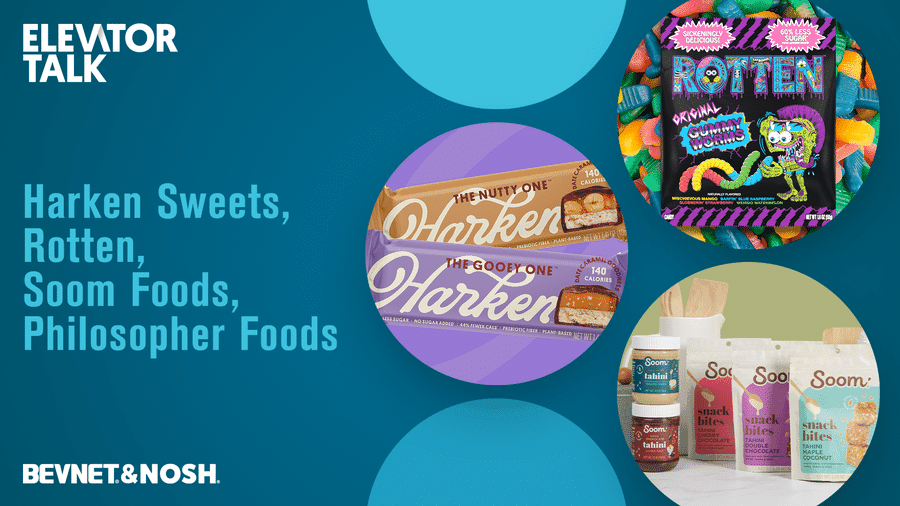
Elevator Talk Episode 88: Harken Sweets, Rotten, Soom Foods, Philosopher Foods
Transcript
Note: Transcripts are automatically generated and may contain inaccuracies and spelling errors.
Ray Latif [00:05] Hey folks, I'm Ray Latif, the editor and producer of Bevnet's Taste Radio podcast, and you're watching the latest episode of Bevnet and Nash's Elevator Talk, the series that profiles early-stage and disruptive brands from across the food and beverage industry. Today's episode will focus on 4 food brands whose entrepreneurs will have an opportunity to hear feedback and advice from our co-host for this episode. That's Wade Yennie, who is the VP of Center Store at the Fresh Market. Wade, so great to see you.
Speaker 2 [00:36] Hey Ray, thanks for having me. It's good to be here.
Ray Latif [00:39] It's good to have you back. This is number 3, the 3rd time I believe that you're joining us for Elevator Talk. The 3rd time is the charm, is what they say, I believe. Yes,
Speaker 2 [00:49] yeah, that's what I was going to say, and I must not have messed up the 1st 2 times that bad, or else I wouldn't be back the 3rd time.
Ray Latif [00:54] Uh, no, you certainly did not mess up. You've been an incredible host for the show. You were an incredible host for our Nosh Pitch Slam, uh, which took place in winter 2023 or December 2023, your most recent edition of the show, which was fantastic. I, I mean, I think about the job that you guys had as judges and the amazing brands that participated, and it was, it was really just eye-opening to see how far we've come as an industry and how great these brands are.
Speaker 2 [01:24] Yeah, yeah, without question, it was really tough. All the brands there at that event were fantastic, tough decision, but you know, it was great to be a part of that. Nice break being in California in December. It got a little warm there, so that was a nice, nice, nice break. But yeah, you're exactly right. The brands have come so far, and you know, things like this get harder and harder as you, you know, whether you're a judge or just giving advice. It's brands are definitely improving, so that's great to see.
Ray Latif [01:50] Absolutely. Uh, the vice president of Center Store for the Fresh Market, uh, you have a ton of experience and insight into how this industry operates. Um, I think when I hear from a lot of early-stage entrepreneurs and founders about getting into a retail, retail store, or retail chain, they're always asking, OK, what's the best approach? How do I connect with a buyer in a way that's going to really benefit my brand and help me to have a better relationship with that retailer? Um, Just, you know, in general terms, especially with Expo West coming up, how should brands be approaching you? How should founders, uh, start that conversation and then, uh, have a better converse, have a better relationship with you, you know, if they are indeed successful in getting into a retailer like the Fresh Market?
Speaker 2 [02:41] Ray, I think the best advice I always give is just to do your homework in advance, right? I mean, to understand how that retailer goes to market, you understand, make sure your category is even represented in that retailer, you know, for example, you know, we're, we're, we're a very high-end specialty retailer. There's, there's categories we don't play in in center store, in grocery, you know, wellness, HBC is one of them, baby is another. So do your homework in advance and make sure that first of all, your category is even represented, but then next, I think it's, it's best to, to make sure you're ready to scale, right? You know, you talk about the fresh market. We have 161 stores in 22 states. Are you ready for that kind of commitment and what that entails? So I always say, you know, inch, inch wide, mile deep, you know, and, and, and fish where the fish are. So make sure that, you know, one, your retailer, your retailer is a good fit for your brand, for your product. Two, make sure you're ready for the commitment, whether it's 161 stores or 10 stores for that matter. If, if you If you get placement in those stores, are you ready to scale to that next, that next level, you know, once, once you get the first case in, I always say that's the easy part. It's, are you ready to fill when they need product to be reordered? Those are the things that come to mind right off the, right off the jump. I think if you have a peer or a broker or someone that has a relationship, an established relationship, an introduction of some kind is always good. So those are the three things that I would say just for starters that to kind of keep top of mind.
Ray Latif [04:10] Uh, I mentioned Expo West. I'm sure you'll be there. Uh, when you're walking that show floor, what, what's catching your eye? What's, what's most interesting to you in 2024?
Speaker 2 [04:20] Um, well, one, I want to make sure I can navigate. Last year was so crowded. It was, it was, it was quite, yeah, I was going to, I felt like I need security detail to get through there, not, not because it's me, but because just getting in and out, it was, it was kind of overwhelming. But I'm looking for, you know, just something that catches my eye, you know, not a particular category comes to mind, but just, just innovation in general, you know, something different, something. Really that just, you know, it's, it's not, not in a category maybe that's that's, that's played out, just something that packaging the pops, some attributes that are popular right now, and I know, you know, I know we're going to talk to 4 great brands today, and, and I don't want to, I don't want to tip my hat yet, but I think some of those attributes will come into our conversation today. But those, those things are just a few of the things I'll be looking for.
Ray Latif [05:10] Yeah, great packaging helps. It, it feels like table stakes these days to have really strong packaging coming out of the gate, and as you mentioned, you know, the four founders I'm going to be talking to today seem like they represent brands that are, are doing just that and nailing their packaging right out of the gate. Speaking of our founders, let's meet our first. Are you ready to meet that person? Let's do it. Fantastic. Let's talk to Katie Lefkowitz, who is the founder and CEO of Hearken Sweets. Katie, great to see you.
Speaker 3 [05:43] Hey, great to see you too. Thanks for having me.
Ray Latif [05:45] And there is that great packaging right there. Fantastic stuff. Uh, harkens, thank
Speaker 3 [05:50] you. You, you, you set me up well.
Ray Latif [05:54] Harken Sweets. Katie, tell us all about your brand.
Speaker 3 [05:58] Yeah, sure. Um, I'll actually start with just a little bit of background on myself since it's kind of very key to the story here. Um, so, well, I'm new to the confectionery space, um, I'm not new to the food world. So, prior to this, I served as the inaugural chief operating officer of Caulipower, which I'm sure many folks um who are listening here today are very familiar with that story, um. And, you know, what I learned as a part of that original team building what was the fastest growing business in all of CBG at the time, um, is really the power that us upstart brands like, you know, the many on this call and that have been on your show before have to transform a lot of these categories, um, and specifically, you know, for me, comfort food categories. Using different ingredients and super good. And so, I really combined that experience with a recipe that I have been making myself for years for a date-based caramel. And as it turns out, when you use just real dates instead of, you know, sugar, butter, milk, um, in the really unique way that we do, you can achieve this gooey caramel texture while retaining the fibrous quality kind of inherent to that fruit. So, I took those two things, put them together, and out popped Perkin, um, which really exists to reimagine those candy bars we all know, love, and grew up with, but to completely nutritionally transform them. And so, you know, I believe we've done just that. All of our candy bars have 150 calories or less per bar, um, which is really amazing, you know, compared with other Kind of healthier candy and even nutrition bars for that matter. Um, and, you know, so many other great claims here. I think the other one I would just highlight, um, is our focus on fiber. Uh, fiber is actually one of the few macronutrients that people are really deficient in, like 95% of people don't get enough fiber. So that's been a really key attribute of our candy bars as well.
Ray Latif [08:33] So I'm going to make a comment and I'm gonna ask a question. The comment is that anyone who listens to Tas Radio on a regular basis knows that I'm a fiend for Snickers bars, so I'm seeing your nutty one right there, and it's just speaking to me in ways that, uh, well, it's very, very attractive to me because I know that Snickers bars are not great for me, and I, I'm hoping this is the alternative I've been looking for. The question I have is, where are you right now in terms of retail and distribution?
Speaker 3 [09:03] Yeah, so we're just getting started. Um, we are, so we're based in New York. Uh, we're here locally in a few different stores. Um, we're in the Wakeburn Banner, so Gourmet Garage, Fairway, ShopRite, um, also in pop-up brochure. And um you know we're talking to many other folks. I mean we're just getting set up in UNFI um we're in UNFI we're getting set up in Kahe so, uh, trying to, you know, make way for success on the distribution side so we can, you know, expand our reach, but the initial response has been Incredible, and we're really excited to see where things will go.
Ray Latif [09:44] Wade, obviously, you know, there are better for you candy bars and confectionery brands out there. Um, Harken seems to tap into the better for you aspect, but also that functionality of, of having prebiotic fiber. Um, you know, what do you think about their approach, Katie's approach to this category, this better for you candy category?
Speaker 2 [10:06] I like it, you know, first off, I too like the packaging. I think it's, it's, it's simplistic, yet it's, it speaks to you, right? And the two that are in your background, the nutty one, the gooey one, you know, you've got a nice shot of the product there. You've got, um, you know, kind of telling me what to expect when I bite into the product. I think there's absolutely some opportunity in the category. I mean, to your point, Ray, you know, you're a Snickers guy, but people are looking for healthier alternatives just in general across, across the board. And so, you know, when you're talking about fiber and you're talking about lessening that sugar aspect, I, I, I think it's a win for
Speaker 3 [10:43] sure. Thank you. I really appreciate that. That means a lot coming from you. Sorry, I just wanted to jump in there.
Ray Latif [10:49] Price point is really important, uh, especially for candy bars. I think, you know, there's a question of, yeah, I'd love this product, but I'm not going to pay a certain amount for it. Um, what is your price point, Katie, and how did you come about it?
Speaker 3 [11:01] Yeah, we'll be, um, at about 3:49. MSRP obviously depends on which shelf we're talking about, um, and I mean the way we arrived at that is, you know, we want to be an affordable, permissible luxury for folks both nutritionally and, and cost-wise. That's really important to us. Um, so, you know, based on the fact that obviously we're using really premium ingredients, you know, dates are Not cheap. Um, and, you know, we've gone through that exercise of figuring out, OK, how can we Do this in a way that we're obviously able to achieve that, uh, scale scalability and also just long-term success as a brand and also meet that with the consumer kind of expectations.
Ray Latif [11:49] Wade, what's your expectation in terms of price point? I mean, obviously Harken's selling at a premium, um, coming out of the gate, but I, I think, what are your, what are your expectations as a retailer to get down to a level, get down to a price point that is a little bit more, um, familiar with people who are consuming or buying candy bars on a regular basis?
Speaker 2 [12:11] I think for me, Ray, it kind of depends on where we're looking at this in terms of what we're competing against and maybe what channel we're looking at. Are we talking natural organic specialty? Are we looking at conventional? I think in the conventional world, you know, and again, I haven't been in that world for a couple of years, so I'm kind of reflecting back, but I think in my mind in conventional, I probably want that to be. You know, that $299 and down price point, that's just in my head. Uh, in the natural organic specialty world, I think she's right where she needs to be. I think somewhere between $299 399 every day is, is going to resonate with the other brands that are out there, and I, and I think obviously you can promote from there. So, um, depending on the channel, that's, that's, that's where I, where I'd direct Katie to be.
Ray Latif [12:56] Uh, and you know, it certainly helps when you're able to get people to taste the product. If they taste it, they're willing to pay whatever premium or perhaps pay for whatever premium there is for a brand. How, how are you going about demoing, Katie, and, and what is your trial strategy?
Speaker 3 [13:15] Yeah, absolutely. I mean, from what we've seen so far, tasting is believing, um, so we've had a ton of success doing that so far. I mean, we send samples out to all sorts of different groups and then from an investment standpoint at the actual store level, it's a huge piece of our strategy, um, because our repeat buy has been. Phenomenal. So, to your point, I mean, just having a new mouth, trying the candy bars really does create this flywheel effect.
Ray Latif [13:51] For me, the, the taste would be priority number one. So if, if somebody said, hey, try Harkens Sweets, I'd be like, yeah, absolutely, I'd love to try it because I, I'm, I'm interested in the taste. But Wade, you know, in terms of the better for you aspects of this brand, plant-based, um, added uh prebiotic fiber, no sugar added, um, 68% less sugar than I assume, um, traditional candy bars and 140 calories. Is there a hierarchy of importance for consumers that you see as something rising, rising to the top in terms of those product attributes?
Speaker 2 [14:28] I think you, you hit my, my nail right on the head there as far as taste first. It's got to taste good, right? And then everything else kind of falls into play there, you know. I mean, again, I hate to keep picking on you a little bit, Ray, but you like Snickers, right? And I'm assuming you like the taste of it, right? So if you, if it doesn't taste good, it's hard to get past to the next attribute because you can put all the fiber and all of these other good things in it that you want to, but if it doesn't taste good, I'm out. So I think that's first and foremost, and then depending on your dietary. Preferences or, or your lifestyle, what, what have you, that's where that next attribute comes in. I think right now, um, prebiotics, probiotics, you know, all those things are, are such, you know, they're, they're resonating with everyone. I think, um, you know, if even, even your normal consumer that maybe 5 years ago, if you ask what prebiotic probiotic was, they have, at least they've heard of it now. So I think um the fact that Katie's product offers that, I think is, is, is a plus.
Speaker 3 [15:26] Thank you, and I would love to send both of you, uh, samples as well at some point. So
Ray Latif [15:30] yeah, thank you so much, Katie. And yeah, it, it definitely feels like that is a differentiator among other brands in this space. There are brands that have less sugar, have less calories, but, um, hearken with that, uh, the taste and then the fiber. I feel like that is a good 12 combo for sure. Great. Definitely, yeah, Katie, I can't believe we're out of time. This has been such a great conversation. Uh, thank you so much for joining us on Elevator Talk. Um, please stay in touch. Let us know how we can help in any way. Are you gonna be at Expo?
Speaker 3 [16:00] Yes, yes, we are having, uh, we will have a booth there. It's our first, uh, ever trade show, so we're
Ray Latif [16:06] excited. Fantastic. We'll, we'll come by and see you and, uh, hopefully I will, uh, be snacking on a bar or two if you'll allow me.
Speaker 3 [16:14] Oh yeah, absolutely, absolutely. Thank you so much for having me. Thanks, Ray. Thanks, Wade.
Ray Latif [16:19] All right. Up next on Elevator Talk, we have Michael Fisher, who is the CEO of Rotten. Michael, great to see you.
Speaker 4 [16:28] Glad to be here. I've uh Watched this show before as an aspiring CPG founder, so it's a, it's a cool moment to be on here. Well,
Ray Latif [16:36] you are no longer an aspiring CPG founder. You are a straight up in the trenches CPG founder as the CEO and founder of Rotten. Uh, please tell us all about your brand.
Speaker 4 [16:49] Yeah, of course. Um, so Rotten is a low sugar gummy candy brand inspired by 90s gross out culture. Um, so we launched our first two gummy worm skews in September and have, have seen a ton of early success both in the e-commerce and the retail channels. Um, and so on the product side, we make candy that is both better for you and better for the world. Our gummy worms have 60% less sugar than the leading brand and uh we don't use any artificial sweeteners or sugar alcohols. And on the packaging side, everything we use is made from compostable materials. Um, but really the, the brand is where we've, where we've gone crazy with things. So, uh, we built the rotten brand to stand out and win in the snack aisle, um, and we really crafted it around this core idea of feed your freak, um, which is our motto to kind of embrace your eccentricities, your weirdness, um, and that's really an ideal that like I've always loved personally from Candy and from, you know, childhood and childhood memories of Candy and all the fun shapes and crazy colors and flavors and so I wanted that to be, you know, a core part of the brand and Um, you know, the reason that I started rotten and um I think I felt like it was needed in the market is, you know, today's consumer is looking for reduced sugar products. So 72% of Americans are looking to reduce their sugar intake, and there's really good reason for that. So, you know, 1 in 4 young people in the US have pre-diabetes and that rate is only growing. Um, so there's a real health need and a desire from people for products like ours. Um, that said, there's a lot of lifestyle groups that feel at odds with the kind of, you know, traditional, healthy, sustainable brands of the last 10 years. Um, I think there's a big disconnect on the brand side between legacy junk food brands and newer, healthier options. Um, and we really want to disrupt that. Um, so our goal is to play a part in the kind of next generation thinking that sustainable and reduced sugar products can actually be cool and fun. Um. And you know, I'll end with just saying like we've we've seen a lot of interest in Rotten due to our differentiated branding, um, both from consumers and from retail buyers. Um, so we recently had a couple kind of early retail wins with partners like Foxtrot and Hyvey, um, and we're excited to continue there.
Ray Latif [19:28] Yeah, I, uh, a really fun idea here and uh I got to tell you, when I think about who this is for, rotten as a brand. I feel like it speaks to me maybe more than kids. Who's your target consumer?
Speaker 4 [19:43] We've we've seen so many different groups resonate with this. I think there's the like millennial angle for people that are nostalgic for a lot of the references that we built our brand on, whether it's Garbage Pail Kids or Creepy Crawlers or You know, 90s Nickelodeon shows and then, but we're also seeing Younger, younger people, both Gen Z, but also Gen Alpha, that just gravitate towards our crazy branding and packaging, and I think there's, I think people resonate for things that are nostalgic even when they don't actually remember them, remember it themselves, and so we're seeing that happen as well.
Ray Latif [20:22] Yeah, I feel like there's also sort of like a liquid death-ish vibe associated with rotten. Wait, are you seeing that as well?
Speaker 2 [20:30] Well, you, you stole my thunder, Ray, because that's, you know, when I, no, no, that's fine. I, when I first saw, you know, when I, when I got the list of who we're going to be talking to today, that's, that's, you know, it certainly falls in my mind in that arena a little bit, but in a more playful way, um, you know, with the cartoonish graphics and whatnot. So, uh, but I definitely see some similarities with the branding, um, and that's not a bad thing because we know how, how well that brand is doing. So it makes a lot of sense.
Ray Latif [20:58] Yeah, let's stay on the branding for a second, the packaging, Wade. Um, uh, you know, I asked Michael who this product is for and, and who it would really speak to. Um, do you feel like rotten is something for a little bit more of a mature consumer, or is, you know, does it speak to that younger consumer, or, or is it something that, you know, could appeal to a lot of folks?
Speaker 2 [21:20] I think Michael described it well. I see my, when I first look at it, my, my initial thoughts are, you know, it's, it's, it's geared towards a younger age, but then when I think about, you know, I don't want to tip my hat as far as how old I am, but, you know, when you think about the, you know, some of the brands of years past like Garbage Pail Kids and things along that nature, I think you definitely can get some of that nostalgia aspect, as Michael mentioned, so I can see the cross appeal across multigenerations.
Ray Latif [21:50] Um, let's talk about price because again, I think, you know, you go to a local convenience store or CVS and you buy a pack of, say, sour gummy worms from a Legacy brand. My expectation is gonna be 250, 3 bucks. Uh, what's the price of a rotten in comparison by comparison?
Speaker 4 [22:11] Yeah, we're selling for 375 bag, um. And we really, we priced to both be competitive in our category in the kind of better for you candy set and, and also, you know, clearly as a as a business decision to make the margins we need to, you know, survive and continue to grow.
Ray Latif [22:33] How close are you to the, I guess, texture of a traditional gummy worm?
Speaker 4 [22:41] Yeah, it's a, a good question actually. So we spent, um, spent almost 2 years doing R&D, um, product development and going through commercialization trials, and texture was actually a key part of that. Um, we, uh, have heard from consumers since launching that while our texture is great, it doesn't match their expectations for the form factor, which is the gummy worm, and so we actually Uh, within the next few months, um, have kind of redesigned the product and we'll be relaunching with a different texture. Um, so I'm excited, very excited for people to try that, and I think it's been. A great learning experience for us around, um, you know, when launching a better for you product, uh, in an existing kind of product or category set, um, being able to differentiate in some ways, but also meet the consumer, um, with kind of what they're used to and expecting in other ways.
Ray Latif [23:44] Yeah, I mean, I feel like we've seen a lot of better for you candy brands come to market, and there's not a lot of them that are exactly the same texture or feel of what we grew up with, but I think there is some leeway we're giving these brands because we know that it's using different ingredients, better for you ingredients, but how much leeway, Wade, are consumers willing to give? How, how far off, you know, I guess percentage wise. Do you think consumers are willing to, to, to give?
Speaker 2 [24:18] Some of that, Ray, I think depends on who's buying the product. If it's mom dictating for the kids what they're going to have, I don't think the kids have much of a say in it. But to your point, I think this consumer, I think, is, is in this category, that better for you product for a reason, you know, they're, they're looking for an alternative. They know that those traditional products aren't. Necessarily, obviously aren't good for them, but that there are alternatives that, you know, maybe we'll give them a little bit of both. I go back to a little bit what we talked about first with taste first. I think as long as it tastes good, I think that leeway is going to be there. And oh by the way, there's some health benefits with reduced sugar or alternative sugars, what have you. So I think those, those two. Things right away, you know, tastes good, and oh, it's better for me, I'm in, right? And I, I think the question I had for, for Michael, or one of the questions I had was, um, you know, there, there are several other brands that are, that are out there in the space, um, you know, making, uh, gummy products, uh, you know, and, and without naming names. In that, in that better for you space. So, traditional products aside, how do you, how are you, aside from your branding, how are you differentiating that product if I, if I said it side by side with the two or three other brands that, that, you know, probably who I'm talking about that are out there, how is your product different in taste and texture, what have you?
Speaker 4 [25:43] Yeah, no, I think that's a great question. So, kind of in addition to our brand and kind of what we stand for feeling differentiated, we, we definitely have approached the product and our product development in a different way too. Um, so, uh, most other brands in our category are focused on reducing sugar and trying to get as close to being sugar-free or being 1 or 2 g of sugar, um. And I think that serves their customers super well. We've decided to go a different approach and so we are heavily reduced sugar. All of our products are going to be under 10 g of sugar per bag. That's over 60%, uh, you know, sugar reduction compared to the leading brand, um, but we've done that in an effort to make the product. Taste as good as possible and taste as close to the kind of conventional traditional candies that people are used to because we think that for the customer we're targeting, that's much more important than making something that has 0 g or 1 g of sugar. At the end of the day, this is still candy. They know this isn't a health food. This is a better for you item. Um, and so we think it's more important for us to focus on developing something that tastes incredible.
Ray Latif [27:02] We're pretty much out of time, but Wade, you said you had more than one question for Michael. It was it, or was it just that one?
Speaker 2 [27:08] We, we're good. We're good, Ray. He nailed it. OK,
Ray Latif [27:10] perfect. Well, Michael, uh, so great to speak with you. Thank you so much for joining us on this episode of Elevator Talk. I feel like this is a bit of a longtime listener, first time caller kind of thing, and it's so great to have you on the show.
Speaker 4 [27:22] Thanks so much for having me. This was fun.
Ray Latif [27:24] All right, up next on Elevator Talk, we have Amy Zeidelman, who is the co-founder and CEO of Sue Foods. Amy, great to see you.
Speaker 5 [27:34] Hi, thanks for having me. Great to be here.
Ray Latif [27:36] Absolutely, so great to have you. Sue Foods. I'm excited to hear more about your brand. Tell us all about it.
Speaker 5 [27:43] Hi, so my sisters and I started Sue Foods over 10 years ago on a mission to make tahini a more popular ingredient in the American market. Wade, we're huge fans and very appreciative of our partnership with the Fresh Market over the years. Um, you guys have definitely been instrumental in helping to validate that vision that we've had for this product. I'm really excited to use this opportunity to Talk more about two different lines that we sell. Our tahini is now sold in over 3000 grocery stores, which we're really proud of. We just kind of started taking off on that after COVID in 2021, and, um, and we have a strong foundation in food service, so we sell tahini in bulk to restaurants, fast casual chains, meal kits across the country as well. But one of our sleeper products is a chocolate spread that we've had for over 8 years now. We do sell our dark chocolate sea salt on your shelves, and we're very excited to be launching our original premium chocolate onto the shelves as well, but we've had some troubles increasing the velocity to where we think that it should be. We're really taking our time right now to hear back from our current loyal customers. about what attributes they love most in order to improve our packaging. So I'd love to talk about our chocolate spread and then our newest product line is Snack Bites. They're made with dates, tahini, and oats, and they're a new functional snack category that actually we have the opportunity for pitching in the near future. And a similar thing, we launched them just a year ago and are currently getting feedback on its most Appreciated attributes in order to best position our front of pack, our packaging, and our messaging for the scale of this product as well. So I'm really excited to connect and hear your questions and talk more about Zoom.
Ray Latif [29:29] A lot to unpack here. Um, and, uh, one of the reasons I, I was really interested in speaking with you, Amy, is because in my notes here, I have that Sum has shut down or has ceased selling product on your website. Now all I hear about is, oh, e-com is a great way to do this, or it's a great way to learn about your customers, and so on and so forth. That's a pretty big decision to make. Why'd you make it?
Speaker 5 [29:55] It is a great way. I have to say we are digging into the years of data that we have in our website right now in order to best inform some of our, you know, current strategies, and I think that it fills a need for businesses in certain stages. Tahini has always been challenging to ship because it's a very heavy product and when it gets damaged, it's very messy. So we've had a lot of issues with our shipping direct. We have great. Business not just on Amazon but now in grocery stores where we are really have always been committed to getting our product to. So now that we were more fully saturated, granted not nearly completely saturated on retail shelves, we felt comfortable shutting down the channel that was costing a lot of our resources, primarily time and money, in order to support our channels where we've seen more sustainable and profitable growth.
Ray Latif [30:46] The snack bits look amazing. I have not had a chance to try them. You said you launched them a year ago, Amy.
Speaker 5 [30:52] Yeah, we launched them on our website in January of last year, and um now that the website's down, we have them available online and are just starting to pitch them to our uh retail partners that are currently carrying our tahini on shelves.
Ray Latif [31:07] Well, how about that? We have one of your retail partners here on Elevator Talk, and, um, you know, I'm sure Wade has some questions about the Snack Bites and, and sort of how they fit into this platform that you've created. Um, Wade.
Speaker 2 [31:21] Yeah, yeah, Amy, thank you. It's the partnership's been great for us. The first question I think of when, when I look at the snack bites, I, you know, I ask this question a lot regardless of the category or the items we're talking about. Where do you see these living at on the shelf? What, who are the neighbors to this product?
Speaker 5 [31:38] So the neighbors to this product are other functional snacks. Our experience is that consumers are using this as a bridge between meals to alleviate hunger or keep them on track with their dietary goals and preferences. And so we see these going into functional snacks also because of the packaging choice that we have being in a pouch instead of in a box where other bars are. Has kind of nudged us into that direction. We're also very inspired by the functional snack category due to its placement of dried fruits and nuts in there, where most of our product is made up of dates and tahini are the two main ingredients, and then sesame seeds are also included in the mixture. So we're excited to differentiate a snacking product within the essence of dried fruits and nuts.
Speaker 2 [32:31] And then from a price point perspective, like what, what, what kind of range are you looking at for the bites?
Speaker 5 [32:36] We're looking at 6.99 on the shelf. There are 5 servings and 15 pieces in the bag, so it's a 5.29 ounce bag, and there are 1510 g bites in each bag. Got you. Now you make me want to open it and show it.
Ray Latif [32:54] I just want to open it and eat one, but I'm, I love tahini. I, I feel like tahini is a delicious, look at that, there it is. Um, if you know sesame, um, then you probably know tahini in, in one form or another, but I, I guess if you're trying to reach more consumers, if you're trying to broaden your base, Amy, I, I would think it almost would be better to use the word sesame or sesame-based bite, um, versus tahini, which is, I guess has a smaller. or a smaller level aware of awareness among most consumers. Did you weigh that? You know, the use of that word
Speaker 5 [33:30] we did, and that is one of the attributes that we're looking to updating on the package that also leads very nicely into our chocolate spread, as you can see from our chocolate packaging, tahini is most prevalent as opposed to the hierarchy being focused, focused on it being a chocolate spread and then of course the subcategory of that as a better for you chocolate. Bread. So that is a lesson that took us a very long time to learn. I think we had our blinders on as it relates to how much people who love tahini, how much they love it, how new most people are to the ingredient, and how they still might be apprehensive of its applications in sweet dishes, as well as, of course, savory. So we're definitely taking those learnings. And leaning into them as our scalable attributes of these two product lines in particular. So I do see, especially with the trends with seeds and beans growing, more highlighting sesame seeds, especially for the bites, and sesame seeds are an actual ingredient. Of course it is in tahini as well, but there are full sesame seeds in these bites, especially.
Ray Latif [34:36] Wait, where, where, where, where would you lean, um, in the sort of sesame versus tahini kind of, um, not a debate but like conversation.
Speaker 2 [34:46] I think there's something to be said about the consistency in the branding, you know, obviously tahini is kind of where they started the business, and it makes a lot of sense, but in a new category that maybe you're, you're looking to branch out and get consumers that aren't necessarily current consumers of the spreads and your butters and. Not, I think there's probably something to be said about that sesame aspect to play that up, and as Ray mentioned, the seeds and nuts, the trending there, and ideally, yeah, you're going to you perhaps you're going to introduce people to your tahini by picking up the bites, you know, and, and I think that's kind of, kind of where my head is at. I think tahini is certainly growing from a You know, educational standpoint, you know, you're seeing products that are refrigerated, shelf stable, and now you're seeing, you know, other categories like, like the bites here, you know, kind of crossing into snacks. So maybe 5 years from now we're having a different conversation, but I think today, now, I tend to lean a little bit probably more towards sesame, but it's, it's, it's probably, it's probably a good debate to have.
Speaker 5 [35:50] That's really helpful. And look, we've, we've pushed through for a decade. We're going to keep pushing for the next 5 years, so we hope to be the brand that establishes tahini as the familiar ingredient in the market. And you're right, we just need to balance how, when, which products to continue pushing forward as it relates to tahini infiltrating the American culinary, you know, love.
Ray Latif [36:13] Well, certain ingredients just blow up because of social media. Like you might have one day all of a sudden this ingredient that everyone knows and is familiar with and it's become this like this this this healthy halo brand or or uh ingredient and you know sometimes that comes from brands. Sometimes brands do a really good job at highlighting a particular ingredient. Um, given that tahini is so Uh, inherent to what you guys do. Amy, how, how do you use social media to educate consumers about Tahini and its benefits?
Speaker 5 [36:46] That's such a great question. Well, we've always been committed to consumer education. I think that's one of the things that most differentiated our brand when we came out. So we're constantly sharing recipes, um, amplifying recipes of people, creators that are making tahini products. Our relationships with restaurants across the country has been very instrumental in that influence of tahini into, you know, people's home cooking. Well, so we like to balance the fact that people are really to amplify what people are doing with tahini to, you know, to make that more prevalent across social media and also just extend appreciation to the restaurants that keep adding more and more tahini to their menus, which has significantly influenced the acceptance of tahini into the American market.
Ray Latif [37:34] Well, it seems like you're doing a pretty good job. You have, uh, what is it, 34.1, 000 followers or 31, 34, 100, I don't know, I don't know what I'm saying, but I'm, you know, the way that Instagram puts this out here where they say 34.1k, you know, they should just round things up at this point or round down. But anyway,
Speaker 5 [37:55] 34,100 or so, I think you go would be.
Ray Latif [37:59] You said it better than I could possibly could, and, uh, congratulations. I don't know if you mentioned this. I'm getting into Publix, uh, last month, which was a big win for the brand.
Speaker 5 [38:09] Yeah, that's our first conventional store. We're very excited. It actually puts Sum into the kosher category for the first time, whereas with our partners in the natural space we've pushed really hard to get it into the nut butter. So it again presents a new opportunity for marketing and customer acquisition. So it's all been an amazing journey and you can taste our snack bites, especially the cherry chocolate. It's my favorite at Expo West. We're Booth N1428.
Ray Latif [38:35] There you go, I'll be there because I'm excited to try those. They look amazing. Amy, thank you so much for joining us on Elevator Talk. Please stay in touch. Let us know how things are going, and, uh, just excited to learn more about the brand. Thank you both. Bye. Our final guest for this episode of Elevator Talk is Tim Richards, who is the founder of Philosopher Foods. Tim, great to see you.
Speaker 6 [38:57] Hey, likewise, thanks for having me on the show.
Ray Latif [38:59] Yeah, Philosopher Foods. I love, I'm sorry, just Philosopher Foods. There's only one philosopher in this brand. Tell us what you guys do.
Speaker 6 [39:08] Yeah, so, uh, we've been around for also over a decade. This will be year 11. Most of that decade we spent making our sprouted almond butters. So we stone grind and sprout these high quality nut butters, super delicious, nutritious, ethical and ecological, all sourced from regenerative agriculture, which is a big part of our mission. And what we're going to be known for hopefully in the next decade is our new gut nuts, fermented and dehydrated almonds and cashews. These are actually the world's first fermented nuts, and yeah, really excited to debut these at expo this year and get it into distribution right afterwards.
Ray Latif [39:44] The one thing I am not familiar with is fermented nuts and what they are essentially and why they're better for you.
Speaker 6 [39:53] Totally, yeah, so a lot of people don't realize it, but nuts actually have a fair amount of anti-nutrients, things like phytic acid. It's a compound that basically binds to nutrients in your digestive tract, makes it physically impossible to digest them. So I don't know if you've ever eaten too many nuts and you start to feel like bogged down. We call that nut gut. So we created gut nuts as a solution to nut gut. Basically, it reduces phytic acid by 41%. We use the probiotic bacteria in fermentation to help break down some of these anti-nutrient compounds. Beyond that, we're also using them to boost the nutrients, so you actually see about 14 to 15 times more antioxidants in the almonds and cashews as a result of fermentation. You also see more B vitamins, you see more prebiotics, and also more postbiotics, which are beneficial compounds produced by the bacteria during the fermentation that boosts gut health.
Ray Latif [40:44] I think nuts in general have sort of a healthy halo. Um, I think most people think about nuts as a better for you snack paired with this continuing trend of gut health. Um, wait, it just, it feels like it's a really on trend type of product, gut nuts. What are your thoughts? What are your questions for
Speaker 2 [41:03] Tim? Yeah, yeah. So, so first things first, Tim, you know, I was checking the website out before, uh, before we got started, and I see a packaging change because it looks like at least on the website right now, um, everything was in, uh, yeah, the mason jars or the glass jars of some kind, and the other thing you mentioned that. I alluded to at the beginning of the show that I didn't want to tip my hat too far on was the regenerative aspect, which is absolutely on trend and just becoming huge. And then thirdly, the, the thing that, uh, you know, um, you, you alluded to, Tim, was that, uh, um, you know, as far as having, uh, I don't know what you call it, what do you call it, gut, gut, nut gut, um, you know, uh, I'm, I'm really interested in trying this product because, uh, my My wife has some issues with, with nuts, you know, she just mentioned the other day, I have to cut back on because she snacks a lot on almonds and peanuts and whatnot, and she, she, she mentioned, you know, I don't feel so well after, after, after I eat, you know, whatever, whatever I believe it's peanuts she was referring to. And so the things you said in the opening segment there was just kind of, you know, triggering in the back of my head. I said, I've got to buy these so my wife can try them out and check it. But Ray, I think there's a lot, there's A lot there, you know, with the different aspects, the attributes that Tim mentioned, the health, you know, the connotations as far as, you know, that being in people's minds, and then the regenerative aspect is not to be underestimated because that is such a, such a hot topic right now, especially on the West Coast, you know, the retailers are kind of surging ahead with, with that, with that whole mindset. I, I, I think it's a win.
Ray Latif [42:40] Yeah, I mean, and as Wade noted, you know, the packaging change, I mean, is that something that is, are gut nuts part of your portfolio? Have they been part of your portfolio for a while, or is it just the packaging change is the innovation? Yeah,
Speaker 6 [42:55] so we launched them a year ago, um, in the glass jars, if you noticed, it's the same exact glass jar their nut butter was in. So just see, it's what was there, it's what allowed us to speed to the market. We got about 1 year of data testing it out, mostly on our website, about 50 stores on the West Coast. Got some great feedback, got some great love at Expo last year when we launched, even though we had glass jars at the time. But yeah, the, the feedback from all the retailers was, you know, love it, we want to bring it in, but it really needs to be in a pouch to either be in the snack nut set or to be in the functional snack set.
Ray Latif [43:25] So regardless of what maybe consumers would think about your nuts and you know, appreciate the fact that you might be in a glass jar, most nuts are sold in pouches is what I'm hearing.
Speaker 6 [43:36] Yeah, and I mean, visually, it's like, this looks like a worse deal than this, right? Even though it's equivalent weight. And so, you know, there's a lot of sustainability aspects that we love about glass recyclable, um, you know, it doesn't leach into the product potentially, etc. etc. um, but, you know, unfortunately, it is heavier, it's breakable, it's more expensive. We're already a premium product. So whereas this jar we're selling for 899 on our website, same amount of nuts in this pouch we can sell for 699. So that's going to put us much more in the realm of reasonability for the set. Um, so it's sort of a necessary evil we're at. Obviously, we're going for recycled patches as much as possible, 44% PCR right now, trying to get up to 85%. Um, but yeah, that's, that's just kind of what we need to do to get to market, unfortunately.
Ray Latif [44:24] Wait, where do you see, uh, gut nuts, and I'm, I'm just gonna stay on this, this line for a sec. Where, where do you see gut nuts as best being merchandis in-store? Is it with other nuts or is this something where, you know, there's, there's a, a, a healthier, better for you aspect to this product that would lend itself to be in a more specific part of the store beyond just, you know, stacked with other nut products?
Speaker 2 [44:50] For me, for me, I think it has to be with the nuts. I, I'm looking at it, um, as, as that alternative, you know, and you know, I mentioned my wife, and her, her digestive, um, you know, potential digestive issues with nuts, and, um, you know, she's, if she's going back to her habits and she's looking at the aisle and she's saying, oh, there's my almonds I usually buy, or there's my penis, and then she sees something like this, I think she's going to be more apt to pick it up. Um, and It makes sense, and I think when you look at it from a retail perspective, it sounds like that 699, I was, I was going to say I think $799 or less you need to be at, which obviously you're there, you know, and, and I certainly appreciate the expense and the sustainability aspects of the glass jar, but all your peers in the space are in that pouch, so I think, Ray, to me that's, that's, that's exactly the right place where he needs to be on the shelf.
Ray Latif [45:42] Let's go to taste for a second because You know, I'm looking at the side of your or the front of your pack on your website for gut nuts, and I see savory, crunchy, umami, zingy, and sour. And I just love that. I love the fact that you're giving people sort of an expectation of all the different kinds of flavors and textures that they're gonna be um experiencing. But Tim, at the end of the day, How many people are buying these products? How many people are buying your product because they're better for you versus they taste great?
Speaker 6 [46:16] It's almost 100% because they taste great. We did a whole, um, we got a bunch of consumer feedback, and I've counted about 7 or 8 reviews out of over 100 where people even mentioned health benefits. The fact is, yeah, they have a savory sort of tangy umami flavor profile thanks to the fermentation. We use lactic acid bacteria, so they give it that lactic acid sour. If you think about, you know, sourdough, pickles, um, you know, things like that, sauerkraut. It's got that, it's got that familiar lactic sour. Um, and so people just haven't had that in nuts before. It's, it's not a flavor profile that's been paired before. And it's delicious. It's, it's actually craveable. It's a lot of people describe it as addictive. Um, and so to have a plant-based protein that has umami is really rare. You know, a lot of the plant-based movement is looking for that source of umami, which is normally found in meat and cheese. They haven't found a protein replacement for that yet, so I think we have a really powerful potential to tap into that market there.
Ray Latif [47:17] Very interesting. Um, you know, Wade, when, when products like this come across your desk, uh, how do you balance health and taste or better for you, uh, components and, and taste, uh, when you're thinking about bringing new products into your stores?
Speaker 2 [47:33] It's, it, it, I, I've probably said it three times now, it's always taste first for us, and, and I think it's one of the things that I feel makes us a little special in the way we do our reviews is often, uh, I would say 90% of the time we're doing full blown tastings in, in one of our conference rooms, and we're having, we're having probably a dozen or more people come in and give comments on, on the taste, you know, we, we can. As as category managers, as, you know, titles aside, we can make decisions based on packaging and price points and things like that, but taste is something that is oftentimes personal, so we like to grab a handful of people in and, and, and give us that feedback. And so I, I'm really interested to try this product because you, you again, Ray, you're ahead of me, is calling out that sour aspect. That was one of the first things I saw when I, when I looked at it. Tim's website and it kind of struck me as I get where it came from because the fermented side, but, but right away I was like, wow, I don't know that I've had a sour nut outside of maybe a flavor additive to make it sour. And so I'm, I'm interested to see how the regular consumer responds to that, that aspect of it, if they're not educated or knowledgeable upfront about fermentation and what that means to the taste of a product.
Ray Latif [48:55] Yeah, we're, we're pretty much out of time, but I, I gotta ask one more question, Tim. You know, I, uh, sticking on taste for a second, if people love your product for the taste first and foremost, and you said almost 100% of the people that you, uh, uh, heard from regarding taste versus otherwise, I said that they're really focused on the, on the former, um. Do you feel like dumbing it down in some ways would be, you know, an even better way to market what you're doing because you have fermented almonds, postbiotic snack. I almost feel like some people would say, oh, postbiotic snack, I'm not gonna like this. It's not gonna taste great. So how much of your thinking is, let's just keep it simple and just call it gut nuts and leave it at that almost.
Speaker 6 [49:37] Well, the problem is we sort of doomed ourselves to at least talking a little bit about the function by calling it gut nuts, right? Um, but on the front of pack, you know, it used to say prebiotic and postbiotic, but we're like, OK, let's just dumb it down. So we just put savory, crunchy, support your gut. Plain and simple. Then on the back, so we have this little lightning bolt that says nutrient dense super nuts. On the back, the lightning bolt continues and talks about gut nuts superpowers. So that's where you can kind of zoom in a little bit on the detail that I like to nerd out on, but it's, it's very much very simple, healthful, and craveable, you know, just kind of like, oh, that looks like a good snack. That's what we're going for on front of pack, and then the PhD level, you know, philosopher deep dive is on the back, and then you can, of course, click on the website to learn even more about all the data behind it.
Ray Latif [50:23] There you go. I think the, uh, the only thing you need to do now is, uh, send the product Wade's way so he can, uh, taste it and share it with his wife as well. So, you know,
Speaker 6 [50:32] absolutely, I'd love to send me your address, and we've also been talking to Mary. So, um, she's really interested in bringing in the set, and we're hoping to do that later this year. Excellent, excellent,
Ray Latif [50:42] outstanding, Tim. It's been so great speaking with you. Thank you so much for taking the time to be with us. Uh, are you gonna be at expo as well?
Speaker 6 [50:49] We'll be there, yeah, Fresh ideas booth 66, and we're still debating main show, yes or no, we'll see. We're also looking at Utopia later this year, so we're trying to see the best use of the trade spend dollars this year.
Ray Latif [51:00] That'll be interesting. I'd love to talk to you about your thought process there. Perhaps, perhaps down the line. But in the meantime, once again, thank you so much for being with us on Elevator Talk. Thank you. Wade, another action-packed show. Uh, I love Elevator Talk so much. It gets us, it gives us an opportunity to really sit down with folks, uh, and have these, these good conversations about their brands and their mindset and how they're trying to either launch or evolve their brands and You know, again, coming full circle, when, when folks are like, hey, I would love to be on the shelf at the fresh market, you know, and you talked about knowing. Uh, the business that you're in. There's still a, a, you know, how do I communicate? How do I best reach that person, and I always ask, you know, should people email you? Should people reach out on LinkedIn, and, you know, what should, what should the subject line look like? How much information should they put in there, because I would assume you're probably getting. Oh, I don't know, 500 emails a day or. Something like that, but uh it's, it's,
Speaker 2 [52:06] it's a slippery slope, Ray, um, you know, I, I feel, you know, it's, it's a blessing and a curse that I've, I've made myself so accessible, um, you know, and, and so I, I never, never, uh, shy away from responding to people on LinkedIn or if they reach out to me directly via email, but I also make it perfectly clear that, uh, my category managers are fantastic, and they run their business, right? So I, I, I will gladly facilitate, you know, the introduction to a category manager. And or have a vendor added to our, our massed vendor list so that when we do our category reviews, um, they get that notification that says, hey, we're reviewing this category now. Um, but yeah, I, I'd say I'm LinkedIn is a great way to get a hold of me. I'm, I'm pretty, pretty, uh, readily available there. Um, my inbox does get a little wonky there between work and LinkedIn. It's, it's a juggling aspect, but, uh, you know, and, and we also, there are, there, there is an opportunity to submit. Also on our website, um, if you scroll down there at the bottom for event for new vendors, they can, they can go that way. But, um, I, I think again, if, if you have an existing relationship, it's, it's just simply, you know, reaching out to your category manager. If you're trying to start a new relationship, if you have a broker that is calling on us for other things, I would, I would go that route because that broker already has our category reviews. But if you're new, you have questions, absolutely reach out to me and uh I'll, I'll help you connect the dots and, uh, and get the road started for you.
Ray Latif [53:32] I got to ask, because persistence is so important in our business, but how do you be persistent and not annoying as a, as a founder?
Speaker 2 [53:40] I, I feel like, I don't know, I feel like that question, if I answer that, that should be compensated, but um, no, I think that's a, that's a trade secret. No, it's, it's just such a fine line, Ray. I think, um, you know, it's, it's understanding, you know, and this goes both ways, right? I mean, obviously you have to sell to get paid, uh, you know, and I have to sell products, right, you know, to, to, to make money for our company, and, and I think having the understanding that a category manager does a number of hats, you know, whether it's a buying hat, a merchandizing hat, an operations hat, all these different things, you definitely can be, um, it can be a negative thing if you Follow up too much. I would say just, you know, understanding when the category is being reviewed and then, you know, if, if you don't have that feedback, if you haven't received it to, you know, gently, gently reach out after maybe after a couple of weeks and to follow up, um, and then, and then kind of, kind of go from there. But, um, if you, if you send samples on Monday. Please don't send an email on Tuesday and ask me if I tried the samples yet. I mean, it's just, it's just like it's a fine line, but, you know, and, and, and you laugh, Ray, but it's, it, it happens, right? I mean, you know, um, you know, I've had people email me, uh, following the UPS truck and see that someone signed for the samples and say, oh, you've got the samples. What do you, and it's like, they're not even in my office yet. So there's just, I, that's an extreme example, but, uh, I, I think it's just a, just understanding that, um, you know. Whether you're on the buying side or the selling side, everyone's a human, um, and treat others the way you want to be treated. And think of, I, I try to tell people to think about the way they feel when they, they go to a car salesman, or, you know, uh, you know, I'm going old school here, a Kirby vacuum or somebody that's at your door, and how annoying those people can be. Don't be that person, right? Just think about the things when you're in a, when you're in a car, car dealership that annoy you, and try and do the exact opposite of what What that person is doing and think about how you would want that, that, you know, that, that interaction to go and, and, and kind of gear yourself towards that direction, especially if you're just starting with a relationship, if that makes sense.
Ray Latif [55:48] 100% and thank you for being so candid about that because I think it is important. I, we tell people, be persistent. You've got to like, you really, you got to do whatever you can to reach that retail buyer and develop a relationship with that person. Um, but there is a fine line like you said, and I think you articulated it quite well, so I appreciate that. Uh, Wade, I owe you dinner, drinks, all the above at expo, so hopefully you can make some time out of your busy schedule. I know how busy you are, period. And so just taking an hour out of your day to do this is extremely, uh, thoughtful, and, and I appreciative. So thank you really for being with us today.
Speaker 2 [56:25] No, I, I, I always appreciate the opportunity. It's always good to catch up with you. Uh, I will be there at Expo, so I look forward to catching up, and I'm sure we can check off a couple of those boxes you've mentioned uh while I'm out there and look forward to it.
Ray Latif [56:38] Absolutely. Thank you so much again, Wade. Thank you to all of our entrepreneurs who joined us today. Thanks to everyone watching and of course to our amazing team at Bevnet, Nosh and Taste Radio signing off for everyone. I'm Ray Lateef and we'll talk to you next time.