Search across the BevNET CPG Media network including BevNET, Nosh, Brewbound, Taste Radio, Nombase and CPG Jobs.

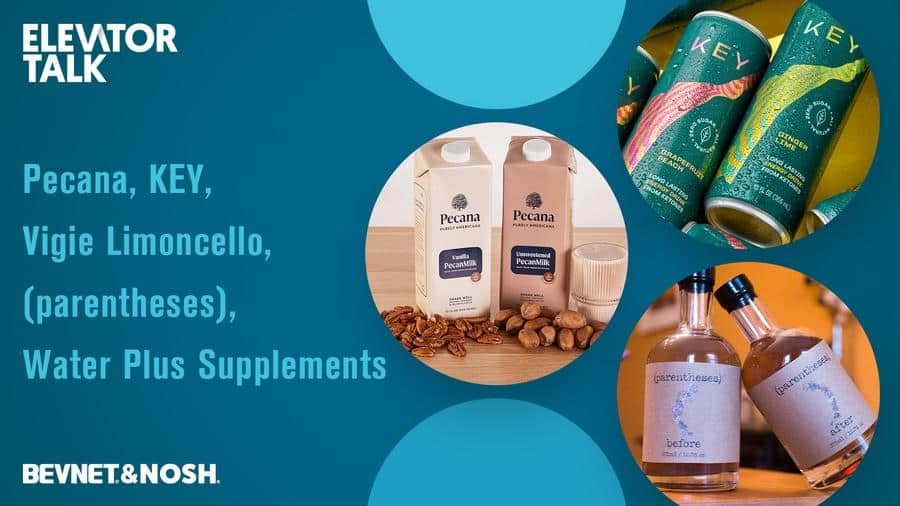
Elevator Talk Episode 97: Pecana, KEY, Vigie Limoncello, (parentheses), Water Plus Supplements
Transcript
Note: Transcripts are automatically generated and may contain inaccuracies and spelling errors.
Ray Latif [00:06] Hey folks, I'm Ray Latif, the editor and producer of Bevnet's Taste Radio podcast, and you're tuning to the latest episode of Bevnet and Nash's Elevator Talk, the series that profiles early-stage and disruptive brands from across the food and beverage industry. Today's episode will focus on 5 beverage brands whose entrepreneurs will have an opportunity to hear feedback and advice from our co-host for this episode, that's Adam Louras, who is a partner with Mercenary. Adam, great to see you.
Speaker 2 [00:34] Always a pleasure, Ray. Thanks for having me.
Ray Latif [00:37] Absolutely. This is back to back months when we're hanging out. Uh, I saw you at Bevnet Live in New York City last month, which was fantastic, and here we are again for another episode of Elevator Talk in which, uh, I think this is your 4th time, maybe your 5th time,
Speaker 2 [00:53] I believe, yeah, you keep, keep inviting me back so I can't be too bad.
Ray Latif [00:57] I think you're, you're doing quite well, my friend. As I mentioned to the entrepreneurs joining us, you've been involved in the beverage industry for quite some time, first as an entrepreneur, now as a consultant, but you've worked with companies left and right supporting their business strategies and scaling strategies, and, you know, here in July of 2024, I'd love to hear from you about, you know, some of the most pertinent issues affecting. Uh, early stage entrepreneurs and, and how you're advising them to address them.
Speaker 2 [01:31] Yeah, great question. The industry is ever changing, you know, it feels like a lot of it's a rinse and repeat, but every 3 or 4 years or so you see these big waves and those challenges that are created by those changes, you know, come our way and we try to help brands through those processes. Um, right now, everybody's looking for profitability. Um, I don't know where this started or where the direction's coming from, but it's certainly being perpetuated by, by investors, by, you know, uh, founders, you, you name it, it's, it's being shouted everywhere. So a lot of the work we're doing right now is around cost-cutting. It's where we think we can help brands the best, um, and a lot of the cost-cutting comes with Actually rethinking and retooling formulations, so there's no one size fits all approach to how do I make my brand more profitable. Generally speaking, we diagnose the brands, you know, and then we kind of apply our lens to what's the best and most effective way for a brand to, you know, make those changes if it's, if it's even possible. It's tough when you're a startup and you're, you know, sub 10 million, you're definitely not at scale. Scale. is the best way to reduce costs and so, you know, small brands, it's really challenging to be able to compete with national brands when they have, you know, a massive scale, um, but one of the other things we're working on a lot of lately is celebrity partnerships. So while that's not really uh touching cost cutting, but it does, it does help, um, entice investors, which is part of the way you can afford to do some cost cutting. Um, but celebrity partnerships are challenging. Obviously, identifying the right partner, um, enticing them to get involved, but also the structure and negotiations around how do you make those deals work, uh, without, you know, bankrupting the company, trying to entice somebody in, but also getting the most value for the brands and, and so we've had a lot of experience as of late working on, on those types of deals.
Ray Latif [03:23] Well, it was great to see Jadicki on stage with a brand that you work with that's barcode and uh Jadicki on stage at Bevnet Live, that is, and you've got one in your hand right there, a brand that you are investing in, that you've invested in that you're also advising. You're, you're essentially the COO of the company, am I wrong?
Speaker 2 [03:41] Yeah, transitioned that title officially to my protege Mac McAvoy, but yeah, um, I started out as a COO and co-founder of that brand, met them. Uh, through the game many years ago, uh, Bar Malik, the founder, and yeah, perfect shining example of a brand that really needs, uh, uh, the celebrity partnership, um, to compete against brands like Gatorade and, and body armor, um, but also just the founder being magnetic and having that ability to attract those types of people. That's a rare thing that we see in the industry when, you know, the founder can just be Um, the brightest star in any room and actually be able to acquire some of those opportunities. But then, like I said, you know, taking it all the way to the finish line is really the hard part. It took, you know, that's a, that's a brand that was able to ink Victor Wimbayama, and, you know, I was a part of that entire negotiation and that took about 1 year, maybe even a little longer to come to fruition from kind of first meeting all the way through. So these are not immediate overnight type opportunities. You know, Jada was a little quicker, about 5 months, but still, you're talking. You know, long, long periods of time to get those deals from start to finish.
Ray Latif [04:48] For sure. Well, uh, I wonder if we can, uh, suggest any celebrity partners for the five brands that are participating in this episode. I'm sure it will come up at some point. Let's meet our first entrepreneur, you ready? Let's do it. Let's do it. That person is Courtney Chase, who is the founder and CEO of Pica. Courtney, it's great to see you.
Speaker 3 [05:08] Good to see you guys. Um, it's a pleasure to be invited on here.
Ray Latif [05:12] Yeah, it's a pleasure to have you. Thank you so much for taking the time. Uh, I had some of your product. It is fantastic. You sent some samples to our office. Really appreciate it. Pecana. I think it's kind of obvious what you do, maybe not to everyone. There's pecans involved for sure, but tell our audience all about your brand.
Speaker 3 [05:28] Um, it's nuts. I mean, very nut joke out of, out of the box. Um, so I'm Courtney Chase. Um, I'm a 3rd generation pecan farmer. My family were actually the largest pecan growers in the entire world. Um, so, you know, being a 3rd generation of that, I oversee that company. I look at products, I'm in the grocery store, that's my playground to look at new products, and I'm always wondering, you know, where can pecans integrate, like. Um, and so I've been drinking nut milks for years, um, on a health journey, and just struggled to find nut milks that didn't have seed oils or sugar, or chemicals or natural flavors, or even dyes, like it was something I was really on a search for, and I couldn't find it. And so, um, during COVID when I stopped traveling so much. To promote pecans all around the world, um, I took time to like formulate what would I want, what would I want to purchase for myself, um, and so I'm just really proud of like the product we came up with. I think it tastes really good. It's something that I was looking for, and um, I'm really proud of our clean ingredient deck as well.
Ray Latif [06:40] Yeah, it is, it is a fantastic product, as I mentioned, and talk about the varieties, the pack size, and how you decided to come up with both.
Speaker 3 [06:49] Yeah, so I started with this is the 32 ounce shelf stable. It's just the what is pecan milk like that, you know, when you're trying to describe to someone. I've gone to countries all around the world and cultures that don't have the word for pecan, and like, wait, how do I describe this? You know, how do you describe what salt tastes like to someone that's never tasted salt or pecan, you know, like all these things, so. I wanted to start with a baseline of what is pecan milk. This is the um unsweetened original, and then I have the unsweetened vanilla, and I just got done producing, it's praline is my third skew, which will be the first to have sugar. We, uh, again, try to keep it really clean with molasses and organic organic brown sugar. Um, so think of praline. I mean, I'm like, I'm from New Mexico, but also in the South, Texas, so we know what pralines are, but pralines are just a sugar coated pecan. So that was the idea for the third skew. Um, so yeah, so we're in shelf stable 32 ounce, uh, bottles.
Ray Latif [07:52] Yeah, Adam, I'd love to hear from you about this concept because obviously nut-based milks, alt dairy has been a category, a segment of the market that has been growing consistently. Um, pecans have not been, I think, the central nut that I've seen or the central focus of a nut milk brand as far as I know, but, you know, what do you think of this concept overall?
Speaker 2 [08:20] Yeah, a great question. So I have a little experience in this. I helped create a Golden Wing for Molson Coors, uh, using barley, so not, not pecan-based, but alt milk. Um, and we did a ton of research into the category. I definitely think there is interest from consumers in trying something new. I think, you know, brands like Oatley have convinced consumers that alternate milks can taste good. They don't just, you know, taste, uh, sour like I, I remember them being when I was a kid. Um, so you have that, you know, that one barrier of education knocked down for you since the category is now well accepted and, and growing. Um, now you gotta convince people why pecans are better, right, than everything else. I'm a big fan of pecans. Uh, I haven't had the milk yet.
Speaker 3 [09:05] Yeah, those are my, we sell to that company.
Speaker 2 [09:09] Yeah, awesome. I am a, I, if you follow my Instagram, I cook a lot of meat, and this is my go to grilling oil, and I love pecan oil. Discovered it in New Orleans, uh, big fan, so super excited to try your product. Um, if I wasn't in Greece for the last 10 days, I would have ordered some of all the products we're talking about today so I could try them in advance, which is, you know, one of the things I try to do. But, um, It's a great concept. I think for me, the hardest part, and this is what we saw with Golden Wing is, it's all about trial. You gotta get, you know, the, the package to people's lips, which is a little strange because it's not typically how people use it, um, but you've got to get them to try it so they can experience it and decide for themselves, you know, is this something that they think is better to replace, you know, whatever they're using today.
Speaker 3 [09:53] Mhm. Yeah, and that's like where I, um, I feel like the trend is going with nut milk. I mean, you're probably more of the expert in that than me, but is, you know, less on the vegan side, but more on the, I want to make sure there's not seed oils or chemicals or things that like, I don't know what I'm ingesting, and so that's kind of where I push this product um into showcasing those those aspects.
Ray Latif [10:23] Courtney, the price point, uh, is $8 at least on your website, $8 per 32 ounce, uh, carton. We're
Speaker 3 [10:31] actually lower than that, um, in HEB we're $599 and, um, yeah, so those are, that's including like some shipping in the smaller like size or that like shipping it one by one.
Ray Latif [10:45] Yeah, and I think that's a great price point. I think Adam was nodding his head as well. Still, it's a, it's a good amount to ask of someone who has never tried this type of product. So talk about that trial strategy, that, that awareness strategy that, you know, Adam was focusing on or talking about as being really important.
Speaker 3 [11:04] Right, I think just like pushing my, you know, my consumer, I believe, um. Already has a sense of health and what they're wanting in the way that they're even seeking out a nut milk, and then looking at the label, I hope that like this solves the answer that someone like me, and I know all of the huge portion of People my age are now understanding that the nut milks they were putting into this healthy smoothie or containing things that were probably inflaming them, um, or so I hope, cause I find that it's very important, but, um, so I'm hoping that like those things drive them to want to spend the extra $1 or whatever against an oat milk, um, which I feel like is inflammatory, so I, um Yeah, I hope that like just the key benefits will make them want to try it with the higher price point.
Ray Latif [12:06] I think use case is important too and you know, Adam, when you were uh developing and marketing Golden Wing, I, I think my question is, OK, can I, is this a 1 to 1 replacement for oat milk or soy milk or, you know, almond milk and, um, you know, can you, can you advise Courtney on, on, you know, ways to help make that use, use case a little bit more uh easier for consumers to understand.
Speaker 3 [12:32] Yeah, I mean, I, I substitute it with any uh like, as in a substitute for any other almond milk or whatever I was using in the past. Um, my favorite thing is a smoothie, that's just, but that's where I'm at in my life. I do put it in my milk, um, but it's, I'm sorry, I put it in my coffee, um, and then, you know, I'm like, I want granola at night, and I'm like, OK, so it's kind of like the cereal that I make at night, um. I, I don't find my, I'll just be honest with you, I don't find myself using it in certain like savory ways, um, just because the, the pecan is naturally sweet, but I don't find that as a negative. It's like, What kept me going with all going to all these food shows and just having people try it. I, I've struggled with weight my entire life. And I would see someone come up to my booth that I thought maybe had also struggled. So you're always looking at this, you know, of is there sugar, and so they would taste it. And look, and they're like, wait, there's not sugar in this? And I'm like, no, and that that's kind of what kept me going and putting money into this project was the light that I saw turn on in certain people's eyes. Um, so, it is innately a little sweeter. Um, so those are the items that I find myself gravitating with this product to like the granola, granolas, the cereal. Um, drinking it by itself, we use very, very high quality vanillas that, I mean, it, it tastes really good and naturally sweet, so I drink it on its own as well.
Ray Latif [14:11] Yeah, just to follow up on that, um, it, it, the, the personal story, the personal founder story about why you created this product is really important. It's also really important to advise people on how to use it, I think. You know, communicating that message can be sometimes challenging. Adam, any thoughts on sort of a simple, clear message that Courtney and Pecana can use going forward?
Speaker 2 [14:34] Yeah, I mean, this is a challenge that faces, I think, uh, all alt dairy faces. Um, the, the, the volume consumption in traditional dairy is to, to pour a glass of milk and drink a whole glass of milk. And what we've experienced in research is that that just doesn't really happen in the alt milk world. People use it as an additive for things, but they don't use it, you know, they don't drink a full glass. Um, so that has pros and cons, but I think when you're testing it, you know, in a grocery setting, doing Samping events, there's, it's unlikely you're gonna give them a bowl of cereal or make them a smoothie, right? So they're gonna have to taste it straight on. So it's a, it's a challenge in the industry because you have to taste it at face value even though that's not how you're going to use it in reality. Um, where, where I think you can cut through a lot of clutter and education is by focusing geographically, and I think you're already doing this in some respects, but, you know, pecan pie in the South is, you know, is, is, you know, common as sweet tea and You know, and lemonade, right? So, um, Texas, Georgia, North Carolina, um, you'll see pecan pie everywhere, so you'll have less confusion over what is a pecan, right? I think you go to other states, people are gonna be like, what is even a pecan taste like? I, I wouldn't most people don't even know. So that's one layer of education you can get right through just by geographically focusing on people that know what pecans are. And then obviously as Ray mentioned, you know, pick a few things that are just obvious choices for it. Don't try to invent new ways to use it. Just put it in your coffee. If that's a fast way to get people to give it a try. Try, you'll see lots of coffees already out there with pecan flavors sold in Texas, right? So it's a great compliment to something that's already a pecan flavored coffee, and that can be a quick initial launch to get traction and get people to try it, and then eventually you can start educating them on other ways you can use it.
Speaker 3 [16:23] Awesome. Thank you for your feedback.
Ray Latif [16:25] Yes, Courtney, thank you so much for being with us on Elevator Talks. So that flew by. We need more time. Maybe we can connect again in the near future. And if you do have any questions about anything business business industry-wise, um, or looking to connect with people in our space, please reach out, let us know. We'll try to help out in any way we can.
Speaker 3 [16:43] Awesome. It was, I'm just grateful to be here, so thank you so much.
Ray Latif [16:48] All right, on to our next guest for this episode of Elevator Talk. We have Karishma Tawani and Tekla Beck, who are the co-founders of Q. Karishma, Tekla, great to see you. Karishma, how are you? Doing great, really excited to be here. Yeah, I love that you guys are so on brand. You got the backdrop that has your product, your name. It has all kinds of information about your, your brand, and uh, this is a really interesting company, uh, and one that I think our listeners are gonna be very excited to hear about. Uh, Tekla, I've known you for some time. You joined us back on Elevator Talk, I want to say like 4 years ago as the founder of a brand called Qiho. Uh, so now you're on to ki, which is a beverage, and uho is a, uh, a, a, not a granola bar, but a snack bar. Um, talk all about what you guys are doing right now.
Speaker 4 [17:38] I am so happy to be back. The last time we went was 2020, right in the middle of the pandemic. Um, still on the same mission, still taking sugar out of the diet and still all natural, now with two brands. Um, but we're super excited to be here, and I can't quite believe I'm here to launch a beverage because coming from the industry, like, the pair of us really should know better. I swore I would never launch a beverage. I swore. And this one's just too good. It is something you feel and it makes you feel amazing, so here we are. Um, and we have an all-natural, long-lasting energy drink from ketones.
Ray Latif [18:18] Yeah, you can probably tell Tekla has had her key with all that energy there. Yeah, well, ketones as your key ingredient seems very on trend. Um, I think, you know, when we're looking at better for you energy and all natural energy, I mean, It's been a tough road for a lot of brands trying to play into that space, but ketones, I haven't really seen too many, if any, brands try to use that as the hero ingredient. Karishma, can you talk about why you went in this direction? Yeah, so, you know, Tekla and I really bonded over our love for beverages, and then we started to think that why neither one of us has energy drinks, and that's because like the original energy drinks, they used to have a lot of sugar, which gave you the sugar shock, and then you had the crash. And then as the sugar-free segment started to increase, energy drinks, they took up the sugar, and they started to jack up the caffeine, which left you with jitters and, you know, sometimes a little bit of anxiety. So what we've done is that we now have added ketones. We swapped the sugar out for ketones that gives you smooth, long-lasting energy without the jitters and without the crash. It only has 80 mg of caffeine for a light lift, and then the ketones give you the smooth energy. Outstanding. Before we get to Adam, uh, where is the product distributed because you, you launched not too long ago, but I think you're based in New York, yes? Yeah, so it's we officially launched end of April and we're already at about 200 stores in New York. Like super excited to officially announce we're now at Airwn in all their stores as of this week, and then online Drinky.com and Amazon. Fantastic price point. So, um, we're about 3.75 per can online and in stores, yeah. All right. Adam, as I mentioned, uh, we've seen a lot of brands come into this space. We do need Better for You Energy for sure. Uh, it's just been tough because it's a very competitive category with humongous players in the space. Uh, but talk about your take on using ketones to differentiate from what's already been out there and what's currently out there.
Speaker 2 [20:35] Look, it's, it's really interesting. I've, I've been taking exogenous ketones, uh, for about 10 years, and I'll admit they work. So, um, that's the good news. It's not just a bunch of hype and sizzle. I'll also say your social media marketing is incredible because I've been hounded by you guys for, for a few months now, so kudos to you for that. Um, I think the packaging is gorgeous as well. So like, for me, just as a, in a simple name, like the building blocks of just a great brand in general, you've got that, which is awesome. Now you take it to the next level, OK, um, we've been looking for everybody and not just we, but Been looking for ways to break into the energy space with something new and interesting that isn't just, oh, let's just add 100 more milligrams of caffeine and we'll, we'll, like the space race until we kill somebody with a heart attack. Um, you know, there's only so far you can take that and so I think there's been some interesting, uh, regression back to a lower level of caffeine as an idea, but not really adding in anything new and exciting as a, as an ingredient that kind of fills the void of, OK, if I'm taking something away, what am I adding back in. So I think ketones are, are a, a really interesting place, um, to play. I would say, in general, when you're banking on a key ingredient, um, the challenge is always, if you do too great of a job of educating people on one ingredient, All you're gonna do is invite competition down the road, and that's gonna happen anyway, but if you're successful, and I hope you are, you'll educate the world that ketones are really great and then you're gonna see 12,000 energy drinks with ketones in them and they'll, you know, kind of steal your thunder. So, I'm always a big believer in finding that right balance between focusing on the why, which is the ketones are providing the energy, but also the what. What is it doing, what is the benefit? If you, if you have the benefit and you own the benefit in the mind of the consumers, why it works is kind of secondary. It's important, but it's not the only thing, and I think um brands like Liquid IV did this really well where they sort of owned. The, the benefit of hydration multiplication, whether that's a real thing or not, right? They made that statement and it worked, um, and they backed it up with, with justification, but it, you can't just go back out now and make liquid IV and think you're gonna get the same result as a, as a competitive brand because it's more complicated. So, um, I would encourage you to just focus on, on trying to find that right balance, but I think you're doing an excellent job so far.
Speaker 4 [23:05] Well, thanks Adam. I, I love what you just said, and the one thing I'll just say on the competitive point is we welcome the competition. Ketones are still relatively new. And we did market research among like 2000 consumers, so we know that the market exists, but we love someone bigger and others coming in to help us build the awareness. And ultimately we actually think ketones are effectively the new protein, they're the new macronutrient. They're a whole new category with different applications and different brands. And our goal is to really build an amazing brand in the energy drink space and we welcome others both in energy drinks and other categories, so.
Ray Latif [23:44] You know, I, I just recorded a podcast interview with an entrepreneur who said that she wishes someone had told her at the outset to keep it simple. A lot of times, yeah, a lot of times she would have a very complex, uh, strategy or method of communication or marketing, uh, plan, and Someone's just like, look, just, just simplify, simplify, simplify. I think when you talk about ketones, however, it can be difficult because you need to talk about what it is. You need to educate. You don't necessarily when it comes to other attributes of your brain, zero sugar, all natural. So I mean, how do you think about that hierarchy of communication when you're, when you have those elements?
Speaker 4 [24:27] You are so on point and actually, if I think of our biggest struggle as we build the brand, it's going to be the balance between education and being more fun. I think what we're trying to do is hammer home long lasting energy. That is the singular focus for us to get through. But you're so right, and I actually think the consumer's not stupid. They're just busy. So we're going to have to really work on how we get that message through about the benefit that you mentioned, Adam.
Ray Latif [24:55] Yeah, I think long-lasting energy is a great way to describe the product, um, getting people to try it, we talked about this, uh, with Courtney from Pecana is another thing. Uh, you do have a try it now button on your website where I think you can send a can for free. Um, but Adam, I mean, in your experience in working with a lot of different entrepreneurs, I'm gonna come back to you with the same question. Um, you know, trial strategy, you know, what's your, what are your thoughts? I mean, and again, you know, you said you've been hounded by Key on social media, so is it, is it very much, yes, sticking to those people who are familiar with ketones, or is it, you know, you know, tracking people who are looking for energy and caffeine online? What, what are your thoughts?
Speaker 2 [25:37] I, my opinion is, uh, that I would avoid people that are big into ketones because they're already, first of all, they're gonna argue with you of whether yours is good or not. They're gonna get overly sciencey and you'll never win that game. It's, it's pointless, right? You're looking for the consumer that wants the benefit. They want, they want energy that works. They don't want the jitters, right? And um, they also want a brand that they can relate to. Not everybody's gonna relate to a bang or a Monster Energy, right? And that's why You know, what Celsius did is really hard to explain, but it's really interesting, the outcome, which is that they've really carved out a new niche of consumers that doesn't really fall in the world of rockstar and, and monster, right? And, and certainly a higher proportion of female demographics. So, I think that finding ways to identify a new consumer, we all need energy, we all need it, right? But there are just certain groups that have avoided it. Some of it's because there's too much energy in a can or too much caffeine, some of it's because of the other ingredients. But finding the right path to getting people interested in that key consumer, no pun intended, um, of, of who is gonna buy this. And I don't necessarily Believe it's gonna be because of the science and all the, you know, wizardry around ketones. That's, that's the why. Again, that's why it works and that's important. And for the people that really want to dig, very few of them will, but that should be there for them to find. But I think to your point, Focusing on the simplicity of, of the, of the benefit and, and the other things about it that make it worth trying is your best way to get it hands in hand. But then, you know, it always goes back to just traditional beverage execution. You gotta get it in stores, you got sample, you gotta let people taste it. They've got to love the taste. I think your design is really intriguing and cool for, for a modern brand. Um, so that's going to help as well, but you got to get them to love it. They got to taste it and love it. They're not going to notice the energy of a few sips in a store. Um, they're gonna have to take it home and, and drink a few of them and feel the benefits. Um, assuming those are there and it works, I think you'll, you'll have a product that's sticky and consumers will come back for it, which is really great, um. So it's super interesting.
Ray Latif [27:44] I, absolutely, and yes, getting into stores, doing the dirty work, blocking and tackling, all the terms that everyone's familiar with or will be if you're new to the beverage industry, uh, are ways you can definitely get out there and you need to get out there. Um, again, I can't believe we're out of time. I'm so sorry that we're only giving you guys 10 minutes, but we, we will, we will be in touch soon, I'm sure. A really amazing brand. Great job with the execution. Great launch. Really excited to see where he goes from here. Thank you so much, Techla and Krishma.
Speaker 4 [28:16] Thank you, Ray. Thank you, Adam.
Ray Latif [28:21] All right, let's keep Elevator Talk going with our next guest. That's Samaria O'Brien, who's the founder of Vigie Limoncello. Samaria, great to see you. Great to see you, Ray. Thanks so much for having me. Yeah, thanks so much for joining. I am so excited to have a limoncello right in the middle of our episode here. It's like the perfect segue. Uh, I think, I think people know what a limoncello is, but for folks who are not familiar, tell us about the beverage and then the brand Vigie. Yeah, yeah, happy to. Um, so Vigie is an artisanal limoncello based on my Sicilian family's recipe and really inspired by growing up in Europe. And what limoncello is, is it's a lemon liqueur that you can sip, mix, or spritz. And so ViG is a really fresh and vibrant take on this Italian classic. It's really perfect for social events and really just mixing and spritzing. So if you go to Italy, limoncello. traditionally enjoyed as a digestif, but it's really experiencing a renaissance with consumers and bartenders really recognizing how versatile it can be in cocktails. And so I started noticing it kind of popping up a couple of years ago, and it happened to coincide with, you know, 2 years ago, my uncle taught me how to make our family Limoncello recipe, and I came back to the US, looked everywhere, including special. bottle shops for, you know, an all-natural version that had an it factor. I'd want to introduce to my friends and couldn't. So I created Vigie and Vigie is special for a couple of reasons. We're less sweet than other brands. We use real hand peeled organic lemons and no artificial additives, so we don't have that really like sickly syrupy consistency that a lot of people think about with Limoncello. And what What that does is makes it really easy to add in cocktails or just combine with with Prosecco for an easy spritz. So I like to say, think of Vigie like a Saint Germain or a triple sec with how versatile it is, and like Aperol with how spritzful it is. Um, but Vigie is really exciting. I mean, it really is super fresh tasting, brings you right back to the Mediterranean. Um, we're really excited to, to be here and thanks guys. I'm shaking my head because I'm like, how do I not have a bottle of Vigie right here because I'd be crushing a little Spritz limoncello right now and I think Adam's probably thinking the same thing just coming back from Greece. Did you have any limoncello when you were out there?
Speaker 2 [30:51] I did, though, though it is an Italian drink, they do consume a lot of it in Greece, and I had a lot of the syrupy one that she's describing, so, but delicious, you know, it's something I, I can have at every single meal.
Ray Latif [31:05] Yeah, and I think Samara, you're totally right. I have been seeing this renaissance for Lehman Chola right now. Um, I, I think the question is, you know, can an American-based brand, make a dent in this space? Can it, can it stand alone in this space? And I think your packaging goes a long way to doing so. Adam, what are your thoughts on that? I think the packaging's incredible, but your thoughts? Yeah,
Speaker 2 [31:28] very cool. I, you know, Whiskey, scotch whiskey, which I'm a big fan of, basically died in the 80s. It was, it was an industry that almost went away completely. And it's hard to believe that now because it's had such a renaissance in the last two decades where it's, you know, arguably maybe at its peak. Um, so there are these cyclicalities that do happen in these, you know, limoncello has been around forever, so it's never gonna go away, but it, it should be having a renaissance, right? It's not unheard of to see these parallels in, in every category, and we saw it recently with Uh, tequila and mezcal, you know, these waves come. So I, I hope, and, you know, apartif style drink category has that renaissance, so maybe it is now, and, and you could be the leader in that charge. Um, I would have brought a prop. We grow our own lemons in California here, and I'm planning on making my own limoncello this year, so I'm excited about that, but it's not lemon season, so I don't have one. Um, but I like the idea of a local-based, um, differentiator. Obviously being in country is really cool. Um, the packaging goes a long way in telling that story. It feels very California and very American and, and now, um, the, the ones that you get, you know, in Europe, as I'm sure you're aware, are, you know, really old and stodgy and, you know, they're not fun and, and new, which I think, um, you'll be able to help people, uh, see that. Difference, but there are still a lot of people that have never had limoncello at all. So you're kind of up against two communities, one that has limoncello and is not a fan, and now you can convince them that this is maybe better than what they've had in the past. And the others are people who have never even heard of limoncello and maybe have never had it at all, um, so they're gonna try it for the first time when you sample, uh, your product. Um, so it'll be interesting to see, uh, how that plays out, but it's definitely time for something like this to exist.
Ray Latif [33:16] Totally agree. Yeah, I mean, we think of it like maybe like the Amaro or the Vermouth category where it was like really enjoyed in such a traditional way, but then the bartending community really reimagined what those spirits could do, and so we kind of see the same potential with Limoncello because People are just such fans of lemon in general, and lemon is such a key cocktail ingredient that it really adds just a layer of complexity with a lot of things that you wanna make, whether it's like adding a sweet component to a sour drink or making it like the star of the show, like a Limoncello spritz. Yeah, Samaria, I also feel like there's a real opportunity given for Vii given that there's more interest in low alk cocktails and you know, obviously no elk spirits and cocktails are having a moment for sure, but I think The real, uh, balance will come when it comes to just, you know, an easy night out with nothing that's gonna knock you over. Um, how much interest, how much, um, emphasis are you putting into that sort of segment? Yeah, um, great question, great question, and so glad that you brought that up. So during our tastings, you know, one thing we talked to consumers about is really just like the scale of the ABV. So VG sits at 25%, which is lower than pretty much mostly Micello on the market. I even lowered the ABV from our family recipe, which was closer to. 35 or 40% exactly for the reasons that you're talking about. People are looking for lower ABV and if something is higher ABV, they want it to have that versatility factor. And so, you know, if you were to want to make a lower ABV drink, the Spritz is something I'd, you know, refer you to if you wanted to go even lower than that, you can. Just up the sparkling water instead of the prosecco there. So that's really what we feel like is the big opportunity here is you can make your own experience with it. Like it already tastes delicious on its own. So if you wanted to have it as a shot, you could, but you can really mix it and really get to that lower ABV if you were seeking that out. You know, another trend, I think you know you probably know where I'm going here, but I think another trend that's really hot in the spirits industry is RTD, um. I don't know what Adam's going to say about this, but he might be like, don't you dare. Um, but is an RTD, uh, in the future, is it in the works? It's not in the works, but it's something we definitely thought about. I actually have seen a couple Limoncello Spritz brands pop up at Whole Foods and other places, which just to me indicates that Limoncello as a whole is gaining more traction. So I feel really great about where we are and like the timeline of this opportunity. So it's something we're definitely thinking about, we're thinking about, but the focus right now is to just build BG as a brand around the 750 bottle. Yeah, I mean, for me as a consumer, I would love to see an RTD, but, uh, you know, Adam, are you in line with what Samaria is talking about? You really just stay focused on the multi-serve on the 750 and kind of if it happens that the RTD has an opportunity, you know, look at it down the line.
Speaker 2 [36:43] Yeah, I mean, like you mentioned in the, in the previous conversation, simplicity, right? It's all about simplicity. Keep your business simple, keep your message simple. Um, there might be a better way. To avoid the temptation and adding the complexity because you could just end up killing yourself, dividing yourself over too many concepts. It obviously lends well to doing uh RTD and I agree, I would love to try one, but as a business, you've got to kind of pick your lane and, and stick with that. And I think trying to reinvigorate a category, you know, without a lot of brands being involved is already a hard enough job, right? Um, just getting people to be excited about Limoncello and then why you're the best one of those that are there, that's a lot, a lot to do. I think your path right now is really smart. It's in the mixed drink world. It's not, hey, just have us pour this at the end of dinner. That's how it's always been served, and then we know how big that category can get. It's been about the same forever. Um, so you got to find a new interesting way of, of leveraging, and I think you're right. The idea of lemon additive to anything is super popular right now. It's being used in everybody's Stanley's and every other concept of adding. Stuff in, right? So I think there's something there. You already know on-premise is the key. You got to get to bartenders, convince them that they've not really thought about this as a mixer ever before, and get them to continue to experiment and find cool ways to use it. That will start to build the brand and build the category, and then you can start to, you know, transition to more direct sales, I think, from that baseline of having consumers know how to use it.
Ray Latif [38:16] Totally. Absolutely, um, you know what, this is gonna sound weird, but I, I, I see your brand. Are you familiar with Snapshot because this is, we're on their favorites, yeah, OK, well then, clearly I know. I, OK, it feels like a real snackshot favorite, and, OK, there you go. It's weird. I, yeah, I would almost feel like I'd love to see a collaboration between, this is gonna sound really weird, between like Gia. And VG, but I know one's a non-elk, uh, Aritivo, and clearly you're not, so. Yeah, maybe lower ABV, but if you guys have any uh celebrity wrecks, open to taking them. I knew celebrities would come up, and there you go, because we talked about it at the at the outset, but yeah, um. And maybe you can connect with Adam because, uh, because he has, uh, he's more plugged into that world than I am at this point, but I hope, uh, we can definitely stay in touch, Samaria, uh, thank you so much for sharing the story about VG. So excited for this brand and like I said, I need to get myself one for the next episode at least. Yeah, we'll send you a bottle. Thanks so much for having me. Thank you so much for being with us. Let's keep it going with the co-founders of a brand called Parentheses. Nick Mechek and Tawny Lara. Nick, Tawny, great to see you.
Speaker 5 [39:35] Thanks for having us.
Ray Latif [39:37] Thanks so much for joining us. OK, from a, uh, well, alcoholic beverage to a non-alcoholic beverage, uh, one that could potentially swap out other alcoholic beverages, parentheses, uh, tell us all about your brand.
Speaker 5 [39:54] So, uh, parentheses is a, uh, non-alcoholic kelp vinegar-based botanical spirit. Um, and it, it really kind of started its development back in 2016. Um, I was a, uh, a sommelier in New York City restaurants and I had to quit drinking, uh, because I was drinking way too much. Um, and After I quit drinking, I kind of latched on to vinegar making as a hobby. So, the wine that I was disposing of in my belly, um, when I was an active alcoholic, uh, then became vinegar. Uh, and that became a more serious hobby, and then that became a business called Sour Humanoid. Um, And uh Tawny's COVID hobby happened to be uh herbal medicine. Um, and after COVID, I ended up working part-time at an Amaro distillery in Brooklyn. Um, and Tawny saw a post on Instagram about a thing called an oxamel, which is vinegar infused with herbs and then, uh, sweetened. And, uh, with kind of like The setup we already had, uh, we started making it for ourselves and we started giving it to friends, um, and our friends really liked it, which we were surprised by. And then, um, we thought like, well, with all the infrastructure we have with the vinegar company, this is really not a big jump to start making this product. Um, so we made a, uh, we call it before and after, uh, so an aperitif and a digesti, um, The aperitif has ingredients that are meant to be kind of uplifting. Um, and then there's some ingredients in there that actually make your mouth water a little bit. Um, so it's nice before a meal. And then the digestive has, uh, herbs in it that are meant to be kind of calming, uh, like, you know, chamomile, lavender, peppermint, calendula, that kind of calming, not, uh, we stayed away from, uh, anything with caffeine. Uh, it's low sugar. Everything that can be organic is organic. Um, And there's no like heavy sedatives, so like we skipped on Valerian and stuff like that. And, uh, right now we're in a lot of uh non-alcoholic bottle shops and still chipping away at that. Um, and our next step is going to be trying to get into restaurants that have like a strong natural wine program. Um, and hopefully, traditional liquor stores, uh, especially since they're working on changing the laws in, uh, New York State.
Ray Latif [42:15] Thank you so much for that, Nick. Um, I, as you were talking about this, my mouth is watering and I'm someone who appreciates, uh, vinegar-based beverages, but can you talk about the taste? I mean, is it on the vinegary side of things?
Speaker 5 [42:29] Yeah, I mean, you know, we discussed that a lot because, uh, it, it, it is on the vinegary side of things. Uh, the other end of that is that like we make everything. So I, I make the kelp vinegar, uh, using really nice organic kelp from Maine, um, and the, the kind of gel that, uh, the kelp has covers it up a little bit. We sweeten it a little bit, that covers it up a little bit. Uh, we dilute it. That covers it up a little bit. Uh, we have lots of super flavorful botanicals in there that covers it up a little bit. But at the end of the day, we decided, OK, we can cover it up all the way and make this an RTD, or we can like look at like amaro, grappa, uh, eau devi and be like, you know what, no one's like, this tastes like alcohol. So it's like, We know that we're gonna lose some people because they don't like vinegar, but it's like. We're kind of OK with that. Like, we know that this is not gonna be for everyone, but we think it's better to go with what we think is best rather than uh trying to appeal to people where it's like, if we cover up the vinegar all the way, we feel like it's just gonna be uh The people that don't like the vinegar still are going to be turned off by it. So what's, what's the point?
Ray Latif [43:44] You know, it's really interesting. Um, I recall an entrepreneur that I spoke with who had created, uh, a non-alcoholic alternative, um, or an alcohol alternative beverage that was focused on gut health. Um, it was like a, it was like a alcoholic or non-alcoholic kombucha or positioned to reach people who aren't drinking alcohol anymore. Um. And the way I just described it was her biggest problem. She had a hard time explaining, I think, what it was and who it's for, um, you know, Adam, I think given that there is a lot of interest in alcohol alternative products, there is a lot of interest in gut health and familiarity with the benefits of vinegar, um, any suggestions on a pretty clear cut message for parentheses?
Speaker 2 [44:33] Speaking as a guy who created a brand that was impossible to explain, um, I can, I can relate to this challenge that a lot of founders have when you create something that's really unique to the world, right? Uh, how would you describe what Coca-Cola tastes like to somebody who's never heard of it before? It, it's really hard, but you know, once you get past that, it seems like it's easier. Um, and that's the hard part. How do we get past it? I see so many founders get stuck in the world of what the heck is it? What does it taste like, right? What I, what grabbed me right away when I went to Your website is, you got to the next conversation, which is when do I use it, and you named the product when you should use it, which I think is probably a better thing to focus on and you're already there. Um, it's gonna taste like what it is and people are gonna like it or they won't, but trying to win people over on that conversation is just gonna tie you up forever because it's gonna be a one on one conversation and each person is gonna need to hear a different thing in order to entice them. But talking about when to use it. And it's good, right? It's good, it tastes good. Try it before you eat. Try it after you eat. And then the next level is how to use it. And I think you need to get there as well, right? Is it a mixer or is it meant to be drunk straight? Um, and don't make it, I'm, I'm sure it's a Swiss Army knife and you could do a million things with it, but try to make it narrow, pick 3. Right? We like it over, over ice, or we like it mixed with carbonated water, or we like it, you know, in this type of drink, but that's it. Keep it real simple. Explain how to use it, and talk about the benefits and, and try to avoid getting trapped in the what is it, what does it taste like world, um, because I don't know how you, there's a Many drinks out there that I wouldn't be able to describe. I don't. Limoncello tastes like lemon, but does it? I mean, it's lemony, right? So you can't get caught up in what does it taste like, right? It has notes of whatever it is, vinegar, but you know, you know, try to skip past that and get right to the point.
Ray Latif [46:30] Yeah, absolutely. I think the other thing about a brand like this is Um, before non-alk bottle shops existed, you would say, yeah, this is a Whole Foods brand. I mean, you definitely want to have it in a natural retailer, and I actually wondered because I, because I saw in your notes that you're expanding it to a lot more non-alcoholic bottle shops, but as we, as we've seen with Broisson, it feels like a challenging retail environment as well. Have you looked at traditional retailers or national retailers as as ways to get the brand in store?
Speaker 5 [47:05] Yeah, um, the other kind of like traditional retail place where we think we can get in, uh, although we haven't really dove into that yet because we're, you know, small, uh, is, uh, like cheese shops and that kind of thing. Uh, there's a place down in Park Slope called Eastern District, and they sell my vinegar and they also sell stuff like Seedlip and that kind of thing. Um, and it, and it does well. Um, we are not so sure how it's going to do in like a Target or Whole Foods because it is so esoteric. Uh, it does require some education. But, uh, the nice thing on that end of it is that like Tawni is a published author and journalist. So she actually has like a pretty good platform, uh, and a lot of friends who are editors and magazines and stuff. So, um, once we have our production up to snuff, she's gonna go real hard trying to, uh, get Education out there.
Ray Latif [47:59] It is, we're such a small batch brand. I mean, every, every bottle is, you know, we, we touch every part of the process and like I handwrite the date on the bottles, so it's, you know, we're we're pretty far from Some from like a larger retailer, but um we're enjoying being like a really small brand that does work with, you know, the indie bottle shops, I will say, indie non-alcoholic bottle shops are doing really well um because they are focusing on community, which is where, where I come from as a journalist who's researched the sober, curious, and mindful drinking movement since 2015. So, um, I, you know, just want to shout out the indie bottle shops doing a lot of work in this space too.
Speaker 5 [48:41] Yeah, there's I, I think the Boisson closing thing really, uh, I mean, and messed up a lot of people, but the, uh, There was a pretty bad mismanagement there, I think, that I, I, you know, I don't see at the indie bottle shops. They, they're doing OK.
Ray Latif [49:03] That's great to hear, and I think you're, you're totally right, Tony, in that the indie bottle shops are the ones that are more invested, not to knock on Boisson, but it seems like they're very heavily invested in the brands that they sell and willing to help build the brands that are in their stores. So fantastic to hear that they're working well with you. And also I've got to read your book here which I'm seeing on your website. I assume this is your book Tawny Dry Humble. a guide to dating, relating, and hooking up without the booze. Is that, is that yours? Yes, that's my book. Yes, yeah. When I first, you know, our sobriety story is also, you know, how this brand came to fruition, and yeah, when I quit drinking, the thought of dating without alcohol really scared the hell out of me. So as a journalist, I researched the subject of liquid courage and wrote a book about it. There you go. I'm gonna have to get a copy for a couple of friends of mine actually who are, uh, cutting back or even completely done with booze, and I think uh they're concerned about this very thing, the very subject that you're talking about. So, um, we are out of time. Nick, Tawny, thank you so much. Really appreciate the time and look forward to connecting again soon. Much for having us. Our final guest for this episode of Elevator Talk is Mohammed El Aj, who is the CEO of Water Plus Supplements. Mohammed, great to see you again.
Speaker 6 [50:22] Hi Ray, good to see you again. How are you?
Ray Latif [50:25] I'm doing well, thank you. It's great to see you again. As I mentioned, I met you at Bevnet Live summer 2024 in New York City. We chatted about your brand. We recorded a short video for social media that will be coming out soon. You have a really, really interesting brand. Tell our audience all about it.
Speaker 6 [50:43] OK. Water Plus Supplements is innovatively combined the beverage and the pharmaceutical supplements industry into one convenient solution. Water Plus Supplements is a patented product that addresses daily needs in a convenient, beneficial, and affordable way by packaging pure filtered water with a pharmaceutical grade blister that will carry your supplements or medicine. Adam and Ray, if you look to any one home or your home, you will likely find a drawer full of supplements or medicines that's what you use once or a few times and are now just hidden until they expire. Why do not use only what you need? For example, if you have a headache, you need just one dose of the pain medicine and a bottle of water to ease your pain. Why buy the entire bottle of pain medicine and waste money? Create waste and bring this medicine into your home where your kids could access them and potentially be harmed. So water plus supplements is the solution. We offer simply use hydration and vitamin and medicine in one simple step, or for less than the price of a standard bottle of water. And our, our patented bottle can convert any kind of supplements or medicine from the pharmacy into single use bottle. Consumers are already buying bottle of water every day. This is not a new product that we have to convince them to buy. We simply add the supplements or the medicine you need at no cost. So with today's economy and with the inflation, everyone is watching their spending. So water plus supplements offer convenient, cost effective and safe solution. For consumer and the product can be tailored to any consumer need. It could be for men, women, kids, elderly, even pets, and we can target any fields such as the gym, airports, cruise ship. The application is limitless. And here is the bottle.
Ray Latif [52:36] Yeah, Mohammed, can I actually ask you to peel the label back and show how this is done because this is really important.
Speaker 6 [52:42] So what do you do, you go to the back of the bottle and you peel the label. It's a pharmaceutical label. And from that label you remove a pharmaceutical blister that will carry anything inside the pharmacy. Name it. It can be a capsule. It can be tablet. It can be gummy. It can be ficent. Anything can be here. And the price of the bottle of water, the price of the product, is the price of the bottle of water. So this is the bottle. When you look at it from the front, we didn't put any label here, and the reason why, because they want the consumer to see the the capsules inside the water. They look like it's floating inside the water, but it is not. Because it's secured behind the bottom of the bottle. So basically any product in the pharmacy we can convert it to the bottle.
Ray Latif [53:34] And what's the price point again per bottle?
Speaker 6 [53:37] The price that I want to be for the bottle is to be the $1 so it's like the price of a bottle of water. If you go to as an example of the pharmacy, you can buy a bottle of water for $190 or you can buy a bottle of water with 1000 mg of vitamin C as an example. So what we're doing now, we're going to be launching 4 products only. The first product we want to target the airports. Every day is like 3 to 4 million people traveling every day. So what I did, I took the bottle. And I did one dose of melatonin. That bottle of water. I'm not going to teach you to buy. You're going to buy this bottle anyway because nobody can bring the water, so you have the choice between buying just a bottle of water or buy a bottle of water with One dose of melatonin, you take it 30 minutes before your flight. You have nice flights. You sleep at the end of the flight. You have no melatonin and you have no water and you're done for the day. If you try to buy melatonin as an example by itself at the airport, it will cost you probably from $8 to $12. So this is one of the products we're launching.
Ray Latif [54:44] Adam, this feels like a, an incredible opportunity for convenience stores. This is, this is seemingly the ultimate convenience play. Um, I, I, I think. The Question is, are people looking for the type of function that they're offering? Yes, melatonin for sure at airports, um, but, you know, how do you create the, what are, what are consumers looking for in a, in a broad way? What is, what is, I guess I'm looking for the biggest opportunity here, like what is the biggest opportunity for water plus supplements?
Speaker 2 [55:23] Yeah, it's a great question and I think you'll, you'll learn that along the journey of, of selling, you know, multiple options and we, we did something similar at Dirty Lemon and, and kind of found uh which specific ailments people gravitated towards in larger numbers, but ultimately, when you divide your business out into lots of different solutions, you end up attracting lots of different groups of consumers and that makes things very complicated and it's hard. Um, to educate each one of them about why they need it. It's easy to say everybody sleeps and everybody needs energy, but you rarely see that the same person who buys the energy also buys the sleep, in other categories of products we've worked on before. So it's, it's a challenge for me. I think this is really Clever, and I've had people bring this similar idea up to me in the past and no one's ever really executed on it, so kudos to you for actually making it real. That's actually the hard part. The idea is pretty easy. Doing it is hard, so that it's, it's awesome to see that. I, I think there's, you know, Ray used the word convenience. That's what really what you're selling. You're selling convenience at the end of the day, and so you need it to be really simple and easy to understand. I think you'll be surprised at how confusing this will feel to the average consumer. They won't understand that the, the solution isn't already in the bottle. They're gonna drink the water and go, I, I didn't feel anything, oh, because they never even knew the capsule was behind the label. So, there is gonna be a challenge here in educating consumers. As simple as it seems, it's gonna be harder than, than, than you'd think. So if it were me, I would say limit the number of things that you're trying to solve, you know, your example of melatonin and sleep at the airport, stick with one or a few and really hammer home how you use it so people get used to this idea. They're not just grabbing a bottle of water and rushing to their terminal. It's, oh, I know I'm buying a bottle of water that comes with a function that I have to take out of the. You know, the back of the label and eat and then drink the bottled water, that process is going to take some time for people to really understand. And if you go too big, too fast, you know, into 7-Eleven or wherever you think you want to go right away, you're going to realize that on the shelf that people don't quite understand it, and you're gonna have to teach them when it's sort of too far down the chain.
Ray Latif [57:40] Yeah, I think one of the other interesting things about Water Plus supplements is that it's a very much a single serve play. I don't necessarily see people buying multipacks or 24 packs of your product, but I could be wrong. I mean, Mohammed is, is, is a multipack in the works. Is it something that you're thinking about, or is it very much this is going to be sold one bottle at a time?
Speaker 6 [58:03] No, what I did, first of all, to manufacture this bottle, it was very, very challenging. No manufacturer has the technology to make this bottle, so I did build the whole manufacturer by myself, and I did a pharmaceutical line so we can make our own supplements to make the product very low cost. So what we did, we did the, we're going to do the subscription model. It's a box that has 30 bottles. And a very standard manufacturer in most companies, they do 12 or 24. What I did, I did 30 bottles, which is supplied for one month, and the products that we're going to be doing is multivitamin. So let's say you take your multivitamin every day, so you will have the freedom when you're leaving home take your bottle and take it, and you can take your multivitamin anytime you want. And the box will be coming as free of charge all the way to your doorstep. All the way you have to need is just take your bottle of water that you're going to buy anywhere in the store, and it will carry your multivitamin
Ray Latif [59:03] that, I mean, I love that. I think the other part of this that I'm not fully understanding, and I'd love to hear more about it is how you can afford to sell at $1.90 per bottle.
Speaker 6 [59:14] Because when you remove the brokers, when you remove the secondhand, when you remove the manufacturing, then the cost of the bottle will be low. At the beginning when I wanted to manufacture the bottle, you know, nobody could do it. I found someone who can do the bottle for me. Then I found another person who's going to do the blister for me. When you combine them, the price will go high. If I do manufacture it myself, then the price will go low, and believe me, with the $1 90s, the margin is very high. The water is not expensive. The supplements and the medicine, they are not expensive. And when you can combine them. You know, consumer, they can still pay the same price as a bottle of water.
Ray Latif [59:57] Well, that's great to hear, and I am excited to see where this brand goes. I feel like it'll be, if you get into the New York market, I feel like it would be a great thing to see at every corner bodega in New York City because I think it would be a hit in that market for sure. Mohammed, thank you so much again for taking the time. Really appreciate it. Good luck with your brand. Please stay in touch and let us know if we can help in any way.
Speaker 6 [1:00:22] Thank you, Ray. Thank you, Adam, for having me. Thank you,
Ray Latif [1:00:26] Adam. Another action-packed, amazing episode of Elevator Talk, if you don't mind saying myself. I feel like, uh, some really interesting brands and concepts, and I thank you so much for speaking with all the entrepreneurs. Uh, I know folks are gonna want to get in touch with you. What is the best way to get in touch with you and the team at Mercenary?
Speaker 2 [1:00:46] You can run out to our website and there's a submission form on our website where you can reach out to us and it'll hit every, every mercenary in the group, or you can reach out to me directly at [email protected]. I'm happy to field any question and answer sessions that people may have after the fact.
Ray Latif [1:01:05] The website is mercenary CPG.com. The man is Adam Louras. He, as you can tell, is someone who knows his business. It's relatively, I don't want to say completely generous with your time because you're a busy guy, but uh definitely email him because he is someone you want to know in this industry. Adam, thank you so much again for taking the time. Uh, coming back from Greece, and here he is the next day on Elevator Talk. You're a gentleman and scholar. Thank you again.
Speaker 2 [1:01:35] He's always ready to see you, Ray, and thanks for having me. It was, it's always cool to see where the brands are going and how things are evolving, and we saw some really interesting innovation today, so happy to be a part of it.
Ray Latif [1:01:47] Thank you so much again and thank you to everyone watching. Thank you to all the entrepreneurs who joined us and of course to our amazing team at Bevnet Nosh and Taste Radio, the best in the business. Signing off for everyone. I'm Ray Latif and we'll talk to you next time.