Search across the BevNET CPG Media network including BevNET, Nosh, Brewbound, Taste Radio, Nombase and CPG Jobs.

Sponsored Workshop: Verticalized AI in Action
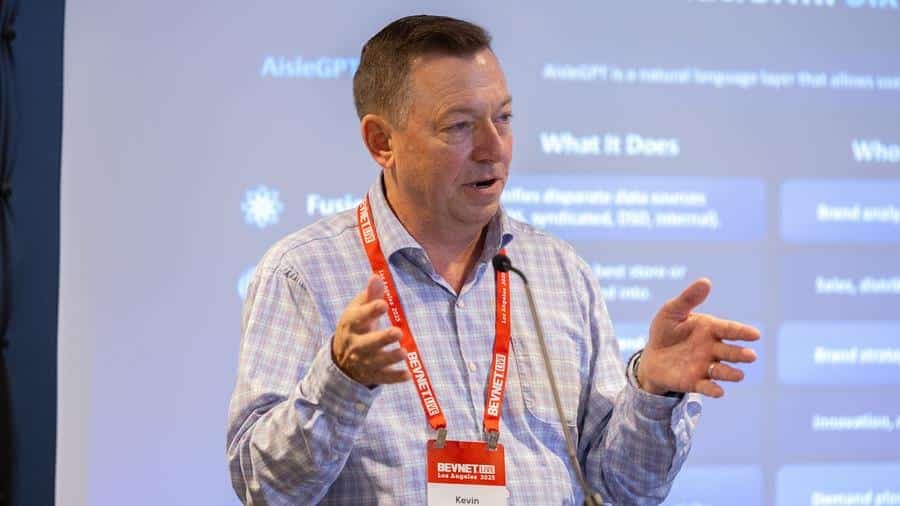
In this high-impact workshop, AisleAI CEO Kevin Senn breaks down how “Verticalized AI” is transforming the way CPG brands win in small-format retail. Unlike general-purpose AI, verticalized AI is trained on domain-specific data — SKU hierarchies, store geography, POS realities, competitive context, and category language — producing insights that directly drive revenue, distribution, and execution in the field. Attendees will learn how leading brands, distributors, and retailers are already using AI purpose-built for CPG to identify whitespace, optimize pricing, improve retail execution, predict demand, and convert fragmented data into measurable outcomes. Through real examples and applied use cases, the session illustrates why the next wave of innovation won’t come from broad AI tools, but from vertical systems designed for the nuances of CPG.
Kevin Senn, CEO & Co-Founder, Aisle AI
George Martinez, Head of Business Strategy & Co-Founder, Aisle AI
Tyler Coates, Chief Operating Officer, Ultimate Sales
Transcript
Note: Transcripts are automatically generated and may contain inaccuracies and spelling errors.
Speaker 1 [00:08] Good morning. Thank you for coming down and staying with us till the last day of the show to learn about verticalized AI. How it can make more revenue, more profits, more distribution when it's focused on CPG. I'll tell you a funny story. This company came out of a Bevnet conference. My co-founder and I, George Martinez, were here a couple of, I don't know, 3 or 4 years ago, and every single person we talked to about data said the same thing. So, you know, I want data. I know I need it. But it's either too expensive and or there's no way for me to actually use it. So George and I said, you know, we should attack this problem. How do we fix this problem for CPG? So This is what we did with Aisle AI. My name's Kevin Senn. I'm the CEO and co-founder. George Martinez, my other co-founder. He's here today as well. And we took the last 3 years and we built a system that basically trained AI to learn CPG, all the terminology, all the little catchwords that everybody uses. I personally am not a CPG person. George is our subject matter expert, 25 years at Pepsi. I'm the technologist that put all of the, all the AI around his brain, basically. So I want you to write this down. I'll give you two guarantees for the way that AI is going right now. I guarantee you the next poppy, the next billion dollar brand, isn't going to be just a better product, it's going to be a combination of a better product with AI powered data. You simply cannot survive in today's world with the way that things are going if you are not incorporating AI into your business today. And it's not just your business. I'll also tell you this your personal and your corporate adoption of AI technology today, not 6 months from now, will determine the directory of your career or your company. I can absolutely guarantee that to all of you. Now we talk about what AI is and it's not a silver bullet, right? It's not magic. The way I like to think about it is it's basically an 80% brunt, you know, brute force multiplier. So if you have a strategic implementation of AI into your business, you can save 80% of all the grunt work you're doing right now. Take that over here, do it quickly, and then still apply the 20% of the human copilot at the top to actually get something done. So this, this is from, you guys all know the big guys, McKinsey and Accenture, all the consulting firms. This was a survey they did of the top CPG firms. So not, not, not merging, not Challenger, the big guys. So this is the big guys, all the money, all the data teams. 90% of the execs surveyed said that AI is essential in the next year to their business succeeding. At the same time, 75% of those people don't know where to start. They have no idea how to do it. I've talked to people through the whole conference the last couple of days, people saying different things like, Yeah, I really want to do AI. I don't know what it is. I don't know how to use it. I don't know what to do with it, right? On the other hand, if you do adopt it, Nvidia is reporting a 30% performance boost across all industries. Now I'm gonna ask you something. Who in this room uses chat GPT or Claude or Gemini? OK. Everybody, right? How many people in your businesses today? Use an AI application to do something that's not chat GPT. Well, you're you're, you're a customer. Now think about that for a second. You all know exactly how much chat GPT can, if you use it right and it's trained well, can help you get through your daily life, find things faster. I mean, I bet you a lot of you people have given up on Google search and you do everything in chat GPT. Now think about if you had that kind of power attached inside your actual business workflow to your actual data that did actual things for you that made a difference to revenue and distribution. How do you do that? This is what we did. Now, I would typically not do this. You're never supposed to read your slide, but I can tell you this is important enough. I just can't make this up. I was finishing up my presentation this last Friday, and this came across my feed. Basically saying Artificial intelligence is not just a wave, it's potentially An existential risk to companies that don't adopt. And I saw another one this morning. Anybody who doesn't adopt AI in their business in 26 won't be around in 27. Maybe that's not true for the big guys, but if you guys, I'm guessing nobody in this room has unlimited resources. So what's the best way to make use of the resources you have? Be efficient, be smart, and use AI to do the grunt work and move you forward. So we're going to talk about today is how is verticalized AI different from general purpose AI. So everybody has chat GPT, but how do you actually put it into your business? We're going to talk about how we did it and what what we have that we can give to you and how it affects the CPG landscape. We'll talk about some real world outcomes that some of our customers have experienced, and we're gonna talk about how you guys can actually move from today where literally not one person in this room raised their hand using AI in a business workflow. How can you take that next step and actually get AI in your business and utilize it? So first of all, what is AI? People, it's sort of out there and people do or don't know what it is. It's basically pretty simple. There's large language models. That work with machine learning and neural networks and it's all kind of progressed over time to where now we have these tools that can take in billions of lines of data, billions and make decisions and actually scale and think like a human. You still, like I said, need the co-pilot, but as an example, in our, in our, in our platform, we analyze 26 billion lines of data every single day it refreshes. We do that in the convenience store space, 27,000 stores. And we bring from that insights to tell you exactly what's happening in every single region in every single product category, anything you want, from pack size to flavor profile, who your competitors are, where they're at, where you are, where you should be, and all that's done by the AI instantaneously. Literally impossible for a human being to do this. And yet we've figured out a way to bring this power to your business. So this is basically the next wave of innovation verticalized AI. Right now everybody's working out their own chat, GPT and cloud, but how do you take that and bring it into You know, foundational models of the first wave, but the second wave is how do we train it on the domain data and tune it for business outcomes. And you know, one of the things that we've done that I think is different and, and unique because we have this data set. You don't need to train our models. Our models are already trained. They know CPG. They know the terminology. They have the data. Every single day our models, our algorithms are running through 26 billion different data points. So from the standpoint of using our, our program, it's literally username and password. You log in and it's all built for you and it's done. There's nothing you have to do. And the reason that horizontal AI fails is because it doesn't know the context and that it really matters. I can tell you it's taken us. 1st 8 months AI was pretty stupid. It didn't know a lot. Seriously, it would give you wrong answers. Now it knows everything, and it takes a long time to get it to this point where it really actually knows what's happening. So what we did is we've got different products. One is called Fusion. So some of you people may have your own data, and what Fusion does is it allows you to bring all your own data into our platform and actually use our conversational AI to talk to it. So as an example, if you've got, you know, VIP, if you've got Circana, if you've got Anything unify it doesn't matter. You can bring it into our platform. We have tons of clients who don't buy our data and just use the platform to explore their own, and we show them how to do it. And the reason that works is that inside our platform, as I just mentioned, we've already taught it the language of CPG, so it has domain knowledge embedded in it today. So these are all the products. We start with ILGPT. This is basically the conversational natural language, so I don't know if you've seen the commercials lately for the new Microsoft computers and the woman's like, you can talk to your computer. You can talk to our platform through your computer or you can type in natural language and just ask it things like, you know, how are my sales in Texas? What's happening in Florida? What are my competitors doing? And it brings you the answer back and then it builds you. I'll show you in a little bit. We've got one of our clients who uses it to build their distributor sale sheets. So basically they can go into a distributor and say, Look, here's where I'm winning. Here's the demographics of what makes sense for my product. And here's some lookalike stores that I've identified inside the platform where you should put me to and prioritizes them actually prioritizes them by what is even the best store in that list. So if we give you 50 stores, it'll tell you what the top 10 are in the next 10 and next 10. So again, back to the idea of limited resources, instead of spray and pray and trying to hope that you're going to hit the right store, you know exactly where to go with your product. And this is the Fusion piece where we unify all the disparate data sources. Anything you've got you can put into Fusion and then explore it through our platform. Atlas, this is really incredibly powerful program. Basically, and I was just, I was just talking to the head data guy at Lagunitas. He told me he's like, look, I want to know what everybody wants to know. I want to know where I'm at. I want to know where I'm winning and where I'm losing, and I want to know the same thing from my competitors. I said, that's funny because that's exactly what this does. So we have We cut up the country into 30 areas and you can purchase just one of the areas that's relevant to you or all of them or any combination. And you'll have a regionalized view of exactly your category, your subcategory, whatever SKUs you want to look at down to the SKU level, your product against your competitors, and it'll show you the exact positions where they're winning and where you're winning and where your white space is and where you should go. We have a, we have a customer using it uh in the East Coast. I mean, what is, what is Spit's growth rate, 50, 60% since we came on board? Unbelievable. And they literally use it every single day to put their distributor sell sheets together and they go in and they sell with a data-driven story. They don't go in and say, hey, look, we have a great product. It tastes good. They say this is where we're winning, and these are the stores where we should be. Basket. Everybody's familiar with the Market basket analysis. We're able to tell you exactly what your affinities are cross affinities, and everything from, you know, it's a very detailed plot of the types of products within your category or across category or even cross skew that you should be partnered with and where you should be in the store. Radar is really fun. Radar allows you to explore what is happening in the market before the market even knows it. So we scrape Amazon, TikTok, uh, Pretty much all the social platforms. And we bring it together with the AI and we have a viral score that tells you what's growing and where and what's about to come off Amazon and go into retail. So for, you know, whether you're the young brand and you want to know how you're doing, or if you're a big brand and you want to know who's coming up to bite you, you can use this product and it's a national, national base to understand exactly where your competitors are and where you're, what you're doing as well. Pulse is my personal favorite because it relates to events and I really like football. So we had this theory, uh, White Claw called us and said, hey, we wanna know what happens on game day. I mean, we kind of, I mean, we know that more cells, but we don't know what it is. Like we don't know from, you know, we put stuff in, but we don't, we don't know the sell through. We have the data that shows exactly what happens in every store around every stadium. So we did a study for them in University of Colorado Buffalo's and down in UT Austin in Texas, and we showed not only what the lift was, but the pack size, whether it was a multi-pack, what the flavor was, what the profile was, and we showed them what their competitors did, and they were able to use that information to then. Make their promotions targeted exactly for the days they needed the product in the store and they even went so far as to show them that, you know, they saw sometimes they'd see this big spike on Friday and then it would drop on Saturday. Well, they were out of stock and they didn't know because they were stocking singles and as it turns out, the number one thing they sell on game day is a multi-pack. Because everybody's going to go tailgate and they don't know what their friends are going to drink, so they get every flavor, and these are insights they didn't know that we can pull out of our data. So that, that, that pulse product then evolved from that concept into, you know, what if we could predict 2 to 3 weeks out what's happening in an area for a particular product, and that's what we can do now. We've launched it for beer and we are within 2% of actuals. So again, It's not just an AI platform. We have all the data, so we've trained it, and then we can actually do a loop that says, We're on day 1 and we predict what day 14 is. And we actually have the real data then to also validate whether or not we're right or not, so we've been able to show retailers that they have Lyft that they're missing. Because they don't understand these patterns. That product, that's my personal product favorite because of the football. PRISM is really fun as well. This is really for retailers. It's an AI vision tool that tells them what's on the shelf, what's out of stock, and how to maximize their shelf space. An example that I like to talk about loves came to us and said, Look, look, we know that 8 ft of our candy. Shelf makes X. I can't tell you what X is, but we want it to be x + 10%. But we don't want to go reset all our stores and take a risk and be wrong. Can you guys model it, do an AB modeling, basically digital twin with your AI because you have all the data, and tell us what to do? And the answer is yes. So we show them how to get 10% more out of their candy shelf without having to go and disrupt all of their planograms, not knowing if it's going to work or not. So these are some of the, the real brands and real results we're just talking about. These are our friends at Spit. They use Pulse and Atlas every day. They doubled their ACV goal over six months from 20% to 44%. We have a I call them a craft brewer. I think I just mentioned them, but they use Atlas to identify the top 200 stores. It's kind of funny when we first went to them. We had done a little work up inside the data. I said, Are you aware of what your top stores are in California? And they didn't even know the names of the stores where they were doing the best or why. So we came back to them and said, well, you're getting your brain, you know, you're losing to Sierra Nevada over here, you're losing to voodoo over here. Here's where you should be and here's how you can win. So we identified the top 200 stores where they could go out and actually have a hit list for their, their team as well as their distributors. And they increase their velocity by 22%. And lastly, in the snack brand we talked about that, we use the basket affinities to show them how they could better position themselves in the store and also revealed, interestingly enough, you know, what's what happened to be the most popular product bought with their product. Another one of their products. So it affected the way they thought about promotions and how they should do 2 for 1s and BOGOs and stuff like that so they could say, because I know me as a consumer, I've got a bunch of kids. I go to, if I go to the store and I buy, I don't really know what my kid likes. I'm going to buy this power bar and that power bar. But now if I see something that's 2 for 1, I'm going to buy 2 of those instead of the competitors, and they, they, they kind of knew that, but the data reinforces the gut instinct and actually makes you take action that'll Affect your sales and distribution immediately. This is the piece where it's the ILGPT, the talkback, so you can literally speak to your Platform with us and say where am I doing well? what are my top 50 stores and it it Automatically draws us back for you. You can play with it, talk to it, and you don't need, that's the other piece about this accessibility. And we talked about at the beginning, you know, what, why was the idea for the company, what happened to Bevnet. Everybody said, Well, I, I don't have a data team. What am I, I mean it's so great. You've got 28 billion lines of data. Who cares? What am I going to do with it, right? And even if I have your platform, I don't, I'm not a Power BI guy. I don't know how to use all this stuff. This builds it for you. So we've got non-tech people with no data teams using this to increase their sales and distribution today. It literally builds you PowerPoints and Excel spreadsheets that you can take in and use as Excel sheet. We've also built in, um, I don't know if everybody's been hearing about Agente AI, but we've built in an Agentec AI, basically a bot. So let's say that you're big enough that you care about market share of your competitors. One of the things we did Let's look at Los Angeles, and this is an example. Celsius is not a customer, but we put this in the system, you know, show me the difference in market share between Celsius and their biggest competitor, and alert me when it changes by whatever number I care to have 2%, 1%, or when it crosses over. It runs. Once you set the KPI, it runs in the background 24/7 looking at all the data every single day. And the second that that KPI is hit that you care about, it notifies you and anybody on your team you put on the list and says, Hey, human, I've just noticed this anomaly. The KPI you care about. You should go focus on this. Maybe you should tell your sales team that you're not doing well in the Inland Empire. Maybe you're doing well in Santa Monica, but you're not doing well in Orange County. Directs you basically. shows you where you should be focused with your team. Again, there's no way on the planet that any human being could do this on their own. It's just, it's just too much data. It's too fast. But having this as your Personal assistant essentially lets you know exactly where to go and when to do it. And what we're offering now also for the show, um, anybody who wants to have a one month free pilot is welcome to. Lisa's in the back there. Lisa, raise your hand. Talk to Lisa and she'll sign you up. Uh, we're giving this away at the show and, and the reason is we are so absolutely confident. That once you use this platform, it's, it's going to be like your coffee in the morning. You're never going to go away from it. It's going to tell you exactly what you need to do. You're going to see immediate results. I mean, this company'sil that's using it literally within 30 days. They're seeing immediate results with their sales and distribution. So we're going to give this away. Anybody who wants it, talk to Lisa and we'll set you up and get you going. Now I'd like to introduce My co-founder George Martinez, he's head of business strategy. He's the smart guy, subject matter expert, and another one of our customers, Tyler Coats, not the smart guy. He's the chief operating officer of Ultimate Sales and Service, one of our customers, and we're gonna go through some of the ways that they use the platform on a daily basis with their customers. So Tyler, if you introduce yourself and go from there.
Speaker 2 [19:56] Welcome everyone, and Kevin Powerful, thank you very much for covering that with the group. Um, and again, personally, just thank all of you for stopping in this morning. I know you've got a lot on your plate and you've had a couple of full days, but making some time to spend with us, we really appreciate that, and we absolutely give a shout out to our friends and folks at Bevnet. I mean, a powerful couple of days that we all have spent learning and understanding the challenges that we all face. Um, Kevin started this morning, um, with a pretty powerful slide, the first slide. And he basically said, you should write these two things down. And as Kevin mentioned, this is a project, a company that started kind of from Bevnet and listening. To folks like you About what was important. And we talked a lot about AI and the power of AI. But what we really focused on was building. Insights that are actionable. For each and every one of you. I think Kevin mentioned earlier, I spent 26 years at PepsiCo. And I have the luxury of having an analyst team of 10 people. And every morning, they would come in and go, here's some information, and we'd look at it, it was like, that was 12 weeks ago. OK. What about next week? Well, here's a better report, it was 4 weeks ago. And, and it just, the time has passed and evolved. And now the insights need to be actionable. Kevin just gave you some great examples of actionable insights. An alert sent you an email and your market share just dropped 2 points. What are you gonna do about it? So the beauty of aisle is it's actionable insights. And we have the pleasure today to have somebody join us that is using um. The AI insights on a daily basis. I'll go back to the chart that you see now, writing those two things down. Pretty important, pretty powerful statements. And you'll see those come true in the next 6 months, and we absolutely invite you to take advantage of jumping on our platform, talking to Lisa in the back, get you powered up. Login password, you're in the system and you're looking at the performance of either your brand or for some new new brands, just looking at marketplace, looking at where the categories is performing. That you need to be in where the subcategory is. And Kevin lightly covered that the overlay within the platform is demographics. So if you have a brand, you've identified who your consumer target is or you probably wouldn't even be in the brand business, but you've identified that consumer. We can tell you through the platform where that consumer is shopping today. We can tell you what stores are performing best by category and subcategory. We can show you what your pricing strategy should be to drive the consumer engagement that you're looking for. That's the power of ILAI. So Tyler Coates here joining us from Ultimate Sales. Tyler, maybe a little background
Speaker 3 [23:29] and yeah, absolutely, thanks.
Speaker 2 [23:30] Ultimate does.
Speaker 3 [23:31] I really appreciate you having me, Kevin, George, you know, I got introduced to IAI, you know, a year and a half ago, and it's been amazing to watch what they've put together. It's been really exciting. So, um, I am the Tyler Coats, CEO of Ultimate Sales. We are a national CS store full service brokerage agency. The only Um, brokerage agencies solely dedicated to one channel. We are CISOR only, um, so, you know, being that narrowly focused, we better be pretty damn good at what we do. And in order to do so, we, we, we need data, and we need data that we're not looking in the rearview mirror on, you know, our job is to, you know, empower our brands, or CBG brands to, you know, help try to predict the future. You know, the channels is very, very evolved, um, ever changing, um, super complex, and Um, there's, there's a lot of, a lot of changes out there that we have to be, uh, on top of and, and, and using, you know, aisle data. Um, it's just, it's one of those ways we could do that for, for our brands.
Speaker 2 [24:32] Tyler, maybe share with just the group, you know, what are some of the upcoming changes, and you just mentioned kind of predicting the future in this specific channel. And well, I don't think anybody here has a crystal ball and can predict. You can prepare for the future, and that's literally what IOAI supports. But tell us, what are a couple of the big changes you're working on? Yeah,
Speaker 3 [24:55] you know what, what, what we're seeing year over year and especially this, this, this past year is food service growth, prepared foods growth, which in turn means more bundles, more affinity purchases. So we need to understand what those are, you know, we do represent a lot of food, food brands, but we need to know what they're selling with. But on the flip side of that, we're we're, we're seeing traffic counts down, whether that's because of EB or or what have you, traffic counts are down. So how are we going to get them in the store, which means what are we going to put You know, uh, uh, on a sign outside, how are we gonna pull them into the store, um, and getting down to the granular level, uh, with data is the only way we can do that and, and, and help pull, pull, you know, additional consumer purchases.
Speaker 2 [25:39] Yeah, great. Um, so how, what is the role of data and aisle AI play in preparing your brands for some of these changes coming up?
Speaker 3 [25:51] Yeah, well, you know, in the past we've always had a lot of data, some of it really good, some of it OK, some of it bad, some of it shipped to data, some of it scanned data. There's, there's been a lot out there, but how do we make any sense of it, you know, we're trying to predict the future with it, but It's hard enough to even pull it all together and harmonize it in a way that makes any sense. And then on top of that, as George mentioned, we're looking at 4 weeks, 6 weeks, 12 weeks behind us. That's, that's that on top of data that's really fragmented in a lot of different places. So which is really why I, you know, IO AI, you know, made sense for us. We're not replacing our analytics team, but we're empowering them to provide. You know, our sales team and allow our sales team to pull data that makes sense. It's daily refreshed versus looking in the rearview mirror and trying to tell a story that To a customer may not be the right story because they're looking at sales data. They're looking at scan data. We're walking in and saying, hey, we have a story from 12 weeks ago. Great, thanks. So do you,
Speaker 2 [26:59] do you have an example of one of the products that you're using to help solve that?
Speaker 3 [27:02] Yeah, absolutely. Well, so for my sales team, you know, the ILGBT is, is, is super powerful. They can, they're not very adept maybe in data. They don't have to email my analyst and say, hey, provide this for me. And ask a simple question before they walk into a walk into a customer and they have their answer. With And then on top of that fusion. So they ask that question. It's pulling in all of our data, whether that's all of our, you know, Scana, Finns, Nielsen, aisle data, um, maybe it's ship to data, and they're asking the same simple question with multiple data sources harmonized through fusion.
Speaker 2 [27:42] As it refers to Kevin dug a little bit deeper into the Atlas and actually showed the map. Could you maybe give us an example of how you or one of your brands that you represent are using Atlas? Yeah,
Speaker 3 [27:55] absolutely. So recently, we represent Hormel Mega Mex Foods, pretty, you know, pretty large brand, and kind of understand Whitespace, obviously where, you know, a few new product launches. So we pulled Atlas 8 or 8 and 3 up in the Northeast and I said, OK, where, where, where's our white space? How are we're going to execute on it was, was my client's first question to us. You know, they're not DSC. We don't work with with a lot of DSC brands. So how is my sales team going to execute on, you know, 845 stores that we have whitespace on? Well, as a broker, we have the ability to go to those distributors, utilize the distributor partners, provide SI programs, and, and instead of walking into. We're not going to walk into 845 stores individually. We can go to the distributor and say, Here's, here's the data. Here's where we're missing. Here's how we're going to incentivize you. And again, it's, it's, it's executable. That's what matters the most. Yeah,
Speaker 2 [28:54] so specifically with Atlas and the different components was the void section of Atlas. Important was it category of performance? Which one seemed to stand out the most? Void
Speaker 3 [29:07] for sure. Void, void for sure. You know the category of performance, you know, in Atlas matters exponentially to us when we have a new brand or a new product launch. What is going on in the category? Where should we be playing? Where should we set up promotions for initial product launches, things like that.
Speaker 2 [29:25] Yeah, thank you, and I've asked, uh, everyone to, um, just spend some time at the end reviewing, um, this map that we have, um, and we have listed AMAs, so aisle marketing areas that you can dig deep into at the store level, and then you could look at voids as Tyler just mentioned you could look at what stores are your is your category performing the best. So that really means, where's your consumer engaging with the product and the attributes of the product that you're looking for. So, um, again, welcome you to take a, a quick peek, uh, peek at that map. So Tyler, um, is it Comes down to just AI that's sometimes can scare people, right? And we have found that out in the CPG business. Technology, AI, probably a little bit later adopters than other industries. What, what is the success that you have found in getting your people adopted to AI?
Speaker 3 [30:31] Well, I think it goes back to ILGBT, the fact that it's just simple. It's everyone on my team uses chat GBT in their personal lives. It's identical that you're asking a business question. That that's, there's there's no way my sales team can't adopt something like that. There is, there's no additional work. There's no training. Just ask a question and, and all of our data is, is gonna be provided back in an insightful, you know, actionable, uh, manner.
Speaker 2 [31:02] Great, great. So as we kind of just in closing, um, what advice would you give as you represent a lot of brands, um, what would you give to some of the brands here at Bevnet? that are looking at entering the market, finding out where the consumer shops. What advice do you have for these folks
Speaker 3 [31:22] that ILAI is the only way to go? I mean, honestly, um, I mean, it's, it's, it's, it's just so powerful and it's, it's nothing to be scared about. I would say that's the biggest thing, and I was hesitant at first. Well, OK, the, the 27,000. You know, independency stores is great. It's a lot of data. It's a lot of stores. I'm like, well, how, how am I going to execute on it? OK, well, how we can put fusion into it. I mean, and then. Again, natural language search is, is what really sold me. It's like, OK, I, I don't need to be scared of, of, of this. It's not, I'm not a data guy. Um, I, I enjoy data, but I'm not a data guy. I don't, I don't understand a lot, a lot of, uh, you know, a lot about it. My analytics team, um, is small, um, but it's, it's the, the output is, is unbelievable. And there again, there's just, there's no training involved. And I think that's what That's what, you know, the biggest takeaway would be is don't, don't be afraid to use it because it's, it doesn't get any easier than this.
Speaker 2 [32:25] Yeah, the comparison is, is well noted, as we've mentioned, we have all used whatever AI open AI system, chat GPT. I don't think any of us really were trained on how to use. Chat GPT we just started using it, right, and we learned it. IOAI and IOGPT is basically in the same format. Just start using it and you'll learn from it. And the funny part is, it learns from you. It learns from how you ask the questions so that it gives you the right answers. Again, no surprise you're doing that today with Chad GPT. Um, thank you very much. Thank you, George. I really appreciate you taking some of your time and sharing a little bit of your knowledge and what's going on, um, in the Industry with uh AI and technology, um, and now for the group we would just like to open it, uh, just a quick Q&A session we have a few minutes left, um. What ideas kinda came to your mind as we were going through one either a question for Kevin, a question for Tyler on how he's representing brands and using um AI or, or myself, or, and we have Lisa standing over in the corner. She will gladly talk to everybody and put you on our, our trial program. But open for Q&A. Anybody have a question? Well, some stores share their data. Great,
Speaker 1 [33:58] so they don't, so they don't. So we have, we have what we did is we partnered with a company called Snowflake. Snowflake is one of the largest data companies in the world. They have data feeds that are available and then we pipe in data from different stores through a partner and then we put everybody's, as Tyler was talking about the information in your data, every one of you as a customer has your own clean room, so it's all partitioned off, so everything's contained inside your. Your own environment and in that scenario, if you buy our data, then we have 27,000 C stores that do share their data through our platform. So it's, and these are, this is not uh not big chain, this is independent and small chain.
Speaker 3 [34:42] And add on to that as well, other stores, right? How, how do you access that data? Many chains you can purchase data from, um, most, most of the larger chains you can purchase from, there are some that absolutely will not. It doesn't matter. They don't, they won't sell their data, but there, there's a very, very, very large number of 152,000 stores. There's probably 125,000 that you can access their data one way or another, then that's where you could provide that. If you had your own data, let's say 7-Eleven, if you convert to 7-Eleven data directly, you could, you could feed this, feed that into IL AI and harmonize it with the 27,000. Maybe you have MVNAav data from Maverick, um, and you can pull it all in and harmonize it under one roof. So there are, there are, there are many ways to access, but um. It's not 100%.
Speaker 1 [35:33] And the other piece of this is, you know, in the legacy brand data people, I don't know if people know this, but the convenience store set that you get from people who will remain nameless is based on 1100 stores in the country. So it's truly this kind of, you know, trending, this is what's happening, what we think's important, we put some algorithms. Ours is actual POS scan data that has, you know, the name of the store, the address, you know, the pack size, the flavor profile. I mean, White Claw didn't even know that they had a different flavor profile in Houston over Los Angeles. They're like, Well, Barry's #1, right? Like, well, Barry's only 6 in Los Angeles and it's something else in Houston. So we have literally down to the absolute every granular piece of data you could have on a per store basis. And the reason they don't do it in Legacy, they haven't hooked up the AI the way we have. It took us, you know, a year to figure this out and millions of dollars, literally our data team to put this all together and tear it apart so that it actually can deliver insights that you can use.
Speaker 2 [36:39] Yeah, great. Thank you for the question. It's a great question. Um, anybody else? I see a hand here.
Speaker 1 [36:50] So we have, we have, it's a great question. So the concept, so everything in data has comes through a schema. There's a different schema for different data sources, and we ingest pretty much all the big ones that we've just call them our, our common. So Scintella, uh, Nielsen, Spin, Circana, anybody at VIP, all of those, we have all of the schemas for those. And we have an automatic AI powered ETL process that sucks it up and harmonizes it. Then we find the common key across them so that your data set, complete data set inside our platform, all talks to each other and then as Tyler said, use LGBT to actually chat with.
Speaker 2 [37:30] Good. Thank you for the question. Do you have a question over here? And thanks for the presentation from Power of AI. Um, you get data sets from TikTokho and Amazon.
Speaker 1 [37:42] Yes. So we have, we have a direct feed from all the different social and from Amazon that goes into radar. And that's how we build the insights to tell you what's coming and what, what you should be looking for. People, some of the, we were just talking to um The guys at the end of the fever and they have the insight for flavor profiles and what you should be building next and we're gonna have a chat about how we can help support them in that as a partner with the data that we've got because we've got the ability to analyze it across the entire country instantaneously. Yes.
Speaker 2 [38:16] You know.
Speaker 1 [38:19] So that's a really good question. We intentionally stayed out of financial and business workflows, and our, we are in the data workflow, so we don't, we don't plug back into, into QuickBooks.
Speaker 2 [38:35] Yeah, great question. Um, anybody else? I thought I saw a hand coming up there. Now the size of the brain. And obviously the larger brands. Have Yeah, it it it doesn't matter the size. I mean, quite frankly, we've given a couple of examples. We've had brands that have not launched, so they're still building the strategy, and they come to us and say, OK, I want to get into the data to see where those consumers are shopping that match the profile of what I'm putting out in the marketplace, so they take advantage of the data and the insights and understanding. Where their distribution should be. It's a little bit of the old adage we always, and we still talk about it. I got 10,000 stores distribution. And you go, oh good, that's, that seems really good, doesn't it? You probably can bet that 6 to 7000 of the stores aren't performing very well. You really need to be in the right store, and that is where we're powered to show you with the demographic overlay where your targeted consumer is shopping. And then as Kevin mentioned earlier, we can also show you what flavor profile is doing really well cause you'd be surprised the flavor profile from LA to Buffalo, New York, or even just New York, those profiles are completely different because consumers are different. So now you're spending time getting deep into where your consumer is, and I think at the end of the day young. We are almost ready to launch a young brand. Challenge a brand or a big enterprise brand, we all need the same information.
Speaker 1 [40:31] And actually I, I would submit you're right in the concept of net dollars. The big brands, there's more money for them to win or lose. But if you think about it, it's super, super important for a brand new brand because you have, you have limited resources. Let's go back. I mean, we, we've been talking about that with the VCs on the stage. I mean, we, we've, everybody knows that I've got this much money. And I got this product. If I make a mistake on my first launch, I'm out of business. I blew it. I spent all my money in Los Angeles selling berry when I should have been selling mango as an example. I mean, if you've got a brand right now and you've got a flavor profile and you want to know exactly where you should go to win. That would be much, it's an existential issue, right? I mean, either you survive or you die. I'm looking at you. I mean, I, I've talked to so many people in this show. And it's, it's the, the really young brands that could use it, I think the most to win or lose.
Speaker 2 [41:34] Yeah, and we, we do have a little bit of tagline, and our mission when we started ILAI was to democratize data. Because we know today that the big brands, enterprise companies, they have a lot of data. And they spent a lot of money on that data. So we've put together a program and again speaking to Lisa in the back, she can show you how you can jump on the platform and you're not spending what Pepsi, Coke, Budweiser is spending for data and then we'll have it broken down by your AMA, your aisle marketing area, so we can support you regionally. At a very specific area that you wanna go launch a brand because you're not gonna launch all at once, right? Everybody launches with the beachhead that they're trying to create and build and then. Continue to build that B chip we can show you based on the map. All the data that says here's your #1 or you once say give me the top 5 places that I should launch. And we can show you exactly where your 5 places are to launch. Go find your distributor or whatever your solution is. That ensures what Kevin just said. There's a lot of great brands that don't make it. Right, they've made some mistakes. Um, and the capital, the cost of capital, what are you spending on resources, people, sales people. Um, those decisions you're making are very critical, and we think we can help you with that. Anybody else have any question or two? Seesaw independent seesaw you. We also have a channel of business with Hispanic. Share a lot of Well, very cheap
Speaker 1 [43:28] We're, we happen to be in negotiations for that data stream right now. Yeah, yeah. So we're, we're, we're, we're, we, we launched this in CSTOR because we knew, well, George knew, Lisa knew, the CPG experts that it's been historically a black box, black hole. Nobody knew what was going on. And so we said, you know, why don't we go where nobody else is first. Let's establish the brand. Let's work through the year of incredible data science that our team did. To get the platform where it's at. And once we have that and we have all the customers, let's go start adding new data sources. So we're as an example, we're in negotiations for Hispanic, we're in negotiations for other different chain actually chain CStore as well. So we're going to continue to expand it. Not gonna talk to 8451 yet, but we'll get there. Yeah,
Speaker 2 [44:20] but you, you, you pointed in the right direction. We, um, also independent liquor stores have been a dark, deep hole for a lot of years dependent on state and, you know, a lot of regulations around, um, that space as well, but. We have our eyes on finding a solution for that, um,
Speaker 1 [44:39] well, just, just in about 6 months check back because we are, we're, we're going to be the exclusive provider of independent liquor store data for the country. We've already got a deal in place with the largest new point of sale system, so we just are waiting for it to mature as far as from a dataset standpoint, but you'll have the ability then to look into independent CS store and independent liquor in one spot.
Speaker 2 [45:07] Yeah, great questions. Um, anybody else question or two?
Speaker 1 [45:14] Just overall was like natural
Speaker 2 [45:15] language, but is there,
Speaker 1 [45:18] do we need help to set up kind of the Scripting and prompting underneath that. No, so we, we've trained it uh to understand CPG. And so, and the other thing too is we, when we, when you come on board as a customer, we do a white glove implementation. So our team will sit down with you. You're basically your lift is an hour of time where we interview you, we talk about what's important to you, what do you care about, you know, what's the region, what's the KPIs, we set the whole system up for you. And then we do have a training program that most people don't need, but we do it anyway and then we support you as you go if you, you know, you have a weekly meeting, if you want it with one of our team members on the success side they'll let you know, you know, here's some stuff I found. I mean we've got people. We have a customer and they're doing X, right? And so our team's in the background just because they're data geeks and like, you know what? I found these lookalike stores that would be really good for you and they bring that, they surface that to you and then they'll show you how to do it yourself. So there's, there's, there's no real, as, as Tyler said, there's no training, um, we set the whole thing up for you and we also do all the data ingestion. We don't expect anybody to have to figure out how to. Put their data up into our platform, we, we do it for you, so.
Speaker 2 [46:30] Yeah, that's a good question though on the understanding, uh, the chat GPT component, um, but we've, we've trained the model, understands kind of CPG terminology. You know, some people would say we all talk a little weird when we talk about, um, this industry, but it's definitely built to understand the, the terms. Good, great question. Thank you. Anybody else? With the question