

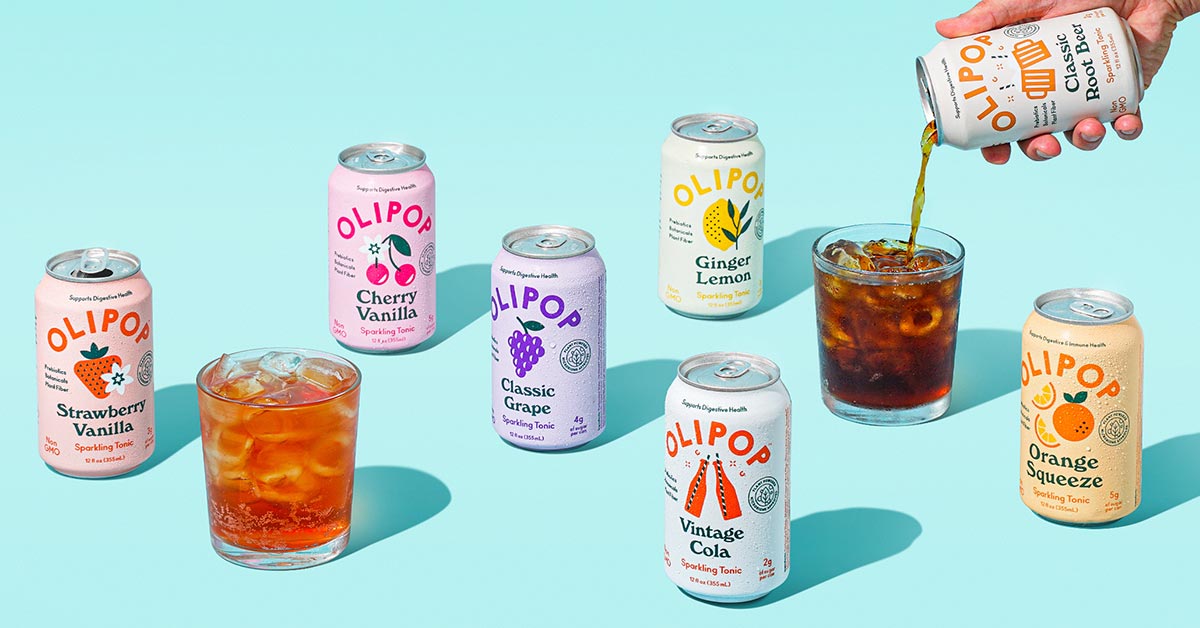
Big soda has been Melvin “Mel” Landis’s meal ticket for most of his professional career. From his work with bottler Coca-Cola Consolidated to various brands in the Coke system, including running Minute Maid in North America and eventually helping steer isotonic brand Body Armor into the Coke stable, he’s been aware of the size and depth of the soda category.
Now he’s gone to work for one of the brands with the greatest potential to disrupt that category, signing on as the president of Olipop. Landis, the former Chief Commercial Officer at Body Armor, said he was living in Florida – near Body Armor co-founder and former CEO Mike Repole – when a friend from that last gig introduced him to Olipop’s leadership team.
After 18 months in an advisory role during the company’s rapid ascension, he decided to apply for a full time job. He got one – replacing co-founder David Lester as president. Lester remains on the board, while Landis will be working under co-founder and CEO Ben Goodwin.
“I wasn’t thinking I was going to work again, but I got involved and started really looking at this thing, and I really fell in love with Ben and what he was trying to do,” Landis said during an interview with BevNET.
Call it “Modern Soda” or “Functional Soda” – the team at Olipop uses them interchangeably – but whatever you call it, it’s really rolling now, with the combination of Olipop and competitor Poppi selling nearly $900 million at non-foodservice retail last year, according to SPINS data viewed by BevNET.
The growth of these two brands has brought in investment and it’s also resulted in workforce professionalization and specialization. On the investment side, Olipop announced last week that it had closed a $50 million round led by J.P. Morgan Private Equity Growth Capital Partners, getting a white-shoe investment firm into a cap table that has been long on celebrities and consumer VC firms. The new money came with a valuation of about $1.85 billion, and the company has raised about $195 million to date.
Olipop accounted for about $470 million in sales last year – more than double the previous year. And it’s profitable, Landis said, “which is one of the other things that I think makes this a bit of a unicorn.”
Goodwin, Olipop’s CEO and co-founder, has long been the scientist to sales veteran Lester’s block-and-tackle operational approach, and Landis, who has worked with rapidly scaling entrepreneurial brands like Fairlife and Suja in the Coke system, as well as his time with Body Armor, is expected to extend that dynamic into the next phase of Olipop’s organizational and programmatic growth.
With Landis on board, Goodwin will be able to continue to focus on strategy and long-term innovation, Landis told BevNET.
From his home in Florida, Landis spoke with BevNET on the topic of his hiring and his outlook for the brand and category, helped by a communications team that confirmed that the category is Modern Soda. Or Functional Soda.
Here are excerpts from BevNET’s extended conversation with new Olipop president Mel Landis; excerpts have been lightly edited for clarity and length.
On his role:
Yeah, my mission is to come in and really help Ben and the team continue to accelerate growth in the business. And it’s to really step back and look at what are the things that now need to happen as this business scales from where we are this year to becoming the next billion dollar brand somewhere down the road. And so I’m here to help accelerate that.
I’ve got some experience in understanding what it takes to scale a business and to really scale it fast, from where it is today, to a really, really big brand. And so my mission is to come in and help all the different functions in the company think about what we have done today that’s been successful that we want to keep and continue to build on.
What are the skills we need to go forward to capture all the opportunity this brand’s got, because it’s one of the most amazing products I’ve seen, and it’s it’s going to disrupt this category. It’s already disrupting this category. But then, the skills you need to get it started aren’t always the skills you need when you scale it to be really big.
On Olipop’s rapid growth and the category opportunity:
This is one of the biggest categories anywhere in any country, of any size. I think it’s something like $50 billion give or take… and it has had limited innovation in almost 40 years since diet got launched. And fundamentally, while people love it, I think there’s a growing recognition that too much sugar in the diet is not great. And so when you look at, then, the ability to come in here and give consumers everything they love about soda, right? The amazing taste, the great flavors, the bubbles, the fun, we’re a soda. But then you look underneath that and you say, but, man, there’s only two grams of sugar, and there’s prebiotics, and there’s fiber and there’s botanicals, and all of a sudden I can have everything I love about soda with all the occasions I love it in, and I can do it with something that actually helps me, that actually improves my health. It’s a little thing I could do on my journey to be more healthy.
You start to think, what could happen if that, when that takes hold, and you say to yourself, one, if someone in my stage like, what a way to go into what may be my last chapter, working on something that could be this disruptive. And you start looking at that, and you just say to yourself, like, it’s, it’s unlimited, the potential of this thing.
On the importance of the convenience channel for the next phase of growth:
I think there’s 180,000 or so convenience outlets in the United States. So convenience is a big white space that we’ve got a major push to continue to build that out, and you’ll see good progress on that as we go through the year. But look, there’s other channels where we’ve got opportunities. We’ve got opportunity in drug, we’ve got continued opportunity in club, and so there’s still a quite a bit of good white space available to us, in addition to the great distribution we’ve already got, you know, across grocery and mass and Super Centers and the parts of the business we started in first.
On the latest tranche of investment, led by J.P. Morgan’s growth capital team:
We’re already a profitable business, which is one of the other things that I think makes this a bit of a unicorn. You know, when you have double digit growth and you’re profitable that’s a really healthy business. This raise was important for a couple factors. One, because it brought in a great partner in [J.P. Morgan] that we think is a great partner for a lot of reasons. They’ve got a wide reach.
It gives us more flexibility to chase what we think are the biggest opportunities that are out there. It gives us more money that we can invest as we either see a white space that we want to go after, or if we think we really are onto something in a channel and we want to double down on it. And so it really kind of has two purposes. It brings a great partner on board, and it gives us additional money that we can invest to grow the business even faster.
On the existing competition within the modern soda category, and between Poppi and Olipop:
I think it’s really interesting that people are now coming into the category, I think it does a couple things. I think, one, it’s a validation that the things we’re seeing are real… that this is a massive category, and disrupting it is a huge opportunity. Second, it will bring more attention to this, because there is still a huge opportunity for a lot of consumers who really have yet to discover us or even the category. And so the more light that gets shed on what this can really bring, the better. The other thing I think it does is it also gives us an opportunity to talk even more aggressively about why we’re even so special and different in this category.
On the potential for Olipop to use more DSD in its growth:
I think, like everything, we’re going to continue to evaluate the business, and we’re going to look at a bunch of different options, but I don’t see that something we will be doing short term. There’s so much other white space that’s available without having to make that choice and and you know, as well as I do, DSD is incredibly powerful in some ways. It’s not always the panacea for smaller incubation…. Once you scale it can be an interesting alternative.