

Bevscape: The Latest Beverage Brand News
Beyond CEO: Protein Drink Pivot Hopes to Flip the Script for Brand
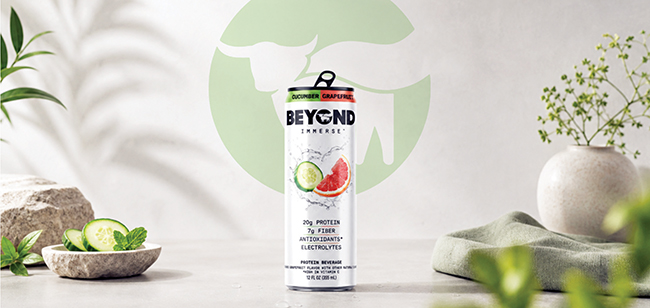
When Beyond Meat announced in January that it had developed its first ever beverage product, a protein drink line called Beyond Immerse, it was a move that appeared to come out of left field.
Why would a company that was fighting to mount a massive turnaround for its fast-declining, flagship plant-based meats business, suddenly take a swing for the clear protein drinks set? While Beyond Immerse was introduced on the company’s online Beyond Test Kitchen platform, where it frequently pilots new, experimental innovations, it was not clear at first whether this was a serious new strategy from the company or a frantic attempt at chasing a trendy category and praying for the best.
Five months later, the company – now rebranded as Beyond The Plant Protein Co. – has made it clear that Beyond Immerse is no fleeting fancy. Since the initial launch, the company has grown the line with new flavors, rolled into retail in the New York metro area via DSD house Big Geyser, and has signaled that Immerse is a leading product for a broader, strategic restaging of what the Beyond brand can be after years of what CEO Ethan Brown called “smear campaigns” that have hindered the company’s growth.
“We’re broadening the aperture of the company to deliver the rest of the superpowers of plants,” Brown told BevNET in May. “I wanted the company itself to change along with this, and not just be about protein, but to be about the superpower of plants and delivering those to consumers in convenient forms that they’re interested in.”
It’s no secret that Beyond’s sales have been in freefall for some time. Net sales declined 15.6% year-over-year in 2025 to $275.5 million, while Q1 2026 earnings failed to provide much improvement as quarterly revenue dropped 15.3% year-over-year to $58.2 million.
For a company that once boasted a market cap of more than $11 billion, circa 2019, it’s been a rough go, but Brown, who founded Beyond in 2009, now sees Immerse and the rebranding as an opportunity to reignite growth and bring consumers back into the core brand offerings as well.
According to Brown, the pivot – and Beyond’s sales woes – come in no small part due to the high level of pushback and, in his view, “smear campaigns” that have beleaguered the company’s core meat alternatives line for years. Beyond, he said, has faced immense backlash from not just rival animal meat manufacturers who have sought to crush competition, but also from interconnected, adjacent industries like pharmaceutical companies (which produce livestock antibiotics), feed manufacturers and others that “wield a lot of power.”
“It’s very hard for us to reach the consumer in an unfettered way when you’re going against such a huge industry,” Brown suggested. “We faced massive misinformation campaigns; Super Bowl ads, people paid online to denigrate our products, all kinds of events where they brought nutritionists down and educated them about how to speak negatively about us.”
Some of these challenges have come from the regulatory space as well, most recently with a bill filed in the U.S. House and Senate in May, the Fair and Accurate Ingredient Representation on Labels (FAIR) Act, which would introduce new labeling requirements for plant-based and lab-cultivated meats and, in the words of Sen. Pete Ricketts (R-Neb.), takes aim at “deceptive labeling of plant-based protein products.”
Other attempts to restrict marketing or sales of plant based meats have come at the state level, and are ongoing.
Brown has repeatedly spoken up about the treatment he believes Beyond has received from rival marketers and hostile media, including attempts to paint the brand’s meat alternatives as unhealthy. When talking to investors and analysts during the company’s Q4 and full year 2025 earnings call, he called the attacks “pseudoscience” and lamented the resurgence in red meat consumption that has occurred in the past several years.
“I can only look at these current trends with a mixture of sadness for the folks that are going to be impacted by it, and increased impatience for those that are seeking to profit from it,” he said on the call. “The good news is that this is a pendulum; it’s going to swing and it’s going to swing back, and I’m very comfortable that Beyond will prosper when it does. But I’m not going to wait around for that.”
Talking with BevNET, Brown elaborated on that comment, suggesting that through Beyond Immerse he’s seeking to flip the script and take “this incoming stress and energy and basically use it to strengthen our company.”
Immerse, he said, came out of a long research period seeking the best way to utilize Beyond’s proprietary clean protein ingredients and extensive scientific capabilities in new formats and categories.
The company looked at other rising protein formats like bars and powders, among other high-growth categories, but ultimately opted to develop a clear protein drink that Brown believes is positioned to compete with legacy brands such as Muscle Milk.
Protein has been in high demand, and the full U.S. protein supplements market – including RTDs, bars and other formats – is expected to surpass $22.5 billion at an 11% CAGR between 2024 and 2032, according to Fortune Business Insights.
In moving into beverage, Brown has touted a team with extensive beverage industry experience, which includes executive chairman Seth Goldman, founder of Honest Tea and Just Ice Tea, former Coca-Cola CFO Kathy Waller and Boston Beer Company founder Jim Koch.
Those relationships have already helped Beyond Immerse establish itself in the marketplace; according to Big Geyser president Jerry Reda, it was Goldman who introduced the company to the DSD distributor. In turn, Big Geyser helped connect Beyond with an experienced brand designer who redid the packaging design for Immerse to help it be more competitive on shelf.
“I think that there’s a real opportunity for a brand leader in the [protein] category,” Reda said. “There’s a lot of protein drinks that are dairy-based. This one is not dairy-based, and they understand the protein business better than a lot of the companies who are just jumping and entering into the protein business for the first time.”
Overcoming negative consumer perceptions may still prove to be a challenge for Beyond Immerse, as will introducing a wildly different product format for consumers who are familiar with the brand. But Brown says he’s up for the challenge and believes that by introducing new and existing consumers to Beyond through the protein drink, the entire company has a chance to thrive as an extended platform business.
“I view this as helping to reintroduce the brand to people who maybe were subject to that smear campaign,” Brown said. “They could literally turn the bottle or can around and say ‘Wait, there’s nothing in this at all’.”
“So my sense is this will grow the core as well as on its own, but I think it will be a very big part of our portfolio. I really believe in the product. You know, I get excited about products, and not every one I feel is going to be a total breakthrough, but this one I feel good about.”
Monster: Tallies Highest Q1 Sales Over $2B
Monster Energy reported a historic first quarter with caffeinated beverage sales crossing $2 billion for the first time during the three-month period.
The energy drink maker posted net sales up 26.9% year-over-year. Net income in the quarter was $569.5 million, up 28.6% compared to the prior year period.
Despite its record-breaking quarter, CEO Hilton Schlosberg cautioned analysts on the call that aluminum prices will continue to be a“modest” headwind throughout 2026, and accounted for about 1% of Monster’s margin in Q1.
“The tariff landscape continues to be complicated and dynamic,” he said in prepared remarks on May 7. “We will continue to recognize tariffs on aluminum through the higher Midwest premium (the additional cost paid for aluminum delivered to the U.S. can manufacturers), and implement hedging strategies across the business where possible.”
Despite the “unexpected” increase in diesel and freight costs as a result of war in Iran, Monster leadership emphasized that the pricing actions it took in 2025 had moderated the impact on margins.
Leadership said it will be “monitoring” to determine if additional pricing actions will be necessary.
Internationally, Monster continues to make significant gains. The company reported that it had become the market leader in Australia and had one of its best sales
quarters abroad.
“Our net sales to customers outside the United States increased 44.9% in the first quarter to approximately 45% of total net sales,” Schlosberg said. “This represents the highest percentage of net sales to customers outside the U.S. recorded by the company to date for a single quarter.”
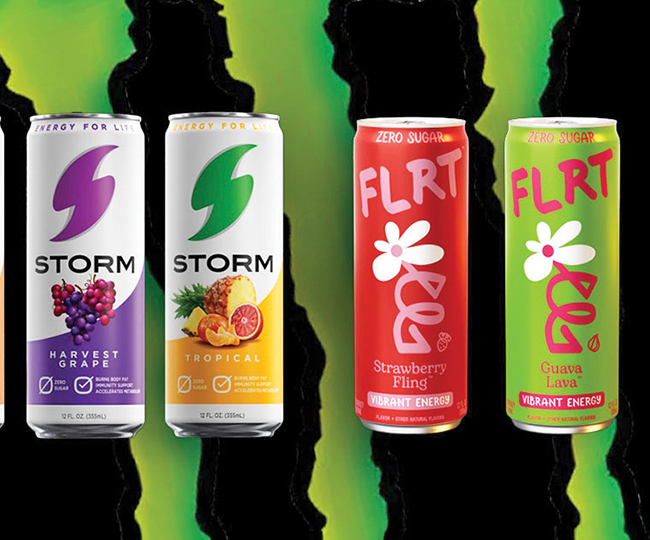
Turning to innovation, Rob Gehring, Monster CEO for Americas, told listeners on the call that the staggered release of female-focused FLRT and wellness energy Storm has positioned the company for a “strong summer,” where the new lines will support growth in Monster’s core offerings.
Company leadership said splitting Storm from the performance energy line Reign will allow the business to directly address consumers seeking wellness energy products.
Despite the growth of zero-sugar options like Storm or FLRT, Schlosberg reiterated that Monster’s full-sugar varieties “continued to deliver meaningful contributions in the first quarter, representing approximately one-third of the company’s total U.S. gains and highlighting the depth of the portfolio.”
Leaning into the demand driven by price-sensitive consumers, Monster has increased its offerings in larger 12- and 24-multipacks, especially in the club channel.
“The opportunity for multipacks has become very evident,” Schlosberg said. “That’s all suggestive of the fact that what goes into a household is consumed at a more substantial rate than if the product was just consumed on a single basis.”
Target Expanding Hemp Beverage Sales to Fla., Tex., Ill.
Mass retail giant Target is adding intoxicating hemp beverages to its Florida, Texas and Illinois locations.
The products will be available in over 300 Target locations across the three states, including all stores in Florida and Texas, and in all Illinois locations that allow for intoxicating hemp product sales (some local municipalities and townships, like Chicago, have restricted category sales within their territories).
Target confirmed the expansion is a test in a “limited number” of stores in those states and stressed consumers must be 21+ to purchase the products.
“At Target, we’re always exploring new ways to meet our guests’ evolving preferences, grounded in our merchandising authority and focus on thoughtfully curating a relevant assortment,” a spokesperson said in a statement.
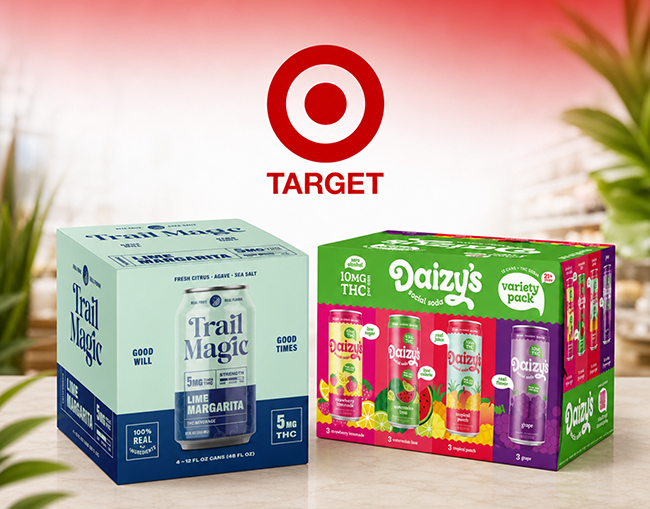
Industry sources report that Target plans to display a limited number of brands – including products from its initial launch in Minnesota last fall, like Cann, Wynk, Trail Magic, Stigma, Gigli, Senorita and Daizy’s – in endcaps within participating stores. It is unclear whether every location will have the same brands.
The retailer has gradually stepped up its sale of products in the intoxicating hemp category. Last fall it began a 10-store pilot run in the Minneapolis region.
In April, the retailer received approval by the Minnesota Office of Cannabis Management to sell lower-potency hemp products in 72 additional stores for the next year.
While Target’s initial launch in October was restricted to 5 mg of THC, the retail chain expanded into 10 mg varieties over
the winter.
Intoxicating hemp products’ future was complicated when Congress passed a spending bill in November which contained a provision that would ban all hemp products containing more than 0.4% THC after November 13, 2026.
Sources report that Target is believed to be hedging against this potential ban by planning to mark down its intoxicating hemp inventory in October if there is no regulatory solution in place at that point.
While Target has not been an active part of the hemp industry’s lobbying effort in Congress, the expansion into the new states may send a message to lawmakers about the business opportunity. The existential threat of November has clouded the category with uncertainty, but it has not deterred other beverage industry stakeholders from seizing the opportunity.
Natural channel retailer Sprouts Farmers Market and convenience store chain Circle K have both added THC drinks to stores in states that still permit hemp-derived THC sales.
Beverage alcohol distributor Breakthru Beverage also recently jumped into the category, announcing it would carry THC drinks in allowable states.

Nutrabolt Names Former KDP Exec Archambault as President, COO
Nutrabolt has shaken up its management suite with the appointment of Andrew Archambault as President and Chief Operating Officer.
Archambault, a former President of the U.S. Beverage Unit at Keurig Dr Pepper (KDP), is tasked with overseeing commercial and operational functions at Nutrabolt, best known in beverage for its KDP-distributed drinks under brands C4 and Bloom.
“I’m thrilled to join Nutrabolt, a leader in active nutrition and next-generation beverages,” said Archambault, whose previous experience includes a stint as president of The Hershey Company. “The company has built an exceptional portfolio and strong team, and I look forward to scaling its impact, strengthening performance, and helping drive its next chapter of growth.”
The appointment comes as Nutrabolt seeks to keep pace with its energy drink competition, which includes both the likes of Pepsi-distributed Celsius/Alani Nu and fellow KDP affiliates GHOST and Black Rifle. Dollar sales for Nutrabolt’s energy drinks have turned negative since the turn of the year, according to Nielsen data, and double-digit volume gains have come at the expense of deep price cuts. The company’s 2-year stack dollar sales growth for the latest two-week periods fell from 19.4% in early October 2025 to 9.1% by early April 2026.
However, in an email to BevNET, Nutrabolt cited Mulo+C-store data from Circana that showed +45% YoY sales growth through May 3, driven by over $200 million in Bloom Energy sales and 1% growth from C4 year-to-date.
As noted by CEO Doss Cunningham in a separate LinkedIn post, Nutrabolt is in the midst of rolling out innovation across its various lines, including C4 Performance Energy, C4 Ultimate Energy, Bloom Pop and Bloom Energy. The company also owns nutrition brands Cellucor and Xtend.
“Andrew is a transformational leader with deep experience driving growth at scale,” Cunningham said. “His track record leading complex commercial organizations across some of the most respected companies in the industry, combined with his ability to translate strategy into execution, makes him uniquely suited to help us accelerate our next phase of growth.”
As Archambault arrived, another leader departed. Jack Harnedy, VP of Revenue Growth Management at
Nutrabolt, announced his departure from the company in May. He joined the company in April 2024.
“I leave with deep gratitude for the leaders who trusted me, the teammates who made ambitious goals achievable, and the partners who pushed us to keep getting better,” Harnedy wrote. “C4 reinforced the mindset of the everyday athlete – showing up, putting in the work, and chasing growth every day. Bloom reminded me that the best brands genuinely improve people’s lives and think BIG with an entrepreneurial mindset. I’m proud of the work we built together – sharper pricing architecture, smarter promotion strategies, and a more disciplined growth engine for the future.”


Receive your free magazine!
Join thousands of other food and beverage professionals who utilize BevNET Magazine to stay up-to-date on current trends and news within the food and beverage world.
Receive your free copy of the magazine 6x per year in digital or print and utilize insights on consumer behavior, brand growth, category volume, and trend forecasting.
Subscribe