

NOSHscape: The Latest Food Brand News
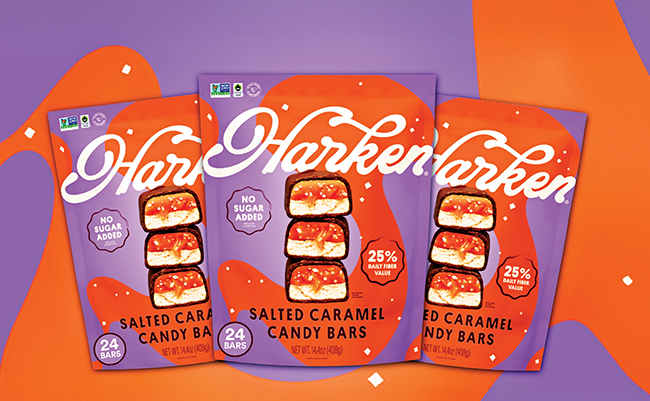
Harken Snags New Capital Ahead of Costco Rollout
Harken Sweets is expanding into Costco with new backing from Taste Tomorrow Ventures and grt sht ventures, signaling growing retailer and investor confidence in the premium indulgence category.
Harken’s Lil Gooey Ones – a snack-size spin on its low-sugar, high-fiber, plant-based candy bars – will roll out into Costco warehouses across the Northwest region. A 24-count pack retails for $13.99.
The launch marks a significant milestone for the emerging confection brand, which has carved out a niche with candy bars designed to balance indulgence with cleaner labels and functional ingredients.
Landing Costco required “a lot of persistence, proof points, and making sure we had the right product for the channel,” founder and CEO Katie Lefkowitz told Nosh.
Harken developed a larger-format Lil Gooey Ones pack for Costco that was designed to “deliver incredible value while still maintaining the integrity of the product,” she explained.
“Costco customers are incredibly savvy – they want products that feel exciting and premium, but also genuinely functional and worth stocking up on,” Lefkowitz said.
To support the launch, Harken plans to invest heavily in demos, creator partnerships, social media content and regional awareness campaigns. Lefkowitz noted that trial is especially important within Costco’s high-velocity retail environment.
“We’re especially excited because the Northwest market is such a strong better-for-you consumer region and feels very aligned with our core customer,” she said.
The new capital will primarily support Harken’s next phase of growth, including retail expansion, inventory and operations investments, brand awareness initiatives and future innovation. Lefkowitz described the partnerships with Taste Tomorrow Ventures and grt sht ventures as especially meaningful given the investors’ experience across food, retail and consumer brands.
“We feel incredibly lucky to have partners who really understand our space with their deep industry and retail ties,” Lefkowitz said.
Taste Tomorrow Ventures, the early-stage investment fund established by beverage incubator L.A. Libations, has only invested in one other food business – sour gummy maker Better Sour. Danny Stepper, co-founder and general partner, said the firm sees Harken as well-positioned within the evolving better-for-you candy landscape.
“Harken is a better-for-you indulgence candy bar that genuinely meets the consumer where they are today – health-conscious, ingredient-aware, and unwilling to give up on taste,” he said. “We’re excited to support Harken’s next chapter of growth.”
Food brands in grt sht ventures’ portfolio include Jesse & Ben’s, Seven Sundays, GoNanas and others. Rachel Mansfield, co-founder of the firm, said Harken stood out for its ability to pair nostalgic appeal with modern ingredient expectations.
“From the moment I discovered Harken, it felt like the kind of brand that meets a real need in the market while still bringing joy to the category,” Mansfield said. “Katie and the team have built something incredibly thoughtful with ingredients and quality standards today’s consumers are actively looking for, but without losing sight of what makes candy fun in the first place.”
Mansfield added that the brand’s early retail traction, including the Costco placement, helped validate the opportunity.
Earlier this year, Harken notched new funding from Selva Ventures and charted a major expansion into thousands of Kroger locations. The latest rollout brings the brand’s footprint to roughly 7,600 doors, Lefkowitz said.
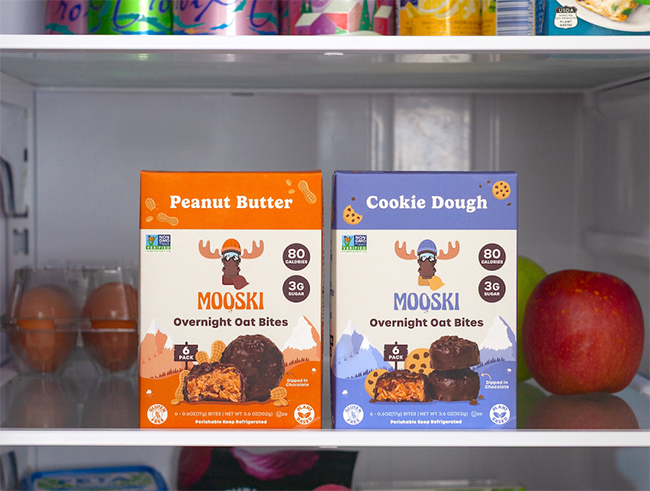
Mooski Goes Big on Bite-Sized Snacking With New Target Expansion
Mooski is making its first major mass retail push with the launch of chilled oat bites at Target – a move founder Robert Broome sees as both a product innovation and a broader channel expansion opportunity.
Rather than chasing bigger, higher-protein formats, the California-based company developed a miniature version of its existing chocolate-coated bars that it’s positioned as snackable and affordable.
“While everyone is doing protein, protein, protein, a big part of where people are going in terms of diets and GLP-1s is not just about protein, it’s about portion control,” Broome said.
Mooski’s core refrigerated bars – made with gluten-free oats, peanuts, almonds, olive oil and agave – contain 210 calories; each bite-size piece (there are six per bag) has 80 calories.
The Target rollout spans 244 stores across 25 states, including several regions where the brand previously had little or no retail presence, such as Florida, Colorado and parts of the Southeast, Broome said.
The individually-wrapped bites launch in two flavors – Peanut Butter and Cookie Dough – at $6.99.
Broome framed the partnership with Target as a breakthrough moment. Mooski’s bars are already sold at several Albertsons and Kroger banners across the country in addition to regional chains, so with the partial Target footprint, he sees the brand as having gone national.
“Our goal is to go nationwide with Target eventually, and I think there’s definitely a path there,” Broome said. “We’re going all in on this partnership, and we’re going to invest a lot in it because this is a big one for us.”
The bites use the same formulation and co-manufacturer as the bars, minimizing supply chain complexity and eliminating the need for new capital beyond the company’s $1.5 million Series A raise last summer, Broome confirmed.
The biggest hurdle, he said, was engineering the soft oat filling in a bite-sized, chocolate-covered format.
“That bite shape is really hard to do. Not many manufacturers can basically take a soft overnight oat inside and cover that in chocolate,” he said.
Looking ahead, Broome sees significant whitespace for the bites in foodservice, particularly coffee shops, as well as club
retail. Each individually wrapped bite includes a barcode on the packaging specifically to support future single-unit sales.
He also believes the smaller format unlocks broader storytelling and merchandising opportunities, from multipack displays to family-oriented positioning to more cost-effective sampling programs.
Nutrition bar makers are increasingly leaning into bite-size formats – a trend fueled in part by the rise of GLP-1 weight loss drugs, but also by a broader consumer push toward portion-controlled snacking. Brands such as CLIF, IQBAR and RXBAR have similarly expanded into smaller-format offerings positioned around flexibility and convenience across eating occasions.
Broome is bullish on the bites, which are also set to debut online this summer with Misfits Market.
“If the data is any indication, [our bites] are going to be really strong for us. I would bet stronger than the bars,” Broome said.
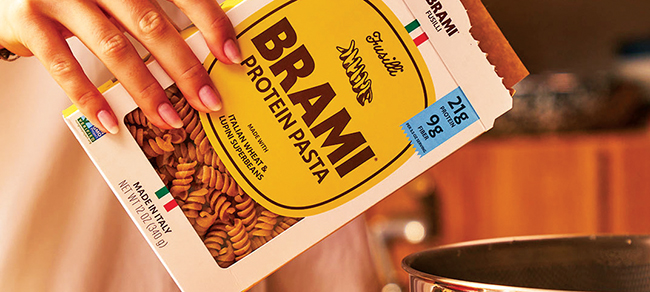
Brami Raises $33M To Scale Lupini Bean Supply Chain
Lupini bean food platform Brami has raised $33 million in a funding round led by VMG Partners.
“This is a huge step towards bringing the Brami vision to life via sharing uncomplicated food inspired by my childhood with more Americans,” founder and CEO Aaron Gatti said. “I’m so grateful for the journey ahead, and all the special meals we will share together.”
The new cash will primarily be used to scale up the company’s supply chain for its hero lupini bean ingredient, Gatti told Forbes. The company has been on a meteoric growth trajectory since launching its pasta products in 2021.
Earlier this year, Nosh reported that Brami’s dollar sales were up 439.9% to about $14.7 million in multi-outlet retail and
convenience stores, while unit sales rose 284%, per Circana data for the 52-week period ending December 28, 2025. The 10-year-old company added a significant number of retail accounts throughout last year, including nearly all Walmart, Whole Foods and Target stores nationwide.
That growth is expected to continue. Gatti told Forbes the profitable company is expecting to grow 400% in 2026.
Brami’s protein pasta is driving the rise. Available in spaghetti, radiatori, penne, fusilli and curly mac, the pasta contains two ingredients – semolina durum wheat and lupini bean flour – while packing 21 grams of protein and 9 grams of fiber per serving.
“Our intention was to craft a nutritious pasta that doesn’t compromise on great taste, texture, and pure joyful eating,” Gatti said. “Instead of cutting corners, we invested in timeless production methods and just two old world ingredients to create authentic bronze cut pasta from premium durum wheat semolina and lupini bean flour.”
The new cash will be used to continue scaling up those production methods at its Italy-based factory. While today’s news marks a major inflection point for the brand, it’s been a long road for Brami to find product-market fit and convince Americans to give lupini beans a taste.
The brand was founded in 2016 with the idea of building a market around snackable lupini beans. The brand still sells its resealable pouches of brined and flavored lupini beans at Whole Foods, but pasta is the star of its portfolio.
“When people realize [the nutrient density], they end up consuming more pasta than they used to,” Gatti said. “Not just more healthy pasta. But more pasta in general. We are really resolving the two major growth challenges that the pasta category has traditionally faced: the ‘empty carb’ guilt association with traditional pasta on the one hand, and the taste, texture, value challenges of ultra low-carb or gluten-free pastas on the other hand.”
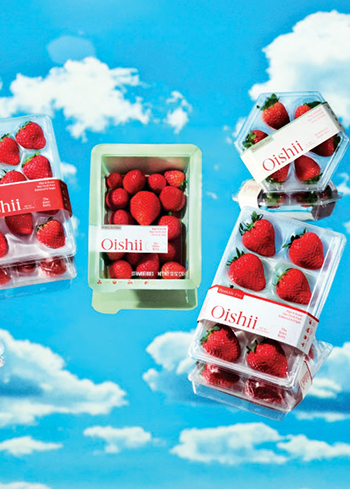
Oishii Raises $150M To Scale Strawberry Farms
Vertical farming food tech company Oishii – they make those big berries – announced the first closing of its $150 million Series C round, led by SPARX Asset Management Co. The round also saw participation from Nomura Real Estate Development Co., Ltd., MISUMI Group Inc., Mizuho Bank Ltd., and others.
The financing builds on a $150 million Series B, which closed in 2024, and brings Oishii’s total funding raised
to-date to $370 million, the company said. The new funding will go towards production capacity, robotics integration, farm infrastructure and R&D on new product formats.
“When we chose strawberries, we knew we were selecting one of the hardest paths in indoor farming,” said Hiroki Koga,
co-founder and CEO of Oishii, in a statement. “They require precision at every stage, from pollination and harvesting to freshness and shelf life, and there were moments along the way where solving one challenge revealed the next one underneath it.”
According to Koga, this funding signals the start of a new phase for the company, marked by “deeper confidence” in its execution and ability to consistently grow high quality produce at scale.
Founded in 2016, Oishii produces luxury-positioned strawberry varietals for U.S. retailers, grown inside its 237,500 sq. ft. Indoor Smart Farm located in Phillipsburg, N.J. The farm, which is named the Amatelas after a mythical Japanese sun goddess, opened in 2024 and is co-located with a solar field.
In April, the company significantly expanded its product portfolio, introducing new formats and lower-priced options in an
effort to make the berries more accessible to a broader consumer base. Oishii first launched its Omakase Berry at nearly $50 per tray; now, the product is available in a new $11.99 format.
Additionally, it introduced new pack sizes for its Koyo and Nikko berries as well as a Premium Preserves live, bringing the brand into pantry staples. Prices for Oishii products now span $4.99 to $15.
Oishii products are currently distributed across 18 states totaling 300 retail locations; it recently rolled out internationally for the first time with a Toronto-based retailer.
Those gains have been enabled by major investments in the business including the 2025 acquisition of harvesting robotics startup Tortuga AgTech followed by a strategic partnership with automation components supplier MISUMI Group Inc.
earlier this year. The company also recently opened its new Open Innovation Center in Japan to spearhead R&D capabilities.
“Since our Series A investment in 2019, we have continuously supported Oishii Farm’s growth,” said Shuhei Abe, president and CEO of SPARX Asset Management Co., Ltd., in a press release. “It is truly inspiring to see the vision we shared at that time steadily becoming a reality, as the company advances seamlessly from research and development to proof of concept and commercialization.”


Receive your free magazine!
Join thousands of other food and beverage professionals who utilize BevNET Magazine to stay up-to-date on current trends and news within the food and beverage world.
Receive your free copy of the magazine 6x per year in digital or print and utilize insights on consumer behavior, brand growth, category volume, and trend forecasting.
Subscribe