

“Moderate caffeine” and “hydration” aren’t typically attributes the everyday consumer associates with energy drinks. But Huxley is hoping to change that.
“Seventy-two percent of consumers are looking for lower levels of caffeine and energy drinks, and that’s something the industry isn’t speaking to,” Huxley founder Simon Solis-Cohen told BevNET, citing Mintel data. “I’m a caffeine-sensitive person, and I assumed there were many people out there like myself, and I was right.”
That confirmation has arrived quickly. Since its 2024 speedrun from concept to launch – Huxley came to fruition in just 130 days so as to debut at Expo West that year – the brand has built a distribution foothold across the Midwest. Its products are currently available in approximately 500 doors, including select Target, Fresh Thyme Market and Hy-Vee locations.
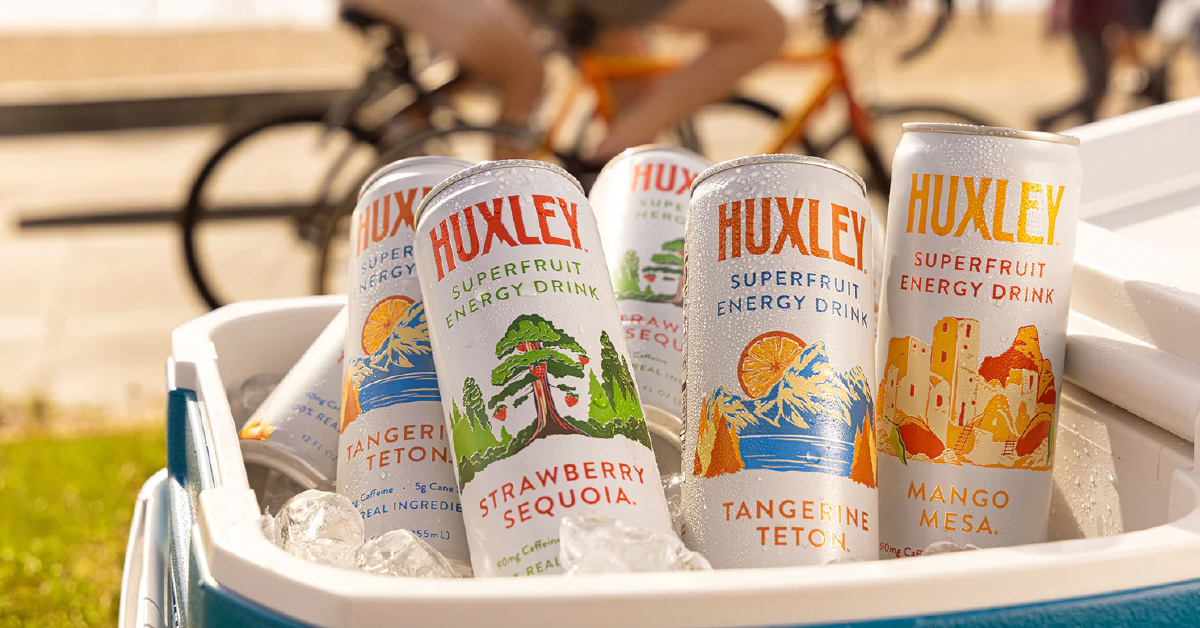
Offered in three flavors – Tangerine Teton, Strawberry Sequoia and Mango Mesa – each 12 oz. lightly carbonated energy drink contains 90mg of caffeine from cascara, 5 grams of organic cane sugar, 100mg of electrolytes for hydration and 50mg of L-theanine to reduce caffeine crash.
After having conversations with other entrepreneurs in the industry, Solis-Cohen said he chose to scale Huxley through regional growth. Last year, the company focused on getting into as many major retailers and independents in the Twin Cities metro as possible. In 2025, Huxley is dedicated to growing its Midwest footprint, as well as expanding into Colorado, Washington and Oregon.
This summer, Huxley is taking its products on the road with a series of 10 Costco roadshows intended to generate greater brand awareness. The partnership was born out of a conversation Solis-Cohen had with a Costco representative at Expo West 2024. The roadshow includes multiple cities in Minnesota, Illinois and Wisconsin.
“The best way we sell our product is by having a conversation and getting people to taste it. We’re not trying to dupe a popular energy drink. We’ve completely reimagined what an energy drink can be,” said Solis-Cohen, noting that roughly 50% of the brand’s customers are converting from other brands, while the other 50% are individuals who feel the energy drink category doesn’t speak to them.
Solis-Cohen is currently working through distributors like UNFI and KeHE and is confident that he can scale Huxley “pretty far” with his broadline strategy. However, having such a disciplined approach to retail expansion also means making the difficult decision to turn down some potential partnerships.
“We have retailers reaching out to us in [regions we plan to expand into down the road] and offering us fantastic opportunities. It’s hard to say no when someone’s offering to put money in your pocket. But I have to stick to my focus of ‘inch wide, mile deep,’” said Solis-Cohen.
Coinciding with its distribution push, Huxley unveiled a new look, changing the description from “plant-powered” to “superfruit” energy drink to highlight its hero ingredient, cascara. The refreshed packaging, unveiled in February, also replaces heat-shrink plastic labels with fully printed cans and brings its value propositions of “90mg caffeine” and “100% real ingredients” to the lower half of the can.
Thanks to cost cuts tied to the packaging updates, Huxley was able to pass on its savings to consumers. “Fantastic” consumer reception has enabled the business to scale quite quickly on the manufacturing front while driving down COGS.
“Instead of just pocketing the money and staying at $3.49, we felt it was important to get to $2.99 as an SRP. We’re not the cheapest, but we’re not the most expensive. We think $2.99 is the perfect sweet spot in terms of price perception on shelf from consumers,” said Solis-Cohen.
Huxley’s 2024 launch was self-financed with the funds from the sale of Solis-Cohen’s digital marketing agency, Highway 29 Creative. At Expo West 2025, Solis-Cohen told BevNET the business was closing a seed round of funding. He declined to disclose the amount of the round, but said it had “easily achieved its investment goal” from angels and “value-add people” to help the brand further its Midwest expansion.
While traditional energy drinks like Red Bull and Monster still top the consumption charts, per Mintel and NIQ, better-for-you options saw the largest increase in consumption between 2023 and 2024. In the two-week period ending May 31, the overall energy drink category saw sales slow to 13.8% compared to 14.6% growth in the four-week period, according to the latest NielsenIQ data analysis by Goldman Sachs Equity Research.
Looking ahead to 2026, Huxley plans to expand its regional focus, adding California, Arizona and Texas. The following year, the company will look to the East Coast.
“We want to be really thoughtful and identify the right retailers to partner with, secure those partnerships and get [the product] out there. Because of how unique our formula is and how much fan love we’re getting, we create very loyal customers,” said Solis-Cohen.