

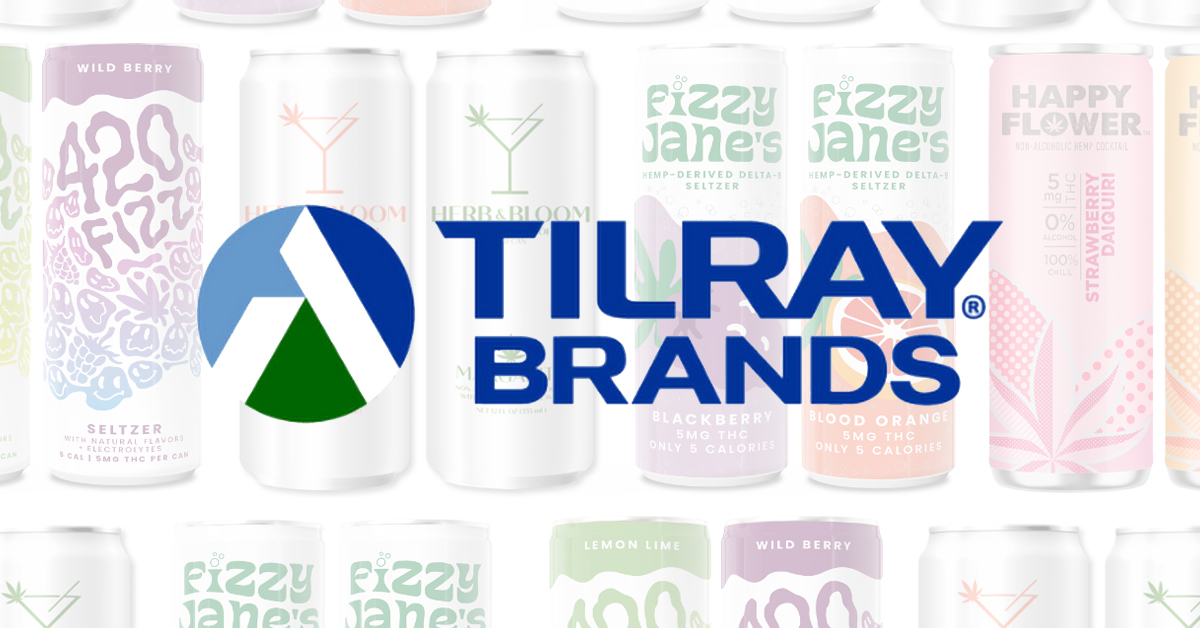
Canadian cannabis giant Tilray Brands’ intoxicating hemp beverages have generated $1.4 million in revenue so far in fiscal year 2025, boosted by distribution expansion to more than 1,000 points of distribution across 10 states, including the addition of Florida, Alabama, Georgia, North Carolina, South Carolina, Tennessee, Louisiana and New Jersey.
Tilray shared those updated numbers during its quarterly earnings call with investors and analysts this morning. The company recorded a 1% year-over-year (YoY) net revenue decline across all its business ventures in Q3, but the latest financials are simply growing pains as the company continues to streamline and consolidate its business, according to leadership.
The company recorded $185.8 million in net revenue in the quarter (ending February 28), increasing to $193 million when on a constant currency basis. Tilray CEO Irwin Simon emphasized that Q3 2024 included $6 million in revenue from now discontinued SKUs.
Tilray’s Q3 gross profit increased 5% YoY, to $52 million, while gross margin increased 200 basis points, to 28%. The company also recorded a net loss of $793.5 million in the quarter, due to a $700 million non-cash impairment “as a result of macroeconomic conditions and declines in market capitalization, foreign exchange loss, amortization, changes in fair value of convertible notes receivable, and stock-based compensation as well as non-recurring transaction and restructuring charges.”
Tilray’s bev-alc division – nearly 30% of the company’s total business – posted slightly better results, recording a nearly 2.3% increase in net revenue, from $54.7 million in Q3 2024, to $55.9 million in Q3 2025. Gross margin from Tilray’s 20+ beverage brands increased from 34%, to 36%.
As announced earlier this year, Tilray has created a strategic initiative for 2025 titled Project 420, which includes the prioritization of SKU rationalization, geography and distribution consolidation and portfolio optimization. The company has increased its cost savings target for the initiation to $33 million, with $20.6 million completed so far.
The total revenue impact of Project 420 on the division is expected to be $14 million, according to Gilmore.
Strategic initiatives and SKU rationalization across Tilray’s total business is expected to have cost the company $13.2 million in revenue through the first nine months of the year, and is expected to total $50 million in lost revenue for the full year, with the company now projecting full-year net revenue between $850 million and $900 million.
Part of Project 420 that hasn’t been executed yet is the consolidation of the beverage division’s network of more than 700 distributors, which includes a mix of Molson Coors, Anheuser-Busch InBev (A-B) and independent distributors.
Tilray’s existing network composition is the result of its various bev-alc acquisitions over the past five years, starting with Georgia-based SweetWater in 2020, followed by California-based Green Flash and Alpine and Colorado-based Breckendridge Distillery in 2021; eight craft beverage brands from A-B (Shock Top, Breckenridge Brewery, Blue Point, 10 Barrel, Redhook, Widmer Brothers, Square Mile Cider and Hiball Energy) and the acquisition of Montauk Brewing in 2023; and four craft beer brands from Molson Coors in 2024 (Hop Valley, Terrapin, Revolver and Atwater).
Part of Tilray’s delay in distributor consolidation is that the company had a two-year agreement to maintain existing deals with A-B distributors following the 2023 deal, Simon said. Now, the company is starting to look at where it can make changes, and is considering bringing on a “third party group” to help “get all the costs and efficiencies and make some of the right moves,” he added.
Looking ahead, Tilray is hoping to increase investment across four key areas, including craft light beer, non-alcoholic (NA) beer, spirits and intoxicating hemp beverages. In the latter space, it’s adding 420 Fizz to its lineup of beverages that already includes Happy Flower, Fizzy Jane and Herb & Bloom. The new offering is a low-calorie, “sweet and flavorful soda proposition.”
Simon acknowledged that there is still a great deal of “educating consumers” that is required in the intoxicating hemp beverage space on what the beverages are, but “if anyone can do it,” Tilray can, he said, adding that the company has the confidence of some major retailers, including Total Wine & More.
For more details on Tilray’s Q3 earnings and its beer business, read our coverage on Brewbound.