

Tangled Up In Brew: How Yerba Mate Became The Next Great Tea Style
Iced tea is one of the world’s oldest refreshment beverages, but for product makers there’s been a tradeoff: the drink’s surface simplicity has inhibited brands’ ability to adapt to changing marketplace trends.
That is beginning to change, ever so slightly.
The category’s evolution is not necessarily steeped in innovation, but instead infusing modern appeal into older approaches. Iced tea companies are finding avenues for growth by leveraging consumers’ evolving tastes and rising adoption of functions sustaining health, wellness, longevity and energy alongside contemporary branding approaches.
Placid Numbers
On the surface, canned and bottled iced tea sales have been relatively stagnant.
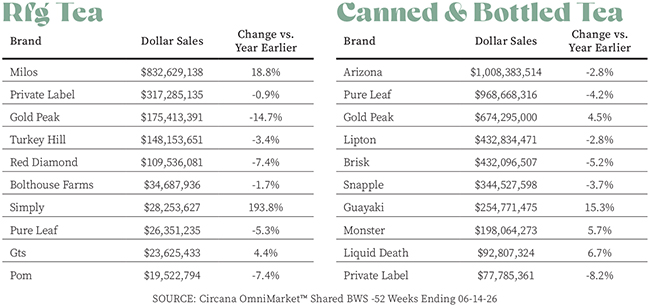
Dollar sales of tracked category brands were down 1%, as volumes fell 2.7% in the 52 weeks ending June 14, according to Circana’s MULO+C channels.
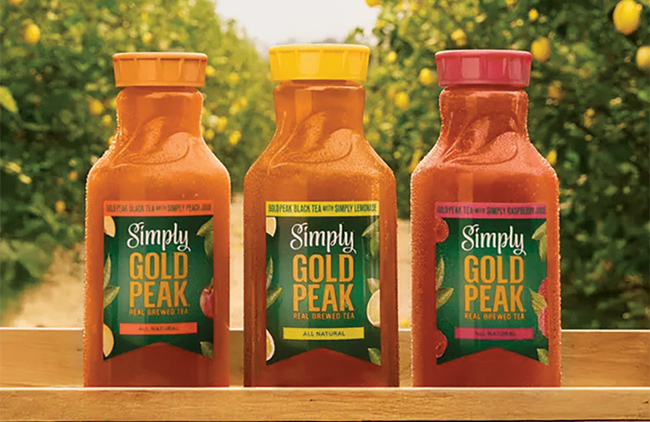
Nearly all the legacy brands dominating the top of the set had declines in dollar and volume sales. The sole exception in the last 52-week period was Coca-Cola’s Gold Peak, with dollar sales rising 4.5% and volumes up 0.8%.
This could be attributed to the success of a co-branded line of half-and-half (lemonade and iced tea) drinks with another Coke property, Simply.
In the refrigerated tea category, dollar sales for Simply – known for its chilled lemonades and fruit juices – shot up 193.8%, while volume jumped 195.9% in the 52-week period.
The co-branded line’s success has attracted younger consumers, particularly Gen Z and millennials, to Coke’s tea options, said Coca-Cola Teas senior director of marketing Fred Mitchell.
“Simply Gold Peak has reinforced the strength of both brands by bringing together two names consumers already know and trust,” he said. “By combining Gold Peak and Simply, we have created an all-natural offering that has helped attract new consumers and drive growth for the category.”
Overall, the refrigerated tea set saw sales lift by 4.8% and volumes up by 3%. Outside of Coke’s insurgency, almost all the strategic and private equity-backed brands were in decline.
“Iced tea is rebalancing around occasion, format and function,” said Sally Lyons-Wyatt, global EVP and chief advisor of consumer goods & foodservice insights at Circana. “The category is not moving in one direction but bifurcating.”
Occasion is driving that bifurcation, whether it’s a single-serve can or bottle picked up for immediate consumption or planned shopping trips and household stock-ups of multi-serve options.
In both instances, “consumers are responding to brands with a clear authenticity proposition,” Lyons-Wyatt said.
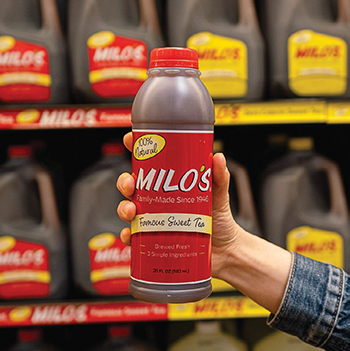
No one is doing that better than Milo’s. The category leader in the cold case has doubled down on its association with comfort, simplicity and authenticity.
Yet, even the traditional sweet tea brand is not ignoring to innovation and has responded to consumer trends by launching fruit punch and zero-sugar tea and lemonade varieties this year. Rather than play to a new tranche of consumers, the new varieties bring approachable optionality to the portfolio without stepping outside of Milo’s core identity.
‘It all comes down to our fans and our product,” said Milo’s COO Chris Droney. “We don’t use preservatives or artificial flavors, operate a 100% cold chain, and we never compromise on taste. That commitment to quality is what has built trust with our fans and helped generate our growth over the past decade.”
Choosing A Lane
Milo’s’ dedication to its 80-year-old identity is being adopted, in similar ways, by emerging iced teas that are taking on a lifestyle aesthetic.
Embracing its association with younger consumers, The Ryl Company licensed the Hershey’s Jolly Rancher brand to release new flavors that resonate with its target consumers from the Gen Z and millennial generations. Investors appear to be confident in the approach, adding a fresh $20 million to Ryl’s war chest in June, after $15 million and $7.5 million in the two previous years.
Four years in, Seth Goldman’s second brewed brand has established itself as one of the flag-bearers of premium, organic iced tea. On track to hit roughly 17,000 retail doors by the end of the year, Just Iced Tea has been rewarded with its proposition by landing a $9 million Series B in February.
Ryl and Just are part of a growing restructuring of tea taking shape in mass retail.
Walmart unveiled a modular reset of iced tea earlier this year. The new section is not replacing legacy names like AriZona or the Coke and PepsiCo-owned brands, but offering a dedicated place for insurgent RTD makers like Spindrift, Halfday, Ryl Tea, Just Iced Tea and Swoon, among others.
Many of these next-gen brands are using organic ingredients or other sustainability bona fides. STEAZ, for example, has landed the first Regenerative Organic Certified for a canned tea brand. Others are leaning toward better-for-you traits with dropped sugar counts and added functional ingredients.
These days, functionality can be defined in a variety of ways. Brands like wildwonder, Waku and Halfday have added prebiotic fiber to draw in gut-health-curious consumers. Ryl has a proprietary technology that increases the natural polyphenols present in tea.
Waking Up to Mate
Meanwhile, brands are also leaning into another of tea’s old-but-new functional benefits: caffeine.
“Tea is inherently functional because it’s inherently caffeinated,” said Scott Dicker, senior director of market insights at SPINS. “People want something to drink throughout the day that’s not water, that’s not heavily sweetened, or heavily caffeinated. Tea offers some of that.”
Anyone glancing at the ingredient list of “clean” or “better-for-you” energy drinks has probably noticed that green tea extract is often the source of caffeine. Tea brands have latched onto a similar proposition.
And while black tea and green tea offer caffeine, yerba mate offers even more.
Founded in 2021 by former Rockstar Energy CMO Jason May, Weird Tea launched as an alternative energy drink. The brand went deeper into the strategy in 2023 when it rebranded to Drink Weird, reformulated its core products with additional caffeine and added a new line of yerba mate drinks.
May isn’t the only founder seeing the overlapping Venn diagram of iced tea drinkers and mate, South America’s traditional brewed beverage, which is a natural source of caffeine, polyphenols and antioxidants — and also packs the added benefit of theobromine, which can provide focused energy.
Yerba mate category leader Yerba Madre (formerly Guayakí) has proven there is a thirsty cohort of caffeinated drink consumers searching for options outside of the coffee or energy categories.
In terms of other caffeinated drinks, the tea category has “overall been a bit sleepy or dated,” said Yerba Madre advisor and former CEO Ben Mand. “Plus, there is a growing unease about what is in energy drinks.” (Mand announced he was leaving and would be replaced by Steve Lesnard shortly before we went to press).
“Energy drinks or coffee typically have that spike and crash of caffeine,” he said. “What our consumers really like is this even release of energy that allows consumers to lock in without the big crash.”
Yerba Madre has opened the door for a slew of RTD mate brands, including CLEAN Cause, Mateína, Ola Mate, and PepsiCo’s Yachak to pursue the energy-alternative approach. Yerba mate is even showing up in energy shots with Botanic Tonics’ Feel Free KavaMate.
Yerba mate’s category dollar sales have grown 10.4%, and unit sales are up 10.3% in the last 52-week period ending June 14, according to SPINS data tracking. The subcategory is outpacing both refrigerated and ambient iced tea categories, albeit from a much lower revenue base.
That’s inspiring more iced tea brands to take an opportunistic look at yerba mate.
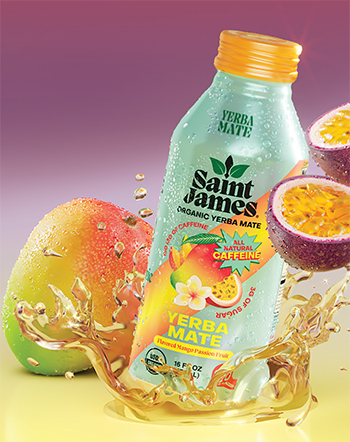
Take Saint James Iced Tea, which is also adding a new Yerba Mate line into its growing portfolio.
The decision to launch the new variety came out of a desire to offer functionality without “forcing it,” said Saint James co-CEO Brad Neuman. What stood out in the tea category was how prolific the distictively packaged Yerba Madre brand had become, Neuman said. “It seems like there are 25 facings of those yellow cans in every store.”
Saint James is launching its three flavors, Raspberry Lemon, Mango Passion Fruit and Strawberry Tangerine, in its 16 oz. resealable aluminum bottles.
Because yerba mate is often used as a pre-workout drink, or can be swapped in for the afternoon cup of coffee, it opens up new use occasions outside of refreshment for the brand, said Neuman, adding “it complements our tea but in no way cannibalizes it.”


Receive your free magazine!
Join thousands of other food and beverage professionals who utilize BevNET Magazine to stay up-to-date on current trends and news within the food and beverage world.
Receive your free copy of the magazine 6x per year in digital or print and utilize insights on consumer behavior, brand growth, category volume, and trend forecasting.
Subscribe