

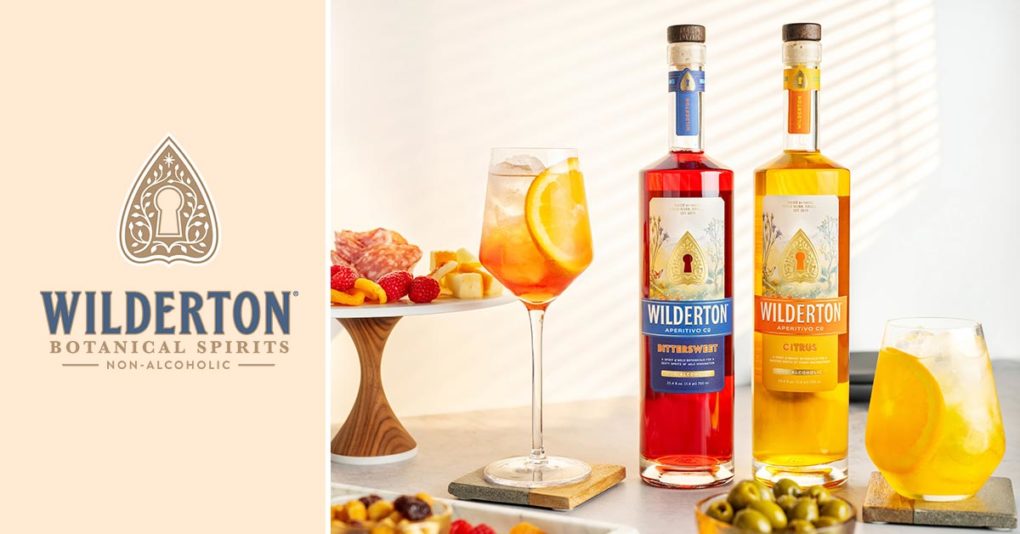
 The craft spirit veterans behind Adult Non-Alc (ANA) spirit brand Wilderton are taking the bittersweet lessons learned since debuting four years ago and channeling them into a new identity: Wilderton Aperitivo Co.
Founded by Brad Whiting and Seth O’Malley, Hood River-based Wilderton launched in December 2020 with three signature expressions that are distilled using globally sourced wild plants. Rather than creating a direct spirit replacement, the founders hedged their bets on offering unique additions to the budding non-alc movement. But that strategy bumped up against a non-alc cocktail culture still in its infancy.
Instead, Whiting said the company is now “going all in on the aperitivo space,” a category that at least in its alcoholic form has taken off thanks to the rise of the spritz and Campari’s campaign to bring Aperol’s orange hue to American cocktail glasses.
Wilderton’s previous line, which was flavor and color coded to traditional spirit categories but not specific types, will now be trimmed down. Two SKUs, Lustre and Earthen, will wind down as the company’s Bittersweet Aperitivo, a Campari alternative, takes center stage alongside a new product debuting today, Citrus Aperitivo. Both products will sport taller bottles and more elaborate whimsical imagery, part of the revamp to become a more “identifiable brand.” Like Campari and Aperol dominate the aperitivo occasion, Wilderton is aiming to do the same with their zero-proof alternatives.
Aperitifs Unlock A Gateway
Among its three previous spirits, Bittersweet Aperitivo was always the product that “shortened the story and selling runway” for Wilderton, said Whiting. Consumers and retailers knew what to do with a Campari replacement and simple cocktails like the spritz, which unlocked “a gateway” to the shelf and recruit the traditional alcohol consumer into the non-alc space.
Unlike other cocktails, the non-alc spritz aligns closer with the taste of its authentic counterpart, Whiting argued.
“What we’ve seen is that the ability to deliver a non-alc spritz that is as compelling as the alcoholic version is a little bit lower of a bar than what a lot of brands, or even we were facing, when we were when we were focusing on non-alc versions of foolproof spirits,” he said.
The spritz is also an increasingly popular cocktail, reaching the sixth most popular spot in the U.S. in the first quarter of 2024, up by two places from the fourth quarter of 2023, and as of July was rising faster than any other top-ten cocktail, according to CGA.
There is another benefit to an aperitivo focus. Many non-alc spirits require the use of preservatives, such as potassium sorbate and sodium benzoate, which aren’t allowed in many natural grocers. While O’Mally attempted to engineer the other Wilderton spirits without preservatives, only Bittersweet offered shelf stability without the restricted ingredients. The shift to focus on that SKU has allowed them to sell to Whole Foods Market and Sprouts, channels where their consumers shop.
“The velocity metrics that we see at those types of accounts are almost three times the velocity than the traditional liquor stores and non-natural grocers,” said Whiting.
The company previously planned to expand market by market: last year the plan was to trickle into California, and in an interview with BevNET last Fall Whiting boasted about iconic on-premise partners like Trick Dog in San Francisco and Death & Co in Los Angeles. But the team is now straying away from the typical spirits playbook, which relies on penetrating bars in specific markets under the philosophy that on-premise is the main point of discovery for most new brands.
“Our velocity is proving that the right retail partner who’s targeting the right kind of consumer for us is actually a better, broader opportunity than spending a ton of time and resources getting into every bar and every independent store in a smaller geographic area,” said Whiting.
Wilderton is now spread across 400 Sprouts stores in over 20 states, and in Total Wine & More and Whole Foods also across multiple states as well.
The shift in account strategy is also changing the brand’s route-to-market as it expands outside of bev-alc distributors; the Sprouts business came through KeHe, as an example.
“Unlike spirits who have to go through the traditional three-tier we are trying to build out a bit of a hybrid where we’re still deeply partnered with our three-tier folks, but a larger retailer who’s building out a comprehensive non-alc set really is going to have the say of where they want to buy that product through,” said Whiting.
Inflection Point in Non-Alc Spirits?
Last July also marked the realization of a dream since launch, the opening of Wilderton’s 4,000 square-foot distillery on the waterfront in Hood River, Oregon as the first non-alc tasting room in the country. Hosting thousands of visitors has helped them gather data, much of which pointed to adding an additional aperitif with a sweeter twist.
Preferences in the tasting room matched overall sales, with 55% of sales from the three-SKU line coming from Bittersweet. But tasting room visitors expressed a preference for something less bitter. That kicked off the idea to bet on two bitter expressions, and the team got to work on a six-month rebrand and the new Citrus. The hardest part, said Whiting, is retiring “his babies.”
But the team is shedding its old look and lineup for what they hope is a clear non-alc brand that parallels the interesting spirit brands consumers have become attached to through beautiful imagery and messaging. The ANA category is at an inflection point, said Whiting, moving away from products that fill a utilitarian void for the bartender and into strong brands with character. It’s a similar approach to fermented and distilled non-alcoholic amaro Pathfinder, which earned some validation as the Stoli Group’s first foray into the zero-proof space.
“There’s a few of us out there that are betting that the consumer is at that point where a really strong, identifiable brand can and should have more long-term resonance than something with a product-first focus,” he said.