

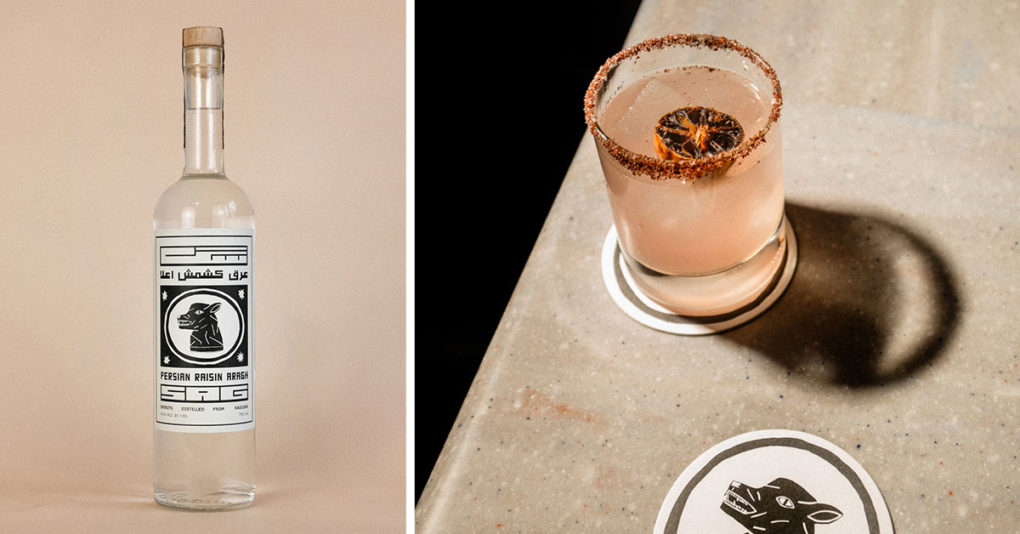
 Arak is a distilled beverage found all over Southeast Asia and the Middle East, but until now an American version has yet to make waves.
Enter SAG, an arak label founded by four Iranian friends based in New York.
“We eat Iranian food, there are all these Iranian restaurants, we get Iranian groceries, but no one was making Iranian Arak here,” said co-founder Amir Imani, who lives in New York City.
As an experiment, two of Imani’s friends began making arak at home and one night “probably with some drinks involved,” the artists in the group came up with a logo. SAG, which brandishes a black dog as its logo, pays homage to the first bottle of arak in Iran, which featured an illustration of the owner’s dog on the label. The drink has since been referred to in Iran as aragh sagi in Farsi, or “arak of the dog.”
A Historic Spirit
While Arak has yet to hit the mainstream in the U.S., spirit drinkers have its creator, an 8th century scientist, to thank for inventing the first alembic still, which opened the doors to producing distilled spirits from wine and beer. Centuries after its debut, Arak is still the mainstay spirit of many Middle Eastern countries, each with its own traditions and regulations. In Lebanon it’s regulated and protected under an appellation similar to Champagne or mezcal. In Iran, where the SAG founders spent their childhoods, alcohol was outlawed for the general population after the 1979 Iranian Revolution.
But arak is still produced clandestinely in Iran, and the spirit made frequent appearances at gatherings.
“It was always part of getting together, being happy, being sad, and not knowing if somebody would get offended if you drink, or if somebody wants to drink. There’s always a little excitement around it,” Imani said.
Arak may be the first-ever flavored spirit and categorized as a liquor in the U.S., but it’s really a high proof (often above 50% ABV), clear spirit, typically made with grapes and with a strong taste of licorice from aniseed added to the distillation. In Imani’s community it was consumed straight alongside a spread of traditional snacks, or cut with cherry or orange juice. In other countries, arak and similar drinks such as Turkey’s raki are mixed with water to dilute its strength and make it more sessionable to accompany meals.
With production limited in Iran, traditional brands from other countries have dominated the global market – and a new generation of producers, such as Lebanese distiller Arak Farid and Palestinian craft distiller Arak Muaddi have brought fresh takes and attention to the spirit. Importers such as Terra Sancta Trading have also been helping to shine a light on revived beer, wine and spirit traditions from the Levant region as well. But so far, American-made arak has been limited to a few distillers, with zero active brands on the market. Miami Arak looks like the most recent attempt, even throwing hard seltzers in the mix, but hasn’t posted on its Instagram since 2023.
A Modern Arak Brand is Born
SAG follows the Iranian tradition of distilling the liquid exclusively from fermented raisins, eschewing the anise often found in other regional distillates. To scale production, the team enlisted the help of Yonkers-based craft distiller Baron Nahmias Distillery, which also produces a Moroccan-inspired distillate from figs, and a number of contract spirits. The result is a 40% ABV California raisin made-distillate that shares more tasting notes with grape-based pisco than other araks.
The first batch was launched in February 2024, followed by a second arriving after a celebration of the Iranian new year in April that drew more attention to the brand. After working in bars and restaurants for 15 years in New York City, one founder’s connections has spearheaded the company’s footprint on-premise, where for now, the SAG team is focusing its energy.
SAG isn’t cheap for those new to the spirit: Priced from $50 to $65 at select New York retailers, the SAG team realizes they’ll need to leverage the on-premise to build awareness that could eventually transfer to better retail sales. They’re hosting events that bring in artists from the Middle East or North Africa – which Imani admits isn’t part of a fully formed marketing plan, but more a slow build as the team learns what resonates with drinkers.
SAG is now featured as part of an arak flight at Levantine restaurants and bars, and in cocktails across New York. Unlike many spirits more rare to the U.S. market, the SAG team is not approaching bars with a signature cocktail – part of that illustrates the spirit’s history as an outlawed substance in Iran, where a cocktail culture certainly didn’t flourish around the drink. But as mostly newcomers to the bev-alc industry, Imani also argues that bartenders know best.
“Most bars and restaurants that we have in New York that sell us, they’re not necessarily Iranian, more New York culturally curious bars and experimental bartenders looking for the new thing,” Imani said.
SAG is also getting in on the ground floor as more young entrepreneurs from the Middle Eastern diaspora are creating their own fresh takes in hospitality, opening hotspots such as Brooklyn’s Laziza or Huda, and earning national acclaim. Bars like The Green Zone in Washington D.C. or La’ Shukran – a lounge from a James Beard Award-winning chef – are pioneering Middle Eastern craft cocktails. That could bode well for more awareness and innovation in Middle Eastern spirits, just as the evolution of Mexican restaurants in the U.S. helped push tequila and mezcal into the premium limelight.
With pre-seed investors on board, Imani recognizes that the team needs to put together a formal plan to increase sales and enter new markets, such as their next target, California. But at the time of our interview, U.S. military strikes had recently hit Iran.
“We’re trying to talk to our friends to see if they’re okay, talking to our family – most days are spent on that, as opposed to thinking about how we are going to sell more bottles,” he said.