

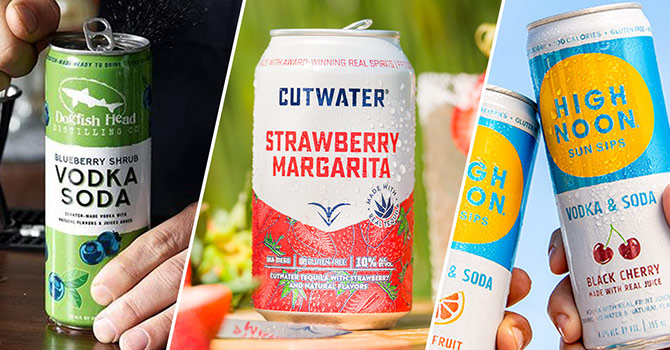
 Spirits-based ready-to-drink (RTD) canned cocktails are projected to grow at a +6% compound annual growth rate (CAGR) in the U.S. through 2028, according to market research firm IWSR.
The segment has grown across all 50 states since 2019, according to IWSR’s U.S. Navigator.
Through the first eight months of 2024, 10 states recorded year-over-year (YoY) RTD volume increases of +15% or greater:
- Wyoming
- Colorado
- Virginia
- Tennessee
- New York
- Florida
- Arizona
- Indiana
- New Jersey
- Wisconsin.
Several factors are driving RTDs’ success in recent years, according to IWSR U.S. Division president Marten Lodewijks. The first is the segment’s transition from larger format, multi-serve packs to 355 mL (roughly 12 oz.) single-serve cans.
“The emergence of single-serve canned RTDs has allowed brands to gain ground in venues/locations where glass bottles are typically not allowed, such as sports venues, concerts and beaches,” Lodewijks said.
In the last five years, 355 mL cans’ share of the RTD segment has “surged from 7% to 69%,” according to IWSR.
In addition to RTDs gaining broader market access through packaging, several state governments have expanded their reach through statute.
In 2024, Pennsylvania enacted a law allowing spirits-based RTDs to be sold in off-premise retailers licensed to sell beer and wine. North Carolina lowered taxes on RTDs in a law enacted in June 2024.
Vodka is the No. 1 spirit base in the segment, toppling tequila three years ago. Both spirits “continue to dominate due to the growing availability of sessionable vodka/tequila soda offerings,” according to IWSR.
Gin is gaining popularity as a base, driven by legal-drinking-age (LDA) Gen Z consumers, according to IWSR. Gin-based Finnish Long Drink is the No. 7 RTD brand by dollar sales in the 52-week period through November 30 at off-premise outlets tracked by market research firm NIQ, according to data provided by insights firm 3 Tier Beverages. The Long Drink has recorded impressive growth in both dollar sales (+52.6%) and volume (+51.3%) compared to the same period in the prior year.
Innovation in the RTD segment is slowing, IWSR reported. Cocktails and long drinks are outpacing other styles in numbers of new entrants, making up about one-third of all RTD innovation products.
Lodewijks called the combination of sustained growth amid declining innovation a “great sign for the industry.”
“While RTDs will remain an innovation-driven category, the proliferation of brands and variants in 2021-22 created consumer confusion and saturation that ultimately only benefitted a few players,” he said. “The more focused innovation approach, with brands relying more on a few core SKUs, gives consumers an anchor around which to explore the category while not being overwhelmed by choice ‘risk’ — the risk that they don’t like what they’ve bought.”
In the U.S., RTD drinkers skew older and more mixed in terms of gender than other markets, according to IWSR. However, consumers entering the RTD segment are “younger and more male,” which “will have implications for the styles and flavors that outperform,” IWSR noted.
“This new cohort will be more swayed by spirit-based products and more willing to buy these offerings in the on[-premise] trade, a key vehicle for brand building,” Lodewijks said.
In the 52-week period ending December 22, the RTD segment has increased dollar sales +4.1%, to $10.27 billion, while volume has remained roughly flat at +0.1%, according to market research firm Circana.