Search across the BevNET CPG Media network including BevNET, Nosh, Brewbound, Taste Radio, Nombase and CPG Jobs.

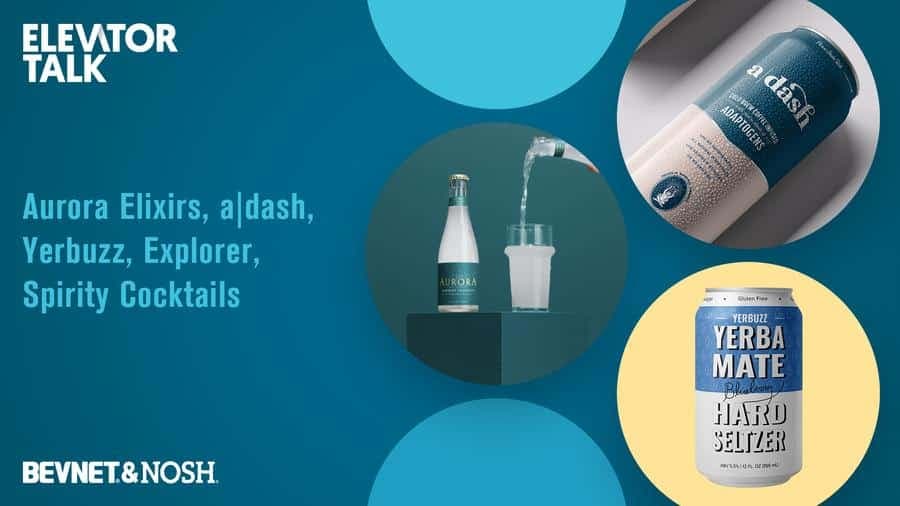
Elevator Talk Ep. 37: Aurora Elixirs, a|dash, Yerbuzz, Explorer, and Spirity Cocktails
EPISODE SPONSORED BY

Retailers, investors, distributors, suppliers, service providers and fellow brands can watch Elevator Talk every other Wednesdays on BevNET and NOSH.
Founders and CEOs of early stage food or beverage brands are invited to join future shows to pitch their products, discuss recent news and get feedback from industry experts. It is free to participate and interviews will be conducted remotely.
Transcript
Note: Transcripts are automatically generated and may contain inaccuracies and spelling errors.
Ray Latif [00:15] Hey, folks, I'm Ray Latif, the editor and producer of Bevnet's Taste Radio podcast. And you're tuning into the latest episode of Bevnet and Nash's Elevator Talk series, the show that profiles disruptive and early-stage brands from across the food and beverage industry. Today, we're gonna be speaking with the founders of 5 beverage brands and hear feedback from our co-host for this episode. That's Jessica Young, the founder and CEO of online retailer Bubble. Jessica, how are you? Good, Ray, how are you? I'm doing fantastic. Uh, so good to see you. Uh, we did a great podcast episode last year. I learned all about Bubble. For folks who might have missed that episode, and I don't know why you would have if you're a loyal listener of Taste Radio. Uh, tell us a bit about your company.
Speaker 2 [00:59] Yeah, we are. Close to being the largest seller, um, online of clean label health foods. Um, so we have a platform that connects the very best brands with customers looking for the most amazing innovative products across the US online. So really taking, you know, your kind of local either green market or, um, health food store and getting all of that inventory online, um, so that, you know, you can reach customers today where they're shopping.
Ray Latif [01:30] Very cool. Um, now how many brands do you guys represent? How many brands are on your platform?
Speaker 2 [01:35] Yeah, we currently have about 400 brands live and selling, all shelf stable. So, um, you know, beverages are in that category. Um, they're online. Um, we just, uh, made some serious investments on the platform front. So, um, we have a In, in, and, and I know you know this, an industry, uh, hefty waitlist of a few 1000 brands. And so, um, we're opening that all up in the next few weeks for brands to sign up, completely self-serve, um, to get on and shipping with us.
Ray Latif [02:06] Very cool. Well, I have a feeling that some of the brands participating today and some of the brands watching at home with the founders of those brands watching at home, we're quite interested in, uh, hearing more about that. In the meantime, we're gonna have some fun today speaking with the 5 founders, but before we do that, we'd like to thank our sponsor for this episode. That's Mother Murphy's Flavors celebrating their 75th anniversary. Mother Murphy's Flavors has elevated flavor innovation in the food and beverage industries. Clients can choose from the company's ever growing library of over 60,000 flavors or its TTB approved flavor library of over 2000 flavors. Their in-house chemists can also help you create a custom flavor that will give your products a winning edge on the market. To learn more about how Mother Murphy's can support your product development and innovation strategy, head to Mother Murphy's.com. All right, Jess, you ready to meet our first participant of this episode?
Speaker 2 [02:58] I am super excited.
Ray Latif [03:00] Let's do it. Fantastic. All right, it's Victoria Posinski, who is the founder and CEO of Aurora Elixirs. Victoria, how are you?
Speaker 3 [03:09] Hi, I'm good, Ray. Hi, Jessica.
Speaker 2 [03:12] Hi, how are you?
Ray Latif [03:14] So great to have you on the program. Uh, I tried Aurora early this year and was really happy that I did. You do have a fantastic product. Tell us a bit about the brand and the products that you make.
Speaker 3 [03:28] Sure, so Aurora makes elevated sparkling beverages. We use whole plant ingredients, botanical ingredients, and they're all non-alcoholic. So we really sit at the intersection of like functional beverage trends and the non-alcoholic beverage trend. So we currently have two lines. We have our original line, which is hemp infused, so it has 25 mg of CBD. And then we have our newest line which is hops infused. So these are, we launched with two flavors of hops beverages earlier this year. So I founded the business back in 2016 after over 10 years in wine and spirits. I moved to Oregon and it was right when both recreational cannabis and wine industries were booming. And I saw an opportunity to create a sophisticated non-alcoholic but aperitif inspired bottled beverage that highlights the sort of soothing and restorative plant ingredients, and they're all locally grown plant ingredients. So we use cannabis, hemp, and hops, and then we really highlight the flavors and aromas of those plants. So instead of masking them or hiding them, we build botanical. Packages that highlight those and enhance those natural plant aromas. We are female founded and we are totally operated by mostly women wine industry professionals, and we hand select all of our ingredients. We blend and batch all of our beverages in our own facilities, so we don't use a co-packer right here outside of Portland, Oregon. And I think we're made for people who are looking for kind of a refined way to replace a traditional cocktail occasion and sort of an interesting non-alcoholic package.
Ray Latif [05:10] Well, you said a lot of things there that made Jess smile. Um, and before we get to, uh, her feedback, I, I'd like to ask you a question about your website. Uh, you have, uh, 3 or two words in one phrase right up there you say aperitif, spritzer, refined mixer. Um, is there a particular, uh, usage occasion that really stands out, uh, as it relates to how your consumers, how your customers consume your products?
Speaker 3 [05:37] Yeah, I mean, I'll be honest, when we first started coming from such a long career in the alcohol industry, the non-alcoholic was very new space to me. So when we were formulating, we wanted something that tasted Amazing on its own, but could enhance a cocktail, a traditional cocktail. So we thought of something that would be both a mixer and a standalone beverage, but it really as the kind of category evolved over the past few years, we found that most of our consumers are really looking to find something that feels celebratory and sophisticated but doesn't contain alcohol. So I would say most of the time our usage occasion is kind of a cocktail replacement.
Ray Latif [06:20] Yeah, we're starting to see a lot more brands play in that space, uh, it is still a bleeding edge category, this idea of non-alcoholic cocktails. Ah, Jess, you know, what's your take on the evolution of that space and, ah, what do you think of Aurora playing in that, uh, in that category?
Speaker 2 [06:38] Well, from what I see and what I know about your brand, I love, and especially looking at your website, I haven't tried the product yet. Um, and I haven't looked into all the ingredient descriptions. But from what it looks like, it seems that you have all natural, um, you know, herbals, botanicals, you're not that you're distilling and, and working with. You're not adding a lot of artificial, you know, sweeteners, gums, dyes, preservatives to, to make something shelf stable or last longer, which, um, is something we look for at Bubble, everything, um, that we sell in bubble cannot contain those ingredients for us to be building, you know, a platform and, and being the retailer of the future of food, um, that's something that we stand by. And so to see someone come into this category, which is still a bit niche, but very much on the rise, um, we, I'm loving kind of how you're approaching it, um, and, and not overloading, you know, with sugar. And that is the consumer, um, who is going to be buying this type of product. That's, that's also what they're looking for, um, so I think you're right on with how you're making the product. Um, I can speak from, you know, a place of what we're seeing sell on Bubble, and, um, you're hit, you're going into a great category. Um, for the person who's shopping online, B2C, who's shopping for better for you, this is a very hot category, um, and it's a very, um, repeat heavy category. So within beverage, this is one of our hottest categories. Non-alcoholic, and we're actually in search of many more. Um, it's been in our monthly vendor newsletter to our current sellers, um, actually like looking for more of what you're making. So I'm happy to be on this, um, you know, call today because we just discovered a great new product that I think, um, we can sell a lot of. So excited for your next moves.
Speaker 3 [08:20] Thank you. And I do want to, we do use pure organic cane sugar, and we do use small amounts. So there's 6, there's 6 g. In our hemp elixirs, and it was very deliberate. I think we wanted to sort of transcend the seltzer space and have something that was more cocktail appropriate. And because we use whole plant extracts, they tend to be on the bitter side. So I found that a little bit of sugar just kind of balances that out and helps to kind of create something that is still full of flavor but not very caloric or overly sweet.
Speaker 2 [08:54] Yeah, from the consumer we speak to, they definitely look for things kind of, um, I think Ray and I were talking about, uh, in a previous conversation, spin drift, for example, adding, you know, whole, um, fruit juices and things like that, maybe even just a straight refined sugar. Um, and also it would be, you know, something that would categorize you to sell on bubble. So, um, yeah, maybe kind of thinking about that. Um, but yeah, yeah, the product looks great.
Ray Latif [09:18] Victoria, um, it sounds like most of your products are sold direct to consumer at this point, um, but can you elaborate on where you're sold, uh, where Aurora is sold, and what the price point is at this point? Yeah,
Speaker 3 [09:31] we do sell direct to consumer, but we're distributed on the West Coast, so in Oregon and California, and we're starting to get into Washington with our hops products, um, and we have definitely have more retail opportunities with hops than we have with the hemp. DVD that we're seeing open up and retail wise we target an SRP of about $5 with the hemp drinks and about $3 with the hops drinks, so it's sold in 4 packs, so about $9.99 dollars for a 4 pack of Of our hops between $999 and $1199 and about $15 for the, for the hat.
Speaker 2 [10:09] Is the product shelf stable? Um, if it is, what is the shelf life?
Speaker 3 [10:16] So we count about 18 months of shelf
Speaker 2 [10:19] life.
Speaker 3 [10:20] We've been doing batch testing and potency testing even on our original products that we bottled back in 2018, and everything keeps on coming up clean, so we say 18
Speaker 2 [10:30] months. OK, yeah, for something so fresh and distilled, that's a really long shelf life, so that's great.
Ray Latif [10:36] Yeah. Yeah, Victoria, in terms of uh your hop variety, hops as an ingredient in beverage has also been on the rise. Um, I wonder, you know, where that ingredient fits into, uh, a customer's, uh, interest when it comes to beverages. Are you seeing more and more people understand that Hobbs just doesn't necessarily need to be a flavor that's specific to beer, or is it something that still requires quite a bit of education?
Speaker 3 [11:05] We're still definitely educating customers on hops, and I think we were still learning about it on our own. We were introduced to hops as an ingredient, obviously outside of beer, knowing and loving it in. IPAs, especially in the Pacific Northwest, but we learned that it was very similar to cannabis in flavor, aroma, and it's really a cousin to cannabis, and that's sort of what led us to it. And then found that it's got these beautiful. Wonderful like restored properties that we ordinarily associate with CBD. Um, so, It definitely brings a beautiful bitter flavorful note to the products and aromas, but it's not like overly bitter like a lot of people associate with IPAs ordinarily. So, but for on its own, I mean, it's a wonderful ingredient, and we see that a lot of the other non-alcoholic products like even some of the non-alcoholic spirits contain hops as well. So people are definitely learning to use it in different ways.
Ray Latif [12:09] Yeah, uh, just in terms of the packaging, um, any thoughts, uh, as it relates to label design, or, uh, package type, in this case glass, um, that you like or would have any recommendations about?
Speaker 2 [12:24] Yeah, big fan of glass, obviously heavy to ship, um, so curious of your, you know, long term distribution play, um, I can speak to, uh, you know, the Non-alcoholic beverages we do ship currently on Bubble, they, they use glass, and so, and that's fine, that the Bubble consumer does love glass, and again, the, the Bubble consumer is the consumer who is shopping online. Um, and so if you're, you know, making a wholesale or kind of hospitality play, Versus D2C, just kind of curious. And again, I'm sure if you're just getting up and going, you probably have many ideas, like we all do, of like, what the future and ideal kind of product, um, would be. But no, everything looks looks pretty great. Um, I love what you've done with hops. It kind of has that Belgian. Glass bottled element to it. So I think the thought there is really great. I think that it really stands out a lot more to even kind of the um hemp products that you have. So I love what you've done there. It's like really reminiscent of that. Um, and again, like, you know, if you're gonna compete online or on a virtual shelf, Or on a brick and mortar shelf, just how do you stand out as non-alcoholic, when, let's say you're within that category, or let's say your merchandise next to actual hop beer, um, would be my, um, kind of note there of how do you, how do you stand out and really let the consumer know this is non-alcoholic, uh, without kind of blasting it, or maybe drawing a little bit of attention to that, actually, because it does look such, so much like a really well-packaged Belgian beer.
Speaker 3 [13:56] I mean, that's great feedback. I appreciate um the positive notes on that. Yeah, I'm, I love glass and I And I had never really thought about doing anything otherwise. You know, sometimes it's like we have this vision in our head when we're starting something and it's so difficult to stray from it. And I think it's like my 10 years in the champagne industry that like, I gravitated towards this little bottle, and it may have been the best move or the worst move ever, but I was like totally fixated on this 200 mL glass shaped bottle. Um, we did learn that hops is very light sensitive, so we moved to the amber bottle for the hops, um, but I do think it was a great move, um, because we love this package, but we don't have any plans to move to cans, and obviously like we wouldn't ever do a plastics product. So yes, it's very heavy to ship and um you know we plan, we plan to grow our distribution, especially for hops, which makes it much more um accessible but but
Speaker 2 [15:00] are you distributing B2C? Do you have one fulfillment center or are you fulfilling nationally?
Speaker 3 [15:07] So we ship, we fulfill everything out of our warehouse outside of Portland, Oregon,
Speaker 2 [15:12] nationally.
Speaker 3 [15:13] OK, yeah. Shipping everywhere from there. Well,
Ray Latif [15:16] uh, you know, I wanted to learn more about this brand, and now I have, and I'm really happy that I, uh, had this opportunity to sit down with you, Victoria. Thank you so much for the time today. Good luck with everything going forward and please stay in touch.
Speaker 3 [15:28] Thank you so much, Ray. Nice to meet you, Jessica.
Ray Latif [15:31] All right, let's move on to our next guest for this episode. That's Kelly Lammy, who is the co-founder and CEO of a|dash. Kelly, how are you?
Speaker 4 [15:38] I'm good, Ray. How are you?
Ray Latif [15:40] I'm doing great, doing great. Thanks so much for joining us today. Uh, tell us about the brand. What is a|dash all about?
Speaker 4 [15:47] So a|dash is a wellness brand that believes beverage is the best vehicle to deliver adaptogens to everyone every day. We're a Nashville-based female-founded and family-owned company, and we focus on better beverages that serve our consumers' health. So at a|dash, we believe the future of health and wellness lies at the intersection. of convenience and accessibility. So we designed this brand to fit into consumers' lifestyles because we know that the easier it is to fit something into your daily routine, the more committed you are to making long-term lifestyle changes. So, the whole goal of a|dash is to simplify your wellness routine by updating your daily coffee ritual. So we're intentionally designed to be different at a dash. So, um, we're lightly roasted, extremely smooth with a hint of earthiness, um, to appeal to coffee and tea drinkers alike. So a|dash is just adaptogens in cold brew, um, the cleanest label ingredients that we can have, very minimal, um, input. It's really the best way to deliver adaptogens through beverage. Um, and our, our first line, which is right here today, um, is our balance view. So this is, um, purposely a lot lower in caffeine than other cold brews in the market. So we only have 110 mg of caffeine. And this is specifically designed, um, to be designed to help balance your cortisol levels, um, and support adrenal health, which is really the big point of this beverage in, in choosing ashwagandha. Um, we've also, I know Jessica will like this. Um, we've removed Everything. Um, we say we removed all the BS so there's no sugars or gums, um, just clean, balanced, functional energy. Um, and really what's different about a dash is we're focused on education and label transparency. So we put on the front and center of every can, um, we have the amount of caffeine and the amount of caf and the amount of a dash that we have. Um, and we do this to empower consumers to take control of the Their own health because uh we know that there's a lot of functional beverages coming out in the market, um, and we want to make it apparent what people are taking, what they're putting into their bodies so they can really be empowered to take control of their own health. Um, and we aim to, um, be a leader in the functional category as it continues to grow. Um, when we say at a|dash, no pills, no powders, mess or stress, just simplified wellness.
Ray Latif [17:58] Alright, fantastic. Um, you know, I'm looking at your can online right now and, um, I finally figured out, I don't know why it didn't come to me sooner, what a dash means because it's underneath there it says cold brew coffee with a dash of adaptogens. Um, Jess, you know, are consumers looking for and are your consumers looking for Um, a dash of adaptogens, or are they looking for a lot more adaptogens, and in general, you know, what are your thoughts, what are your initial thoughts on a cold brew coffee made with, uh, things like ashwagandha and other adaptogens?
Speaker 2 [18:31] Yeah, I mean, you're definitely hitting, you know, two trendy categories, right? Cold brew and adaptogens, great, combine them, home run. Um, but what I will say is that people that play in cold brew and coffee are typically experts at cold brewing coffee, and where is that coming from, and what's the story? How is it roasted? And they're fanatical about that. And then on the flip side, people that are playing in adaptogens are And and the consumer looking for those types of products, but specifically adaptogens, want to know the same thing, where and why, you know, how is my Ashwagandha kind of entering this product, right? And so I think it's really important for you to come through with the brand, um, pitches, playing online, if you're doing D to C, if that's your main distribution channel, of the sourcing behind that, just given those two verticals coming together, um. And then, you know, like, yes, everyone is drinking cold brew, especially with work from home movement. People are bringing the cafe at home. They're drinking their cold brew while they're working from home, they're stocking up on that. Uh, we saw a major shift into the coffee vertical on Bubble through the pandemic last year. Um, and then it quickly became one of our highest, um, and this is gonna be a repeat because everyone's beverage. Um, today, Um, uh, highest, um, repeat for our auto ship program, um, beverage. And that's, that's right up there with the, um, non-alcoholic spirits. So, um, yeah, great call with the product. I would just say, like, at first glance at the brands, I'm excited to learn more. Um, having a little bit more come through of the, the sourcing, um, just when I look at the can, would be great, just given the, um, Insight on those two verticals from the industry perspective, and then from the consumers of those two verticals.
Speaker 4 [20:21] Yeah, that's, that's great, um, great advice there. Yeah, it's, um, because Ashwagandha is a considered a supplement, um, it is pretty strict in terms of manufacturing. So, um, we do have like all our certificate analysis and our graph statements and stuff. So that's good information for us to put up on the website to let people see kind of where we're sourcing, um, our. Coffee through and that it's organic and fair trade extract, cobra extract that we're using, um, as well as the fact that we use vegan ashwagandha, um, that we import. So yeah, I think that's a great call out for us to really share more of the information on the website of how we are sourcing and why we, um, chose these ingredients and these suppliers to provide the best clean energy to everybody.
Ray Latif [21:03] You know, Kelly, uh, Jess brought up an interesting point about, uh, coffee drinkers versus adaptogenic beverage drinkers, and, um, I wonder who is your target consumer, who is this product for?
Speaker 4 [21:15] So we really don't see ourselves as a beverage company. We see ourselves as a wellness company. So, um, our main goal is delivering adaptogens through the products. So, um, as we build out our portfolio and our SKUs, are really the main goal of it is to have a full serving of, of that adaptogen in each can. So in order to simplify your wellness routine and move steps. So the, the brand really came about as I was dealing with postpartum anxiety. Depression and really started to look at functional medicine and started incorporating ashwagandha into my daily routine with some other adaptogens and it had a, a really big impact. Um, so we know that anxiety, depression, stress, um, a lot of these disorders that we've all been impacted, especially through COVID is, um, a really big, uh, point for everybody. It's almost 50% of Americans will, um, have a mental health condition, a diag. mental health condition in their lifetime. So our goal is really to use adaptogens to help support people in their well-being, whether that's physical or mental. And, um, for us, education is, is a big platform and that's what we're really starting to talk about is how adaptogens can be used, um, why we're using the amounts that we're using and how they can benefit and serve your health. So it's really, um, the story of the brand is super authentic, um, and I was Taking probably 12 or 13 supplements every single day in order to support your health from ashwagandha to zinc to vitamin, you know, vitamin C and um it's really difficult in order to maintain a wellness routine when you're adding so many things in. So for us, we know that the easiest way for people to improve their health is through food and beverage and that food and beverage are really medicine and should, could be used as medicine. So for us, we want to ify everything in order to help consumers, um, be able to take advantage of, of these really functional ingredients that can serve their health. So, um, our consumer is definitely more niche and focused on adaptogens and how they're consuming them right now. Um, but we know that coffee is the number 2 consumed beverage in the world behind water. Um, so it gives us an opportunity to touch more consumers and really get more people in order to serve more people's health in the long run.
Ray Latif [23:24] Hm, I would have thought tea was the number 2, most consumed beverage, uh, in the world, but it's coffee,
Speaker 4 [23:29] but it's coffee.
Ray Latif [23:31] There you go. Um, you know, Jess, it's interesting because when I'm thinking about, um, you know, the amount of supplements that Kelly was taking for her physical and mental health, you know, I wonder like, how do you translate that most effectively into a beverage? How do you tell that story in a way. That's really going to reach the people uh that they're trying to reach, um, you know, without sort of having to do an overly complicated uh education about, you know, coffee and adaptogens and, you know, why they're together in this can.
Speaker 2 [24:10] Um, yeah, Kelly, that's a great question that Ray asked. I certainly would be thinking a lot about, um, that as a brand exercise all day every day, if a dash for my company. So, um, You know, right, you, you kind of have a complex problem, right? Because people are just used to coffee, cold brew. Give me a can, I want to be on the move, ready to drink, right? That's that category that you're in, in terms of like the vehicle and the vessel of what you've designed. Um, and coffee gets you up and going in the morning. It's like, OK, well, give me a, a, a punch and let's go. But then you have adaptive gins, which are there to balance your cortisol levels for, for Flight or fight. And so, you know, thinking about how to educate the customer, for example, I think recess has done a good job in beverage with CBD and the response, right? They named their brand Recess because it gives you a mental recess, and that, that was kind of their challenge with, um, CBD, particularly. So I think, you know, kind of applying those same messaging points for your specific brand might Of the consumer well that you're trying to speak to. And then again, that kind of supply chain and what's under the hood and what makes it different. Um, we see a lot of brands on Bubble, particularly that come through right now that are branded really well, which I put your category in, looks great, but it doesn't speak to the consumer. And so you can do that through a, a few ways. It's feeling, it's, um, what do you want the consumer to kind of walk away with. Um, so looking at other brands and how they're shaping that story? What are they doing in real life, right? What kind of samplings and tastings and, um, experiential can you do with your brand to kind of cut through, especially as a new brand, right? Um, entering the market. So, um, yeah, my advice would be to kind of look at that and who's done a good job in, you know, similar verticals, but different, um, and then kind of apply those rules, um, for your product.
Ray Latif [25:59] Kelly, we're almost out of time, but I just wanna ask you a quick question, you know, as a new entrepreneur, as a new uh brand in this space, I wonder what you need most, uh, in terms of help. Is it marketing, is it investment? Is it distribution, um, is it operations? Where, where would you think, uh, you would need the most help to help advance your brand for the rest of the year?
Speaker 4 [26:25] Yeah, I think all of us, of us on this call and Beveridge will probably say capital or working capital to help with um inventory, especially if you are working with the Coman or manufacturing. So for us, um, yeah, we're raising a round of capital right now. Um, we are completely bootstrapped um on our first production run that we've done, um, and now we're bringing on a, a round of capital to help um Increase inventory and activate in some uh regional accounts and chain accounts because the goal of the brand is to start direct to consumer and move into retail in order to reach the most people and be available. So, um, capital, working capital and investment, number one, and then, yeah, that kind of ties in with marketing and advertising and getting, uh, more dollars to help put behind the brand and get the message out there.
Ray Latif [27:11] So the round is still open. The
Speaker 4 [27:13] round is still open. So if anyone's looking to invest, please reach out to me.
Speaker 2 [27:17] Always open, Kelly. Always open. Always lesson number one. Yes,
Speaker 4 [27:22] always opening. Always, uh, I've been in sales for a while, um, so always be selling slash closing, but always be raising, I guess, as an entrepreneur.
Ray Latif [27:31] Very good, very good. All right, Kelly, uh, thank you so much for, uh, being with us today. Really great speaking with you. Uh, let us know if there's anything we can do to help as you build your brand.
Speaker 4 [27:41] Thank you so much, Ray and Jessica, and, um, congrats to all the other beverage founders on here. I can't wait to hear your stories.
Ray Latif [27:47] Well, let's hear, uh, the story of our next brand, that's Yerbuzz from Nick Robin, who is the head of sales. Nick, how are you? Good.
Speaker 4 [27:54] How
Ray Latif [27:54] are
Speaker 4 [27:55] you guys doing
Ray Latif [27:55] today? Doing fantastic. Your buzz. I have a sense, and when I first saw the brand was going to be on Elevator Talk, I had a sense of what you guys are all about, but wasn't entirely sure. So, please let us know what is your buzz.
Speaker 5 [28:09] So Yerbuzz is the world's first hard yerba mate. So for those that aren't familiar with yerba mate, it is a South American tea of Argentinian origin. For most of you might be familiar with those big yellow cans that you see in a lot of gas station grocery stores with the big white lettering of yerba mate. And for years, probably until I started working with this company, I thought that was the name of the product. But as I mentioned, it's a tea. Those are actually called guayai, we're called Yerbuzz. So, a little play on words there, like, I'm, I'm buzz, no you're buzz. So, yeah, it's um no sugar, no artificial sweeteners, it's gluten-free, it's vegan-friendly. And everything that uh down here in San Diego, people like, a better for you beverage.
Ray Latif [28:54] Yeah, you know, we're seeing a lot more interest in better for you alcoholic beverages. Uh, Jess, I don't think Bubble carries alcoholic beverages at this point, but I know you have some perspective on the category.
Speaker 2 [29:07] My opinion is actually for go to market, I think you may. A smart move, as we know, as your run sizes increased, you can change packaging, as many of us do. But, you know, most people don't know Yerbuzz, but they know yerba mate is like a huge superfood right now. In the same way it's cold brew. Um, I might not know what You know, a dash on our, our previous pitch was, but I might know what cold brew is, and that might jump off the shelf, um, in the same way as CBD or yerba mate. So I kind of like that you're doing that right now, but I think as you grow the brand, you might want to switch that out if you're doing in person. sampling, get Yerbuzz out there. That should be a staple. But for on the shelf, I, I do kind of like that right now, um, but I would encourage you as your brand, Yerbuzz takes on, um, to switch that up. But I think it's good to go after like the yerba mate, um, you know, click through or pick up right now. I'm all digital, so.
Speaker 5 [30:04] No, I definitely agree. I mean, a lot of people think our drink is called yerba mate, and it's kind of a nice marketing ploy, probably helped the sales a little bit cause people thought we were guayaqui when again, we're Yerbuzz. So I think if we are looking to rebrand, if we do rebrand, I think we are gonna make that Yerbuzz a little bit bigger on the can. Yeah,
Ray Latif [30:24] well, you know, in this, the, the idea of yerba mate in an alcoholic beverage, I think might throw some people for a loop, um, given that yerba mate is a better for you functional ingredient, a better for you caffeine, some people might say, um. You know, Jess, uh, do you think consumers are looking for more of these products? Uh, I, I mean, they're looking for better for you, they're looking for better for you alcoholic beverages, but are they looking for better for you alcoholic beverages with a functional ingredient or a known functional ingredient like yerba mate?
Speaker 2 [30:56] Yeah, I think that's something you could, if you're thinking about rebranding or just kind of looking at, um, I don't think that the general consumer is, they might like know yerba mate is a buzzword. Oh, kind of like CBD. It's good.