Search across the BevNET CPG Media network including BevNET, Nosh, Brewbound, Taste Radio, Nombase and CPG Jobs.

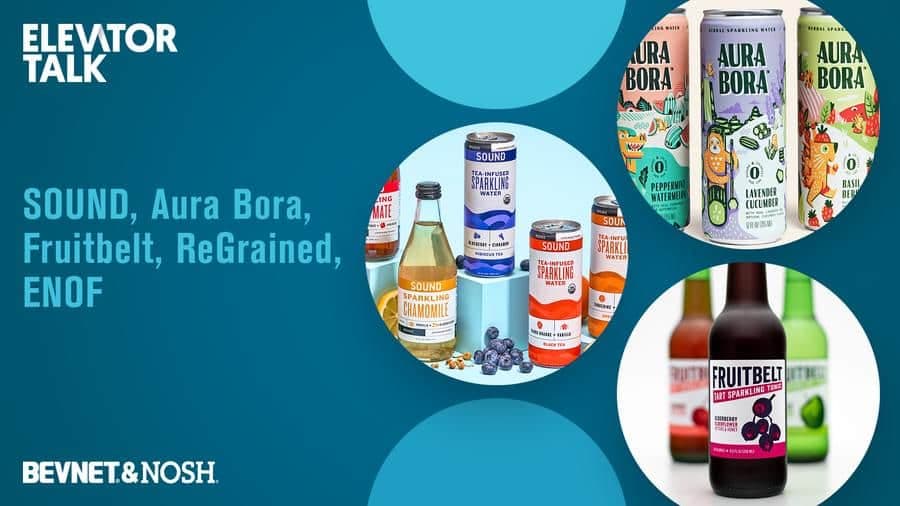
Elevator Talk Ep. 17: SOUND, Aura Bora, Fruitbelt, ReGrained, ENOF
Transcript
Note: Transcripts are automatically generated and may contain inaccuracies and spelling errors.
Ray Latif [00:15] Hey, folks, thanks for tuning in to another edition of Bevnet's Elevator Talk live stream. I'm Ray Latif, the editor and producer of Bevnet's Taste Radio podcast, the number one podcast for the food and beverage industry. As always with Bevnet's Elevator Talk live stream, we're gonna be chatting with entrepreneurs from across the country about their innovative brands and innovative products, uh, and news related to those brands and products. Joining me as a co-host for this episode is Jennifer Palmer, who is the CEO of Gerber Finance. Jennifer, how are you?
Speaker 2 [00:47] I'm great, Ray. How are you? I'm
Ray Latif [00:49] doing pretty good, pretty good. It's a hot day seemingly all across America. How is it where you are?
Speaker 2 [00:54] It's 90 degrees and sunny. It sounds like it feels like summer.
Ray Latif [00:58] It definitely does. We're right in the middle of it. So Gerber Finance, uh, I think folks at home would assume that you're bringing an investor's perspective to this episode. Can you tell us a little bit about what you do at the company and how you're involved with the food and beverage industry?
Speaker 2 [01:13] Yes, well, Ray, first of all, thanks so much for having me today. I'm so excited to be here. Gerber Finance is the leading finance partner for companies who are experiencing accelerated growth but also looking to achieve sustainable profit. So we're more than just a finance partner though. We have a social purpose too. In addition, Gerber Finance has a Gerber Finance Foundation also centered around food and bed. What we're focused on Is providing relief from food insecurity for children. Giving back is so important to us, so we try to only align ourselves with companies who are also doing good. So we look for companies who are doing good for the community or the environment, companies who are looking to really work hard to make change. We're celebrating our 25th birthday this year, and over time our interest in the food and bed industry has only grown. So in the past 7. We've funded over $100 million of clients in the food and bev industry, and this year alone during the pandemic we've closed eight deals with half of those in this space. Some of the notable companies that you probably know that we've worked with over the years include Ni Organic Tea and Swish Beverages, which created Babe, and on the food side, Nona Lim, Madeleine Chocolates, and Mikey's. Those are just some of the few that we've worked with over the years.
Ray Latif [02:27] That's amazing. And in terms of the way you invest in companies, could you talk a little about what that financing looks like, because it's a little different than some of the other investors that we've had on the show.
Speaker 2 [02:38] Yeah, so what we're actually looking to do is we're looking to provide debt, so we lend against the assets on your balance sheet, and what that allows companies to do is to retain ownership. So when there's an exit, it's much more profitable for them personally, and we have a three pronged test when we're looking at companies and it's purpose, potential profit. So first, what is the company's purpose? We carefully choose who we work with. Again, we have strong, strong morals, strong values, and we have a mission. So we want to make sure that the companies we're working with, their mission aligns with ours and that we can relate to them and that they're really passionate about their business. Second potential. Sometimes this is just a gut decision though, so we need to see the promise of business going forward. We need to see where there's going to be a big trajectory, and we believe in that. And then Finally, profit. While we're always striving to help our clients grow, we want to help them to do so profitably. So if there's losses, we need to understand why. There's got to be transparent reasoning behind. So purpose, potential, profit, it's a unique formula that's leading our work. So we become, you know, the advocate for the client. We help them grow and we help them maintain, you know, success and help them maximize profit.
Ray Latif [03:45] Fantastic. Well, uh, I'm really excited, as I mentioned, to have you on the show, uh, and offer some feedback and advice to our entrepreneurs who are gonna be joining us. We have 5 entrepreneurs from across the country, as I mentioned, and, uh, looking forward to speaking with each of them. Jennifer, are you ready to talk to our first guest?
Speaker 2 [04:01] I can't
Ray Latif [04:02] wait.
Speaker 2 [04:03] All right,
Ray Latif [04:03] outstanding. Uh, once again, if you're just tuning in, this is Bevnet's Elevator Talk live stream. I'm Ray Lateef and joined by Jennifer Palmer, the CEO of Gerber Finance. All right, let's get to our first guest, and that is Saleem Najar, who's the co-founder of Sound Sparkling Tea. Saleem, how are you?
Speaker 2 [04:20] Hey, Ray, I'm doing very well, and
Ray Latif [04:22] thank you for having me on the show.
Speaker 2 [04:23] How are you doing?
Ray Latif [04:24] I'm doing pretty good, pretty good. Uh, I wish I could see you in person. The last time I saw you in person was in February. We recorded an interview for our Tas Radio podcast that was for episode 74, the title of which is The Most Valuable Asset Entrepreneurs Don't Know They Have. It was a fantastic episode. Thank you so much for joining us for that one.
Speaker 2 [04:43] Of course, of course. Thank you for having me and Tommy on it. It was a blast filming and it seems like that was yesterday, and a lot has changed since then.
Ray Latif [04:52] Yeah, I would say so. Um, for folks who haven't had a chance to listen to the podcast or aren't familiar with sound, can you tell us a bit about the company?
Speaker 2 [05:00] Sure. So, uh, we make tea-based sparkling beverages, uh, and in, in the highly commoditized sparkling category, we differentiate ourselves really with the quality of our ingredients. Looking at the competitive sparkling landscape, we noticed most brands use either natural flavors or natural sweeteners in their products. These ingredients didn't really leave my co-founder Tommy and I with a clean aftertaste, so we decided to create our own beverage and utilize only organic single-source non-GMO extracts, which is the most transparent version of an ingredient. We felt the next trend in the ever-growing better for you CPG movement was clean ingredients and transparency, as evidenced by the success of our friend Peter Rahal at RXBA. We feel this trend is even more relevant in a post-COVID world and are optimistic about what the future has in store at Sound.
Ray Latif [05:46] Outstanding. Now, you guys uh launched in 2015, is that right?
Speaker 2 [05:52] Yes, yes, outdating us. It's been 5 years. Crazy 5 years,
Ray Latif [05:57] 5 years, right on the cusp of this emergence of sparkling tea. I mean, we've seen sparkling tea in the past, but the number of entrepreneurial brands getting into the space is, is growing by the, by the day, it seems like. Jennifer, are you, have you been familiar? Are you familiar with sound and you know, what are your thoughts on the brand within this emerging space of sparkling tea?
Speaker 2 [06:17] So unfortunately I don't know sound previously to this conversation, but I'm really looking forward to getting to know the product after this. My understanding is that you are also expanding your offering to include sparkling water. Is that correct? That is very correct. Yes. So when, when we launched back in 2015, as Ray noted, um, we launched as a sparkling tea and we're one of really the first pioneers in the industry, um, but we have strategically I'd say pivoted when we launched last year our can line, which we call a tea-infused sparkling water, um, because we feel that the bigger, the bigger pie or the bigger piece of uh, of the sparkling of the market is just sparkling water in general. So that's why I said we make a line of tea-based sparkling beverages. Um, so we, we look to flavor our sparkling water with organic single-source tea extracts and fruit extracts. So a much cleaner version, um, than a potential natural flavor or natural sweetener. Well, according to the New York-based Tea Association of the USA, tea is the most widely consumed beverage in the world next to water. It can be found in almost 80% of all households. So I'm really not surprised that you're making this transition. Obviously both are highly consumed products, but so are their categories saturated with offerings. So as you make this transition, I'm just curious for you, you know, where do you see the future of the company? Is it going to be on sparkling, on the sparkling water side or the sparkling tea side? So we think, you know, our mission at sound really was to try educating mainstream America and really the, the negative effects of sugar and, you know, diabetes is a, is a huge issue here in America. 1 in 5 Americans have are diabetic or pre-diabetic, and that comes from consumption of sugar. And the number 1 consumption of sugar in America is in beverages. So we really wanted to come out. With an objectively healthy, good tasting product that used as clean and transparent ingredients as possible. So our end mission would be to really try serving the masses in affordable, healthy, clean, transparent beverage as we grow. So I would say to answer, I guess your question, more so the sparkling water side than necessarily specifically a sparkling tea. And obviously I mean with with so little time that consumer has in front of the shelf, how do you quickly capture their attention? Great question and that's been part of our, I, I wouldn't say struggle, but part of our journey the 1st 5 years, um, was really educating a consumer on what a sparkling tea or what our beverage was even flavored because when we first came out, there wasn't Lipton sparkling tea or any of the big players in the space. So if you look at our packaging, actually, this is our first line, um, the glass line. Kind of just said exactly what it was, you know, sparkling rose tea to kind of educate a consumer and give them an idea of what they're getting to. So it's still a challenge for us, I'd say to this day that the education process, but as other brands have joined the market and people are becoming much more open and aware of ingredient profile and the, and the want for the transparency and ingredients, it's, it's become easier and easier. You mentioned your packaging and the fact that you have glass products. It looks like you have both, right? Glass and cans. So are those being made in the same facility? So currently, they are not being made in the same facility. Um, but one of our top priorities during COVID amidst COVID was to really focus on our operational efficiencies. And so that is something that we are absolutely in the process of looking to, um, to unify, to, to get under the same roof. Well, for what it's worth, you know, sometimes we like when we see our clients don't have all their eggs in one basket where there's a little bit of diversification amongst the supply sources. Uh, very good to know.
Ray Latif [10:04] Yeah, you know, I, I think one of the most amazing things about what you've done over the past few years, Celine, is the fact that you've really focused on what the consumer wants. Um, at this point, however, you know what the consumer wants. Uh, may not be your core competency. It might not be, um, you know, uh, tea flavored, uh, product, but the sound name is such a strong one. It's a sound brand name. I mean, is there an opportunity to expand beyond what you're currently selling in terms of sparkling water and sparkling tea?
Speaker 2 [10:38] There absolutely is, and that is stuff I would say we have been working on in the midst of COVID and probably too early to um to talk about any of that now, but I think you're definitely onto something, Ray. And um, you know, the brand name sound comes from sound as an adjective, sound body, sound mind. It's really a descriptor for the quality of ingredients that we use and also um how We go about just handling business operations from our partners to our customers to, um, you know, actually, Jennifer, I know you mentioned the importance of, you know, um, working with, you know, working with, uh, partners that maybe focus on, we, we partner with a nonprofit called Wellness in the Schools um here in New York that really focuses on low-income. Um, low-income elementary school students and really to bring about an education in terms of nutrition and the, uh, and really eating whole food and kind of staying away from sugar. So we try spending a day a month in the pre-COVID world, um, working with them in schools here in New York. So that, that's really important to us. And again, just kind of fits our, our name SOUND. That's really what our brand is about.
Ray Latif [11:43] Outstanding. Salim, it's always good catching up with you. Uh, thanks so much for joining us on the live stream and, uh, love that you got the, uh, Bevnet magazine behind you with the cover story featuring SOUND sparkling tea.
Speaker 2 [11:56] Uh, we are eternally grateful for that and for all the support and love from you guys. And Jennifer, it was an absolute pleasure meeting you, and I hope we can connect, uh, outside of this. I would love that. I wish Sam lots of luck. Thank you.
Ray Latif [12:08] Take care, guys. Talk to you soon. All right. Uh, Jennifer, great questions. Uh, you know, it's interesting, the number one question I think we get, uh, at Bevnet and Nash and Taste Radio is, you know, do you know any investors, you know, someone that can help me with finance? Um, and, you know, some investors just aren't ready to talk to emerging brands. They just, that's, that's not their focus. Um, at what stage do you look to invest in brands? I mean, uh, how far along do they have to be in terms of revenue?
Speaker 2 [12:39] Most of our clients are typically doing at least $2 million of revenue a year, but we will certainly look at companies below that threshold if we feel that they've got great growth potential. So while, you know, the initial stages of talking to a company we're looking to see where they are today, where they've been, and where they're going tomorrow, I think it's where they're going tomorrow that's the most important element in that analysis for us. Again, it goes back to that gut decision and connecting with the people. So even if they're below that $2 million mark, we'll have a conversation and you know I'm happy to talk to anybody. I'm always so inspired talking to entrepreneurs, so even if they're just doing $500,000 of revenue a year, I'm happy to have that conversation because you never know, and I'd love to be able to help them in any way, shape or form, even if it's just a referral out.
Ray Latif [13:25] Fantastic. Well, we'll share your contact information at the end of the show, a little, you know, keep people watching as it is. Not that they wouldn't be turning out, especially for our next guest, who is Dan Kurzrock, the co-founder and chief grain officer of ReGrained. Dan, how are you? Hi,
Speaker 3 [13:39] I'm great, Ray. Great to be with you. Nice to meet you, Jennifer.
Ray Latif [13:43] Great to see you. Uh, Dan, a longtime listener of Taste Radio. Thank you so much for that. Uh, I really appreciate it. Regrained, uh, I know the brand pretty well. Uh, for our audience members who don't, tell us a bit about the brand.
Speaker 3 [13:55] Yeah, yeah, for sure. So ReGrained is a mission driven ingredient company actually that has packaged foods products. So what we do is we use A technology that we actually ended up patenting to develop upcycled ingredients and also innovative food products, you know, with those ingredients, and we really do that in two main ways. The one that most people would be familiar with if you know ReGrained is the products that we make and distribute as finished goods to, you know, Whole Foods and places like that. We have a line of nutrition bars that have been out for a few years and actually just this March, a heck of a time to launch a new product, right? We released our puffs, which is our latest innovation. It's a salty snack that's really exciting. Big picture though, what we're doing actually is creating new supply chains for ingredients that have otherwise gone to waste and connecting the dots between those that supply and food companies that can use them. So we actually are in development with over 50 various food producers, you know, some large multinational CPG brands, some emerging brands, as well as food service companies. Playing in close to 20 different product categories now from bakery to snack and beyond and also with top co-packers to help, you know, bring everything to life. Everything's built around this core hero ingredient that we've developed, which is rescued actually from the beer production process. So we take the grain that's had its sugar extracted and the result of our process is a powder, not unlike a flour that can then be used as A base for, you know, a large variety of finished goods products and it's actually been really exciting in the last year or so we've discovered that our process for Actually, you know, recovering these ingredients, processing them, figuring out how they can and should be used actually works really well for other, other side streams. So we're also looking at, for example, what's, you know, left behind from some of these plant-based milk products, you know, juice, you know, there's there's really a lot that we can do with our technology and know-how to bring upcycled foods to life, and that's that's really our mission is to help create a food system that can do more with less and connect these dots in a new way just by thinking about some of these maybe old problems in a new way.
Ray Latif [16:01] Taste, taste sells everything at the end of the day, and I wonder, you know, your products taste great, but how much of your communication is about taste versus upcycling? What are your consumers really gravitating toward? Is it the fact that you are a sustainable, focused, a company focused on sustainability, or is it that you just make great tasting products?
Speaker 3 [16:22] Yeah, the way in is definitely the great, the great tasting products. You can't have a product that tastes like a good idea, and that's something that that we learned pretty early on. Our first version, we created a minimum viable product. It was a handmade nutrition bar that we packaged by hand and sold at farmers' markets and things like that, and it was really, we were just trying to see if there was legs behind, behind our idea, and It was, you know, we had a great ability to get people's attention using taglines like Eat beer and things like that. But what we've learned, you know, really just to I guess be concise about it, is that the mission and the sustainability is a reason for loyalty, not a reason for purchase. So when you look at our new line of puffs, for example, and flavors like Mexican street corn and Texas pit barbecue and Urban Garden, we're really leading to catch their attention. With the flavor profile backed up by a really stellar nutrition, you know, for example, these puffs, it's 40 pieces, only 100 calories, good source of fiber, you know, so they're seeing, OK, great flavor. OK, this is a healthy indulgence, and oh by the way, it's upcycled. What's that mean? Oh, it's part of the fight against food waste and, you know, authentic environmental action. And oh, that's, once I check those boxes I'm being psyched about the, about the flavor and about the nutrition and the fact that there's this mission to it, it really makes that right thing the easy thing for the end customer. So that's how we think about that.
Ray Latif [17:41] Jennifer, uh, you know, upcycling, uh, a buzzword that we've, uh, seen and heard a lot over the past year and a half, um, you know, some Some, for some companies, it's just a buzzword, you know, clearly for re-grained, it's everything. Um, you know, how much of that do you put, how much of the, the upside and the sustainability component, uh, you know, is a, is an important part of what you guys do in terms of thinking about aligning yourselves with the food and beverage company?
Speaker 2 [18:09] Reducing food waste is something I'm very interested in, as is the market. Obviously we just saw Imperfect Foods, you know, raised $72 million in a Series C, and they're focused on reducing food waste. So I think my interest is certainly in line with the market, and as I mentioned earlier, we work with Ni T, who, you know, is focused on this as well. So I certainly think that, you know, ReGrained is in the right area of the market at the right time, and I'm very interested to learn. More and one of the things that I love in addition to the sustainability is I love that the company is not a single product company. However, I'm just a little bit concerned because puffs and bars are two very distinct categories, and this could be tricky to manage. We all know the bar business is suffering right now, just the bar business in general, given the pandemic. So I'm just curious, are you going to be concentrating on the puff side of the business, or do you think it's still worth pursuing the bar side? Can you do both?
Speaker 3 [19:04] Yeah, it's a great question, and it's all a part of a bigger strategy for what I would describe as actually developing a market for novel ingredients, because what we're doing is we're, we're actually creating new supply chains that were previously going to lower uses. So this we call it Supergrain plus that's coming from the beer production process. We need to show our partners that there are, you know, proof points that this is, these are going to make great products that sell that people people buy. And and we'll buy again. And so actually everything that we're doing with our consumer brand is designed to just get that that proof of concept that's out there right now. The puffs are absolutely a bigger focus than the bars. The bars were actually the first product we ever made. I was an underage homebrewer and I was making bread with my own grain and selling that to friends to finance the next batch of beer. That was our roots, and we made bars because we could make a few 100 of them in an afternoon, package them by hand, and it was a way for us to get to market, you know, really lean. Now what we've been able to do is take a huge step back and look at all the different things that we can do with, with our platform with this, you know, this ingredient and then, you know, other ingredients and look at of all the things that we can make, what should we make? So we looked at, oh, should we do a pretzel? Should we do Should we do chips? Should we do a cracker? Should we do an alternative milk? That's actually a really fun application for this, this ingredient. And, and what, what should we bring to mind? So we actually designed this, this puff product to enter a category where they're, it's just screaming for, for better for you, you know, options that aren't just less bad. There's a lot of that that's out there, but that is actually, you know, bringing some, some nutrition to the category, bringing some differentiation, and it's it's higher velocity. Um. You know, as well, you know, as the bar. So with the bar, like what we would love to see is a large bar company saying, hey, we would like to make ReGrained bars, and we can enter into a partnership for them to then take on that business because that's our end model really is for our partners to handle the marketing, the distribution, the sale of the products that are then powered by ReGrained. But first we need to get these products to market and show that that's, you know, that that's something that's that's viable. So it's You know, there's kind of the short term, the medium term, and the long term of what we're trying to do all in the effort to develop this market for upcycled foods to reduce waste and then, you know, ultimately service that market with our, with our technology and our, you know, and our innovative capacity.
Speaker 2 [21:19] And Dan, you talked about your supply chain a little bit. Have you had any supply chain issues? And if so, how do you prevent them from happening again?
Speaker 3 [21:27] Yeah, so our supply chain is uh the breweries, right, in the case of Super Grain Plus. Uh, in the beginning of COVID, some of the breweries did have to, you know, shut down or reduce their production, and that was something to look at. But what's, what's really staggering about this opportunity that we're tackling is just the sheer volume of opportunity. In the, in the US it's about 20 billion pounds of grain used by the brewing industry every year. So even a small brewery. is using massive amounts of this grain. So we're in the San Francisco Bay Area. We've got over 100 breweries within a 10 mile radius of where we are. We've got some really great partners and we're working with breweries that have established distribution channels into retail. So they're making packaged beers, they're making the same beers in the same way every single time. And so we have a very consistent Uh, supply chain available to us for that, it feels infinite, honestly. Um, as we look to scale globally, because what we can do is actually take our technology and our model and we can deploy it, uh, you know, at various food production hubs around the world, we actually have a strategic investment from Molson Coors, venture capital arm, and so that if we thought we had an infinite supply chain with local craft beer, I mean, think about the scale of, you know, one of the largest multinationals, and how much grain, you know, is available there. And so it's sometimes helpful to put it in. Perspective of just like how much is really out there. It's about 1 pound for every 6 pack, you know, that that's used. So it's it's mind boggling even for me, and I do this every day.
Ray Latif [22:56] I can't imagine what the mountain looks like of spent grain from Molson Coors or Anheuser-Busch. It's, it's got to be a lot. Well, uh, you know, it's amazing to see what you're doing, Dan, and you know, that spent grain. Normally would have ended up, you know, in the cow pasture, but it's ending up in people's cabinets now,
Speaker 3 [23:13] and that's best, and that's best case, you know, a lot of it actually for urban breweries, you know, people don't realize that actually the breweries have to pay to have it hauled away at a compost or landfill depending on where they are. And so this boom in craft beer and, you know, more and more breweries opening up, it's really created A new, new dynamic that we really hope to make a difference in. So it keeps us, keeps us stoked.
Ray Latif [23:33] Well, you're on your way, Dan. Thanks so much for joining us on the live stream, and as always, please stay in touch.
Speaker 3 [23:39] Always, yeah, thank you so much, Ray. Thank you, Jennifer.
Ray Latif [23:41] Thanks, Dan. Take care. All right. All right. Once again, if you're just tuning in, this is Bevnet's Elevator Talk live stream. I'm Ray Latif joined by Gerber Finance CEO Jennifer Palmer. We're talking to entrepreneurs from across the country about their innovative and disruptive brands. Speaking of innovative and disruptive, let's talk to the co-founders of Fruit Belt, Michelle Guzzolo and Beth Denton. Michelle, Beth, how are you? Doing
Speaker 4 [24:04] well, thank you for having
Ray Latif [24:06] us. Hey, thank you so much for joining us. Yeah, calling in from different locations. Where are each of you calling from?
Speaker 4 [24:12] I'm calling from Ohio right now, just visiting family and hanging out. And I'm calling from the fruit Belt. I'm dialing in from the fruit Belt, as in our name, uh Southwest Michigan, um, where we source our fruit. Um, we make a sparkling fruit tonic, um, sweetened with honey and spiked with bitters. It's a non-alcoholic drink and we've been in business since 2013. We launched in 2016, and, um, just thrilled to be here with you.
Ray Latif [24:43] I'm thrilled that you're with us as well. Um, you know, I've seen your products in a few different places. Could you talk a little bit about your retail and, uh, distribution footprint at this point?
Speaker 4 [24:52] Sure. Um, we are thrilled to be with Whole Foods in the Midwest. We're in all the Whole Foods stores across the Midwest from Minnesota to, I guess, Iowa, and we are, um, Uh, beginning to make an incursion into our home state of Michigan, which has taken us a while, ironically, but now we have, we have a sales rep in Michigan who's just on fire on the coast of Michigan, and we are beginning to talk to distributors in Wisconsin, in Indiana, in And we just brought one on in Montana, so that's exciting. So we're expanding beyond the fruit belt. Yeah, we are. We're bringing the good news of the fruit belt to hopefully the whole country.
Ray Latif [25:37] Now, how is the product positioned? Um, do you talk about it as a tonic, as a sparkling drink, as a soda, uh, soda alternative? You know, what, what's the, what's the best way to communicate what Fruit Belt is?
Speaker 4 [25:50] Great question. So, um, when we were first conceiving the drink in 2013, and, and as it turned, turns out, a lot of people were thinking like we were thinking. They were thinking, we need more interesting elevated drinks that are different from root beer. We need less sugary drinks, and as a matter of fact, an inspiration to us was the Harvard. Public health put out a statement where they measured the sweetness and spoons of sugar in all of the drinks, and they set a new target of 30 calories for, I think it was 12 ounces, which is really, really low, and so we were like, we set that as our goal and we haven't quite hit it. But that was our aim, and so we were looking for how could we make a really interesting drink that was near that target and was still, still had some sweetness to it, still had dimension to it. And, and it was an adventure because we didn't use um Like a flavor lamp, we just tinkered around with it and we start with fruit juice, sparkling water, then we eventually introduced bitters, but the bitters are from the orchard, so it's all from one ecosystem, the everything that we source, and of course honey, right? I mean, that's what we're really aiming to do is tell a, it's a, it's a drink about a place, honestly. Um, but we don't want to limit ourselves to the Midwest and so now we're thinking about other, uh, Jennifer, you've referred to, you know, what, what are your plans for the future? What, what do you, where do you think you're going, um, and like some of the other brands here have talked, um, about sparkling water. Um, we're definitely thinking about that direction. Our drink is, is delicious. We are lowering the amount of calories. The new flavor that we've come out with that we're very excited about is elderberry with elderflower. Actually, we've never seen a drink that had both of those qualities to them, even though they're both, you know, they're obviously from the same plant. You'll see, you'll see elderflower by itself or elderberry by itself. We wanted to combine that as well as bring in the botanicals from the orchard. But we do, and our drink is really, you know, it's kind of like And American San Pellegrino and San Pellegrino, their sparkling drinks really focus on the taste and the experience of tasting something great and having fun, and that's what we're about. But we also have a social mission, and that is to preserve orchards. A lot of orchards around here are going away. Um, because they're also, while they're great for growing fruit, they're also great for growing houses. And um another thing that we are doing um is for every 4 pack that we sell, we give a certain portion of that to groups that are interested in educating people about pollinators. Um, as we know, bees are, are kind of uh becoming an endangered species, whether it's, you know, um, bees that are in the traditional sense, but also native pollinators. So, we're really interested in that, in that. Now, and other people here have talked about how, how, how they want to educate their customers about their ingredients or whatever, and this is, it is an uphill battle. You have to have a great tasting product first and then you can kind of Um, venture into that. It's not, it's not the most prevalent thing unfortunately. I wish, I wish everyone would be like so concerned about the bees, you know.
Ray Latif [29:20] Well, if you're making an American San Pellegrino, I have a feeling you're going to have a few fans. How does that sound to you, Jennifer?
Speaker 2 [29:26] It sounds great, yeah, I would love that. I'd love it. I have to say, um, I know Fruit Belt, and I think the marketing strategy is super fun. I always really loved seeing the imagery. I don't know much about the company's history. How long have you been in business?
Speaker 4 [29:42] Um, so we joined together in 2013. We are longtime friends from Southwest Michigan. We had a background in community organizing, and we just decided to do this in a way, on a lark and as an adventure, um, and then took three years to come up with this formulation, two flavors to begin with, and that was a very, you know, that was a big adventure doing that, and then we launched in 2016, so here we are.
Speaker 2 [30:09] So when you talk about expanding, it sounds like you'll also have to expand your supplier base. How do you go about evaluating potential new suppliers?
Speaker 4 [30:17] That's a fantastic question. Um, we, um, just continue to talk about our partners for, uh, the, you know, the other women-owned companies that we're trying to work with, um, the ethnobotanists and those kind of people in the world, yeah, yeah. So the, the people who developed our bitters are a group, a team of ethnobotanists. Um, one of them is in San Francisco and one is in Montana and one is, I think there are 2 in San Francisco, and they develop, uh, bitters based on the botany of place. And so we started with the bitters about Michigan. Um, and one of the things we are exploring right now is, as we expand, where do we source not only the, the botanicals more transparently and, and more single source, but how do we continue to source more juice, more concentrate, and so forth. Um, right now our partners in Michigan have an abundant supply of two kinds of juice, and we, we also work with sometimes outside of Michigan sourcing like elderberry juice is not. So commercially prevalent in this country, so we have to go beyond the US. We can't even go to Michigan, so we have to begin to tell the story of fruits that are emerging because they're interesting taste and they're functional, but they're not commercially viable as crops. So we're in a sense, it's like um agricultural innovation dovetailing with product innovation in the same sense that our early friend. Um, was talking about with re-grained. It's, it's like this really interesting process of like, um, working with the farmers to discover a new crop and then working with them as they make the crop, you know, commercially viable. But while we're doing that, we can source from Poland, we can source from, you know, so we have, we have big and small partners as far as suppliers. Does that answer your question, Jennifer?
Speaker 2 [32:23] It definitely does. It does. Thank you so much. That's a great, great, great answer. Thank you. And, and on the sales side, are most of your sales, are they e-commerce?
Speaker 4 [32:33] Oh no, um, our majority of our sales are through Whole Foods actually, um, and we want to develop e-commerce and it's our goal to bring out cans at the end of this year in, in Q4, um, to bring out three flavors, and, yeah, we're super excited about that. We've just found a copacker in, uh, Wisconsin who can do that with us. And, and they also allow for like just in time production and so we can do shorter, smaller runs. We can basically do 3 SKUs for $15,000 which we could do like every other month. So we are so excited about. Bringing that together, but we'll keep the glass. We'll keep the glass because it's premium and the stores like it, and Whole Foods tells us they want the glass because of the premiumization, you know. Well, because, yeah, because basically we'd be kissing goodbye, you know, like the margin and, and the, the kind of premium positioning if we abandon the glass. So we want both. I'm interested in hearing your perspective on that. Well,
Ray Latif [33:38] and, and I, I'm sorry to say, but we've got about 30 seconds left, um, but, uh, Jennifer, please, I know you can give it in 30 seconds. We will, Jennifer will share her, her, uh, contact information so you can have a longer conversation beyond the 30 seconds that you have now.
Speaker 2 [33:51] Yeah, I'll, I'll try to talk like a New Yorker and be real quick right now, but definitely feel free to follow up, but Whenever I look at a beverage company, especially, it sounds like there's some concentration here. I'm always concerned about a company's dilution, and dilution is the difference between the amount you invoice and collect. And so it sounds like you, you've just got to watch that a little bit and so please feel free to reach out to me after this, and we can have a longer conversation and get into that a little bit more.
Speaker 4 [34:16] Thanks Jennifer and thank you Ray. Thanks everyone. Thank
Ray Latif [34:19] you very much, Beth and Michelle. So great hearing from you. You know, 11 very last thing I got 10 seconds. Uh, what's the price point on your products and how are they sold? They sold in 4 packs or what's that like? What does that look like? Um,
Speaker 4 [34:31] 4 packs, 6.99 at Whole Foods, 199 a single.
Ray Latif [34:35] Fantastic. Well, that elderberry and elderflower, when you said that my mouth was watering so much, but I'm drinking this bland coffee all afternoon, and man, that sounds
Speaker 4 [34:44] so good. We're gonna get you some, Ray. We're gonna get, believe me, please,
Ray Latif [34:49] thank you so much. I really appreciate it. I really appreciate you being on the live stream. Thank you. Thanks. Bye
Speaker 4 [34:54] bye.
Ray Latif [34:55] All right. Great stuff. Uh, what a, what a fun story, uh, and what a fun, uh, group of co-founders. Um, you know, Jennifer, I asked you this before the show. In terms of when you first connect with an entrepreneur or, uh, a company to when you decide to align with them from a financial standpoint, you know, what's the length of time? How long does that take?
Speaker 2 [35:17] Great, great question. So typically for us, you know, the first thing we want to do is connect with the company. Ideally, we would see them face to face, but in this market, we've got to just, you know, accept technology and have a face to face conversation. So we'll, we'll set up a Zoom and we'll connect with the company face to face, and then once we feel comfortable with one another, we'll ask for some additional financial information. We want to see what the company looks like on paper, so we ask for a current balance sheet, income statement, historical financial statement. As well as projections, of course, to see what the company looks like going forward and to make sure that we are the right fit for them. Once we have all that information, we can typically fund in 4 to 6 weeks, and that's pretty quick, but we try to move very, very quickly. We try to be very efficient because we understand that the process is very distracting for companies and so we want to be as efficient as we can and put the process behind them so they can get back to running their business and we can get started with helping them grow.
Ray Latif [36:14] I'm sure your entrepreneurs really appreciate that 4 to 6 weeks is a pretty quick turnaround, so outstanding. All right, let's move on to our 4th guest for this episode of the live stream. That's Paul Voge, who is the founder and CEO of Aura Bora. Paul, how are you? And did I pronounce your last name correctly?
Speaker 5 [36:33] I'm doing well, Ray. You didn't, but no one does. That's totally fine. Thanks for having me on. It's Bogie. You
Ray Latif [36:39] got it, Bogie.
Speaker 5 [36:40] You got it, yeah,
Ray Latif [36:40] OK, outstanding. Thank you so much. I should have.
Speaker 5 [36:43] I'm a, uh, I'm a big fan of the podcast, big fan of Bevnet. So excited to meet you and excited to meet you too, Jennifer. Thanks for having me.
Ray Latif [36:50] Well, uh, I'm really excited to hear about Ara Bora. I saw your cans in our cooler, I think, about a month ago. Uh, you guys are nearly brand new, right?
Speaker 5 [36:58] That's right, yeah, we, we launched with just the cans. We canned ourselves at the end of 2019, but our first commercial run was beginning in 2020, so we've been in the market right around 6 months.
Ray Latif [37:07] And what do you guys do?
Speaker 5 [37:09] We sell 5 varieties of herbal sparkling water. So think the sparkling water you know and love, but with more interesting varieties and more natural ingredients.
Ray Latif [37:19] Now, you know, the sparkling water category, as Jennifer spoke about and as we talked about with Salim, um, you know, a growing category, uh, lots of room, uh, for that uh category to continue to expand, but highly competitive. Um, you know, what's been your approach to differentiating yourself from everything out there, um, now and the ones coming onto the market in the future?
Speaker 5 [37:43] Yeah, good question. And you're right, it's, it's really competitive. That, that cooler at the front of the grocery store, it feels like each time it's getting wider and wider. There's more and more companies asking for attention. So our, our big differentiation is our flavors. So I'll just run through the five. you're probably all familiar with drinking LaCroix, Poehler, Waterloo, etc. We all have a conventional daily driver sparkling water brand. Our hope is to be more of a treat, more of an exciting sparkling water to drink. My wife, Maddie and I were both uh kind of fed up and uninspired by the sparkling water we were drinking. So our biggest point of differentiation is we have best in class flavors. So I'll just go down the line. We have lemongrass coconut. Peppermint watermelon, holding the lavender cucumber, basil berry, and cactus rose. Each one of those flavors has a real herbal extract uh contributing to the flavor. So the hope is that consumers grab it and think, whoa, this is a sparkling water that I know and love, but a way more interesting experience that I look forward to.
Ray Latif [38:41] I was trying to read Jennifer's face when you went down that list of flavors and tried to pick out her favorite one. I know mine would have been peppermint watermelon. What, what would be yours,
Speaker 2 [38:50] Jennifer? I like the coconut. I like that 1st, 1st flavor. It sounds delicious.
Speaker 5 [38:55] Good, good, we'll have to get you some.
Speaker 2 [38:57] That would be great, thank you. I'm so curious, Paul. My goodness, what's it been like to launch a company during the global pandemic and worldwide economic crisis?
Speaker 5 [39:06] Yeah, you know, uh, if I had known that, we would have done a few things differently, but I think, I think we're all just trying to figure out, uh, what's the new normal. So, as I said, we, we just started selling in January, so we did tons of demos and sampling and signing on distributors. Fortunately, in January, February, and March, cause I think all of those things are getting tougher and tougher to do, if not impossible. Um. So I, I'll say, one, it's given us with a lot of companies, an increased uh interest in selling online. So our website's been uh doing a decent amount of sales during COVID. And lucky for us, we launched in retail. So we're in grocery stores that are, uh, you know, being worked on by awesome essential workers that are stocking shelves and keeping, keeping the lights on and keeping us all, uh, you know, well-fed and well Don't know the, the, uh, first version of the word fed, but, uh, they're making sure that we can sell our products. So all that to say, I'm really grateful that we're selling the grocery stores and, and it's definitely been a, a whirlwind during COVID, that's for sure.
Speaker 2 [40:06] Are you selling direct into retailers or are you only working with distributors? And if you're working with distributors, how are you managing your trade span? We talked a little bit about dilution previously. Um, you know, the, the distributors are great to get your product in, but obviously, uh, trades spend, you know, it comes at a cost.
Speaker 5 [40:23] It sure does. Yeah, you're telling me. Uh, so we started with a couple of local distributors. Uh, we make the product where I used to live in Colorado and we, I live now in San Francisco. So we started with two local distributors that the trade span was pretty low. We'd occasionally give uh one free case or two free cases to get into a new store and then Each of those new stores we launched in, I knew the manager's name, I knew who stocked the shelves, I knew which hours they were open. Um, and then as we scaled and signed on both KE and UNFI, we were really fortunate to be selected for the KHE Elevate program, um, which they waive a lot of the, the fees that are traditionally associated with, with working with a big, uh, distributor like Kahe. That helped us really get the product launched and, you know, limited our downside risk quite a bit. So, beginning of COVID, we were in 30 stores. Today, we're in 425.
Speaker 2 [41:13] Wow, that's fantastic. And, and what's your price point?
Speaker 5 [41:17] Yeah, right now we just sell single serve by the can for $1.99. OK,
Speaker 2 [41:21] great.
Ray Latif [41:22] What does Aura Bora mean?
Speaker 5 [41:24] Yeah, uh, it means nothing, um, but it was a, a fun rhyming word that I thought was memorable. Um, Maddie, my wife is actually a copywriter and very into branding. So we wanted something that was, uh, kind of meant nothing but kind of meant something. Aura has a good kind of hippie herbal connotation to it, and it's nice to rhyme and a little tongue in cheek to name a water company off of loosely an island in the South Pacific.
Ray Latif [41:50] Gotcha. Uh, you know, I love your Instagram page. It's really well organized. Um, it seems like it's been curated, uh, very professionally. Um, I, I wonder, Jennifer, we haven't talked about social. Does social matter to you guys? I mean, does it, does it play a role? Um, because it seems like what you've been, what you've been talking about is, is really sort of by the books financing.
Speaker 2 [42:12] Yeah, yeah, I'm sorry, we're anything but by the books financing. For us, it's all about connecting with the people and connecting with the brand. So social is very important to us. So thanks for bringing it up. We absolutely pay close attention to that, and, uh, you know, I, I follow many of our clients, uh, regularly on social media, and I'm always just so impressed with what they're doing. So I would love to hear, Paul, about your social media efforts for sure. It's very, very important in our evaluation process.
Speaker 5 [42:40] Sure. Yeah, I think, um, I think a few years ago, if you ask someone on the show even in our position, they would have said, uh, beverages are just too heavy to ship. There's really no reality where you can be a, a digitally native beverage brand. And I think that's largely changed and definitely accelerated in the last 90 days or however long COVID's lasted thus far. Um, we're, we are getting a pretty decent, uh, cost per click right now on our social ads as well as good engagement from, uh, fans of the brand online. So we've been trying to push as much traffic to our site. Those are, uh, that's great data to have. So You know the reorder rate, those are also just usually the most loyal customers. If you buy it in a store, you're buying it at the same time you're buying flour, eggs, and butter. If you're coming to our website, we own you for 35 seconds there. That's how long I think it takes to do Apple Pay. But um yeah, we own you for that experience. So we'd like to know those customers well because those are the trendsetters that tell their friends to buy us on shelf.
Ray Latif [43:38] Fantastic. Well, I am so glad that you found a sparkling water that you do love and that you have plenty of it now, uh, especially the cans behind you. I'm, I'm really excited for you, Paul. I, I think, you know, um, as Jennifer mentioned, it's got to be completely nuts to, uh, to be, you know, navigating your way through this pandemic and global financial crisis. But, um, you know, if you can make it through this, you can make it through anything, so. Thank you. That's what
Speaker 5 [44:06] we've been telling ourselves. I hope that's true.
Ray Latif [44:09] I think it is. Uh, congratulations on the launch. Good luck going forward and please stay in touch. Will
Speaker 5 [44:14] do. Thanks, everybody.
Ray Latif [44:15] Thank you. All right, exciting brand. Yeah, I've, uh, I've tried Aura Bora. It's, uh, it's a really great tasting product. I, I, I didn't try the, the coconut variety. I'm gonna have to look into that because now you've, you've really piqued my interest, Jennifer.
Speaker 2 [44:28] I think the branding behind Aura Bora is fantastic. So I wish them lots of
Ray Latif [44:32] luck. Fantastic. All right, down to our final guest of the show, and that's Mark Gillis, who is the founder and president of ENOF. Mark, how are you?
Speaker 6 [44:42] I'm great. Thanks for having me, Ray.
Ray Latif [44:44] Appreciate it. Thank you so much for joining us. You know, uh, I got an email. I think it was from your team. What was that, about 2 weeks ago. I saw this beautifully packaged seasoning that looked like nothing I'd ever seen before. Uh, and are you
Speaker 6 [45:00] sure it was mine?
Ray Latif [45:03] I'm so glad that we have you on the show to talk about this. Tell us about ENOF. ENOF
Speaker 6 [45:09] for, it stands for Essential nutrients from organic Foods. And, uh, you know, the brand was really born as a result of a 4 year old problem that I had named Natalie, which is my youngest daughter. And, uh, my wife and I for a long time had been struggling to get her to eat, uh, vegetables. And the irony for me was that I was Actually running a natural foods business. There children don't wear shoes, apparently. It was one of those moments. But, uh, my, my wife turned to me and said, you need to fix this problem that we have. And um from that was born ultimately this, this product, which is really interesting. Uh, it's totally novel. Um, I, uh, I'm using a technology that traps the phytonutrients from organic vegetables during a freeze drying process and concentrates them into a powder. And, uh, just a tiny amount of this powder would provide all of the nutritional benefit from the vegetables that we use. So, what, what ultimately I did with my daughter is I started adding this into the food that she actually was willing to eat. You can also put it into drinks. And, um, you know, she was able to, to obtain the nutritional benefit from these vegetables, which for us was a complete game changer. And uh once I started to tell people in my circle about what I was doing, they pretty much demanded that I give them some too. So, the business has just kind of grown from that point.
Ray Latif [46:49] I have a million questions, but I don't want to take up Jennifer's time because we're honored to have her with us on the show. So Jennifer, I, I'll let you start. Uh, what are your thoughts on ENOF? Do you have any questions, uh, for, um, Uh, for our guest.
Speaker 2 [47:01] Thanks, Ray. Well, Mark, I always love companies who are solving challenges, and I can certainly relate to the challenge you had as a mom of four young girls. I continue to struggle with vitamins. Of course they want the chewable, and I'm concerned about their teeth and adding more sugar to their daily consumption. My child, my children, all of them, they all push back on some of the powders or the pills, so I'm very eager to try this. Uh, however, I recognize though that getting parents generally to try new daily supplements for their kids requires a lot of work on the part of the company. So I'm Just curious, how are you educating your consumer not only on the nutritional benefit but also making parents feel comfortable that the supplements themselves are healthy? How do you get those parents to be a believer? Are you trying to work with pediatricians to get their buy-in? What's your strategy?
Speaker 6 [47:51] We're really trying to educate people through social, um, you know, we're going direct to consumer with our product. We are, I have no interest in, at, at least at the moment in selling through retail. I think that the product requires a fair amount of explanation and you really just don't have the amount of airtime you need in store to, to actually accommodate that. Um, so really, the story is being told on social and the way we, we approach it, first and foremost is to, um, is to, is to ask people whether they're experiencing the same type of challenge that I had, and if that piques their interest, they typically end up visiting, you know, my website and they learn very specifically about the technology and what we're doing. This product is not a supplement in the traditional sense. It's not a powder in, in the way that people think of uh the super uh super greens and things of that nature. Um, the amount of, of powder that you actually use in our case for a serving of ENOF, which would be the nutritional equivalent of 2.5 servings of actual vegetables is only 260 mg. So you can literally put this into anything you eat or drink, and you would never know it's there. Um, but really, the, the idea that the product is made out of organic vegetables is something that resonates with folks, and that's effectively the only set of ingredients that we have in the product. So it's, you know, you look at the ingredient deck that we have versus even a multivitamin, which is just chock full of synthetic and isolated nutrients. I think people very quickly understand the difference, and they gravitate to this in part because they're trying to do, I think, the right thing for their kids. They want to use a natural product. They want to have something that's plant-based, not something that was built in a lab.
Speaker 2 [49:48] Well, it definitely seems like the right time for your brand. Early-stage businesses focused on baby and children nutri nutrition. They're seeing increased activity, and of course, you know, because of the pandemic, immunity is a very, very hot topic right now, and it's just one that I think is here to stay for some time. So I'm curious though, are, do you have any plans to capitalize on the current environment?
Speaker 6 [50:13] I think it's happening a little bit naturally just as people are more focused on health and wellness. And I think there's also a pretty, um, pretty good understanding in the general population that eating vegetables is probably the best thing you can do for your health, um, you know, barring getting a vaccine, uh, in the COVID situation. And I believe that is in fact correct. I mean, there's plenty of science that indicates that that is in fact true. Um, so, I think as people identify my brand and my product as having a lot of those attributes, it's, it's kind of drawn people to it and I've definitely seen, you know, an increase in my business as a result of people's awareness of what's going on, you know, with the, with the pandemic. Um. I'm not really trying to push on that point, though, with respect to my brand, because I'm not making any particular claims. To do so requires a tremendous amount of time and energy and money. If you really want to do it the right way and, and approach it from that kind of more medical perspective, I think I'm really trying to address maybe a slightly different concern, which is just kind of that general health and wellness question that people have. And I think it's particularly an issue when you've got a child who won't eat vegetables and you just know definitively this is not good for them. They need to do more for themselves. They need those nutrients, you know, for their own development. And so, I've, I've kind of built my, my, um, my marketing around those ideas.
Speaker 2 [51:53] And Mark, is it a one Skew company, and is that enough, or do you have plans to diversify?
Speaker 6 [51:59] No pun
Speaker 2 [51:59] on
Speaker 6 [51:59] the word enough there, right? Um. I have, uh, several different kind of permutations of my existing product that are on the drawing board. Um, the beauty about this technology is that it can be used with essentially any vegetable or fruit and even seeds, uh, or grains, if it was something that made sense. Um, and you're able to, uh, focus in on specific phytonutrients depending on which vegetable or fruit you choose. So, identifying different blends of that nature is something that I do anticipate doing. I'm not there yet, um, but it, it's coming. Right now, it's just the one. My, my, uh, my single little canister. So, hopefully, I can develop enough of an audience around that, that, uh, an interest in it that I can, um, you know, then introduce some additional products down the road.
Ray Latif [53:03] Mark, as I mentioned, you know, your packaging is so beautiful and so stand out. Um, number 1, you know, who designed it? Do you get a professional designer to do it. And number 2, I mean, you know, is it something where are you, you know, are you using it to draw folks in in terms of social media and, uh, like things like Instagram ads? I have a feeling, you know, someone would see this in an Instagram ad and be like, oh my gosh, look at this. I know more about it. Are you seeing that kind of, uh, that kind of thing happening?
Speaker 6 [53:30] Yeah, so, um, to answer your first question, I did engage, uh, a third party to help with my design work, and, um, I had a pretty good idea that I wanted to introduce the element of the rainbow just because one of the things about this product, which is kind of neat, is it covers the rainbow of different colors, which really relates specifically to some of the phytonutrients that are, that exist in the vegetables themselves. So, I think people have learned recently that eating the rainbow is actually a good thing, and that's one of the reasons why I wanted to kind of address that. Um, on the question of, uh, using kind of the imagery in social, I think it is effective. Um, I haven't done a lot in Instagram, quite honestly. I would say 95% of my effort up to this point has been Facebook directed, um, and specifically Facebook and not their Instagram platform, but that's coming. Uh, it's just a process, you know. I mean, it's a, From a starting, uh, from a standing start just one year ago, um, to get to where I am now has just been an unbelievable ride, but I, there's only so much, you know, you can do, and, um, I've been applying most of my resources in the places where I felt like I could have the most impact, uh, the fastest. But Instagram is definitely coming. It's on its way.
Ray Latif [54:57] Are you saying you're looking for the financial resources to launch a social media campaign?
Speaker 6 [55:03] No, it's not, I, I'm not finance constrained, um, at the moment, uh, which is a good place to be. Um, so, I, it's not that I, it's more a function of developing the right strategy and then just having the, the time, uh, from that perspective, that resource, which I, I need to be able to focus in on some of the other platforms. Pinterest is another that I have a great deal of interest in pursuing. And I think there has been some, you know, recently more activity, commercial activity on that platform that I would like to, you know, look at, uh, as well.
Ray Latif [55:43] Well, it sounds like you're off to a pretty amazing start, uh, really thoughtful when it comes to your business strategy, branding, uh, everything really as it is. Um, Mark, I, I'm so glad that we got to connect. I'm so glad to have you on the live stream. Thank you so much. And, uh, if you haven't had a chance to send the product to our office, please do. It's, uh, people that would love to try it.
Speaker 6 [56:06] I'd, I'd be happy to do so. Thanks guys. Thanks for having me.
Ray Latif [56:09] Thank you. Talk to you soon.
Speaker 6 [56:11] OK.
Ray Latif [56:13] All right. Wow. That brings us to the end of our uh guests for the show. Uh, I just saw some pretty outstanding concepts and brands. Jennifer, overall, you know, what are your thoughts on uh, this, this group of folks and, uh, you know, their potential on the market?
Speaker 2 [56:29] You know, I, I think they're incredible. Gerber over the past 25 years has worked with companies across almost all industries, and even after that, we consistently conclude that beverage is probably the most competitive industry of all. But you know, with that, you know, you find that there's great innovation. So despite The steep competition, despite the limited shelf space, which makes it very difficult for entrepreneurs to launch their products and in this industry to grow profitably, what it does is it does it pushes the innovation, and I think we've seen that today with all of our companies. We everything is really novel, and I think they all have their own particular Particular mark, I guess, if you will, uh, on their company and in the industry. So I think all of them are well poised to do well, and it's obviously very unique and turbulent times, but I think they'll do well.
Ray Latif [57:21] I agree. You know, from what I saw, I think my mouth was watering in a few cases, and I think, again, I'm going back to that notion of taste. The taste is so important now. Enough doesn't, you know, it's tasteless from what Mark was saying. But hey, you know, if you can get a 5 year old to eat some, uh, eat their nutrients, uh, you know, if you go to their website, you see them putting it on some french fries, I think I'm happy with that. Um, as I mentioned, uh, I'm sure there are folks who would want to get in touch with you, Jennifer, talk to you guys, send you product, a sample. What's the best way to do so?
Speaker 2 [57:55] The Best thing to do is to email me. That's j Palmer@ Gerberfinance.com, G E R B E Rfinance.com. We are all about relationships, so I do read all of my emails and I do respond.
Ray Latif [58:08] Uh, I'm so happy to hear that because, uh, it's difficult, I'm sure, to get back to everyone, uh, via email all the time and the fact that you're willing to make time for the, uh, earliest stage entrepreneur is really remarkable. So thank you so much for that and thank you so much for all your contributions to our industry. Um, let's do this again soon. I, I, I'd love to have you back on the show.
Speaker 2 [58:28] I really enjoyed this today, Ray. So thank you so much again for having me. And, uh, best of luck again to all of the companies we saw today.
Ray Latif [58:35] 100%. All right. That brings us to the end of this episode of Bevnet's Elevator Talk live stream. But we'll be back next week as we always are on Wednesday at 3 p.m. Eastern. Please tune in for that. Until then, signing off for our co-host, Jennifer Palmer, and our amazing Bevnet and Nash. I'm Ray Latif. We'll talk to you soon.