Search across the BevNET CPG Media network including BevNET, Nosh, Brewbound, Taste Radio, Nombase and CPG Jobs.

Sponsored Workshop: Revolutionizing Beverage Packaging: The Future of Variable Digital Can Printing
Transcript
Note: Transcripts are automatically generated and may contain inaccuracies and spelling errors.
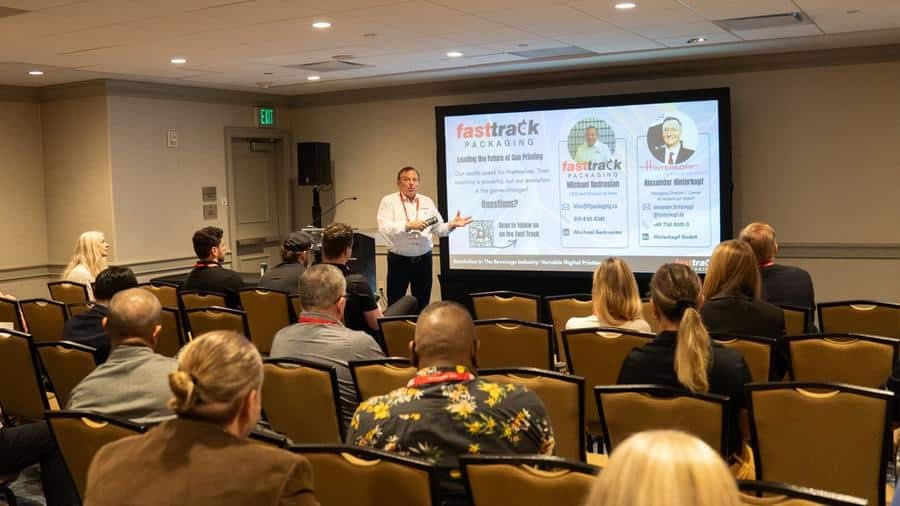
Mike Pedro [00:10] So, good morning and good morning brand owners and manufacturers. And this presentation, just so everybody knows, we want to take pictures. It'll be available so we can send that out to you, so that way you can just sit back and laugh at me for doing this and uh we can go from there. But this is innovation that's new in the can industry. It's never been released before. So hopefully you'll learn and enjoy it. Um, also, everybody received a can, uh, when they walked in. There's a purpose for that. Um, there'll be a winning can at the end. Everyone is printed differently, and I'll explain that through the presentation. And then also we have Cynthia here if you can put your hand up and Eric at the back, he can put his hand up. So at the end, if anybody has any questions, want to get together or come up to our booth, we'd love to continue the conversation, um. So thank you. So I'm Mike Pedrozian. I'm the chief operating officer and director of sales of Fast Track Packaging. I have over 40 years of print experience in the digital, Flexo, and sleeve manufacturing. I hold several patents in those fields as well, and it's been a fun industry focused on sustainability in aluminum packaging, focused on innovation, efficiency and eco-friendly solutions. And I share my love and passion for this printing industry. I still teach at universities and colleges. I sit on multiple boards, Flexo Association, etc. and I do talks at conferences like this to share. The industry, it's grown so much and changes all the time. And the other gentleman up here in, uh, couldn't be with us today, that's Mr. Alexander Hinterkoff. He is um the one that we developed this with, and he's the managing director and owner of Hinterkoff Technologies, uh, based in Germany but has um operations and equipment worldwide. He's a driving force again in the innovation in the printing industry focused on high resolution, energy efficient digital printing machines. So We'll get down to What you came to listen to and um at the end, if you need anything, let us know. So, at Fast Track Packaging, what are we? Who are we? Fast Track Packaging is the leader in can decorating in North America. We do over 1.5 billion cans a year. We have operations in Canada, and Salt Lake City, and we also have warehouses in Columbus, Ohio and Atlanta, Georgia. We service the beverage industry in North America. And we're truly a one-stop shop. We have graphics. We have pre-press. We do digital printing. We do sleeve printing. We do sleeve making, and we now do variable printing that we'll get into directly on cans as well. We're trusted with a lot of brands across North America. Whether it's the startup company or medium-sized company or large, we do work for just drop some names, Anheuser-Busch, um, Ghost, Poppy. We also do smaller brands, medium brands. There's nothing that um we don't do. We're a small Now larger family run business and everybody in the family is involved and we continue to grow that. Here what we've done is we've all faced these issues before. We don't have to do that anymore. We've resolved them all as far as lead times being way too long, print inconsistencies, limited in colors, finishes by not having enough special effects. Delays affecting not only customer timelines but copackers' timelines and efficiencies in their plant. It was a bottleneck and we've resolved all that. In doing that, we had to be better and lead the industry. The market changed. The old way couldn't keep up. Customers demand just Fast turnarounds, low minimums. So now we can do cans in days rather than weeks and months with no minimums rather than truckloads. So we can do that with the quality that surpasses what is currently out there in the industry as far as offset cans or. So brands that needed high resolution, we've resolved that. Finishes, we've resolved that. Everyone wanted unique personalized cans, not cookie cutters. Now we can do variable print, and I'll explain why in a little bit, but we can do 10,000 different cans within a run without slowing down the machine. Which means by not slowing down the machine to do changeover, changeover, your cost doesn't go down or it doesn't go up, sorry, it remains the same. So with that being said, you can make all these changes, and I'll show you some examples of that as well. So what you see here are the machines behind our technology. They're Hinterkoff machines. We use them proudly. They have the technology to print the variable print and the quality that leads us into this. And there are a lot of different digital options out there in the market. This is by far the best. We have been through the ups and downs with other manufacturers, and this is by far the best solution. We've invested heavily in these machines, and printing is not just plug and play. It's an art and a science, and with our experience and with Hinterkoff's experience, that's what's made it practical for us to be doing what we're doing and leading that market. So here you can share your story. So every can can tell a story. You can do it differently, tailored to your audience, whether it's a small impact, whether it's a family function or a corporate gathering or a A concert or if it's something that you're co-branding, you can do it. It unlocks new markets in every aspect. So what does this innovation do? 360 degrees of seamless printing. There are no seams. There is no overlap. Everything is seamless and the printing. Quality, the reproduction is unlike anything else you've seen. And you'll see on the cans here, um, we printed this for these, um, for this presentation, and you'll see the quality all the way up to the neck, no graininess. It's, in this case, it was gloss finish that we chose to Showcase here and that's been done. So with that being said, you run faster, you run with less setups, which then gives you less waste and your cost remains low. Yes, So great question. And they asked me to repeat it so that way it gets taped. So what kind of finishes and effects. So the finishes, you can do matte and gloss, you can do spat spot matte, spot gloss or a combination thereof. And then you can also what I call layer it. So you can get a raised lettering and stuff like that. In the course of developing over time, you will get things like A little bit of different inks. So remember, digital technology has been around for a while, but relatively new. So inks are being developed all the time. So for now, I'm going to say you have Your mats and gloss and tactile, which is the raised lettering, it's, it will get to where shrink sleeves are, shrink sleeves, thermochromatic, raised lettering, grit, glow in the dark, all that stuff is available in shrink sleeves, but it will come, but those are the ones that you We can have right now on the machine. And these are the two presses that we have in our facilities. And again, just like any other technology, the presses, they were here and then they move here and move here, adding with more colors and more speed, but the technology remains the same and the quality remains the same, so there is no inconsistency in quality and color in those presses. Here's a prime example of a typical shrink sleeve or digital printing can for us, um. What you see there is all the branding, so the branding, the ingredients, the legal information, contact information, your codes and messages, all of those are all standard. You print them from one can to the next to the next. It's all the same. Well, with variable print, you can change all that. You can change everything you want. You can change QR code to QR code to QR code, serial number. In the THC industry, you can do all that. Printing images, you can have somebody throw a football this way, this way, this way. You can have somebody catch it. All of that can be changed, colors can be changed. The look and the feel can be changed. All of it done within the same run, the same parameters, without slowing down the press, without plates, without waste. It goes from one can to the next to the next, just like these ones here. They were printed all on the same run, different graphics, and we have some people that know what it's like when you change graphics. It's another setup, clean up, waste, not here. It's from one to the next to the next. And even here you can everything can be personalized. You can change names and we were talking earlier I was part of the program that started the Coke when Coke labels had different names on it. So this technology has now evolved to digitally printing direct on cans so you can personalize it regional themes. You can tell your stories. There's no plates or downtime and it's continuous at that speed. It's perfect for campaigns, batch runs, seasonal runs, all of that again, no plates, no downtime, and it continues to be something that the market is going towards smaller runs and it's not like it used to be. Oh, I want to run a skew. Oh, you have to order 5 truckloads of cans at one skew. Not anymore. So you can order whatever you want. There are no minimums. If you need to know what your can is going to look like, we'll run you a pilot can. You can see exactly what it's going to look like before you say, yep, I want that one. Let's go with that. And again, uh, On these ones here, you can see the umbrella changes colors. You can do that. You can move the seagulls from one to the next. The, The person on the wave changes and over there uh fortune cookies, you can change what's on that fortune cookie tag. You can do all of that again, all within the same run. So from here what we have is If you look at your can and you'll see that somebody will have one that has all the 3 aces, whoever has that one. Come and see us. So, so you win, so So you'll win a prize. So come up and see Cynthia or Eric up at the booth, and we'll take care of that. So that's the end of the presentation, which I would like to say is just the beginning of the questions because it's more so. How can we help? How can we work together, um, to help you come up with solutions to build your brand and because let's be honest, your cogs are probably your most expensive part is your can and your lid. So how can you do that in eliminating a waste, competing with the big guys with being different than everybody else out there. It's doing stuff like this that makes you different. You can tell your story. You can do different things without spending a ton of money on plates and set up and down time and waste. Yes, he had a question.
Speaker 2 [13:55] And
Mike Pedro [13:58] Now what What do you mean by standard print offset printing like a, I'm going to call a Coke or Pepsi can. Yes, it'll definitely be more than that. But what you have there is you don't have truckload minimum that you have to order. So when they print, they print. Flat and you'll never get the quality that you will from digital can, um, because they have to print with wet inks. They have stay aways so everything is trapped in silver. You don't have that on a digital can. The print quality, the type font is so small and detailed to get, we don't have one on here, but flesh tones and stuff like that, the hardest to print. You can do this with this technology. So it is more. But do you want to tie up money and buy a truckload, or do you want to run A skid or 2 or 3 or half a truckload and be more focused to the market.
Speaker 3 [15:02] Yes, Cereal juice. I want 10
Mike Pedro [15:14] No problem. That's No, and actually it's like variable print, but instead of doing one you're doing. Percentages of a run. Yeah, that's no problem whatsoever,
Speaker 3 [15:27] yeah. Yes Well, thank you for the presentation. Super hot. Can you talk a little bit more about the room? Do you have any exclusivity?
Mike Pedro [15:38] No, we don't, um, albeit transparent, say, we've tried other printers. We've invested heavily and How do you say it nicely? It didn't work out. Um, there are bad print technologies out there, and, um, over the course of my career, I've purchased 40 or 50 different presses in the digital market. It was new. It was different. And, um, so my key is, and again, we have um somebody from Hinterkoff here. It's not a matter of Plug and play. It's a matter of. A lot of people that got into the shrink sleeves. A lot of people that will get into digital think, Oh, I can buy a machine so I can print. It's not that easy. You have to have some expertise and be a printer and know what you're doing to do it. Is it easier than it was before? Yeah, when I started. There was no doctor blades or analog rollers when I started. It was really tough to print a good job, but now the technology has come a long way and it still continues to improve as well.
Speaker 3 [16:49] About the, bases. Are you a US entity?
Mike Pedro [16:54] So we have plants in Canada, we have plants in the US, so we keep Canada, Canada, and we keep US US. So the two separate entities, um, I'm gonna say 80%. Of our businesses in the US we have a large facility in Salt Lake City. We, we ship a lot to Europe. Yes, we do. Yeah. Yeah, and we do a lot of work um for. Companies over in Europe that are now co-packing in North America that come to us and do that as well, yeah. Yes, Good question. No, there isn't, but you just have to. There are some change parts that you have to get because if you're. The can prints this way. So you have to have different mandrels to hold the can and everything to spin. But that's. There's no size limitations. So, we go down to 6.8 and 19.2's, um, and we can do it that way. Aluminum bottles, yes, we can do some. Um, again, it's the tooling part that you have to be concerned about, yeah. Yes.
Speaker 3 [18:14] Uh comment about
Speaker 2 [18:15] like the texture. What's the timeline
Mike Pedro [18:21] Well, there are some now, um, so we can do a little bit of tactile, but with the ink, um, manufacturer. They wanted to get this right first and then they'll build on it and it's the same thing that happened with offset printing. And if you take a look at the monster can before it was flat, it was like a Coke or Pepsi. Now they start to add some texture to it. Same with shrink sleeves, shrink sleeves, we ran the ghost can for years and they had grit. They had two different heights. They had mat and they had gloss. They had everything on it. Um, yeah, so.
Speaker 2 [19:06] curious, so Do I have to send it.
Mike Pedro [19:13] Great question. So turnkey, um, and the reason for that is, Your can, not your can, but if somebody was to send us cans, it makes it different on ink adhesion to the can. That's why we prefer the cans because we do. Things to them before we print them to make sure that the ink adheres to the can properly. Other questions? Come on, Cynthia. No, but if anybody wants to stop by the booth later on, I'm sure there'll be questions come up, but it's just a really unique opportunity for the industry itself, and we're proud to be part of it, and we're here to help too. Yes. No, that's great.
Speaker 3 [20:10] use the technology to print on.
Mike Pedro [20:17] So we can do metal bottles, um, aerosol cans, um, and then when it gets to fast track, um, we, we do shrink sleeves for L'Oreal, Palmolive, um, we do yogurt, um, cups, um, all kinds of PET bottles. So for us, we're Uh, a printer and a packager, whether it's a PT bottle or aluminum can. But the trend is definitely going to aluminum versus plastic. People want to get away from plastic, and I, I get that. But there are some things like we still do 750 mL liter bottles of wine and, um, PET bottles for Gatorade and stuff like that too. Any other questions, come and see us. I'd love to help.