

NOSHscape: The Latest Food Brand News

Ferrero Group Agrees To Acquire Purely Elizabeth
Ferrero Group in August reached an agreement to acquire Purely Elizabeth, following months of speculation that the better-for-you granola brand was exploring a sale. Financial terms of the transaction were not disclosed.
The company will continue to operate as a standalone brand within Ferrero Group, with founder and CEO Elizabeth Stein
retaining her role alongside the existing leadership team, and expects to benefit from Ferrero Group’s product development resources to expand its portfolio.
“Building Purely Elizabeth from an idea 17 years ago into the brand it is today has been one of the most rewarding journeys of my life, and I’m incredibly proud of what our team has accomplished,” said Stein in a statement. “As I thought about the next chapter, finding a partner who understood what makes Purely Elizabeth special and shared our commitment to quality, innovation, and building for the long term was incredibly important to me.
Founded in 2009, Purely Elizabeth entered the gluten-free granola space while it was still a relatively niche national market. The Boulder, Colo.-based business has established itself as a key player, holding the number one spot in granola in
simple ingredients such as oats, whole grains, nuts and seeds.
According to a press release, Purely Elizabeth has more than doubled its sales over the past two years.
“In Ferrero, we’ve found a family-owned company that believes deeply in what we’ve built and sees the tremendous opportunity still ahead. I couldn’t be more excited to continue leading Purely Elizabeth alongside our team as we bring our mission and products to even more people.”
Ferrero Group, the Luxembourg-based producer of Nutella, Tic Tac and Kinder, has built a significant presence in North America over the past decade while expanding into snacking, ice cream and breakfast cereal markets. The company acquired Ferrara Candy Company in 2017, adding brands like Trolli and Brach’s.
The following year, Ferrero bought Nestle USA’s candy business, including Butterfinger, Baby Ruth, Laffy Taffy and Nerds. A year later, it snapped up select cookie, fruit snack, ice cream cone and pie crust businesses from Kellogg Co.
In 2022, Ferrero acquired Wells Enterprises, which added Blue Bunny, Bomb Pop and Halo Top to its sprawling house of brands. And last year, Ferrero purchased WK Kellogg, which brought Frosted Flakes, Froot Loops and Rice Krispies under its roof.
“Purely Elizabeth, with its terrific portfolio of quality, tasty products, is a great addition to Ferrero,” said Giovanni Ferrero, president of Ferrero International S.A., holding company of the Ferrero Group, in the press release. “With this transaction, Ferrero builds on its recent acquisition of WK Kellogg Co, reinforcing both its presence at breakfast time in America and its reach in the better-for-you segment.”
Purely Elizabeth has raised over $53 million to-date, including a $50 million Series B round in 2022 led by the SEMCAP Food & Nutrition division along with Swander Pace Capital and SEMCAP’s partner, Fresh Del Monte. Previously, the brand secured $3 million from General Mills’ 301 INC investment group, led by John Haugen, who later co-founded SEMCAP.
Purely Elizabeth has grown alongside broader shifts in consumer behavior, including rising awareness around ingredients and sustainable sourcing, increased demand for better-for-you snacks and the growth of adjacent categories like yogurt and smoothie bowls.
Peppertux Raises $2.35M to Fuel Retail Expansion
Can America’s appetite for pistachios extend beyond the viral Dubai chocolate trend? The founders of Southern California startup Peppertux – along with their new investors and retail partners – are betting on it.
The company closed a $2.35 million bridge round in July led by Santatera Capital, with participation from Lever VC, in preparation to expand across thousands of conventional grocery stores and broaden its lineup of pistachio-based spreads and snacks.
Founding husband-and-wife team Ahat and Lia Caskurlu told Nosh the funding coincides with the company’s biggest growth phase yet.
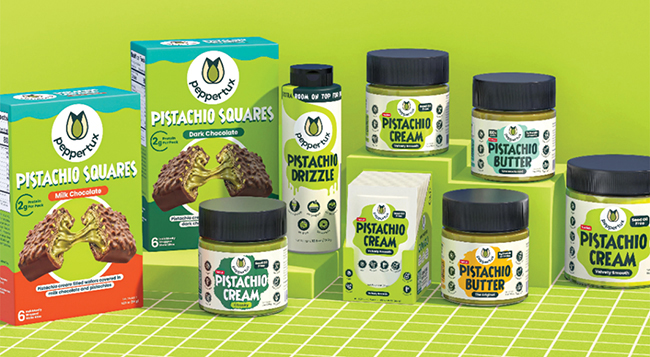
After expanding its jars of Pistachio Cream spread into 1,140 Target stores earlier this year, the company recently launched a Pistachio Drizzle topping in squeeze bottles into more than 2,100 Kroger locations, with Albertsons set to add both products in August. Earlier this spring, the brand also entered H-E-B.
Combined, the launches represent roughly 4,000 new conventional grocery doors, marking the brand’s largest retail expansion since its launch five years ago.
Unlike many emerging brands, Peppertux reached this point without institutional capital. The new funding will primarily support inventory, promotions and retail execution as Peppertux scales its conventional grocery presence, while accelerating new product development.
Although Peppertux began with pistachio spreads, the founders increasingly view the business less as a nut butter company and more as a pistachio innovation platform.
Next up are individually wrapped Pistachio Squares, chocolate-covered wafer cookies filled with pistachio cream.
Originally introduced as “protein squares,” the founders said retailer feedback prompted a repositioning. Buyers consistently
assumed the products belonged in the protein bar aisle, creating confusion around merchandising.
Rather than competing against bars containing 20 to 30 grams of protein, Peppertux repositioned the products as premium wafer cookies destined for the cookie aisle. Each individually-wrapped piece contains about half the calories and sugar of a KitKat bar, according to the company.
The repositioning underscores a broader shift taking place across food and beverage, where brands are increasingly emphasizing familiar formats with incremental nutritional benefits rather than overt functional positioning.
While pistachio has become one of food’s hottest ingredients thanks to the Dubai chocolate phenomenon, the opportunity emerged years earlier.
In 2019, the Lia and Ahat began selling premium Turkish olive oil before realizing the category simply moved too slowly to build a scalable consumer brand. During countless grocery store visits, the pair noticed pistachios were a mainstay in the produce and snack aisles but almost nowhere else.
“You would see bags and bags of snacking pistachios next to the watermelons, next to some of the end caps. But … where are all the other pistachios in other aisles?” Lia recalled wondering.
After more than 70 recipe iterations, the founders launched a pistachio spread at California farmers markets before
attracting buyers from Gelson’s, Wegmans and eventually Target through trade shows. The founders say nearly every major retail account came inbound rather than through traditional sales outreach. The company hired its first broker late last year.
Peppertux’s Pistachio Cream became Wegmans’ third-best-selling nut butter item last year behind Nutella and the retailer’s private label almond butter, according to the founders. The performance has prompted the retailer to expand the assortment with additional Peppertux products, including Pistachio Drizzle, single-serve pouches and a chunky Pistachio Cream developed at Wegmans’ request.
But growth hasn’t come without challenges. Demand for premium early-harvest pistachios has intensified as more brands launch pistachio products, forcing Peppertux to compete for limited supply. The company sources the majority of its pistachios directly from Turkey, relying on longstanding farmer relationships while diversifying manufacturing across Europe and the U.S. to reduce supply chain risk.
The founders said Santatera Capital was attracted not only to Peppertux’s recent retail momentum but also to its long-term vision of building multiple pistachio-based categories.
Peppertux presented investors with a 10-year innovation roadmap spanning spreads, snacks and additional grocery categories, while emphasizing its strategy of becoming the category-defining pistachio brand rather than chasing short-term trends.
Santatera Capital – which has backed brands including Mezcla, Sunnie Snacks and Little Sesame – said it was drawn to Peppertux not only because of the recent surge in consumer interest around pistachios, but because it believes the category is still in its early stages.
Fund manager Daniel Ramos described pistachio-based products as an emerging segment benefiting from growing demand for premium, indulgent foods that also carry a wellness halo. Santatera sees potential for the company to build a broader pistachio platform capable of expanding into adjacent categories such as snacks and foodservice.
He also pointed to the company’s rapid growth, along with its expanding retail footprint, which is on pace to surpass 7,000 stores by year-end, as evidence of strong product-market fit and retailer demand.


Receive your free magazine!
Join thousands of other food and beverage professionals who utilize BevNET Magazine to stay up-to-date on current trends and news within the food and beverage world.
Receive your free copy of the magazine 6x per year in digital or print and utilize insights on consumer behavior, brand growth, category volume, and trend forecasting.
Subscribe